





























Laura has a sleeping baby to watch when her friends decide that the evening needs a supernatural challenge. The Baby Blue ritual in The Summoning of Baby Blue requires a frightening story before its participants face the bathroom mirror, which seems a useful arrangement for a horror anthology. Someone tells a tale, everyone gets nervous, and the dare becomes harder to dismiss. Except the storytellers go into the bathroom first and speak alone. Their friends are outside, missing the stories we get to see.
I missed their reactions. A dare draws some of its power from the people waiting for you to lose your nerve, and Sergio Gonzalez’s framing story separates that pressure from the storytelling. An isolated person facing a mirror can certainly be frightening. Here, though, the arrangement leaves the friends functioning as a queue of narrators when they could be making one another increasingly uneasy. It also contradicts the instructions they have just received, creating a distraction at the point where the ritual needs us to accept its rules.
Those rules have an effective little cruelty to them. The participant summons a ghostly baby into their arms and must put it down before its furious mother appears. There is something immediately uncomfortable about being made responsible for a child you cannot safely keep holding.
Laura’s babysitting job gives that idea a suitable home, while the arrival of Stacy, Maureen, and eventually Hunter supplies willing participants. The inserted shorts keep changing the threat before the mirror premise wears thin, but every departure also suspends the danger facing this group. Returning to them means rebuilding anticipation that the stronger stories have already earned elsewhere.
The anxiety of looking after someone becomes much more immediate in Felipe Vargas’s Hive. Sasha, played by Xochitl Gomez, is struggling to supervise the energetic Val, played by Lorelei Olivia Mote, at a playground. Before the situation turns sinister, there is already a small, recognizable strain in the task: Sasha is responsible for a child whose energy makes that responsibility difficult to manage. The creepy-child material gains traction because it enters an existing problem. We understand the pressure of keeping someone safe before the short makes safety difficult to judge. The playground’s promise of harmless activity becomes increasingly hard to trust.
Vargas’s other contribution, Carnivora, makes that feeling harder to shake. Two sisters, played by Gigi and Carmela Zumbado, are caught between their responsibility toward their grandmother, played by Julia Vera, and their desire for freedom. Their relationship gives the horror something to press against.
Leaving an unpleasant situation is a simple enough wish until leaving also means abandoning somebody who depends on you. The old house keeps that obligation close, and the sisters’ shared involvement allows the discomfort to exist between people rather than resting entirely on the next frightening discovery.
Then the bodily grotesquerie becomes difficult to stomach. Carnivora is the anthology’s strongest short because its disgust has somewhere emotional to go: the urge to recoil collides with the expectation of care. Vee Saieh’s script makes familial responsibility a source of tension before the repulsive imagery intensifies it.
That progression matters. The nasty material does not have to create our involvement from nothing, since the sisters already have a reason to remain in a place that makes escape attractive. Their predicament stays legible even as the horror grows stranger, giving this segment a satisfying sense of development that some of its neighbors lack.
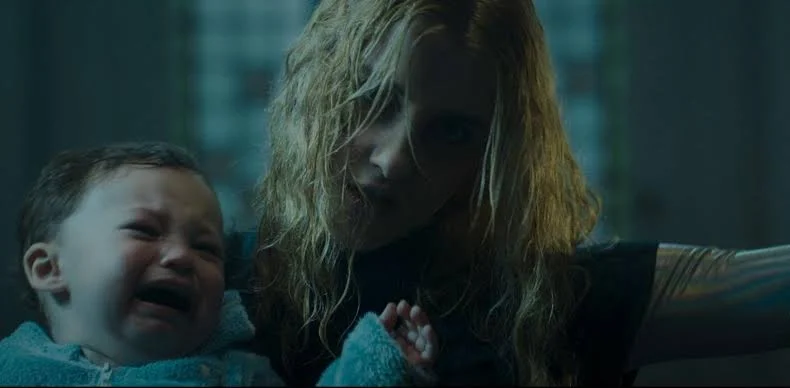
These connections make the collection feel less scattered than its framing device sometimes suggests. Laura’s babysitting, Sasha’s supervision, the sisters’ obligation, and the ghostly mother all bring fear into relationships organized around protection.
They do not need to belong to the same supernatural history for those echoes to register. Nor does every short need to make the connection. Part of the pleasure here is discovering how quickly the film can replace one uncomfortable feeling with another, moving from responsibility toward a child to revulsion within a family, then toward the danger of an unfamiliar adult.
Brandon Piskorik’s The Scarecrow, which actually precedes the babysitting story, works through a much simpler apprehension. A driver played by Aaron Burt encounters scarecrows obstructing a foggy road, and their recurrence makes continuing onward feel increasingly unreliable. The short does not need an elaborate personal history to make that repetition unsettling.
Its compactness allows the image to retain its strangeness. Corey Benson Powers’s Locksmith brings the danger indoors, where a young woman played by Paige Bourne has admitted a threatening worker into her home. Pete Berwick’s menacing presence gives the situation enough friction without requiring a supernatural explanation. The discomfort comes from having already granted access to someone you now want gone.
Brian Sepanzyk’s In the Shadow of God leaves a different sort of uncertainty. Rachel, played by Sara Canning, returns to her childhood home after her father’s bizarre death, and disturbing events seem to spread through the neighborhood. The short delivers the collection’s sharpest jump scare, though the connection between its events remains elusive.
Its obscurity sometimes limits the sense of escalation, since it is difficult to feel a threat developing when its causes stay so indistinct. Yet Rachel’s return gives that uncertainty a personal setting: she has come back after a death, into a place that should carry familiarity, and the disturbance keeps extending beyond the home where she might begin to understand it.
The Summoning of Baby Blue was released digitally on June 5, 2026, and is available to rent or purchase on Apple TV and Amazon Prime Video. Directed by an ensemble team including Sergio Gonzalez and Brandon Piskorik, the horror anthology centers on three teenagers who attempt a viral urban legend ritual in a dark bathroom mirror, unleashing a vengeful supernatural entity that stalks them across interconnected nightmare tales.
Full Credits
Title: The Summoning of Baby Blue
Distributor: Black Mandala, Brainstorm Media
Release date: June 5, 2026
Running time: 1 hour 16 minutes (76 minutes)
Director: Sergio Gonzalez, Brandon Piskorik, Felipe Vargas, Corey Benson Powers, Brian Sepanzyk
Writers: Camilo Zaffora
Producers and Executive Producers: Michael Kraetzer, Nicolás Onetti, Megan Tremethick
Cast: Valeria San Martin, Justina Ceballos, Daniela Flombaum, Giovanni Onetti, Agustin Olcese, Nicolás Onetti, Milagros Ribet
Director of Photography (Cinematographer): Luciano Montes de Oca
Editors: Sergio Gonzalez
Composer: Luciano Onetti
The Review
The Summoning of Baby Blue
The Summoning of Baby Blue finds its strongest scares in the discomfort of caring for someone you cannot easily leave. Carnivora gives its grotesquerie emotional weight, while Hive turns supervision into anxiety. The shifting threats keep the collection engaging, even as the muddled mirror ritual weakens the friends’ shared ordeal. Some stories leave a sharper impression than others, but there is enough unsettling imagination here to reward an appetite for small-scale horror.
PROS
- Carnivora connects bodily disgust to family obligation.
- Hive builds fear from recognizable caregiving pressure.
- Varied threats sustain curiosity between segments.
- Pete Berwick brings menace to Locksmith.
CONS
- Contradictory ritual staging weakens shared tension.
- Returns to the framing story require suspense to rebuild.
- The final short’s obscure causes limit escalation.