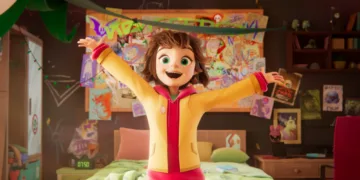









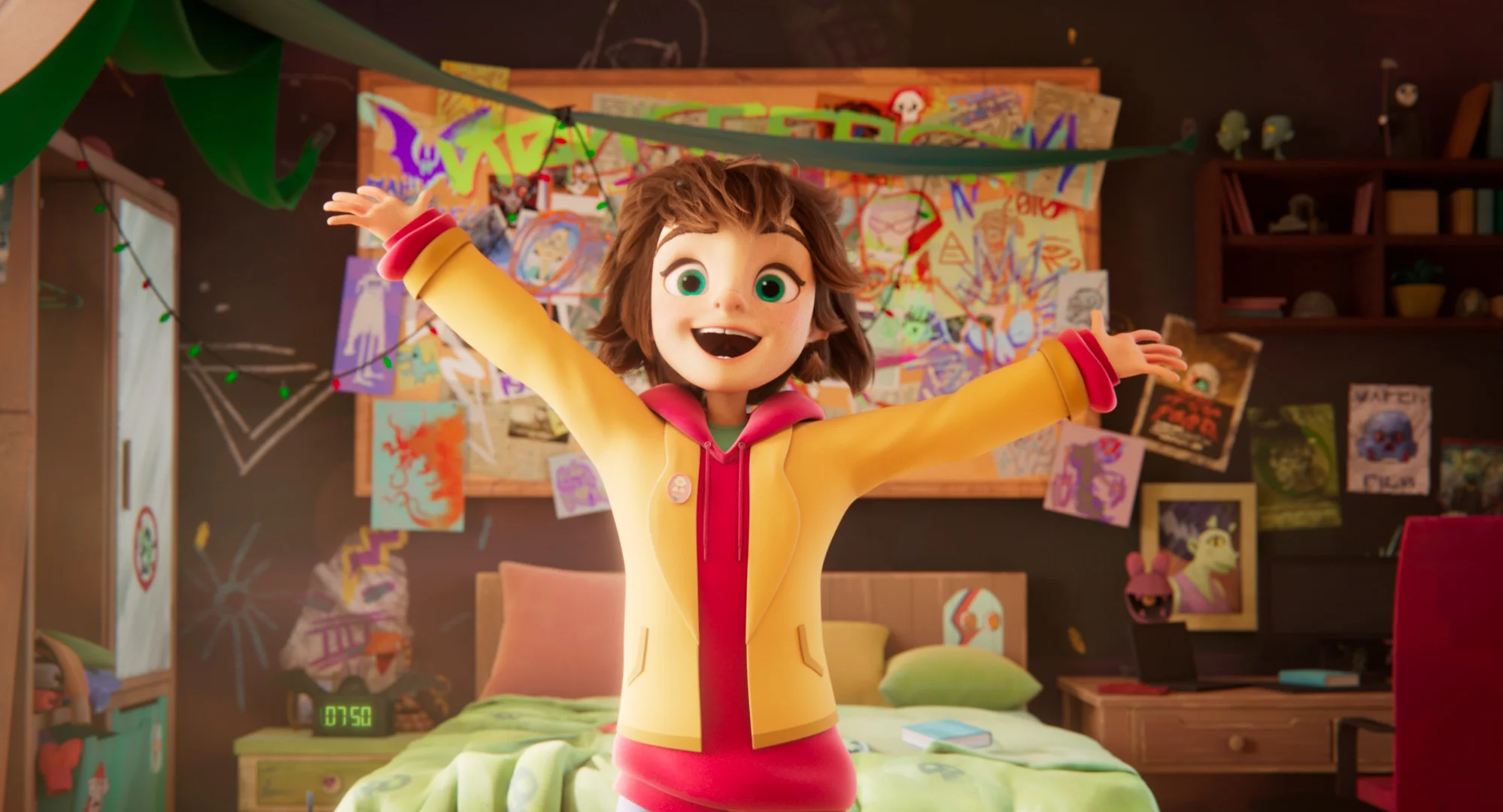

Primrose has matching houses, manicured lawns, and five centuries of pride in keeping monsters away. For twelve-year-old Mia, who is determined to prove those creatures exist, this is a particularly unhelpful place to grow up. Her ballet-loving twin fits comfortably into its expectations; Mia keeps exasperating the adults. Director Verena Fels gives this disagreement a useful visual setting in Monster Mia. Production design, the arrangement and appearance of a film’s environments, can establish social rules before anyone explains them. Here, even the lawns seem to have received excellent behavior reports.
Rotwood Academy, the monster school Mia attends after her expulsion, replaces that uniformity with gothic surroundings, colorful classrooms, and bodies that refuse to come in one standard shape. The move initially looks like liberation. Yet Rotwood has its own approved version of reality: humans are dangerous creatures from whom monsters need protection. I like how the film lets the welcome of its designs coexist with that restriction. Mia has found a place where looking strange is ordinary, but being human still requires concealment. The architecture changes faster than the assumptions.
The monsters’ disgust at human food makes this reversal especially easy to grasp. Cupcakes sound revolting to creatures accustomed to grave-worms. It is a simple joke with a clear mechanism: take something the audience accepts without thought, describe it through unfamiliar tastes, and watch normality lose its authority. The school’s role as a refuge works through the same adjustment. Monsters have reasons to feel vulnerable, which makes their fear understandable without making their beliefs about every human accurate. The comedy gives younger viewers a way to recognize that distinction without stopping for a lecture.
Mia herself presents a slightly trickier version of the problem. At her human school, she insists on a truth nobody wants to hear. Among monsters, she protects her new place by withholding the truth about herself. That contradiction gives her disguise an emotional purpose beyond the practical business of keeping the plot moving. She wants to know these creatures, and she also wants them to accept her. Her curiosity is generous; her secrecy reveals how quickly the possibility of belonging can make honesty feel dangerous. She does not need to become cynical for those desires to collide.
The friends around her help loosen the categories that both communities enforce. Paprika is a vegan vampire, a character whose preferences immediately interrupt the usual expectations attached to her species. Oscar’s detachable head supplies a more physical form of comic oddness.
Penelope, the young witch who moves from rivalry toward friendship, offers a change in relationship rather than another amusing creature trait. These are accessible ways of suggesting that a first description leaves plenty out. Paprika’s joke is particularly economical: identifying her as a vampire provides information, then identifying her diet makes the audience revise it.
The larger story is less willing to depart from expectations. Once Mia conceals her identity, disclosure becomes an appointment the screenplay will eventually keep. The subsequent rupture in friendships follows the familiar pattern in which affection formed under a false impression must survive the revelation.
Familiar construction can give children a secure route through unfamiliar surroundings, and the emotional problem is relevant to Mia. Still, the sequence offers limited uncertainty about how the film will test her. The monster-school premise provides playful variations inside a plot whose major turns remain easy to anticipate.
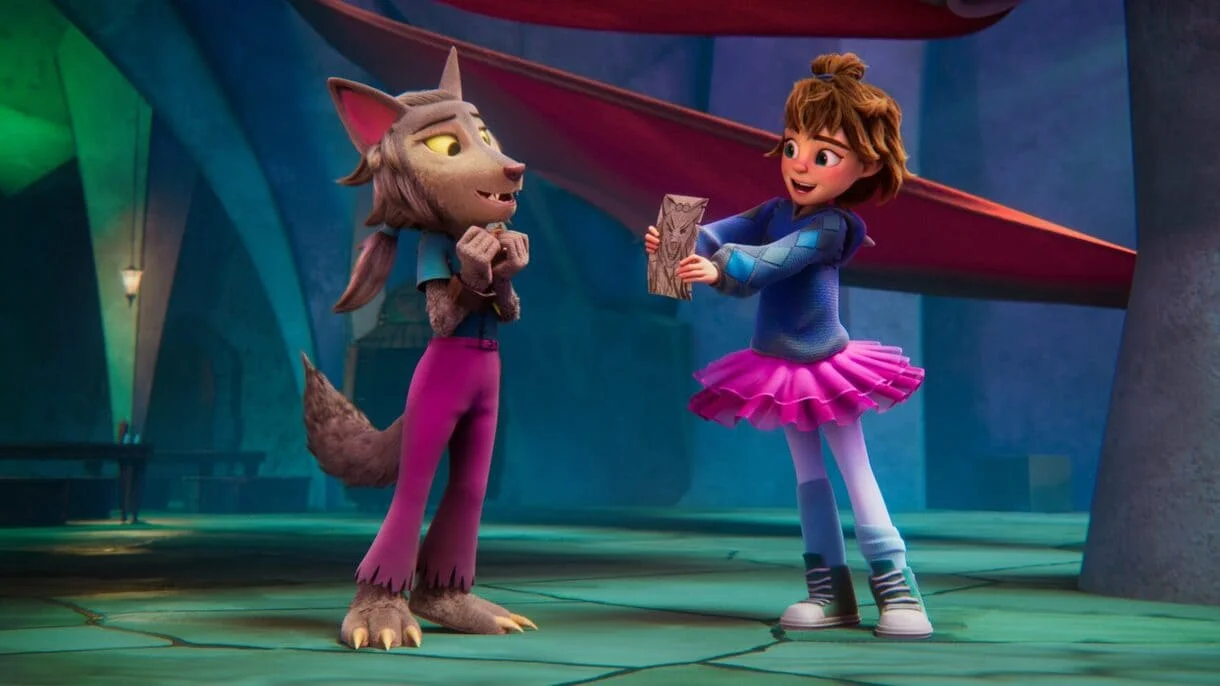
At approximately 81 minutes, the film moves briskly through those turns. Its short running time suits the directness of the adventure. The visual tone helps keep the experience light: bright colors and comic creature features make Rotwood inviting enough to explore. The finale raises the temperature with pyrotechnics and a temporary vampire threat, so its gentle spookiness does include moments of danger. The school’s appeal rests on making strange company enjoyable before asking the audience to worry about losing it.
The climax finds a fitting use for animation by turning the acceptance lesson into a physical transformation. Humans become monsters and monsters become humans through the principal’s scheme. A change of perspective becomes something characters must experience in their own bodies. This is a clear extension of the earlier food joke, now with consequences that require cooperation. Mia’s human and monster allies participate in resolving the crisis, giving the reconciliation an action to perform. The fantasy briefly makes inherited labels unreliable for everyone at once.
Fels places rather less trust in that action when the dialogue explains the lesson again. The human teacher who expelled Mia later acknowledges the value of changing perspective, a reversal already made visible through the transformations and the cooperation they demand. The repetition reduces the pleasure of arriving at the idea independently. There is, however, something worth retaining in the teacher’s change: the adult who helped make Mia an outsider has to reconsider her own judgment.
Monster Mia premiered at the Annecy International Animation Film Festival on June 22, 2026, before its theatrical release on October 15, 2026. Directed by Verena Fels, the animated family feature follows a young girl obsessed with proving monsters exist who gets transferred to a secret boarding school full of real monsters, where she must hide her human identity and team up with her new creature classmates to stop a sinister plot against her hometown.
Full Credits
Title: Monster Mia
Distributor: Plaion Pictures, Filmladen, Kazoo Films
Release date: October 15, 2026
Rating: G / PG
Running time: 1 hour 21 minutes (81 minutes)
Director: Verena Fels
Writers: Katharina Reschke, Jasmina Kallay, Tom Martin, Ines Häufler, Dunja Bernatzky, Sonja Matthes
Producers and Executive Producers: Dunja Bernatzky-Staber, Kris Staber, Nicolás Matji, Edmon Roch, Holger Weiss, Dominique Schuchmann
Cast: Lilian Jane Gartner, Verena Altenberger, Michael Ostrowski, Philipp Hansa, Nina Hartmann, Armin Assinger, Susi Stach, Silvia Schneider
Director of Photography (Cinematographer): Daniel Komosny
Editors: Elisa Maier
Composer: Zeltia Montes
The Review
Monster Mia
Monster Mia gives its familiar outsider story a welcoming visual imagination. I especially like how Primrose’s uniformity and Rotwood’s creature-filled classrooms help explain the rules Mia struggles against. Her secret adds a meaningful tension to the acceptance theme, though the predictable disclosure plot and repeated moral explanations limit the storytelling. The playful monster conventions and brisk pace make this an appealing, gently spooky family adventure.
PROS
- Expressive contrast between Primrose and Rotwood
- Playful reversals of monster conventions
- Meaningful tension between honesty and belonging
- Brisk, accessible adventure
CONS
- Predictable identity-revelation plot
- Dialogue repeats lessons already expressed through action