




























The spirits behind a closed door can be understood before they can be seen. Footsteps and chanting tell you something about the occupants of the next room, allowing an encounter to begin with an act of interpretation. SHINONOME ABYSS The Maiden Exorcist gives its Japanese supernatural setting a practical vocabulary: listen, distinguish, prepare, call. Learning to recognize a presence matters because different spirits demand different responses. You can shoot through a door, or use your voice to bring its occupants toward a trap. The haunting becomes intelligible through the actions it permits.
That is an effective way to introduce players to an unfamiliar supernatural vocabulary without requiring prior knowledge of every creature. The mononoke acquire identities through their sounds, movements, and susceptibility to particular methods of disposal.
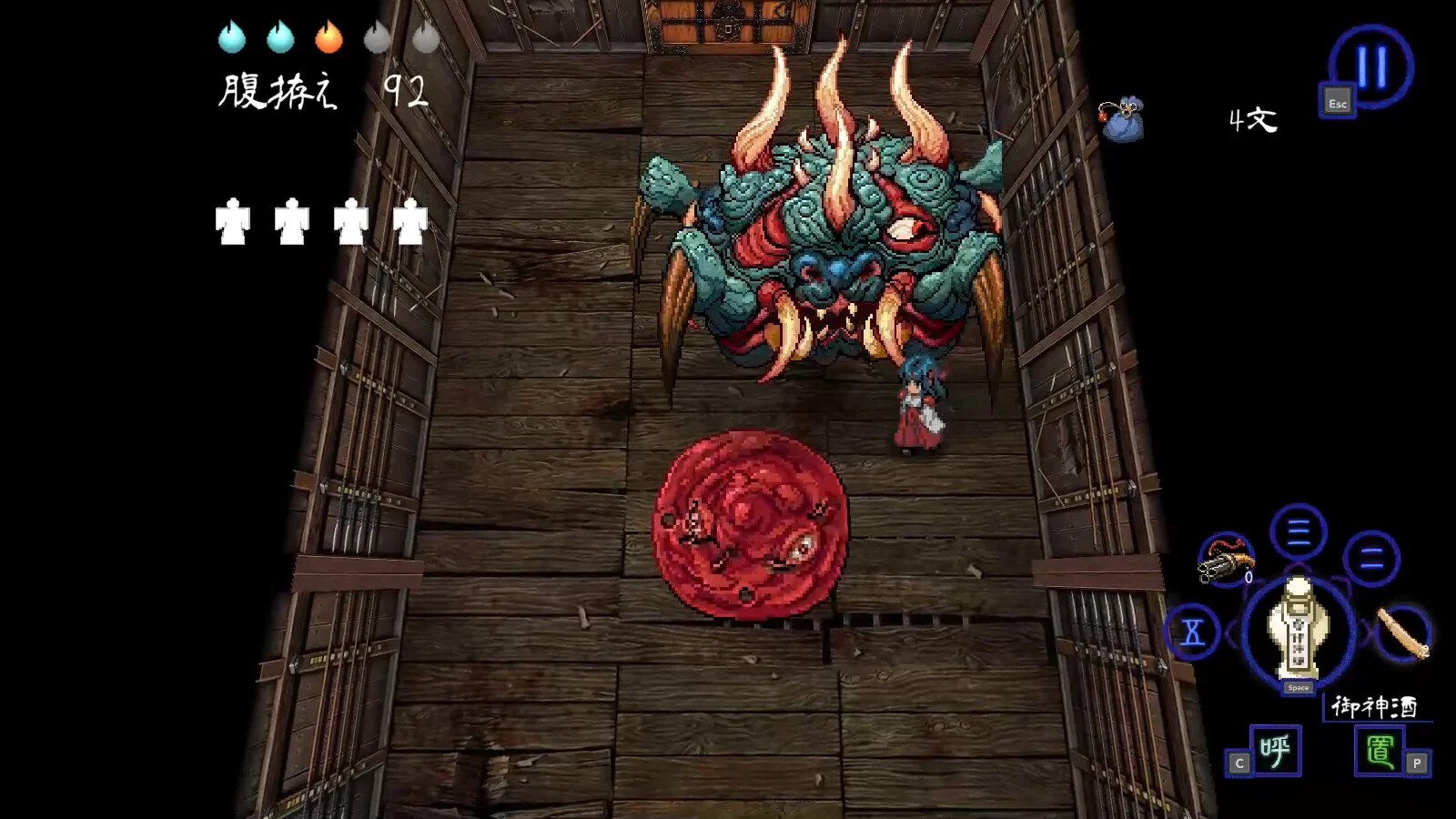
Detailed pixel art makes those differences visible, while Yono’s small, almost chibi figure looks precarious among the macabre inhabitants. The distant, top-down view might suggest command over the building, yet closed doors keep knowledge incomplete. The affinity with Fatal Frame lies in this vulnerability and the threatening quiet of domestic spaces. Here, listening gives that quiet a tactical purpose, and calling out deliberately breaks it.
Yono has entered these haunted estates in search of her missing brother, an exorcist whose teachings supply her with the beginnings of a survival education. That relationship gives the player’s learning a modest fictional foundation. Her brother has left her knowledge she must now put to use. The personal story receives little sustained development, however.
Short scenes introduce story stages, and brief passages accompany item discoveries, leaving limited space for the sibling relationship to acquire emotional weight. The houses communicate their dangers through constant interaction; Yono’s search proceeds through much thinner dramatic material. Her predicament is easy to understand, but the writing does little to deepen the attachment.
The game’s richer account of her predicament sits inside the inventory. Carrying a gun and ammunition already commits precious space that might otherwise hold food, a key, or a candle. Stamina diminishes with time, candles burn down, and darkness interferes with finding useful objects.
A key can therefore require a sacrifice that affects the next several rooms. Leaving the candle behind preserves progress through a locked door while making the route beyond it harder to inspect. Supplies can be dropped and retrieved, but backtracking consumes time in a game that rewards efficient completion. Even an apparently cautious decision has a cost elsewhere.
Resident Evil provides a useful reference for this negotiation among ammunition, keys, and carrying capacity. Shinonome’s distinctive pleasure comes from extending that negotiation into the behavior of the haunting itself. Some spirits resist gunfire; others consume ammunition that could be spent elsewhere.
Fires and pits offer solutions that leave inventory space untouched. Certain spirits can even be induced to create a flame into which another enemy can be drawn. Such interactions give the supernatural setting substance beyond its visual motifs. Exorcism involves discovering how its inhabitants and spaces affect one another, then arranging those relationships in Yono’s favor.
There is considerable satisfaction in making a dangerous room useful, although the enemies’ cooperation can become excessive. Direct pursuit makes their movements readable enough for a carefully prepared trap to work. The same behavior allows repeated luring to become a dependable answer to imposing creatures.
Closing doors can delay pursuers until they abandon the chase, further reducing the need to spend supplies. These patterns belong to the puzzle’s logic, and predictability is necessary if planning is to mean anything. Still, a threatening appearance loses some authority once the player recognizes how obligingly its owner will approach the nearest fire.
The modes place different demands on that accumulated knowledge. Harai supplies predetermined story stages, with fixed arrangements of enemies and resources that can be studied and solved. Its teaching works through controlled circumstances: discover an interaction, recognize its usefulness, improve the route.
Misogi generates maps randomly, and Gyou offers randomized play at a higher difficulty. Those modes ask the player to apply familiar methods without relying on a remembered arrangement of rooms. The distinction matters because the game’s pleasures divide between solving a particular construction and understanding its rules well enough to handle a new one.
Scoring gives familiarity another purpose. Enemy kills, completion speed, and certain items retained at the finish contribute to performance, with online leaderboards encouraging refinement. A room that has ceased to frighten can remain interesting as an efficiency problem.
Leaving an item behind becomes a calculation about the final score as well as immediate survival. This shift from apprehension to optimization suits the fixed stages, though it changes the character of the haunted house. Its unknown occupants gradually become anticipated obstacles, and its threatening spaces become routes whose wasted steps can be counted.
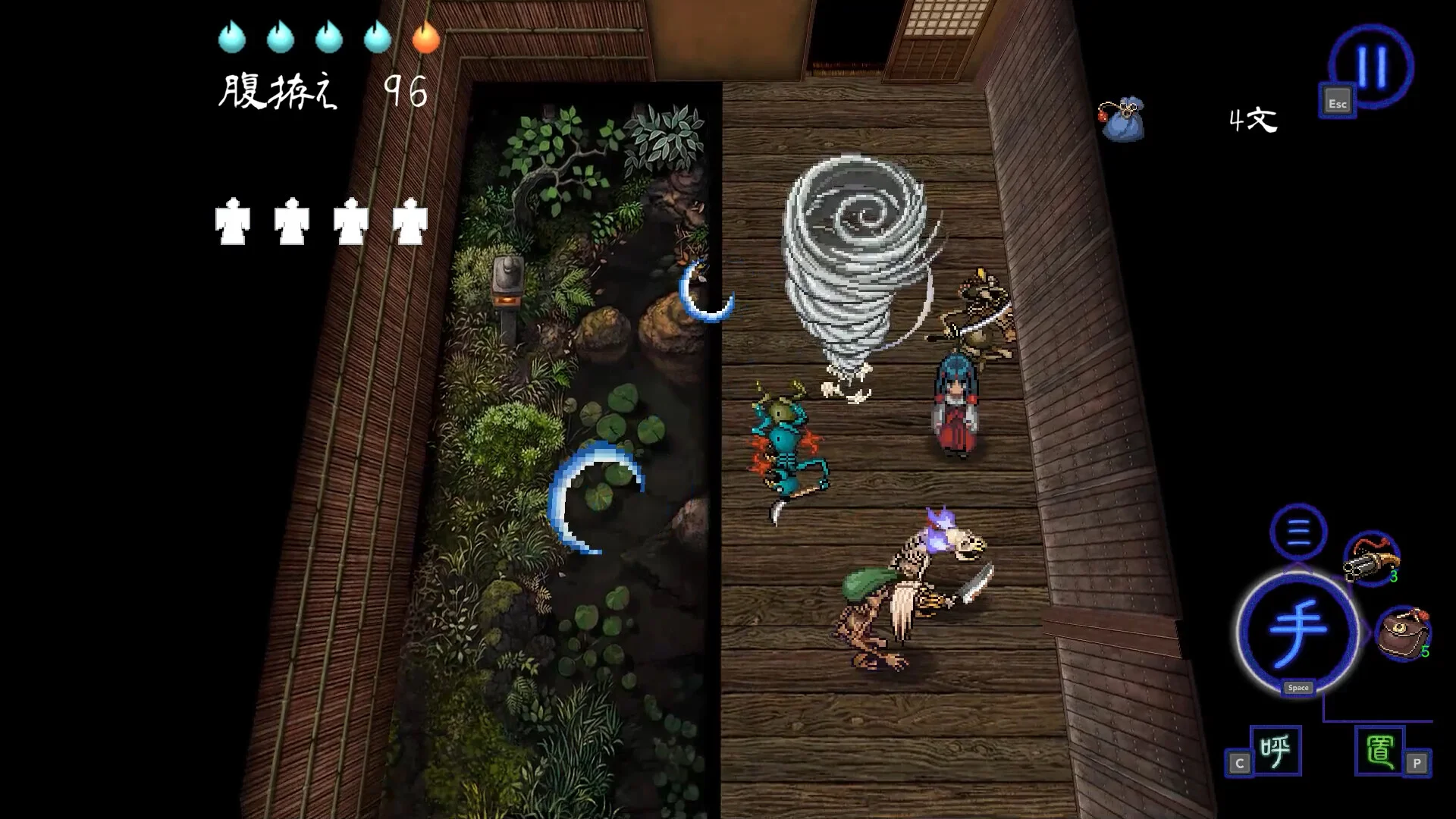
Slow movement makes that transition uncomfortable. During discovery, Yono’s pace gives an ill-considered entrance serious consequences: escaping an alerted enemy is difficult, so attention belongs before the door opens. Once a stretch has been solved, walking through it again offers little comparable pressure.
Repeated rooms and a narrow palette make the return feel longer, despite the care within individual pixel compositions. New mechanics arrive gradually, which keeps the early learning manageable, but later developments such as transformation take time to appear. The game asks for considerable patience before revealing the extent of Yono’s abilities.
That patience is tested most severely after death in a predetermined dungeon. Restarting preserves the player’s understanding while removing their progress; the available save points serve to suspend play rather than provide ordinary recovery checkpoints.
Repetition can consolidate a newly learned response, but it can also delay the opportunity to use it. After a minor oversight near the end of a familiar route, the player already knows which candle to carry, which door to close, and where to draw the pursuing spirit. Reaching the unresolved encounter requires walking through those settled decisions again, at the same deliberate pace that once made them frightening.
The Review
SHINONOME ABYSS The Maiden Exorcist
SHINONOME ABYSS The Maiden Exorcist makes its Japanese supernatural setting readable through sound, behavior, and resourceful acts of survival. Listening behind doors and turning dangerous rooms against their occupants gives exorcism a satisfying practical intelligence. Thin storytelling and predictable pursuit limit that achievement, while slow restarts make familiar routes wearisome. Its strongest discoveries reward patience; repeating their execution can exhaust it.
PROS
- Sound makes unseen spirits tactically readable.
- Scarce inventory space creates consequential choices.
- Environmental traps reward inventive solutions.
- Fixed and randomized stages test different kinds of knowledge.
CONS
- Sparse storytelling leaves Yono’s search underdeveloped.
- Predictable pursuit weakens enemy menace.
- Slow dungeon restarts prolong already-solved routes.
- Repeated rooms and a narrow palette limit visual variety. 1.