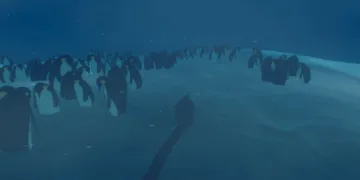



























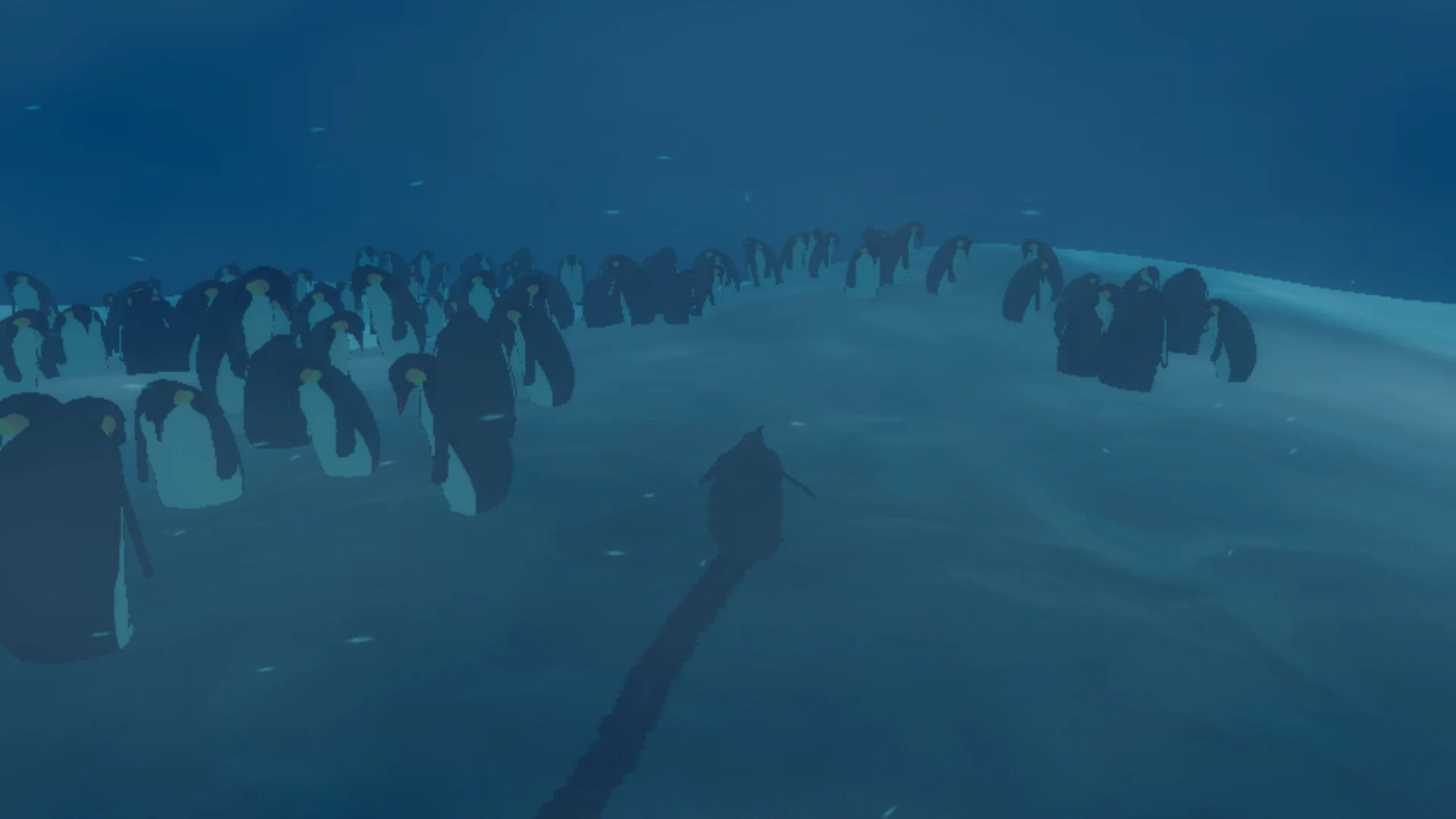

Switching to a chick in Penguin Colony lets you pass through openings that exclude a larger bird. A heavier penguin can weigh down a switch; a rockhopper can reach a higher ledge. Transferring control to a nearby colony member turns the animal’s body into a tool for reading the environment. The relationship is immediately understandable: size, weight, and jumping ability determine which possibilities a stretch of ice or ruined architecture offers.
The decisions built around those differences are less developed. Much of the main route accommodates several species, and a suitable replacement usually waits close to any obstacle that requires one. Switching therefore tends to solve a local access problem without demanding much preparation. Optional routes give the abilities further purpose, but frequent platforming makes the rockhopper an easy default. The colony offers several ways to inhabit the landscape, then gives its best jumper a disproportionate share of the useful work.
Belly sliding briefly suggests a different balance. Across open snow, its generous momentum makes covering ground pleasurable, with uphill slides that happily disregard sensible physics. The increasing emphasis on precise hopping restricts that pleasure. Stiff jumps and slippery steering become liabilities around narrow landings, while the large circular stamina display can obscure the view during faster movement. A game whose discoveries depend on looking closely has an interface that sometimes gets between the player and the ice.
That physical relationship matters to its adaptation of Lovecraft’s At the Mountains of Madness and The Shadow Out of Time. Set in Antarctica in 1939, Penguin Colony places the player beside a Nazi expedition seeking ancient knowledge and power, with Māori guardians, the Kaitiaki, resisting the intrusion. The humans supply the ambitions and explanations. You supply a succession of small bodies passing through their consequences. Burned camps and damaged soldiers become things to encounter without the usual expectation that encountering suffering will unlock a combat objective.
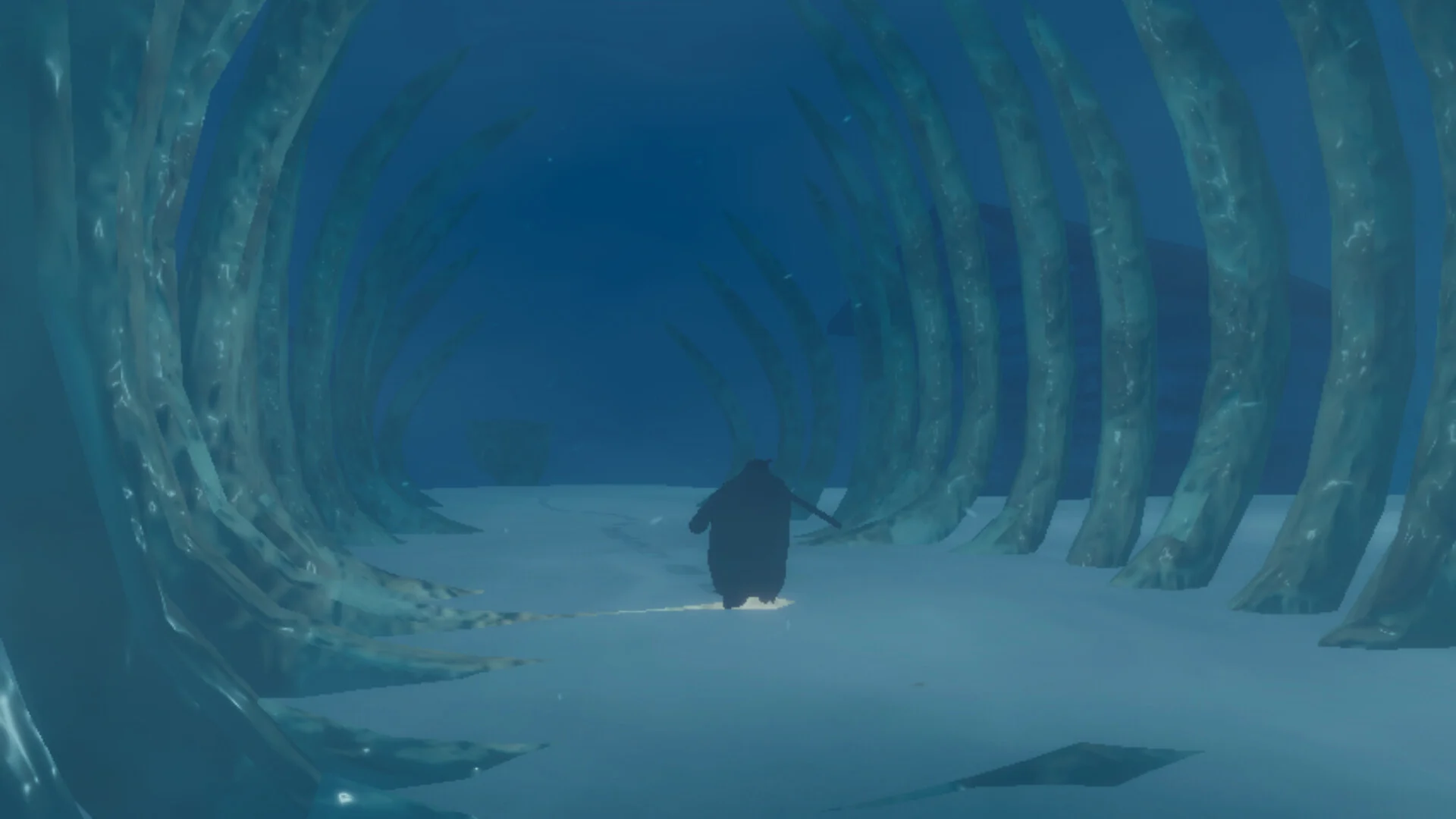
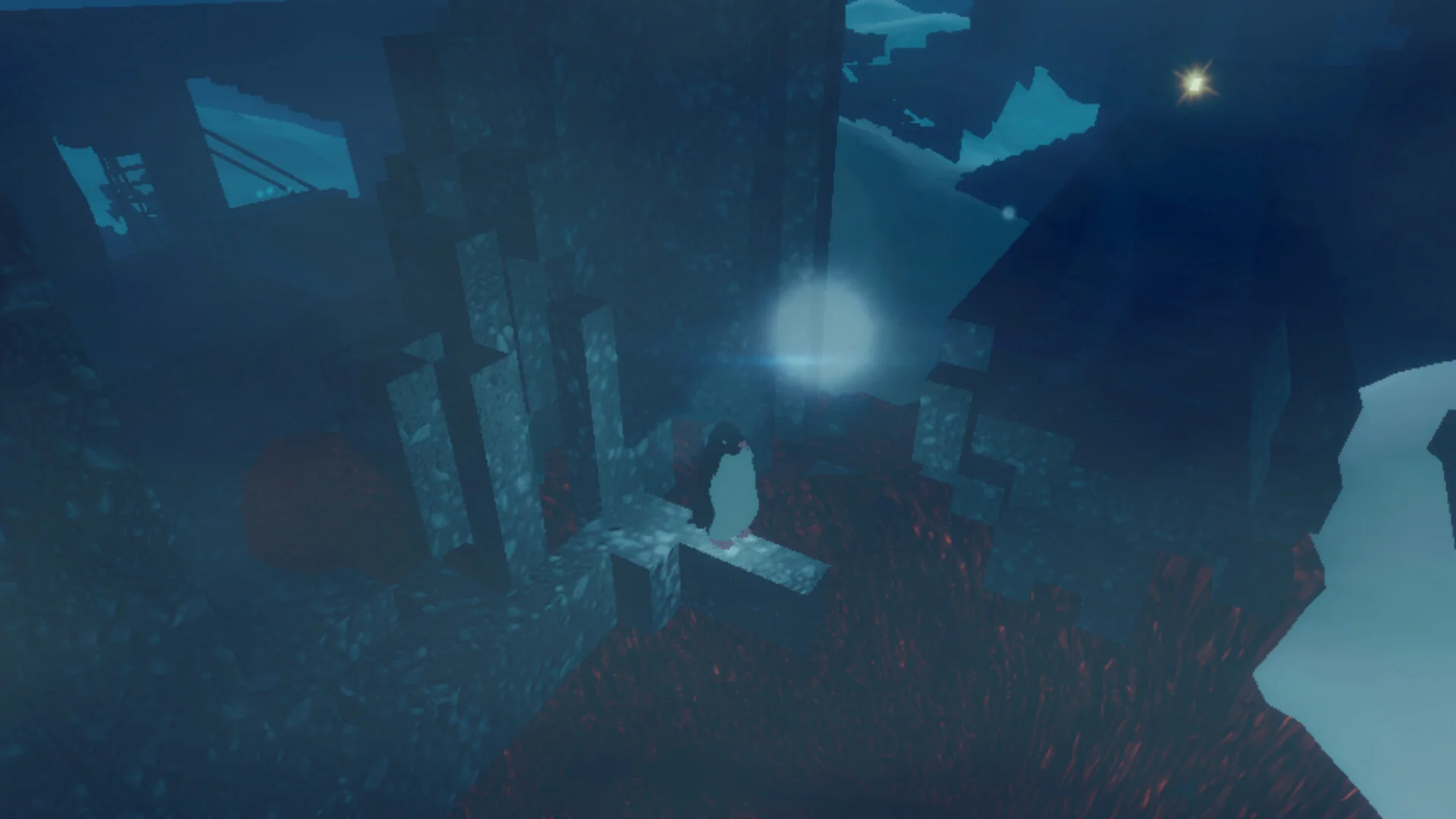
The low-poly architecture supports this separation. Angular spires and broad chasms establish spaces built on a scale that makes a penguin seem incidental. Blue fog and cold gray surfaces interrupt the white terrain without making the ruins feel welcoming. Waddling through them preserves the mismatch between your body and the structures around it. The absence of substantial combat leaves room to observe that mismatch; giving the bird a way to defeat everything would dissolve much of the perspective’s value.
Chapter four exposes the limits of the movement system by introducing a pursuing creature. Darkness, awkward camera behavior, and uncertain routes make platforming harder to read precisely when escape requires quick decisions. Fear depends partly on understanding what action might save you. When the route and the jump are both uncertain, attention shifts toward managing the controls. The creature has to compete with the practical question of where the game expects a penguin to land.
Launch-build collision failures create a separate problem. Becoming trapped in geometry or falling outside the level through an apparent opening breaks the link between curiosity and discovery. The recovery function does not always resolve these situations. This matters beyond the interruption itself: a crack that resembles a hidden route can punish the same exploratory behavior the narrative needs. Once environmental invitations become unreliable, ignoring a suspicious gap becomes a reasonable decision.
The reward for taking those invitations is usually information. Across seven chapters, photographs, glyphs, words, and fragments of narration gradually assemble an account of the expedition. English and te reo Māori appear among the discoveries, while blue orbs help recover meaning from unfamiliar language. Choosing another bird can grant access to another fragment, which can change the significance of something encountered earlier. The consequence belongs to your reading of events; gathering evidence does not give you control over the human story.
Guidance is subtler than a stream of objective markers. Flares, illuminated flags, wind direction, and a focal-point function offer bearings, leaving optional discoveries for the player to notice. That approach rewards attention when a detour yields a photograph or a revealing passage. Sparse stretches weaken it. Long searches can produce little new understanding, and without an ongoing discovery map it can be difficult to judge if an area still holds something worth finding. Cumbersome traversal makes an unrewarding search harder to dismiss as a pleasant wander.
The map arrives at the end, alongside an invitation to compare findings with other players. This gives missing information a communal purpose: another person’s discovery can reopen an apparently settled interpretation. A return visit also benefits from knowing where significant fragments lie. Yet the late map cannot help pace the first search. The invitation to collaborate is thoughtful, but its appeal depends on the initial expedition sustaining enough curiosity to make the remaining gaps feel worth investigating.
Lenval Brown’s narration supplies a strong reason to keep listening. His low voice carries the human account while penguin calls, wind, electrical hum, and crackling fire maintain the immediate environment around it. The separation suits a story in which explanations deserve scrutiny. Accounts of the ancient civilization’s conquests and its manufacture of enslaved shoggoths connect cosmic power to recognizable practices of domination. Against the expedition’s pursuit of possession, the Kaitiaki’s effort to contain the ancient force gives knowledge a different responsibility.
The narrator’s late self-justification makes that distinction personal. Confronted with a destructive entity, he begins imagining the recognition and security that preserving its knowledge might buy. His academic curiosity acquires a library bearing his name and a comfortable cottage. Earlier fragments now describe a man capable of recognizing danger while calculating his own reward for leaving it intact. The player has spent the game gathering information to understand what happened; he considers using what he understands to excuse the decision he wants to make. Brown’s voice gives that calculation room to unfold, down to the imagined home beneath two oak trees.
The Review
Penguin Colony
Penguin Colony makes discovery a form of narrative agency: changing birds opens routes, while gathering fragments changes your understanding of the humans passing through Antarctica. Its account of conquest and compromised curiosity earns attention, supported by Lenval Brown’s narration and imposing environments. Thin ability puzzles, sparse discoveries, and unreliable traversal weaken the connection between searching and learning. The late revelations reward persistence, but the systems needed to reach them demand too much patience.
PROS
- Discoveries reshape the player’s understanding.
- Sharp examination of knowledge and exploitation.
- Strong narration and environmental sound.
- Architecture reinforces the penguins’ smallness.
CONS
- Species abilities produce limited decisions.
- Awkward platforming, camera, and obstructive interface.
- Sparse discoveries interrupt narrative momentum.
- Collision failures undermine exploratory trust.