

















The rulers of Luocha plan to use a festival to erase their subjects’ memories. Held once every sixty years, the Magic Dream Festival offers the authorities a crowded, celebratory occasion for distributing amnesia powder. Sun Xun’s animated feature Magic Atlas finds a disturbing political idea in this arrangement: public participation can provide the machinery for public dispossession. The people gather for an event that will deprive them of the capacity to remember it. Celebration supplies the cover, while the attack reaches backward into experiences the state has yet to claim.
Camera-equipped mosquitoes make the festivities an especially unpleasant place to be a worker. Their tiny lenses bring surveillance into the air itself, extending the reach of a coal-mining empire whose inhabitants already live under severe restrictions. Flight is illegal. Between the prohibition on leaving the ground and the planned destruction of memory, Luocha’s rulers seek control over both movement and continuity. A population denied its past would struggle to recognize exploitation as something repeated, shared, and therefore open to challenge. Coal gives this fantasy a material weight: the empire requires laboring bodies, and its authorities intend to retain those bodies while interfering with what they know.
Into this order flies a magician, whose machine carries him directly into criminality. His imprisonment brings him into contact with Xiao Zhi, a young orphan, and the magic atlas passes between them. That exchange establishes a modest but meaningful alternative to the festival’s mass erasure. Something can be entrusted to another person; knowledge might survive through a relationship. The film does not need to explain every property of the atlas for the gesture to register. Against the state’s handling of people as an interchangeable population, the magician recognizes a particular child as someone capable of receiving what he holds.
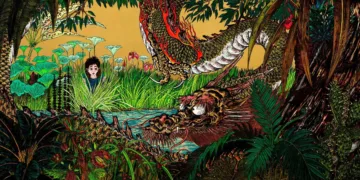
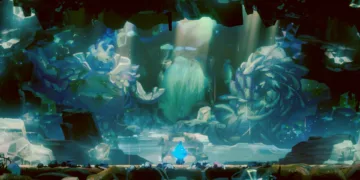
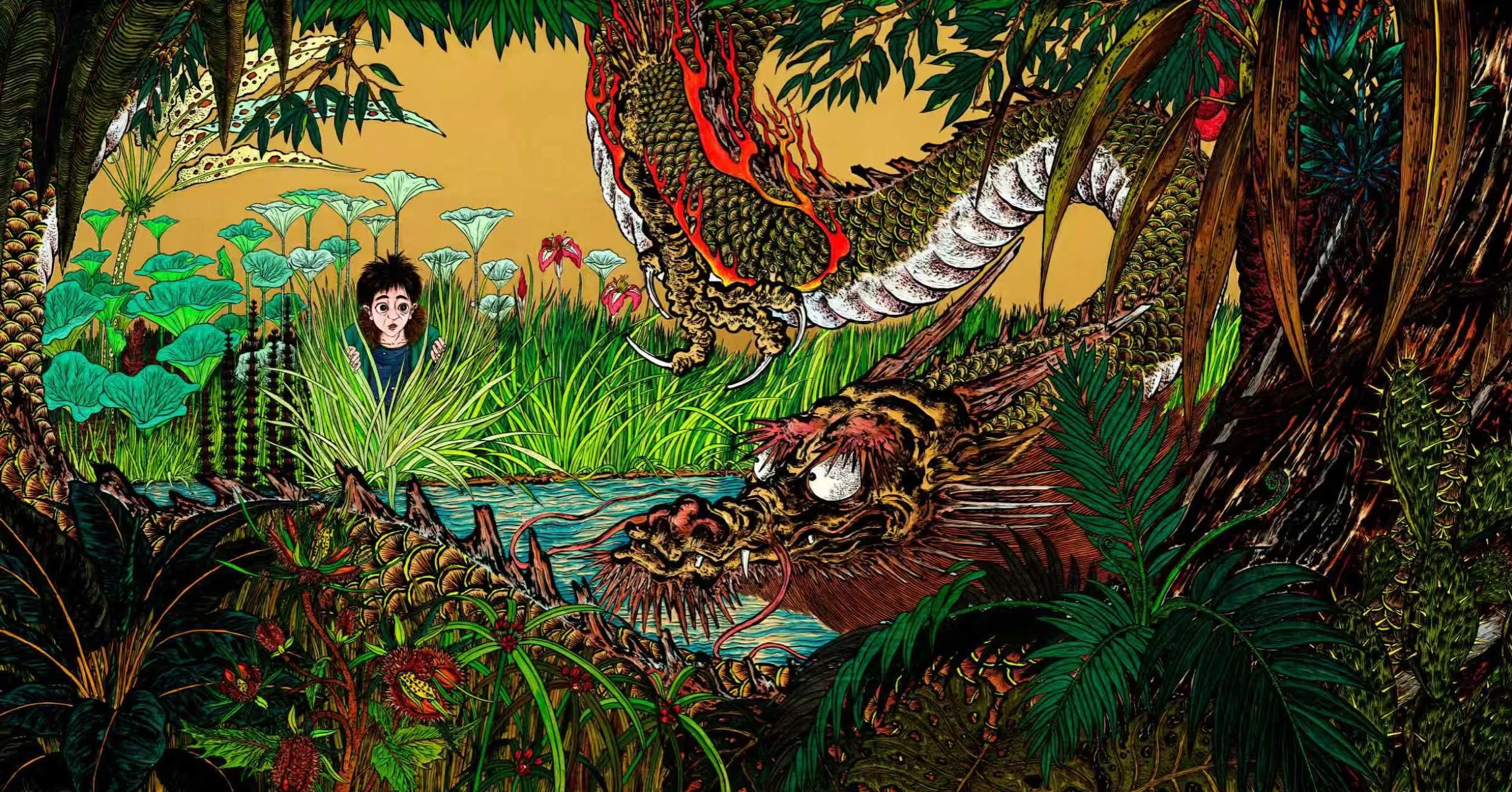
This conflict acquires an extraordinary physical presence through Sun’s animation. Extensive woodcut passages retain the force of carved marks, with black and white pressed into dense, sharply articulated forms. Owls and hares appear among branches whose sculptural shapes give the natural world a firmness that survives its transformation into moving images. The eye can follow a creature while remaining conscious of the lines that constitute it. These sequences offer a pleasure peculiar to animation: living movement and constructed surface remain perceptible together, without either canceling the other.
Early narration connects ink and woodcutting with time, space, and existence. The association is given substance by the images themselves. Making a mark requires time; carving a succession of images leaves evidence of repeated decisions. Across a production that occupied ten years and many animators, this visible accumulation gives the film a suggestive relationship to its amnesia plot. Its surfaces preserve the work of getting something onto the screen. Reading them as an answer to enforced forgetting does not require assigning a political meaning to every line. The duration of making is already part of what the film asks its audience to consider.
Sun also refuses to let one medium settle into a reassuring visual language. Ink, painted textures, digital animation, and insistent color interrupt the austerity of the woodcuts. An early horizontal passage across mounted warriors moves through black and white and sepia before opening into color, making changes of palette part of the experience of passing through an image. Elsewhere, the shift from restrained monochrome to heavily worked, brightly colored passages can scatter attention. Individual images command such close inspection that their succession becomes difficult to absorb. The decade of labor deserves recognition, but time spent making a film cannot settle how that film organizes the viewer’s time.
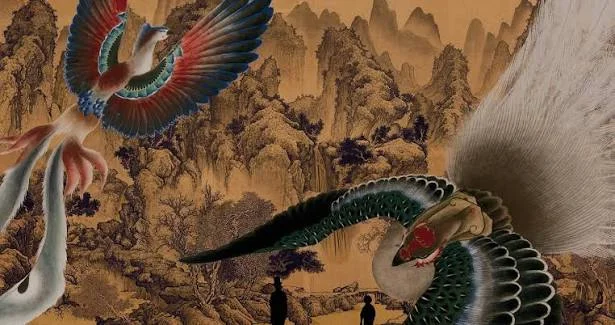
The same distinction applies to its political imagination. Luocha’s instruments of domination are concrete enough to provoke thought, yet its exaggerated, cackling rulers can make power look easier to recognize than it is to understand. The festival scheme is horrifying because it joins ordinary public life to an attack on memory. The conspicuous villainy surrounding it supplies a simpler explanation: wicked figures want to do wicked things. Coal, labor, and surveillance suggest a system with material interests; the rulers’ grotesquerie sometimes draws attention away from those interests toward the satisfaction of identifying monsters.
The magician and Xiao Zhi offer a possible route through that problem, since their connection gives the atlas a human destination. As the film proceeds, however, the narrative line joining imprisonment, transmission, and threatened erasure becomes increasingly difficult to follow. The weakness is specific. Unanswered questions about the atlas are compatible with wonder, and the prisoners do not owe the audience a conventional escape. But the expanding imagery gradually reduces the pressure of the relationship that made its political possibilities tangible. There is less opportunity to understand how receiving something from another person might alter life under Luocha’s rules.
To demand a neatly decipherable allegory would flatten what Sun has made. The camera mosquitoes need no exhaustive explanation, and the woodcut animals do not require translation into a list of approved meanings. Their forms can produce unease or tenderness before any interpretation arrives. Yet uncertainty has its own dramatic demands. As the final stretch gives itself over to mystical imagery, visual intensity continues to supply discoveries while the established struggle loses traction. Attention remains active at the level of looking, with fewer connections to sustain concern for the magician, the child, and the threatened population.
That late expansion does challenge Luocha’s claim to contain every imaginable possibility. The film’s early attention to time and existence prepares a scale on which this industrial empire can cease to be the whole world. There is freedom in that enlargement, particularly after the cramped political logic of prohibited flight and managed memory. Its cost falls on the people whose lives gave the argument its urgency. When the film moves beyond the empire’s horizons, the workers under those tiny surveillance lenses become harder to keep in view, still exposed to a machinery of forgetting that cosmic distance has not dismantled.
Magic Atlas premiered at the Locarno Film Festival in August 2026. Directed and animated by Sun Xun over a decade-long production process, the visually striking animated feature blends traditional artistic techniques with mythological and historical symbolism to explore vast, surreal landscapes and fantastical realms.
Full Credits
Title: Magic Atlas
Distributor: Locarno Film Festival, Festival Circuit
Release date: August 2026 (Locarno Film Festival)
Running time: 1 hour 25 minutes (85 minutes)
Director: Sun Xun
Writers: Sun Xun
Producers and Executive Producers: Sun Xun
Cast: Ya Yu, Kong Qingxin, Da Yuzi, Song Yuanyuan, Zhou Bin, Zhu Erya, Chen Qi, Da Shuaishuai
Editors: Sun Xun
The Review
Magic Atlas
Sun Xun’s woodcut animation gives memory a physical presence, making Luocha’s planned erasure of its subjects’ past especially disturbing. Magic Atlas earns admiration through the precision of its images and the political force of its festival, surveillance, and forbidden flight. Its exaggerated villains simplify the system those details expose, while the late mystical expansion weakens attachment to the magician and Xiao Zhi. The film imagines freedom on an immense scale, but struggles to sustain concern for the people who need it.
PROS
- Extraordinary woodcut animation with palpable texture.
- Sharp connections between memory, labor, and political control.
- Visual techniques give accumulated creative work an expressive presence.
CONS
- Late abstraction weakens the protagonists’ narrative pull.
- Dense stylistic changes can scatter attention.
- Exaggerated villains simplify the depiction of power.