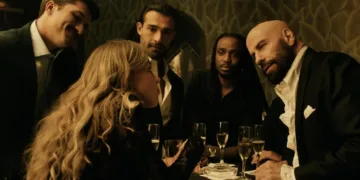
























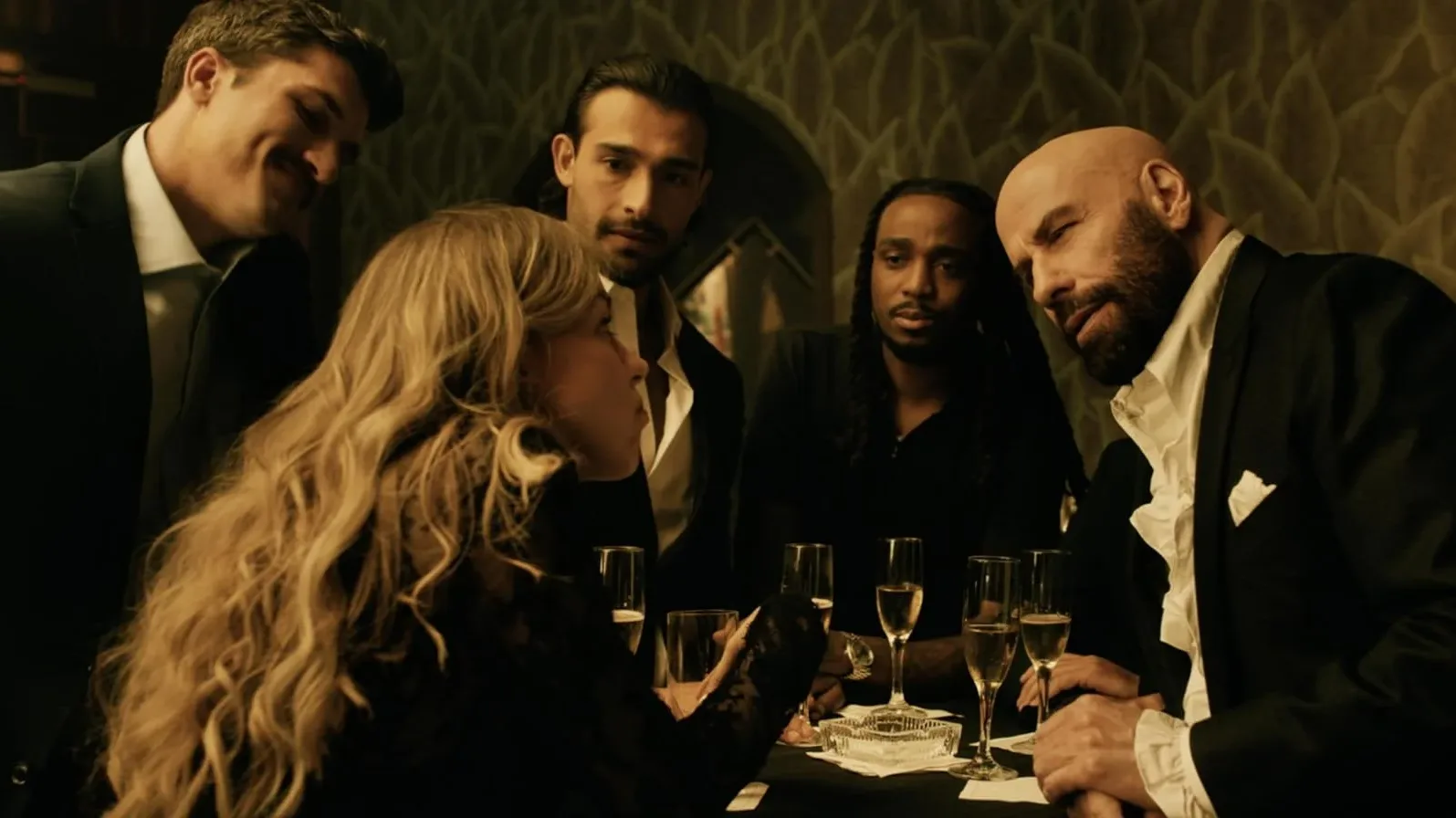

Slow motion gives Mason Goddard’s crew ample time to look like accomplished criminals. Their group strut in The Gentleman Thief establishes solidarity through the simple privilege of being watched: these people belong together, and the camera expects us to enjoy their company.
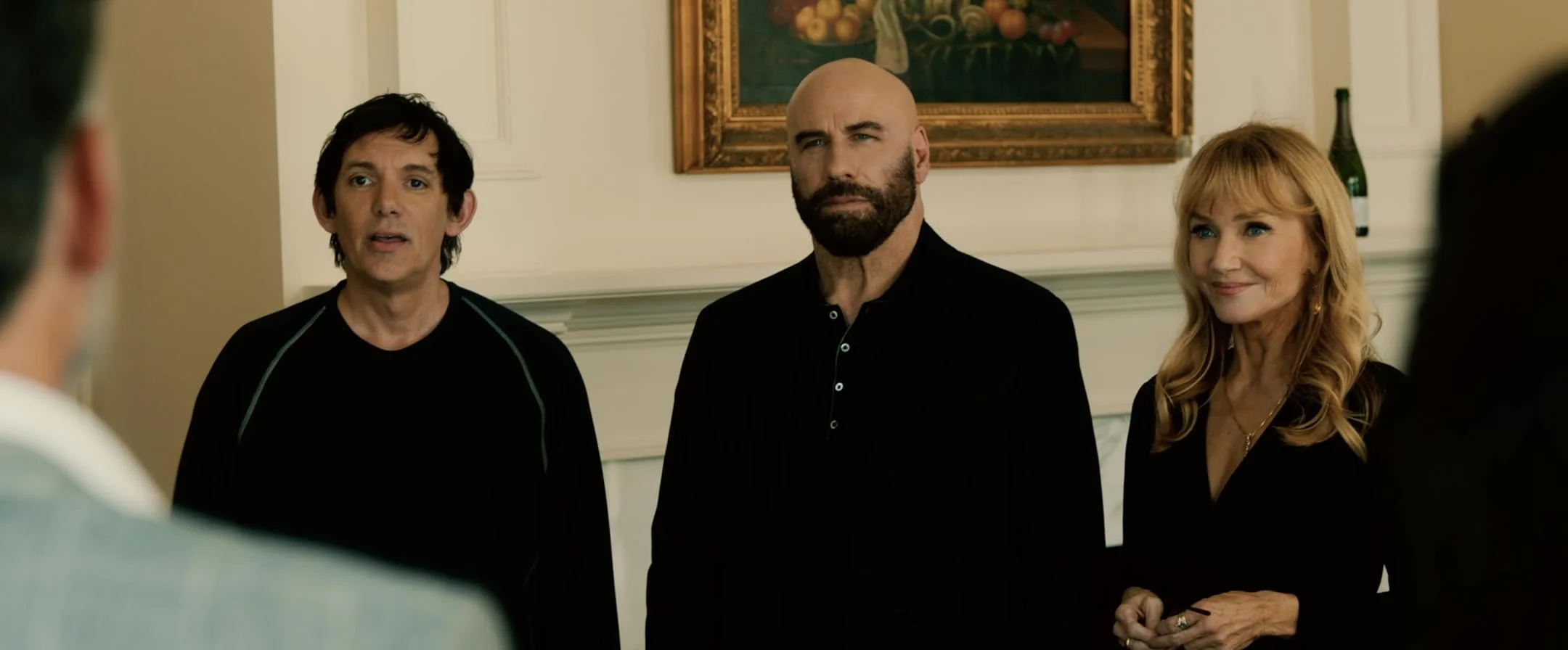
John Travolta supplies the central authority as Mason, a retired thief drawn back into work by his younger brother Shawn, played by Lukas Haas. Before their expertise has faced much scrutiny, Randall Emmett’s direction has already granted them the visual privileges of professionals. Looking capable is part of a con artist’s equipment. The film takes that equipment seriously.
The theft of an expensive watch puts this authority to a practical test. Mason lifts it at a party, and the owner takes so long to notice that the act scarcely seems to disturb the evening. Even then, suspicion fails to settle on Mason. There is a possible pleasure here in watching a thief operate beneath another man’s attention, but the scene gives that attention so little resistance that success feels almost automatic. The missing watch should leave us admiring the distance between what Mason knows and what his victim perceives. Instead, the victim seems barely available for the transaction.
Chris Sivertson’s screenplay builds the larger operation around a painting valued at $100 million aboard wealthy collector Hamish’s yacht in Miami. False identities, sleight of hand, and divided loyalties promise a contest of appearances. The surrounding images establish a simpler basis for our investment.
Waterfront resorts, private jets, boats, and designer clothes make criminality an agreeable way of inhabiting expensive spaces. Hamish’s wealth makes him a comfortable target for our indifference, while the gang’s access to the same pleasures keeps the robbery within a remarkably insulated world. The camera distributes admiration far more readily than suspicion.
This has its attractions. Emmett allows Miami’s coastline and extravagant accommodation to occupy the screen without embarrassment, and the crew’s relaxed presence makes the setting feel hospitable. DJ Khaled’s appearance, hosting a drive around a Formula One circuit in multimillion-dollar cars, extends that hospitality into a lengthy recreational privilege.
It is easy to understand why the characters would enjoy themselves. The difficulty is sustaining our anticipation of a robbery while their attention keeps finding such pleasant alternatives. A caper can accommodate leisure, especially when apparent relaxation conceals preparation. Here, the excursion contributes little pressure to the operation waiting elsewhere.
The drone photography compounds that separation. The camera sweeps over buildings, crosses the coast, and threads through cars, displaying considerable freedom of movement while the criminal scheme proceeds at a much less responsive pace.
Such mobility could establish routes, exposure, or the uneasy relationship between a protected interior and the world outside. Its repeated function here is to display attractive territory. We are given a city to admire without much sense of how it might trap these people. The visual perspective is expansive; the characters’ predicament rarely becomes correspondingly acute.
The forceful score keeps insisting on a tension that the conversations struggle to maintain. Planning and explanations of old relationships occupy stretches that ought to alter our expectations about the job. Too often, they merely increase the amount of information available.
The banter has a loose, companionable quality, occasionally permitting an amusing throwaway line, but its unhurried exchanges weaken the impression of people negotiating uncertainty. Heist dialogue can make concealment audible: a qualification, a hesitation, a detail offered too easily. These discussions tend to tell us what we need to know and then continue talking.
An escaped crime boss seeking revenge against Mason offers an external threat, introduced through a prison-van breakout. His prolonged absence from the central action weakens the usefulness of that introduction. We know danger exists, yet it exerts little continuing force on the resort atmosphere.
The accumulating double-crosses provide changes of allegiance without consistently changing the temperature of a scene. When the yacht explosion supplies an emphatic burst of spectacle, the conspicuous digital effects further loosen the physical credibility of the danger. Noise and destruction arrive, but the film has done too little to make exposure feel cumulative.
Travolta remains useful precisely because he can suggest a history the screenplay spends so much time explaining. His controlled, occasionally stiff presence gives Mason a reserve that suits a man reluctant to abandon retirement on a golf course. Shawn’s arrival creates a credible disturbance: Mason recognizes trouble and still allows his brother to draw him back toward it.
Haas supplies the restless enthusiasm that makes this an uneven partnership. Protecting Shawn gives Mason a motive with some human weight, though Travolta’s restraint also limits the friction between brotherly responsibility and the desire to be left alone. His decision costs him less dramatically than it promises.
Rebecca De Mornay’s Odessa, an art dealer and Mason’s former lover, brings another attachment into this comfortable criminal circle. Their flirtatious reunion benefits from the suggestion of established familiarity; neither performer needs to manufacture the excitement of strangers. The writing gives them less help in making that familiarity dangerous.
Odessa’s return complicates the operation, yet the scenes between them rarely make attraction feel capable of disrupting Mason’s judgment. With Shawn, his willingness to return to work at least gives affection a visible consequence. With Odessa, the pleasure of renewed company often carries the scene by itself. Mason has people worth remaining available to, but their claims on him seldom disturb the composure with which he receives them.
The Gentleman Thief was released digitally on July 28, 2026, followed by a limited theatrical release through Vertical Entertainment. Directed by Randall Emmett, the action-thriller follows a retired master thief who is lured back into the criminal underworld to pull off a high-stakes heist while dodging a lethal trap set by an old enemy.
Where to Watch The Gentleman Thief (2026) Online






Full Credits
Title: The Gentleman Thief
Distributor: Vertical Entertainment, Highland Film Group
Release date: July 28, 2026 (Digital), July 31, 2026 (Theatrical)
Running time: 1 hour 37 minutes (97 minutes)
Director: Randall Emmett (credited as Ives)
Writers: Chris Sivertson
Producers and Executive Producers: Randall Emmett, Joel Cohen, Sean Stone, Noel Ashman, Jake Brander, Jas Mathur
Cast: John Travolta, Lukas Haas, Rebecca De Mornay, Sam Asghari, Natali Yura, Quavo, DJ Khaled, Danny Pardo
Director of Photography (Cinematographer): Alejandro Lalinde
Editors: Marc Fusco
Composer: Yagmur Kaplan
The Review
The Gentleman Thief
The Gentleman Thief grants its criminals visual authority that their methods seldom earn. Travolta’s reserve and the crew’s easy companionship provide some pleasure, while Miami supplies an attractive setting. Yet the effortless watch theft, leisurely explanations, and intermittent revenge threat leave little uncertainty for the audience to inhabit. Mason’s loyalty to Shawn gives the operation a human motive, but the filmmaking rarely makes that loyalty feel costly.
PROS
- Travolta’s controlled screen presence
- Attractive Miami locations
- A credible brotherly motive for Mason’s return
CONS
- Theft sequences offer insufficient resistance
- Expository dialogue weakens momentum
- The revenge antagonist disappears for too long
- Conspicuous digital effects diminish physical danger