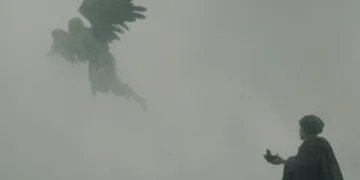
























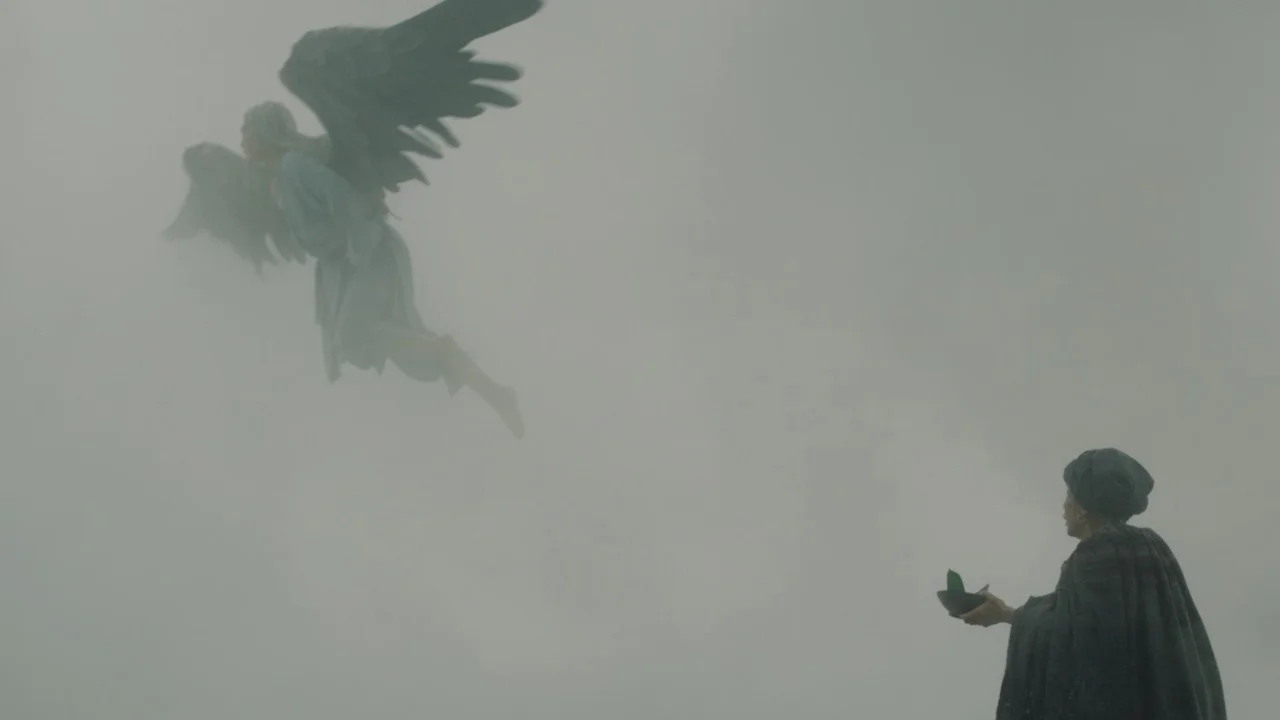

Abdicating the throne does not stop the king in Qiu Jiongjiong’s Fuxi: Joy in Four Chapters from returning for his annual meal. He has become a cuckoo, exchanging royal duties for an existence among painted clouds, yet his subjects continue to prepare his food.
Fan Guang Yao plays this winged dignitary with a solemnity that survives the enormous costume. The arrangement is affectionate, faintly absurd, and socially revealing. A ruler associated with the origins of agriculture still receives the produce of other people’s work. His transformation leaves the custom of tribute intact, carried into a countryside constructed from boards painted with green swirls.
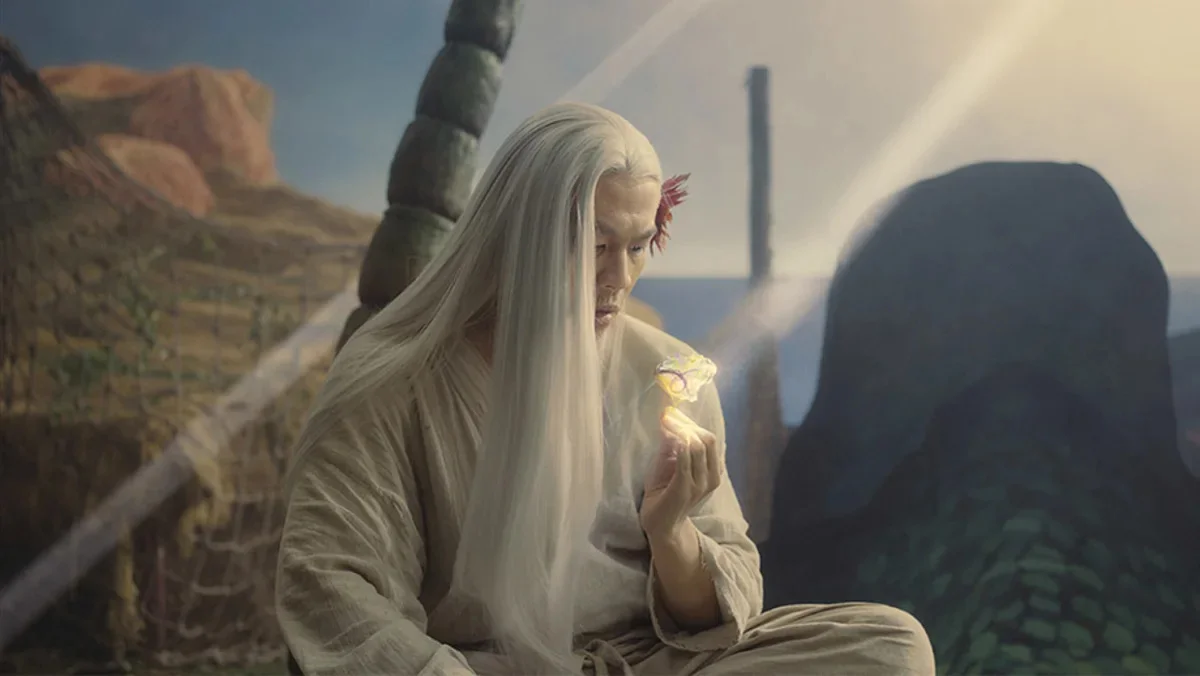
An earlier meal places a different obligation on the person providing it. Among prehistoric humans whose tails hold sacred significance, a dying grandmother supplies her own appendage for a soup that will feed her descendants. The grotesque joke contains a tender conception of inheritance: the departing body sustains those left behind.
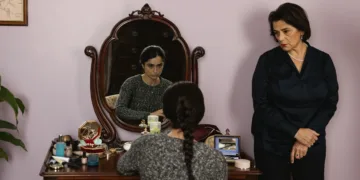
Lee Kang-sheng, wearing a silver wig with the texture of rope, gives the elder a sly, unhurried presence amid the ritual’s outrageous practicalities. His return as the woman preparing the king’s offering connects two forms of service without making them equivalent. One meal distributes an ancestor’s body among her family; another maintains a relationship between subjects and sovereign.
“Fuxi” names both a delicious food and the act of eating it, an accommodating definition for four stories spanning myth and history. Their theatrical construction permits enormous changes to register through modest alterations.
Dogs played by masked actors howl outside the ancestral settlement; in the agricultural world, they have become domestic companions, and one supplies narration. The costumes remain flagrantly artificial while the social position changes. Qiu’s painted landscapes and cloth water establish a world that can be rearranged before our eyes, where the passage of centuries requires neither naturalistic scenery nor an authoritative historical voice.
The richest episode complicates this playful compression by allowing individual dishes to carry particular experiences. Four supernatural guests assemble for a banquet in a stylized 1997, surrounded by a city suggested through illuminated building cutouts. The food prepared by Su Dongpo’s book boy summons episodes from the Song dynasty poet’s life.
Played by Lee Hong-chi, Su is remembered through an appetite that persists across repeated periods of exile following conflict with political authority. Culinary invention becomes a record of adaptation. The use of a lamb’s spine gives that argument a material basis: the pleasures associated with a celebrated writer retain traces of the circumstances under which he had to eat.
Qiu’s attention to cooking prevents this cultural memory from becoming merely reverential. Overhead views of pork belly browning in a bubbling pan give preparation its own visual authority. These images have a weight that the surrounding scenery cheerfully refuses. Painted hills can stand for a region, and a headpiece can stand for the moon, but the food demands a closer inspection of surfaces, heat, and ingredients. The contrast is sensuous without making appetite innocent. The feast’s abundance includes recollections of political punishment, with a humble cut of meat carrying that history into the company of guests eating fish steamed with chilies.
The final chapter brings the relationship between cooking and dependence closer to ordinary labor. A young kitchen servant, played by Zhou Jiarui, escapes his position and is pursued by officers of the failing Qing dynasty. Three supernatural companions teach him to prepare congee, emphasizing patience and the fellowship of a shared meal.
The activity survives the change in company; its meaning changes with the relationship. A boy who has worked in a kitchen encounters cooking as something that can be learned and shared among companions. The modest dish gives this encounter an intimacy that the royal offering lacks, with its elaborate obligation to a figure who arrives from above.
These later episodes also expose the uneven dramatic development of the earlier ones. The ancestral rite is memorable, and the returning bird king sustains a lovely collision between dignity and ridiculous appearance. Yet their central situations yield comparatively little beyond the rituals they establish. Exile and escape give the subsequent meals pressures that can develop through circumstance, memory, and instruction.
Across 135 minutes, the repeated arrival at another feast sometimes substitutes continuity of motif for a developing relationship. The film does not need a continuous protagonist, but the poet’s changing fortunes make the relative stillness of the earlier tales harder to overlook.
Sol and Luna, played by Wen Ke and Xiao Luxi, supply another kind of movement. Wearing enormous celestial headpieces, they oversee the stories and appear among the people preparing their production. Their seesaw on a foam mountain turns cosmic duration into a small piece of stage business: one rises as the other descends, and centuries pass beneath them.
Qiu gives these figures a physical task instead of burdening them with grand pronouncements. The tinted filmmaking interludes similarly bring the anthology back to people arranging a spectacle. Its freedom to pass between spirits, historical figures, and performers grows from scenery that never asks to be mistaken for an unmediated world.
The late pullback to a cast-and-crew celebration extends the shared meal to the people represented as making the film. Preparing the spectacle becomes another communal activity deserving its feast. There is warmth in granting the workers a place within the celebration, though the gesture carries a cost: bodies offered to descendants, food presented to rulers, and meals improvised under constraint become easier to absorb into one reassuring account of human appetite.
The appearance of the crew introduces a further relationship for the film to consider. Once the makers join their characters at the table, attention falls on the labor that has made this apparent abundance possible, from the painted countryside to the food placed before the camera.
Fuxi: Joy in Four Chapters had its world premiere at the 39th Tokyo International Film Festival on October 29, 2026. Directed by Qiu Jiongjiong, the fantasy drama connects four distinct stories across four millennia through the universal language of food, feasting, and folklore.
Full Credits
Title: Fuxi: Joy in Four Chapters (Chinese: 腹喜)
Distributor: Uluka Studio / Midnight Blur Films
Release date: October 29, 2026 (Tokyo International Film Festival)
Running time: 2 hours 15 minutes (135 minutes)
Director: Qiu Jiongjiong
Writers: Qiu Jiongjiong
Producers and Executive Producers: Ningyuan Ding, David Tang, Jin Zhao
Cast: Lee Kang-sheng, Darren Wang, Annie Chen, Lee Hong-chi, Fan Kuang-yao
Editors: Qiu Jiongjiong, Xinzhu Liu, Chen Xu
The Review
Fuxi Joy in Four Chapters
Qiu Jiongjiong’s theatrical banquet finds its richest flavors in the relationships food sustains: ancestral obligation, royal tribute, survival, and freely offered companionship. Painted landscapes and closely observed cooking give these connections wit and texture, with Su Dongpo’s exile supplying the strongest dramatic substance. The earlier tales remain comparatively static, and the closing celebration softens some distinctions the meals have established. Still, the film’s pleasures reward attention to who prepares the feast and what their hospitality requires.
PROS
- Inventive theatrical sets and playful celestial stagecraft.
- Inventive theatrical sets and playful celestial stagecraft.
- Su Dongpo’s episode connects appetite with political hardship.
- Lee Kang-sheng’s sly presence links contrasting rituals.
CONS
- Earlier chapters receive limited dramatic development.
- The closing celebration softens differences between obligation and fellowship.