








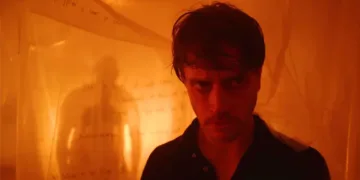
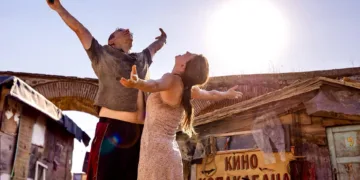




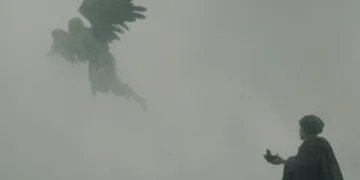



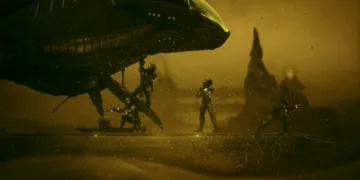






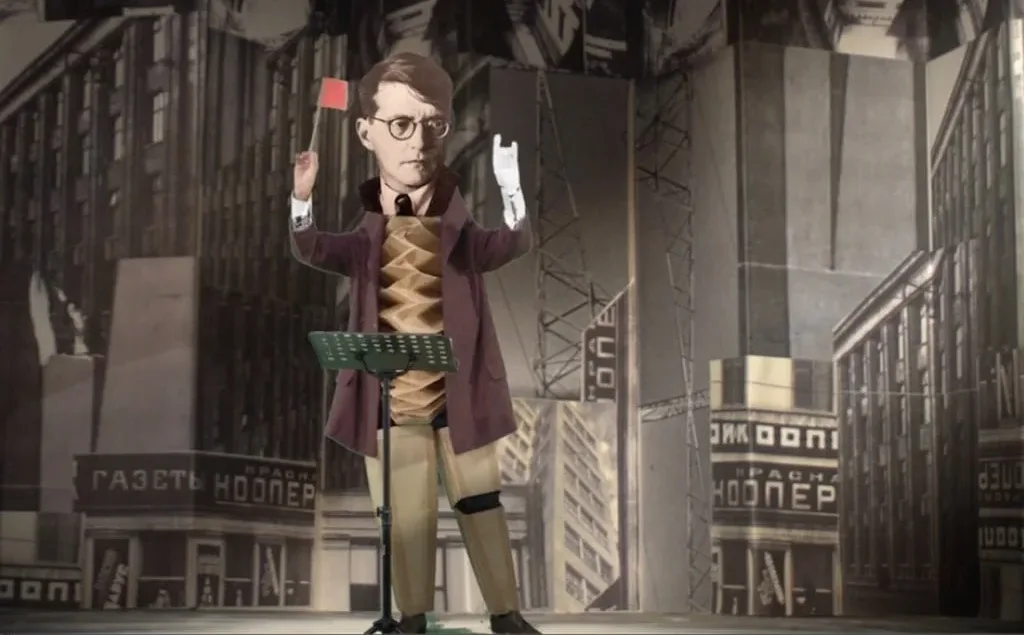

A newsreel continues playing inside a ruined auditorium. Around it, William Kentridge’s imaginary Soviet museum seems to have survived the disappearance of the future it was built to announce: its rooms remain, its images circulate, its historical inhabitants keep moving through the wreckage.
In Oh to Believe in Another World, that persistence has an eerie tenderness. The cardboard walls are too fragile to shelter anyone, yet they contain an entire political century. Created to accompany Shostakovich’s Tenth Symphony, the film gives the music a place to haunt, somewhere its agitation and sorrow can acquire bodies.
The museum’s shifting scale makes that habitation strangely persuasive. Miniatures and human dancers occupy apparently continuous spaces; a small model becomes an environment large enough to lose oneself inside. Knowing that the architecture is fabricated does little to diminish its desolation.
An empty swimming pool, with Lenin stationed on a high diving board, retains the shape of collective recreation after the recreation has vanished. The absurdity hangs there with him. These spaces seem suspended between construction and abandonment, as though the promised world had begun decaying before anyone could finish furnishing it.
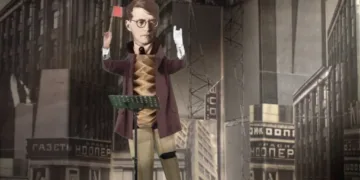
Kentridge populates them with figures whose faces have already hardened into history. Lenin, Stalin, Trotsky, Mayakovsky, and Shostakovich appear through puppetry, photographic masks, drawings, and dancers concealed beneath collaged identities. Their bodies possess an awkward mobility that their expressions cannot acknowledge.
A dancer bends and exerts himself while the face above him maintains its monumental composure. The comedy comes from this refusal of the image to participate in the body’s embarrassment. Power can look ridiculous without noticing. Kentridge allows that ridiculousness to persist long enough for laughter to become uncomfortable, particularly when the face belongs to someone whose image once organized the lives of millions.
Stalin’s mild half-smile is the most disturbing instance. It remains available for every action, untouched by exertion or circumstance, and it is still there when he produces a gun and starts shooting. The expression’s continuity makes the violence feel horribly frictionless. Nothing has to register on this face.
The living body supplies motion while the public image remains protected from experience, including the experience it inflicts upon others. Some of Kentridge’s other faces are blurred, scribbled, or barely outlined, but Stalin’s apparent serenity is enough to make the separation between a person and his political likeness feel murderous.
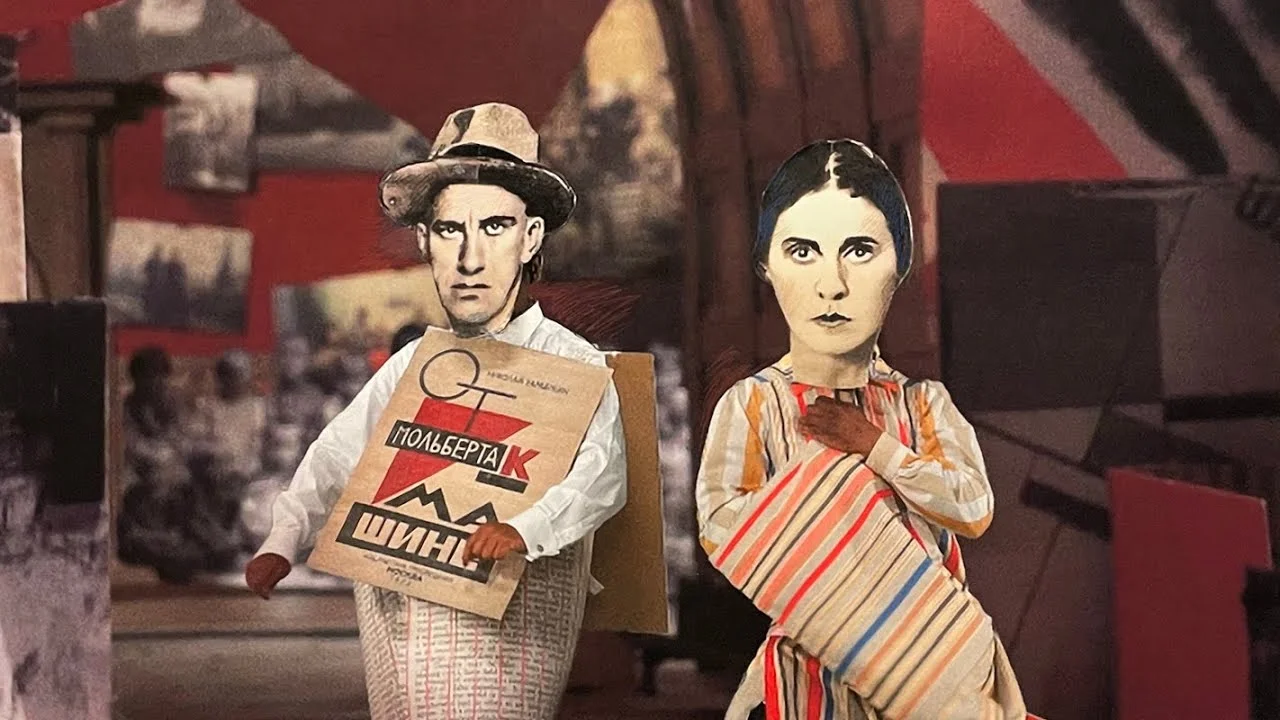
The symphony prevents these figures from settling into a static exhibition. During the fast second movement, accelerated montage and Mayakovsky’s commands produce a sensation of time becoming compulsory. “Comrade life, march faster!” addresses existence itself as something insufficiently obedient.
“We’ll chase humanity into happiness with an iron fist” makes the promised destination inseparable from the force used to reach it. As the images hurry under the music’s pressure, the demand becomes physical: life must keep pace with its appointed transformation. The film’s agitation grows from the fit between cutting, orchestral speed, and words that leave no room for hesitation.
Against that momentum, the photographs of ordinary people have a different weight. Faces within revolutionary crowds are circled, distinguished from those around them by marks that identify them for destruction. The gesture is small enough to perform with a pen.
Its consequences are immeasurable. Kentridge’s constructed leaders command attention through their size and grotesquerie, but these photographs admit something the masks cannot: the density of lives that were never designed to function as emblems. Individual biographies remain inaccessible within the images. We encounter people at the point when an administrative gesture begins converting them into absences.
Shostakovich’s own cutout presence, conducting the work that gives this world its rhythm, complicates the division between those who direct and those who are directed. The composer has been absorbed into the same unstable matter as everyone else. Elmira Nazirova, his student and a figure of personal attachment, appears dancing in the third movement, admitting another register of feeling into the historical spectacle.
Neither presence requires a neat symbolic translation. Their movements allow the music to touch private life without making that life fully legible. Kentridge’s historical interpretation remains particular, while the symphony’s emotional reach keeps exceeding what any single mask or photograph can explain.
There are stretches when the images struggle to sustain that openness. The repeated masked bodies, collage surfaces, and enclosed rooms establish such a consistent visual climate that changes in musical feeling can seem to pass through an apparatus whose responses have become familiar.
Confinement is part of the subject, but it also becomes a restriction on the film’s expressive range. The photographic crowds briefly suggest other lives and textures beyond the recognizable historical cast; returning to the paper theatrics can feel like retreating from that possibility. The invention remains considerable, though its repeated vocabulary sometimes makes the museum feel too thoroughly understood.
When Kentridge’s hand enters the miniature world and the masks come off, the exposure of the construction offers an uncertain release. We can see how this history has been arranged, how its scale was produced, how bodies were assigned their faces.
Yet the museum’s frame remains difficult to escape. It permits belief to return chiefly as something already damaged, preserved through the knowledge of its betrayal. I am moved by that sorrow, and less certain about the authority it sometimes acquires. An aesthetic so fluent in mourning can make the desire to build anything again seem almost indecently innocent.
The closing graveyard brings the film toward people for whom belief was only one part of being alive. After the slogans, the monumental heads, and the bodies made to carry them, these graves require a quieter kind of attention.
Calling the dead symbols of a failed future risks assigning them another task after death. The photographs have already shown how easily a person can be selected, marked, and absorbed into someone else’s design. In the cemetery, the film leaves us with the harder absence of everything those people might have done beyond the roles history gave them.
Oh to Believe in Another World is a short animated film created by South African artist William Kentridge, set to Dmitri Shostakovich’s Tenth Symphony. Utilizing stop-motion, paper puppets, and archival aesthetics, the piece reflects on artistic survival and idealism under Soviet tyranny.
Where to Watch Oh to Believe in Another World (2022) Online
Full Credits
Title: Oh to Believe in Another World
Distributor: Marian Goodman Gallery / Independent Exhibition
Release date: June 15, 2022 (Festival premiere), October 30, 2026 (Baku International Arts Festival)
Running time: 9 minutes
Director: William Kentridge
Writers: William Kentridge
Producers and Executive Producers: Not publicly specified
Cast: William Kentridge, Dada Masilo, Zen Jefferson, Thabiso Phatudi
Director of Photography (Cinematographer): Duško Bolha
Editors: Žan Živković
Composer: Dmitri Shostakovich
The Review
Oh to Believe in Another World
Kentridge’s cardboard museum gives Shostakovich’s Tenth Symphony a fragile, haunted habitation, where fixed smiles survive violence and human bodies struggle beneath the faces of history. The meeting of music, montage, and grotesque comedy is often extraordinary. Repeated visual devices gradually narrow its expressive range, while its devotion to mourning leaves renewed belief feeling suspect. Yet the circled photographs of ordinary people keep troubling the spectacle, returning its monumental grief to lives that cannot be recovered.
PROS
- Powerful interplay between orchestral rhythm and montage.
- Miniature spaces sustain an atmosphere of historical desolation.
- Fixed masks turn physical comedy into disturbing political imagery.
- Archival faces give collective tragedy human particularity.
CONS
- Recurring puppetry and enclosed settings become restrictive.
- The elegiac framing leaves limited room for renewed belief.