























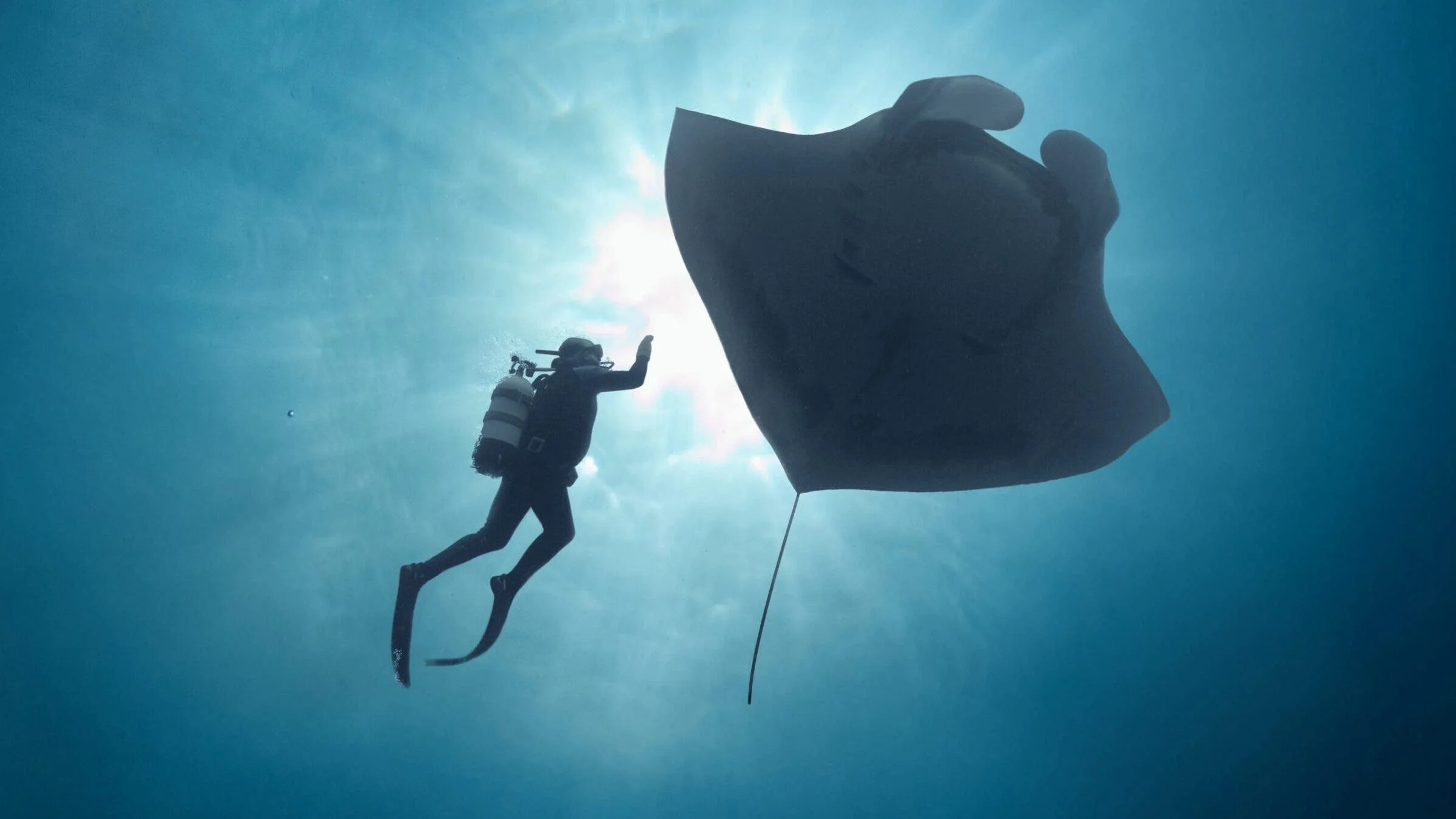

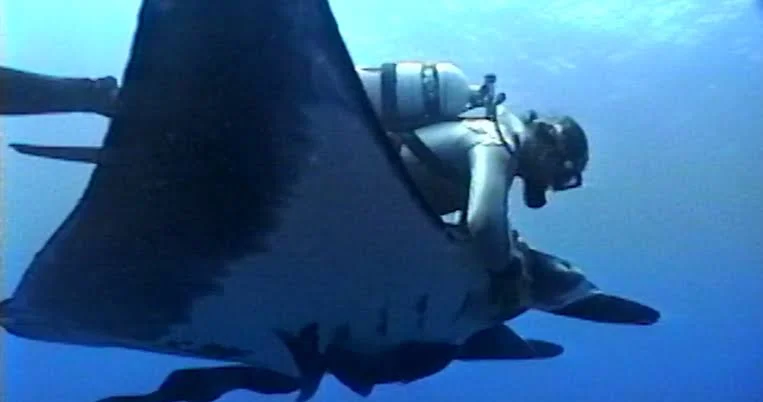
Terry Kennedy has the footage. Whatever doubts his stories might invite, the old recordings show him swimming with giant manta rays, climbing onto their backs, entering a proximity to wild animals that most of us will never experience. In Cody Sheehy’s The Last Dive, these images give Terry’s recollections an extraordinary physical presence. He remembers a manta he named Willy approaching his boat and striking the hull with his wings. Listening to him, then watching the encounters he preserved, I understand the temptation to accept his account on its own affectionate terms.
Yet the camera cannot quite follow him into the animal’s intentions. Terry describes protection, recognition, even jealousy when he interacts with other mantas. The recordings establish contact; those explanations belong to Terry. My first instinct is to treat this distinction as rather bloodless. Must an elderly man submit his friendship for peer review? Then the riding footage returns, and the distinction starts to matter. What he believes the animal wants helps authorize what he does to it.
Now in his eighties, Terry returns to San Benedicto Island in Mexico’s Revillagigedo archipelago, hoping to find Willy after a long absence. Their encounters stretched across nineteen years, and he wants another chance to see the creature that changed his life. He needs a team to make the expedition possible. Sheehy moves between this search and the accumulated record of Terry’s earlier adventures, allowing the older man to revisit a life whose freedoms his body can no longer sustain.
The biographical material offers several possible explanations for his attachment. A former Navy man and Hells Angel, Terry has a past involving violence, prison, and subjects he declines to discuss during interviews at a bar. A rapid montage introduces that history, while recollections from former partner Joyce Clinton give his years at sea a witness beyond himself. His unwillingness to elaborate deserves no automatic suspicion. Still, the film uses the outline of a troubled past to give his transformation significance without examining much of what needed transforming. The ocean receives the confession that the interview cannot obtain.
Terry says he distrusts people and prefers animals. That admission gives the search an emotional specificity the more colorful résumé cannot supply. Being approached by Willy seems to offer recognition without the complications Terry associates with human company. His tenderness is persuasive. Sheehy is less persuasive when he lets that tenderness carry questions it cannot answer, particularly around the physical contact celebrated in the archive.
Manta riding is no longer permitted, yet the footage retains the exhilaration of an achievement. The film gives too little attention to the change in understanding that separates the recorded encounters from present practice. Terry’s pleasure remains immediately legible; the animal’s experience remains interpreted through him. A documentary can preserve the excitement of those images while asking harder questions about the conduct they record. Here, affection repeatedly supplies the answer before the question has been properly considered.
And affection has produced something tangible. Terry’s move away from recreational spearfishing, his distress at the killing of mantas, and his involvement in documenting fishing activities give his transformation consequences beyond personal fulfillment. The appearance of fisherman turned conservationist Mike McGettigan opens the story toward collective protection. The film connects the archive to research and conservation efforts, giving these recordings a public value that survives any uncertainty about Willy’s feelings.
This makes a simple charge of selfishness inadequate. It also makes the film’s limited scrutiny frustrating. Terry has evidence of learning and useful action behind him. His story could withstand a closer examination of the habits that persisted alongside that change.
The fishing footage is especially painful because it interrupts the privileged intimacy of the diving images. Animals that Terry has taught us to regard as individuals become vulnerable to killing on an industrial scale. Sheehy returns to that distressing material repeatedly, though the repetition contributes less understanding than renewed anguish. Questions about fishing, tourism, and the practical mechanisms of protection receive comparatively brief treatment. Once the violence has established the stakes, another return to it can feel like emotional insistence where explanation is needed.
The shark sequence exposes a different selectivity. Menacing music, shots of sharks, and cuts to divers leaving the water organize the encounter as danger. Terry’s account of Willy protecting him from a hammerhead belongs to the same division of roles: the manta becomes a companion, the shark an antagonist. The editing supplies an interpretation without establishing that the animals’ behavior warrants it. Apparently, admission to this underwater circle of sympathy comes with a character assessment.
That inconsistency matters in a film asking viewers to care about marine life. Sheehy can make the mantas fascinating through the recorded encounters themselves. The older footage and present-day dives allow us to see why Terry continued returning, without requiring every movement to become evidence of devotion. The shark material shows how readily the film abandons that curiosity when suspense becomes available.
The expedition’s countdown provides a stronger source of tension because its limits are real and understandable. Terry has a finite number of days to search, and his age gives each unsuccessful dive a weight beyond a missed wildlife encounter. The alternation between past and present sometimes stalls: another memory, another descent, another interval of waiting. Yet the structure also exposes a difficult mismatch. Terry needs a farewell within the time available to him. Willy cannot be expected to organize his existence around that need.
Encounters with other mantas, including one Terry calls Chevy, keep an inhabited ocean visible around the search for a single absent animal. I found these moments useful precisely because Terry’s objective does not exhaust their meaning. His memories can matter without becoming the measure of everything moving through the water.
His dependence on the diving team introduces another relationship the film’s romantic attachment to Willy can obscure. The freedom preserved in those old recordings now requires assistance, cooperation, and the willingness of others to accompany him. The expedition brings him back into the water through the company he says he distrusts.
The Last Dive premiered in theaters on October 30, 2026. Directed by Cody Sheehy, the documentary follows Terry Kennedy, an aging veteran and ex-Hell’s Angel, on a final journey to Mexico’s Sea of Cortez to reconnect with his long-lost friend, a massive 22-foot oceanic manta ray named Willy.
Where to Watch The Last Dive (2025) Online
Full Credits
Title: The Last Dive
Distributor: Area 23a
Release date: October 30, 2026 (Theaters)
Running time: 1 hour 28 minutes
Director: Cody Sheehy
Writers: Mark Monroe
Producers and Executive Producers: Mark Monroe, Randy Gebhardt, Christopher Gebhardt, Ted Haddock
Cast: Terry Kennedy
The Review
The Last Dive
Terry Kennedy’s attachment to Willy gives The Last Dive genuine emotional weight, and his archive preserves encounters worth seeing. I wish Sheehy trusted those images enough to question Terry’s interpretations. Manta riding receives insufficient scrutiny, sharks supply convenient menace, and repeated distress sometimes replaces explanation. Yet Terry’s conservation work and dependence on fellow divers complicate any easy dismissal. His return to the ocean is moving; the film’s account of what that return means deserves closer examination.
PROS
- Extraordinary archival encounters with giant mantas.
- Affecting exploration of aging and attachment.
- Conservation work gives Terry’s transformation tangible consequences.
CONS
- Insufficient scrutiny of manta riding and animal intentions.
- Shark sequences rely on selective fear.
- Repeated footage sometimes stalls the search.
- Fishing and conservation mechanisms receive limited explanation.