

























Liberty and Emerald discover that their client’s missing signature has a perfectly good explanation: she used disappearing ink. Aphrodite Lovesong, a former model played by Robin Givens, wants her prenuptial agreement thrown out, and the dead witnesses are unavailable to spoil her argument.
The California divorce lawyers recognize the deception, conceal their discovery, and secure a victory. Within the opening episode of Ryan Murphy’s All’s Fair season two, Naomi Watts and Niecy Nash-Betts have effectively solved their case by identifying the evidence they should keep quiet about.
There is promising nastiness in that decision. A firm helping wealthy women leave dreadful husbands has found a client whose resourcefulness includes deceiving her own counsel. That could put some useful friction into its professional sisterhood. Instead, the disappearing signature becomes a shortcut to a win, with the lawyers’ complicity receiving little immediate dramatic weight.
Across the three episodes reviewed here, the series is much happier producing a new complication than letting an existing one become uncomfortable. Dina Standish’s murder arrest, for instance, has already been cleared up through an alibi. A cliffhanger can apparently be settled between appointments.
Dina, played by Glenn Close, still wants peace with former colleague Carrington Lane, which is a remarkably ambitious position to take around Sarah Paulson. Carr responds to forgiveness with insults, earns a slap, and remains available for the next social occasion.
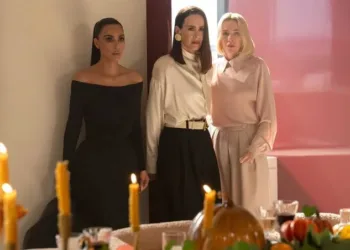
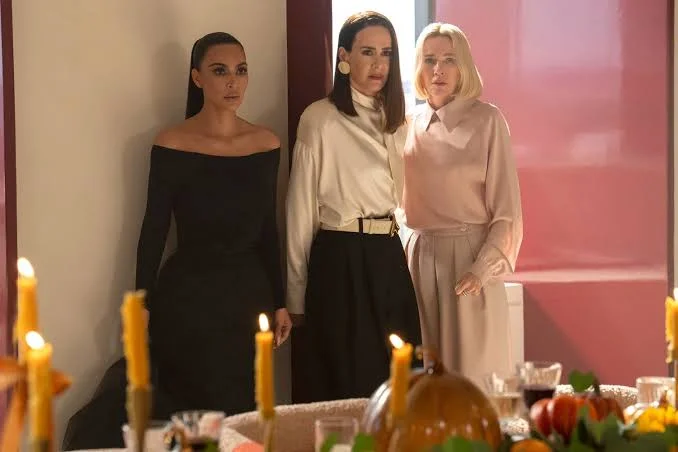
This is excellent news for the Scorpion Ball, hosted by Kim Kardashian’s Allura Grant. Allura has bought a cape she identifies as Elizabeth Taylor’s original; Carr turns up in an apparent duplicate. She also brings Allura’s ex-husband, Chase, who has a child with the firm’s newly qualified Milan, played by Teyana Taylor. The cape has competition as the evening’s most disputed possession.
The ball works because its provocations have somewhere to go. Carr humiliates Liberty after she comes out to her colleagues; Emerald and Milan intervene, and the accumulating hostilities become a fountain fight, with Liberty dragged into the disorder while trying to stop it. “Hot in Herre” accompanies the spectacle, firmly encouraging us to enjoy the destruction of Allura’s expensive decorum.
Paulson gives Carr’s attacks an appetite that keeps the scene moving. She wants to hurt someone, preferably several people within conversational distance. Kardashian’s restrained delivery supplies little resistance as Allura’s meticulously managed occasion deteriorates; the host’s mounting outrage barely competes with her guest’s enjoyment.
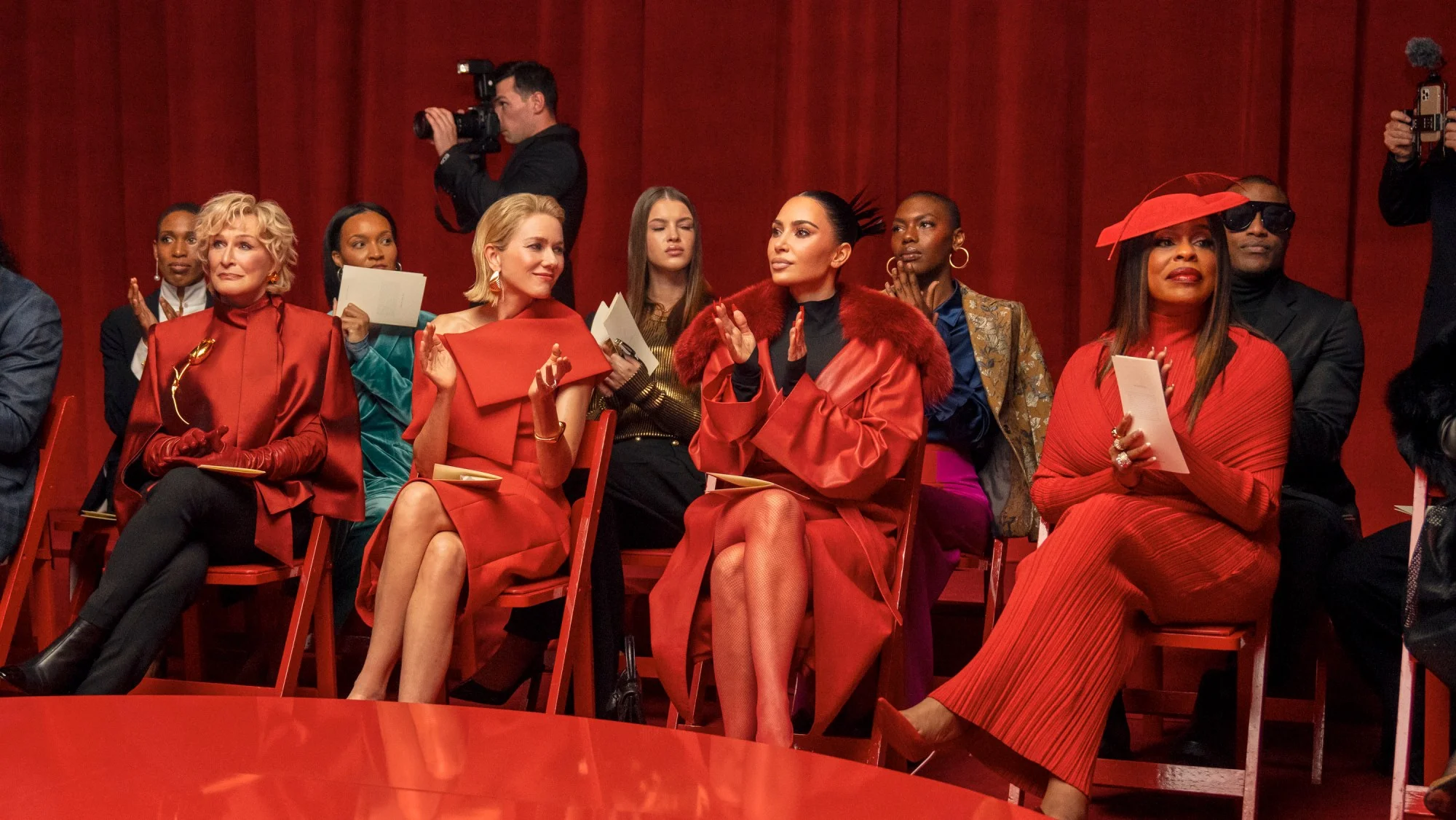
Carr’s cruelty also determines where the comedy becomes unpleasant. Her attacks on Liberty’s sexuality and the women’s bodies are expressions of aggression, and Paulson’s relish cannot make every barb equally funny. What she does provide is a clear intention within a scene crowded with competing reactions.
Her spite connects the characters, giving each intervention a cause. That makes the subsequent turn to danger especially abrupt: after the fountain has supplied a large comic payoff, Allura collapses and scorpions spill from her purse. The episode has spent its energy making a party go wrong, then asks us to fear that something has gone fatally wrong.
“Going Down” gives its emotional switches a sturdier mechanism. Dina gathers the women for a trip to scatter Doug’s ashes, bringing Carr along as another attempt at reconciliation. Carr’s fear of flying initially makes her the nuisance everyone must manage. Then both engines fail, and everyone has a reason to stop managing appearances.
Allura admits her dislike of Emerald’s hats; Liberty regrets waiting so long to acknowledge her sexuality. Carr describes the parental rejection behind her hostility, apologizes, and admits a sexual regret. The falling aircraft gives these wildly different disclosures the same urgent deadline, which is both ridiculous and an efficient way of getting this group to listen.
Paulson takes Carr’s hurt seriously enough to make the apology register. The performance briefly allows vulnerability to interrupt the character’s pleasure in attacking people, and the episode does carry that interruption past the rescue by Allura’s security hire, Raul.
A pet-custody dispute that previously gave Carr an opportunity for an obscene allegation ends with the lawyers refusing to indulge their clients’ continuing demands. Survival changes a professional decision. The developing attraction between Carr and Liberty asks for a larger adjustment. After Jamie breaks things off with Liberty, Carr offers encouragement and the pair arrange a concert date. Liberty has barely had time to recover from Carr’s public humiliation before she is asked to recognize a potential partner beneath it.
The Thanksgiving episode finds a less hurried way to give a divorce emotional meaning. Food writer Gloria Bloom, played by Margo Martindale, once cooked two holiday meals to accommodate her family’s demands and was rewarded with ridicule. Now her husband wants a share of what she has built, plus her tuna noodle casserole recipe. She has told him how to make it repeatedly.
He never listened. The dispute gives the show’s language of female independence something specific to answer: a husband treating knowledge he ignored as property he should receive. Gloria’s eventual agreement to supply the casserole for life leaves an awkward obligation attached to her escape.
Gloria then caters the women’s Thanksgiving gathering, allowing the weekly case to enter their private lives instead of disappearing after a settlement. Dina’s young boyfriend Brody is working the dinner because he wants to become a chef and meet Gloria, which gives his presence a purpose beyond making everyone notice his age.
Carr brings a pretzel-and-Jell-O creation tied to her childhood, and Liberty’s conspicuous enjoyment makes their attraction legible to the table. These details give several relationships something to do together. Even the questionable food becomes useful plotting when Raul’s illness takes him away from his protective duties.
That last connection is also where the dinner’s comic business starts arranging a thriller. The catering operation provides access for an armed intruder, and the gathering that has brought clients, lovers, and colleagues together becomes a vulnerable concentration of people.
The construction is tidier than the abrupt arrival of scorpions after the ball, but the demand on our attention is sharper: we have been invited to find the meal funny, then watch its details help leave Allura exposed. The next episode owes that room time to be frightened before anyone gets another good line.
All’s Fair Season 2 premiered on Hulu and Disney+ on November 4, 2026. Created by Ryan Murphy, Jon Robin Baitz, and Joe Baken, the legal drama series follows an elite, all-female team of divorce lawyers handling high-stakes separations, billion-dollar breakups, and intense personal rivalries in Los Angeles.
Where to Watch All’s Fair Season 2 Online


Full Credits
Title: All’s Fair Season 2
Distributor: Hulu / Disney+
Release date: November 4, 2026
Rating: TV-MA
Running time: 60 minutes per episode
Director: Ryan Murphy, Anthony Hemingway, Uta Briesewitz, Crystle Roberson
Writers: Ryan Murphy, Jon Robin Baitz, Joe Baken, Jamie Pachino
Producers and Executive Producers: Ryan Murphy, Kim Kardashian, Glenn Close, Sarah Paulson, Naomi Watts, Niecy Nash-Betts, Kris Jenner, Alexis Martin Woodall, Eric Kovtun, Scott Robertson, Nissa Diederich
Cast: Kim Kardashian, Naomi Watts, Niecy Nash-Betts, Teyana Taylor, Matthew Noszka, Sarah Paulson, Glenn Close
Director of Photography (Cinematographer): Blake McClure
Editors: Moira Morel
The Review
All's Fair
Across its first three episodes, All’s Fair season two finds comic momentum in public feuds and lets Sarah Paulson give Carr both vicious purpose and flashes of hurt. The Thanksgiving case even brings the legal and personal plots into productive contact. Yet quick resolutions, abrupt threats, and Carr’s hurried romance keep weakening the consequences. A collapsing aircraft gets these women to admit their feelings; the writing still rushes what happens after they land.
PROS
- Sarah Paulson’s spite and vulnerability give Carr dramatic force.
- The Scorpion Ball turns overlapping resentments into ensemble comedy.
- The flight crisis produces changes that survive the rescue.
- Thanksgiving connects the client’s case with the women’s private lives.
CONS
- Legal shortcuts sidestep the lawyers’ ethical compromises.
- Carr and Liberty’s romance moves too quickly past recent cruelty.
- Comic spectacle gives way to abruptly introduced danger.
- Kardashian’s muted delivery weakens the party’s emotional escalation.