


























Every episode of Apple TV’s 12 12 12 repeats FBI agent Jack Strickland’s account of the ideal robbery: twelve months to prepare, twelve hours to execute, twelve days in which to catch the thieves. Title cards identify the corresponding strands, The Planning, The Heist and The Takedown.
The viewer receives both an organizing principle and regular reminders of the series’ distinctive feature. Such insistence gives this eight-episode thriller the peculiar confidence of a programme that knows exactly how to explain its format. The harder task is making that format continue to earn its prominence.
Some of its most persuasive moments require little explanation. Julius Feldmeier’s contortionist unfolds himself from a safe-deposit box inside a locked vault, turning a specialist’s contribution into an immediately legible physical feat. The tunnel approaching the vault supplies another useful restriction: progress must be slow, and the space itself resists the thieves.
Here, attention settles on bodies, distances and practical obstacles. The intercut foot and car pursuits achieve a different kind of coordination, sustaining movement across simultaneous action. These sequences make a good case for the show’s professional assurance before its elaborate chronology has much to prove.
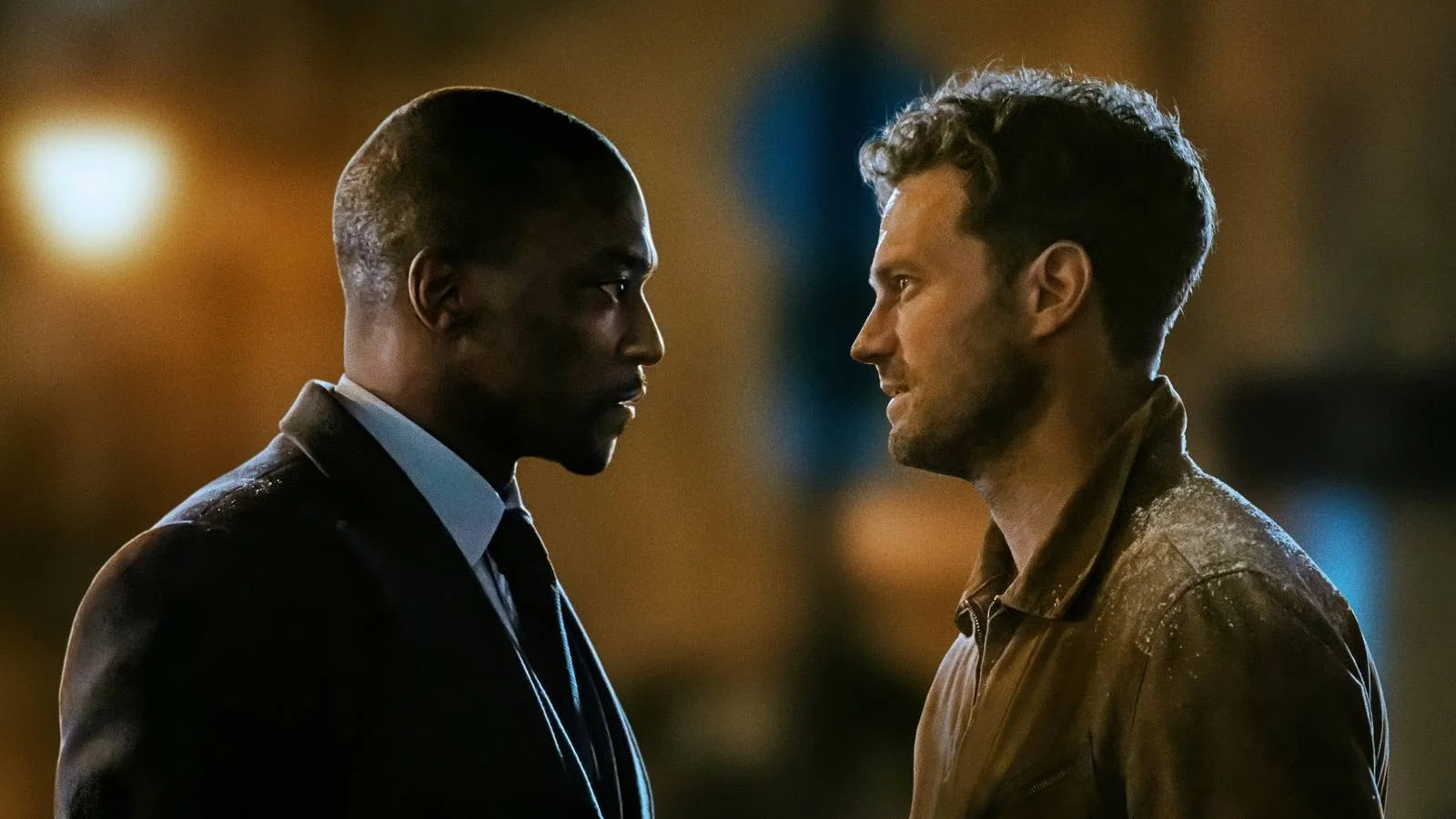
Created by Dudi Appleton and Jim Keeble, the series places Jamie Dornan’s Paul Galvin and Anthony Mackie’s Strickland on opposite sides of a Zurich bank robbery. Paul has been building a life in France with his partner, Severine, until his brother Bobby recruits him to steal Russian criminal money.
Strickland connects Paul to an earlier Newark operation that left a fellow agent dead and his own career damaged. Beneath the three clocks sits a familiar proposition: the thief wants a future, the cop cannot leave the past alone, and both will make other people live with the consequences. The structural novelty leaves that star-led arrangement largely intact.
The switches sometimes enrich it. Learning about an earlier obstacle after seeing an apparently smooth operation can restore a sense of effort to Paul’s ingenuity. The clearly marked timelines also deserve credit for keeping the chronology readable. Yet comprehension and suspense are different matters.
Watching Paul engineer the placement of the Russians’ money in his chosen vault has limited uncertainty once another strand has established its arrival. Interest must then come from the method or from what his preparations expose about him. Too often, the series settles for completing information we already possess. The twelve-day pursuit has the advantage of being able to move into genuinely unsettled territory.
Dornan makes Paul’s resourcefulness easier to accept than the familiar claim that he needs one final job. His practical problem-solving gives the character a basis for authority, while his loyalty to Bobby complicates his desire to protect his family. Jack Kesy’s brother repeatedly meets trouble with aggression, creating a conflict Paul cannot simply outthink.
There is credible friction between them, though Bobby’s readiness to endanger the operation becomes a convenient supply of fresh emergencies. The writing keeps returning to that volatility without giving the obligation between the brothers enough new emotional weight to match each renewed risk.
Strickland’s authority works differently. Mackie sustains a screen presence through clashes with his supervisor and Swiss counterparts, but the dialogue often tries to manufacture intensity for him. “I’m not here for the cuckoo clocks!” turns a local objection into an opportunity for imported American bravado.
It also reveals how readily the maverick-cop convention converts professional resistance into evidence of its hero’s seriousness. Strickland’s grief and disgrace give his fixation a cause; they do not automatically justify his conduct. The series can make Paul sympathetic and his pursuer threatening, yet those reversals produce sharper changes in allegiance than in our understanding of either man’s responsibility.
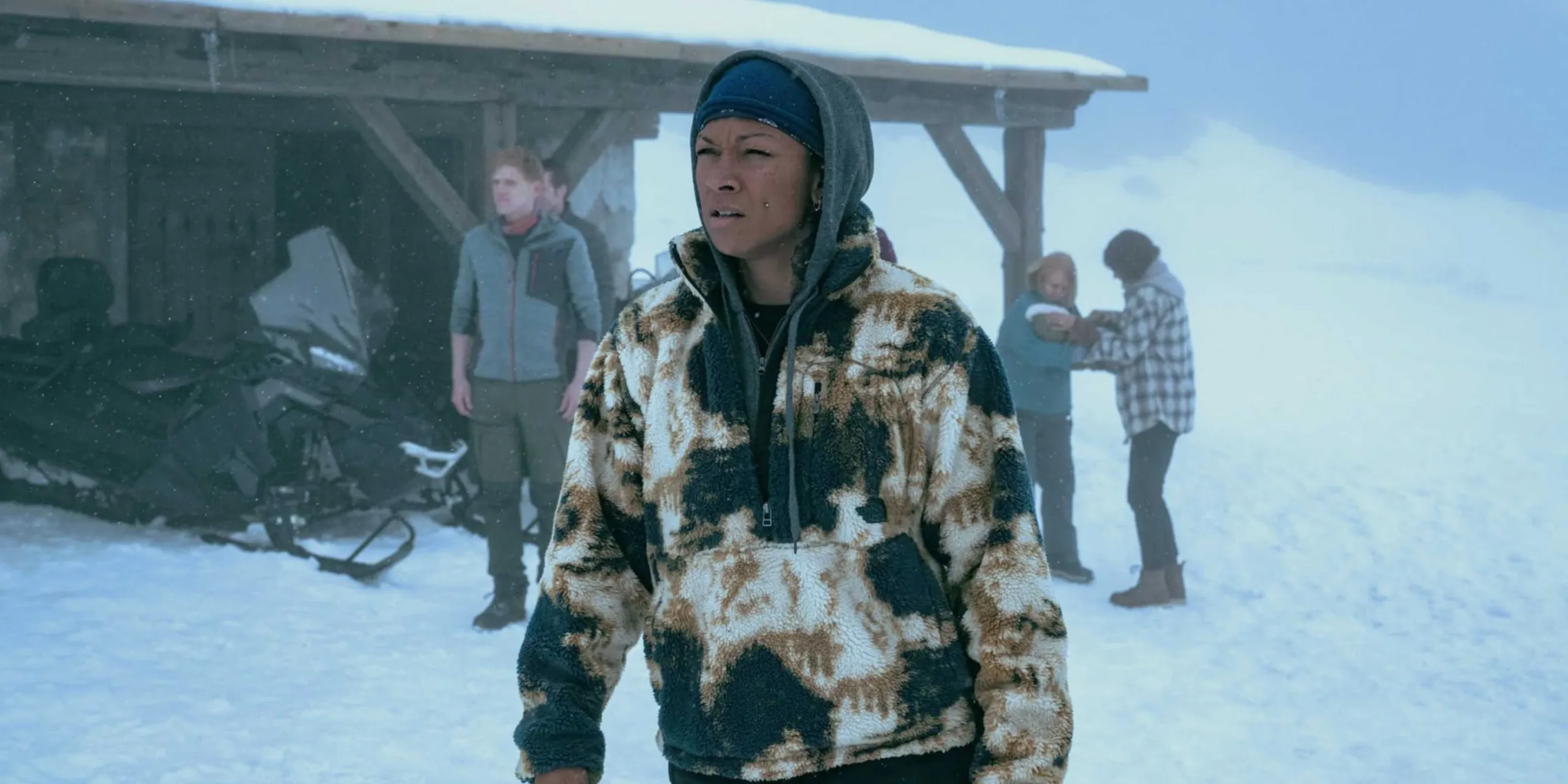
Around these two, a capable ensemble receives a narrower kind of importance. Kali Reis’s Kira brings train expertise, and Hildegard Schroedter’s Gunda supplies access through bank security. Their contributions matter to the robbery. The limitation lies in how little that competence opens onto lives and interests beyond the assignment.
A streaming season can assemble an international crew, distribute specialized skills across it and still preserve a very conventional hierarchy of attention. Here, the men leading the chase receive repeated opportunities to have their motives reconsidered. The specialists mostly receive opportunities to make the chase possible.
The women closest to the leads expose that hierarchy from another direction. Agathe Rousselle’s Severine gives Paul a domestic future to protect, leaving her characterization heavily dependent on his conflict. Sallie Harmsen’s Lena has investigative work to do beside Strickland, so describing her as mere decoration would miss her contribution.
Her extended absences in the middle of the season are the more telling problem. The Swiss partnership cannot acquire much cumulative texture when the story repeatedly puts it aside. With three periods available for developing relationships, the series finds plenty of occasions to revisit events and fewer reasons to stay with the people outside its central duel.
The escape briefly loosens that arrangement’s grip. A subway train and a mountain hideout turn flight into a succession of logistical problems, while the Christmas cold becomes an environmental threat rather than seasonal dressing. These changes give the pursuit energy and let the crew’s practical skills matter again.
They also increase the burden on a story that has made preparation so conspicuous. An ingenious contingency needs enough groundwork for the pleasure of recognizing its design, particularly when entire stretches of each episode have been set aside to show us how this operation was conceived.
A deliberately triggered avalanche makes that difficulty tangible. Without disclosing its outcome, the sequence asks us to accept an enormous intervention in the escape while the preparation strand leaves its workings insufficiently established.
The spectacle is fair enough as heist extravagance; its uncertain place in the plan is harder to accommodate. We have been taught to scrutinize the relationship between decisions made months earlier and events unfolding over hours. At this point, a substantial piece of the operation remains outside that relationship, even as the episode continues to count the time with exactness.
12 12 12 premieres globally on Apple TV on November 13, 2026. Created by Jim Keeble and Dudi Appleton, the tense heist thriller follows an intricate cat-and-mouse game across Europe, tracking a high-stakes bank robbery through three distinct timelines covering twelve months of planning, twelve hours of execution, and twelve days of fallout.
Where to Watch 12 12 12 Online
Full Credits
Title: 12 12 12
Distributor: Apple TV
Release date: November 13, 2026
Rating: TV-MA
Running time: Approx. 50-60 minutes per episode (8 episodes)
Director: Kari Skogland, Ellen Kuras, Takeshi Fukunaga
Writers: Jim Keeble, Dudi Appleton, Samantha Corbin-Miller, Joe Murtagh, Jamie Carragher, Tolula Dada
Producers and Executive Producers: Anthony Mackie, Jamie Dornan, Kari Skogland, Dudi Appleton, Jim Keeble
Cast: Anthony Mackie, Jamie Dornan, Jack Kesy, Kali Reis, Ólafur Darri Ólafsson, Agathe Rousselle, Sallie Harmsen, Patrick Fabian
The Review
12 12 12
12 12 12 gives its robbery three timelines without substantially changing who gets to matter. Dornan’s practical ingenuity, tense vault work and energetic escapes keep it watchable, while clear signposting prevents structural confusion. The trouble is the allocation of attention: specialists remain functions, familiar male obsessions absorb the drama, and major contingencies escape the scrutiny promised by all that planning. Apple’s thriller is better at accounting for elapsed time than developing the people spending it.
PROS
- Clearly marked, readable timelines.
- Tense vault sequences and coordinated chase editing.
- Dornan gives Paul’s resourcefulness credibility.
CONS
- Earlier timelines sometimes revisit foregone outcomes.
- Supporting characters receive limited development.
- Strickland’s forced tough-guy dialogue.
- Major escape contingencies lack sufficient groundwork.