


























Cheezels and the Teenage Mutant Ninja Turtles belong to the same childhood in Allen. When ten-year-old Petey Burns befriends an extraterrestrial visitor on the Queensland coast, he welcomes him into a world where American screen heroes share space with familiar Australian snacks and playground collectibles. The children show Allen their toys, introduce him to the video board game Nightmare and record his exploits on videotape. These details give the encounter a credible cultural address. Petey has already absorbed fantasies from elsewhere; now something extraordinary has arrived at his own beach.
The resemblance to E.T. the Extra-Terrestrial rests in what the children do with their visitor. They bring him into their domestic routines, discover his healing and levitation powers, and treat secrecy as part of friendship. Directors Daley Pearson and Jeffrey Walker understand how easily this American cinematic language can become an Australian child’s private vocabulary. An egg-shaped spacecraft supplies the marvel, but showing its occupant a Tazos collection makes the relationship recognizable. Petey’s promise of permanent friendship, marked by a circular scar on his palm, carries the absolute seriousness of a child who has found someone worth keeping forever.
Decades later, forever has become a housing problem. Adult Petey, played by T.J. Power, still occupies the family home, now shared with his brother Jaden and Jaden’s pregnant wife, Carly. His equipment reaches toward space while his life remains attached to one address: he fears Allen might return and fail to find him.
The videotapes and contact devices make his attachment active. He spends his present maintaining the possibility of recovering his past. The film’s most persuasive account of arrested development lies in this busy, technically equipped waiting, which gives him something to do without requiring him to change.
Jaden and Carly complicate that account because they met Allen too. Played by Josh Helman and Charlotte Nicdao, they possess the same extraordinary memory without granting it the same authority. Their expected baby requires space, and Petey’s devotion requires everyone else to keep accommodating him.
The film has a useful corrective here to its own nostalgia: a shared childhood does not produce identical adult obligations. Petey’s disappointment over Sarah, a local police officer now engaged to her colleague Rory, belongs to this pattern. Other people have continued making choices while he has treated his future as dependent on someone else’s return.
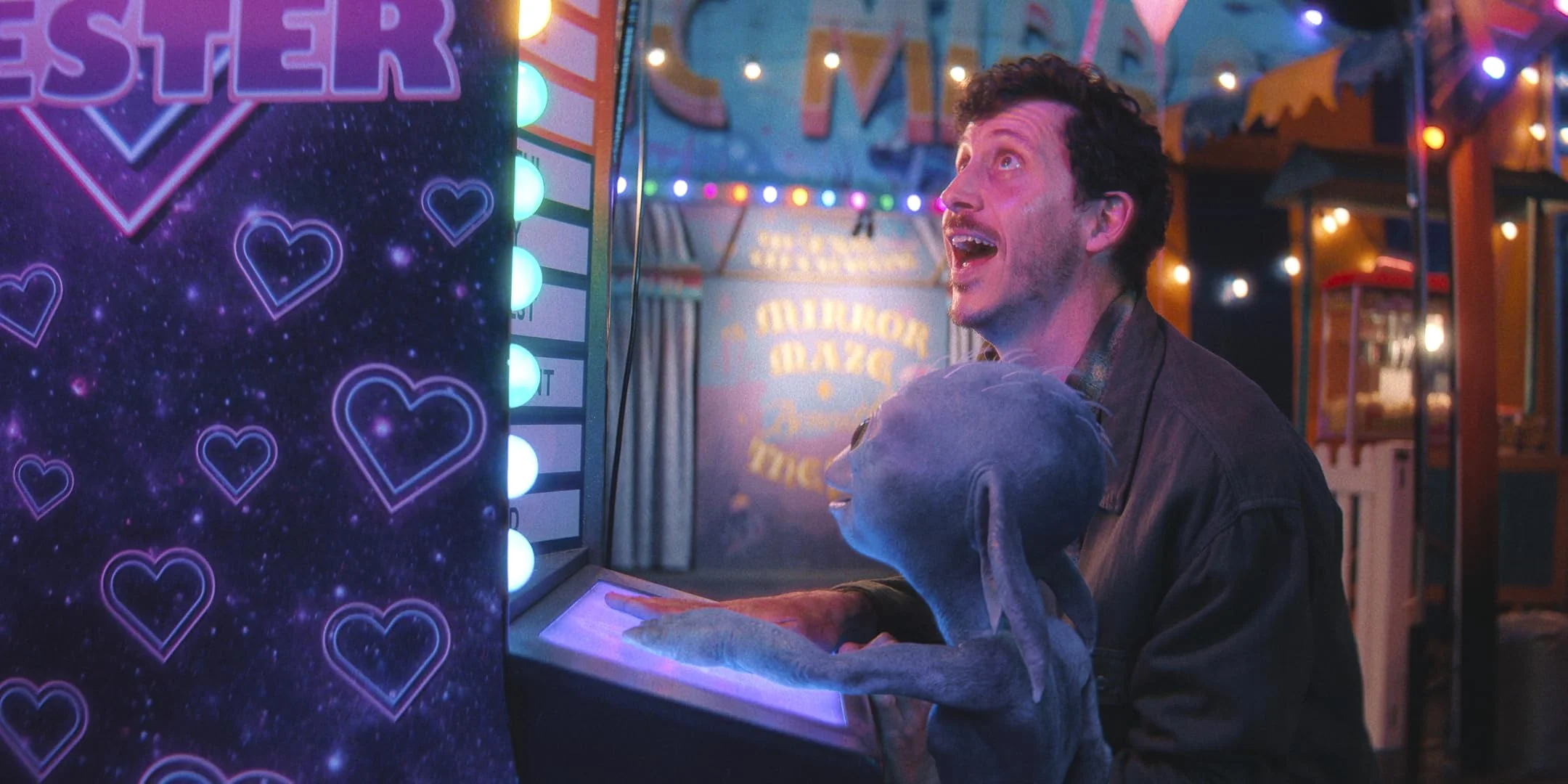
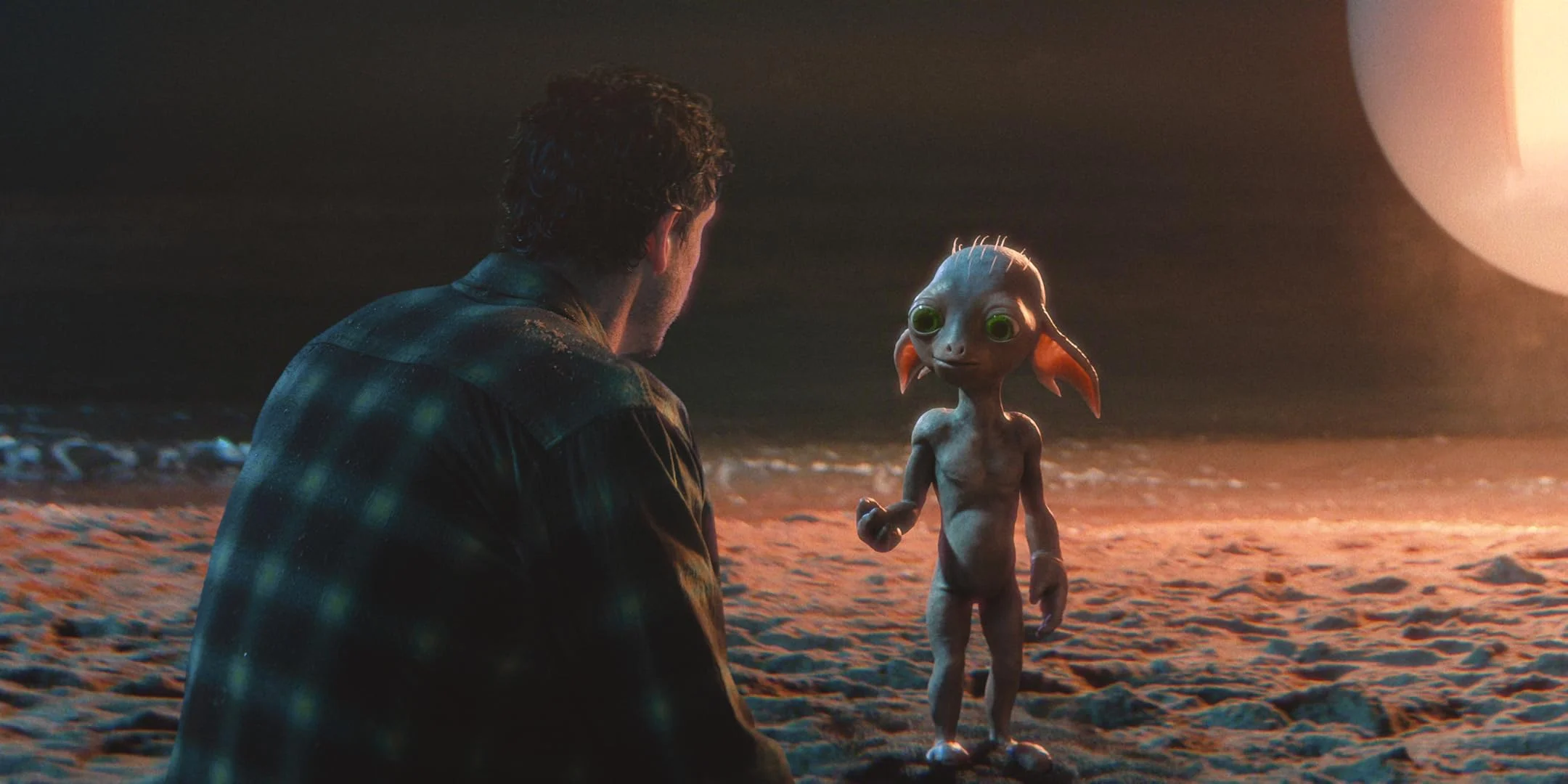
Allen’s reappearance makes the friends’ unequal experience of time literal. For Petey, the separation has occupied decades; for Allen, it has felt much shorter. Their reunion therefore restores a relationship whose importance they cannot measure in the same way. The carnival visit and Allen’s electrical powers offer the pleasure of picking up an old game, with the alien still eager to play. Petey has spent years preparing for this evening. Allen has no equivalent history of waiting behind his enthusiasm, which gives their renewed companionship an imbalance that affectionate recognition cannot settle.
Toby Oliver’s bright cinematography keeps the reunion visually hospitable, even as the story gives Petey reasons to become afraid. Severe stomach cramps lead to an examination by Carly, a veterinarian, and a discovery that changes the meaning of the childhood pact. Without disclosing its mechanics, the development makes Petey’s body subject to a promise he understood as emotional. The cheerful carnival play and the physical danger now belong to the same friendship. That collision is productive: the imagery continues inviting us to enjoy Allen’s company after the plot has made uncomplicated trust difficult.
Allen himself offers limited help with this complication. His gentle exclamations, eager play and persistent air of innocence keep him accessible as a children’s companion, but leave the relationship short of expressive possibilities once misunderstanding becomes consequential. The earlier games established affection clearly enough. The later situation needs room for incompatible understandings of that affection. Instead, Allen’s familiar responses preserve much of the original emotional arrangement. The film can still find charm in his electrical tricks, yet those pleasures do little to clarify how Petey can relate to him after learning that their bond carries an unforeseen bodily cost.
Rory supplies a simpler conflict. Played by Benedict Hardie, he resents Sarah’s concern for Petey and pursues the reunited friends, giving the adventure an antagonist whose hostility is easy to identify. Disguising the alien, fleeing through the carnival and arranging rescues put familiar objectives in front of Petey just when his friendship has become difficult to interpret. A family comedy can accommodate unsettling implications without turning into horror. Here, though, the pursuit displaces the harder negotiation between the friends. The imported adventure pattern offers a ready route through danger while leaving less attention for the discovery that made the danger personal.
The late reconciliation with Jaden and Carly restores some of that missing attention. Their relationship with Petey gives growing up a practical meaning: recognizing the lives that have continued around him and the demands his waiting has placed on them. The scene has a tenderness that the repeated verbal lessons about separation struggle to trust.
The dialogue explains goodbye through letting go, then explains letting go through maturity, narrowing the space in which affection and disappointment might coexist. Petey’s family has already made the cost of remaining unchanged understandable, and their reconciliation briefly allows him to face that cost without translating it into another instruction about how best friends should part.
Allen premiered globally on Netflix on November 12, 2026. Created by Daley Pearson from Ludo Studio, the family-friendly sci-fi comedy follows an adult man who must reunite with his childhood extraterrestrial best friend twenty years after an unexpected parting.
Where to Watch Allen (2026) Online


Full Credits
Title: Allen
Distributor: Netflix
Release date: November 12, 2026
Rating: TV-14
Running time: 1 hour 45 minutes (105 minutes)
Director: Daley Pearson, Jeffrey Walker
Writers: Daley Pearson, Sophie Miller
Producers and Executive Producers: Sam Moor, Ross Allsop, Daley Pearson, Charlie Aspinwall, Sophie Miller
Cast: T.J. Power, Charlotte Nicdao, Josh Helman, Emily Barclay, Benedict Hardie, Chaydon Jay
Director of Photography (Cinematographer): Toby Oliver
Editors: Geoff Lamb
Composer: Joff Bush, Daniel O’Brien, Ack Kinmonth
The Review
Allen
Allen gives the American magical-friend tradition a recognizable Queensland home, then asks what happens when permanent companionship becomes an adult's organizing principle. Petey's waiting and his family's changing needs give that question substance, while cheerful imagery sharpens the reunion's bodily unease. The film loses confidence in this difficult friendship, diverting it into pursuit and explaining its emotions too insistently. Its local texture and tenderness survive, but the relationship remains less developed than the adventure built around it.
PROS
- Australian childhood details give the borrowed fantasy a lived-in setting.
- Petey's contact equipment makes his fixation concrete.
- Cheerful imagery sustains unease around the reunion.
- Family reconciliation gives growing up a tangible human meaning.
CONS
- Allen's limited characterization restricts the complicated friendship.
- Pursuit and rescue displace the reunion's harder questions.
- Repeated goodbye lessons overexplain the emotion.