




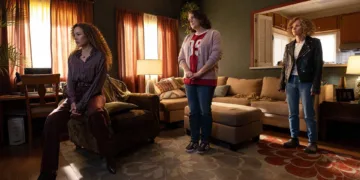


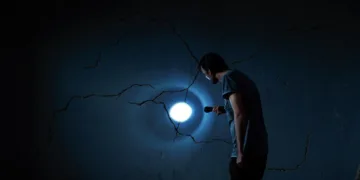
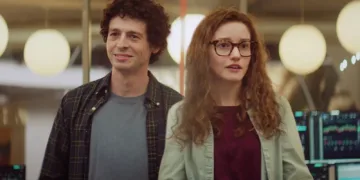
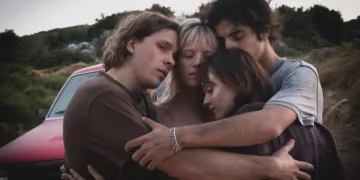
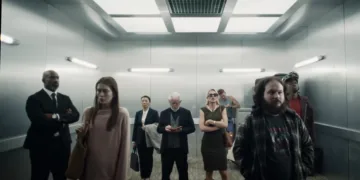









For three seasons, Yellowjackets operated on two clocks, cutting between teenagers stranded in the Canadian wilderness and the deeply troubled adults they became. Its fourth and final season introduces a third timeline, which means the editors now have three stories competing for attention and considerably less room to let any of them breathe. It’s an ambitious expansion for a series already fond of interrupting its best scenes with another mystery. At this point, the timeline could use its own air traffic controller.
The new strand takes us to 1998, after the surviving soccer players are rescued from their 19-month ordeal. Their return follows Natalie (Sophie Thatcher) contacting the outside world in the Season 3 finale. The premiere, “Hivemind,” presents their rescue through television news coverage, medical examinations, and reunions with families who have spent nearly two years expecting the worst. Meanwhile, the show revisits the final days in the wilderness and the survivors’ increasingly chaotic lives decades later. Three settings, three dramatic priorities, and plenty of opportunities to interrupt a perfectly good scene.
The results are frustratingly uneven. Season 4 has some of the strongest character material Yellowjackets has delivered since its debut, especially after the rescue, but its adult storyline remains trapped in increasingly ridiculous conflicts. Longtime viewers have reason to return; anyone expecting the final season to restore the show’s narrative discipline is in for a rough time.
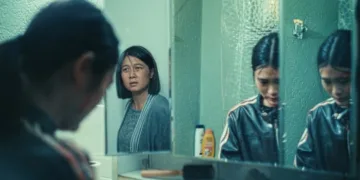
The premiere demonstrates both the appeal and the problem. Its 1998 news broadcasts establish the rescue as a national spectacle before the episode moves to teenagers approaching showers and mirrors with bewilderment. These ordinary objects acquire an unsettling quality because the scenes linger on the girls’ reactions. Then, just as their return begins to register emotionally, the closing minutes cut back to violence still unseen in the wilderness. The edit turns relief into another cliffhanger. It works, although after three seasons of postponed revelations, the trick is becoming painfully familiar.
Natalie arrives at the hospital expecting a family reunion and discovers that nobody has come for her. Staff are still trying to contact her mother. Sophie Thatcher has a devastatingly simple situation to play: Natalie has survived the wilderness, yet coming home offers little immediate comfort. Van receives a warmer welcome.
Her mother, played by Molly Ringwald, announces that she recorded The X-Files throughout her daughter’s absence, confident she would return. It’s funny and unexpectedly touching because it captures the absurdity of ordinary parental affection after an experience so horrific. One girl gets an empty waiting room; another gets nearly two years of alien conspiracies on videotape.

The return to high school provides another excellent stretch of uncomfortable television. A memorial service fills the gymnasium with sentimental arrangements of “The Wind Beneath My Wings” and Sarah McLachlan’s “Angel,” apparently determined to ensure nobody leaves with a functioning tear duct. The music is aggressively earnest beside what the survivors know about their ordeal. Returning to classrooms and curious classmates only increases the distance between the girls and the people celebrating them as inspirational figures.
Sophie Nélisse is particularly good at showing that dislocation through Shauna’s withdrawn behavior. Her violent authority in the wilderness has disappeared, replaced by parents, teachers, and a society with considerably stricter rules about eating one’s teammates. Nélisse makes her silence feel resentful rather than submissive. Shauna has experienced a kind of power that ordinary teenage life cannot accommodate. The post-rescue relationship between teenage Taissa (Jasmin Savoy Brown) and Van (Liv Hewson) likewise benefits from smaller scenes about preserving a connection once the circumstances that forged it have vanished.
The production finds clever visual ways to communicate this discomfort. Lottie (Courtney Eaton) sits in a hospital examination room decorated with cheerful woodland animals, an absurdly innocent echo of the wilderness. Episode 2 turns a grocery store into an unsettling location for Shauna. Sliced deli meat recalls her responsibilities as the group’s butcher, and a dead deer with antlers being cut up beside the road extends the association into everyday life. Civilization has supplied ordinary props; Shauna can no longer see them that way.
The soundtrack helps, though it sometimes takes over. Nirvana’s “Where Did You Sleep Last Night” accompanies the hospital montage, establishing the period and an appropriately uneasy atmosphere, but the music does some work that conversations with the returning girls could have carried. Portishead’s “Wandering Star,” accompanying Shauna on a solitary nighttime walk in Episode 2, is stronger: the song’s uneasy atmosphere intensifies an already eerie image. Depeche Mode’s “Enjoy the Silence” supplies a more obvious joke when Shauna turns on the radio against her mother’s wishes. Subtle? Hardly. Effective? Absolutely.
The remaining wilderness storyline has a different problem. After Natalie’s call, the teenagers know help is approaching but cannot predict when. They need to agree on an account of the murders and cannibalism, especially because Hannah (Ashley Sutton) witnessed what happened. Some want to send her home to her daughter; others fear what she could reveal.
That gives the plot a useful ticking clock and a concrete moral dilemma. Yet the audience knows several survivors conceal their crimes for decades. The suspense lies in their choices, not another round of mysterious noises or delayed revelations. The show keeps adding questions to a chapter whose final page we have already seen.
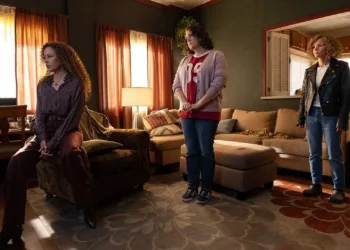
The contemporary storyline makes those wilderness detours look positively disciplined. Adult Shauna (Melanie Lynskey) has driven away much of her family, with Jeff (Warren Kole) moving out alongside their daughter Callie (Sarah Desjardins). Melissa (Hilary Swank), another survivor, moves her family into the house next door, turning longstanding hostility into an outrageous neighborhood dispute.
Their malicious pranks and vicious confrontations can be genuinely funny. Lynskey makes Shauna’s gentle delivery sound threatening, and Swank gives her someone capable of returning fire. Yet Shauna’s anger has become so predictable that each outburst carries less dramatic weight. The homeowners’ association is going to need a much bigger rulebook.
Christina Ricci faces a similar challenge as Misty, whose elaborate fantasies about eliminating Shauna provide comic relief. Ricci’s bright expressions and unsettling enthusiasm make murderous calculation amusing, as though Misty were organizing a school fundraiser.
Tawny Cypress gets heavier material as Taissa, whose grief over Van and visions of her younger counterpart suggest a more personal psychological story. Yet these performances struggle to compensate for a plot that circles familiar betrayals and improvised revenge schemes. The characters have committed enough crimes to populate several police procedurals, but their latest conspiracies rarely generate comparable urgency.
The contrast is clearest when the season cuts between the younger and older Shauna. Nélisse communicates resentment through strained silence; Lynskey is repeatedly handed another explosion of rage. The editing moves the adults from threat to threat without allowing consequences to settle. Meanwhile, the post-rescue scenes give a reunion or an uncomfortable conversation room to develop. The same series that turns a supermarket aisle into a source of dread needs another murder plot to keep its present-day story moving.
There’s an inevitable comparison with Lost, another plane-crash mystery built around fractured chronology and uncertain supernatural forces. Yet Season 4’s best scenes suggest that explaining every mystery matters less than allowing characters to respond to what has happened. The empty waiting room, the appalling school memorial, and Shauna’s encounter with supermarket meat achieve that through ordinary situations and precise timing. Then the season cuts away, returning to the wilderness or another adult confrontation. The girls have finally escaped the forest. Why does the editing seem so reluctant to let them stay home?
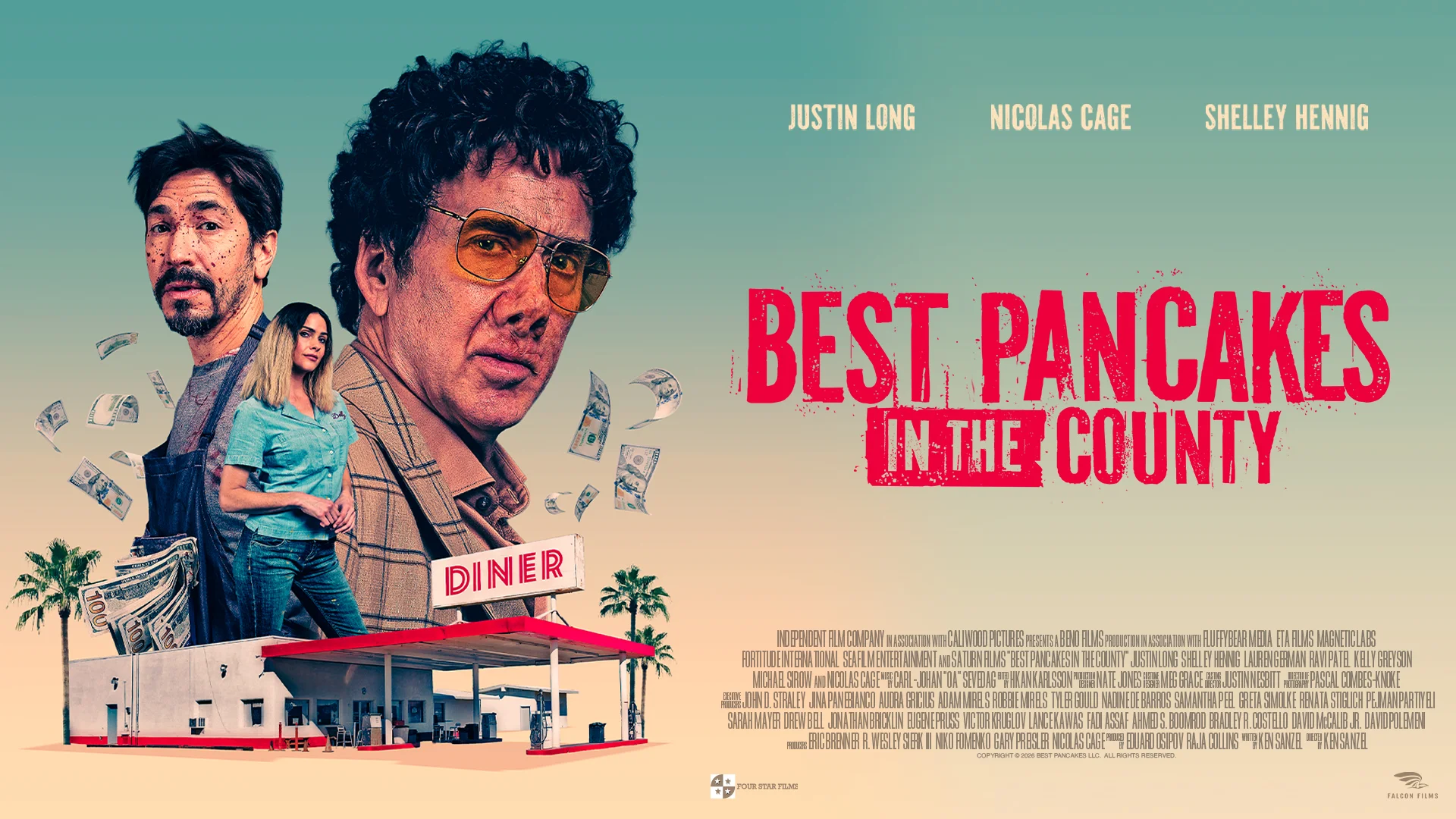
Best Pancakes in the County received a simultaneous release in select U.S. theaters and on digital VOD platforms via Independent Film Company on November 20, 2026. Written and directed by Ken Sanzel, the action crime-thriller unfolds over a single night at a remote small-town diner, where rogue federal agents, a fast-talking con man, and an underestimated waitress become locked in a deadly standoff.
Where to Watch Best Pancakes in the County (2026) Online



Full Credits
Title: Best Pancakes in the County
Distributor: Independent Film Company
Release date: November 20, 2026
Running time: 1 hour 38 minutes (98 minutes)
Director: Ken Sanzel
Writers: Ken Sanzel
Producers and Executive Producers: Raja Collins, Eduard Osipov, Eric Brenner, Niko Fomenko, R. Wesley Sierk III, Justin Nesbitt, Pejman Partiyeli, Bradley R. Costello, Victor Kruglov, Sarah Ann Mayer
Cast: Nicolas Cage, Justin Long, Shelley Hennig, Ravi Patel, Brandon Mychal Smith, Lauren German, Kelly Greyson, Jaylen Moore, Michael Sirow, Tetiana Dar
Director of Photography (Cinematographer): Pascal Combes-Knoke
Editors: Magnus Häll, Håkan Karlsson
Composer: Carl-Johan Sevedag
The Review
Best Pancakes in the County
Best Pancakes in the County borrows enthusiastically from American crime cinema but struggles to organize its eccentric characters, elaborate confrontations, and violent surprises. Justin Long and Shelley Hennig bring welcome energy, Nicolas Cage supplies outrageous theatricality, and a handful of inventive action sequences show what Ken Sanzel can accomplish. Yet muddled choreography, repetitive dialogue, and uneven pacing undermine the entertainment. An acceptable choice for an undemanding evening at home, particularly for Cage enthusiasts, but disappointing beside the sharper international crime films whose traditions it echoes.
PROS
- Entertaining performances from Justin Long and Shelley Hennig
- Nicolas Cage's eccentric criminal mastermind
- Inventive kitchen-based fight sequences
- Amusing diner humor and character interactions
CONS
- Confusing action choreography and editing
- Overcomplicated plotting with predictable revelations
- Repetitive dialogue and uneven pacing
- Inconsistent tone and underdeveloped characters