






























Battle Cabin has a sharper understanding of survival than its relentless gunfire allows it to express. The customary post-apocalyptic hero is the person prepared to defend a patch of land and everything stored on it. Aaron Falvey’s New Zealand thriller offers that figure in Summers, an old man who has turned his cabin into a fortress, then lets the history of his family make the heroic image difficult to sustain. Its best scenes expose how easily protection becomes ownership. Its weaker ones keep sending armed men toward the house until the distinction scarcely matters.
Civilization has fallen after an electromagnetic pulse and a biological outbreak, a disaster outlined in opening title cards with the dry efficiency of an emergency notice. Kellan (Josh McKenzie) and Melinda (Delaney Tabron) have managed to maintain a garden and a semblance of domestic peace.
Then an injury leaves Melinda vulnerable to infection, and the medicine she needs belongs to Summers (Marshall Napier). He agrees to part with it only if Kellan helps defend his property from attackers. In this ruined society, access to care depends on satisfying the demands of the man holding the supply. Kellan must accept the bargain and leave his ailing wife behind to spend a week guarding another man’s home.
The wider collapse, however, remains curiously vague. The title cards explain what happened to New Zealand, but the film rarely makes the scale of that disaster persuasive beyond empty terrain and hostile strangers. Justin Eade’s screenplay is far better equipped for a dispute over one cabin than for a country stripped of its institutions. That modest focus could have produced an incisive thriller. Instead, the film repeatedly returns to armed confrontations that reveal little about the people involved, making it a qualified recommendation even for viewers drawn to its rough, practical action.
McKenzie gives Kellan’s initial reluctance a useful awkwardness. He enters Summers’s domain because Melinda needs help, not because he wants a weapon or a fight. Confronted with men eager to kill, his uncertainty registers against the older man’s practiced suspicion. Napier, meanwhile, inhabits Summers with the weary assurance of someone who has spent years explaining brutality to himself as necessity.
Their exchanges have tension because the old man’s expertise is undeniable and his authority is suspect. Kellan must depend on the very conduct that threatens to erase the principles he has carried into this new world. When the two face repeated assaults on the cabin, the physical danger is clear; the greater interest lies in watching Kellan become accustomed to responding in Summers’s language.
The figure of the self-reliant defender has enjoyed a long cultural life, particularly in stories that imagine the end of government as the beginning of personal freedom. Summers is an uncomfortable representative of that ideal. His daughter Shell (Kahli Kopae) leads a faction hostile to him, and their antagonism carries a history of mistreatment that cannot be explained away as ordinary competition for scarce medicine.
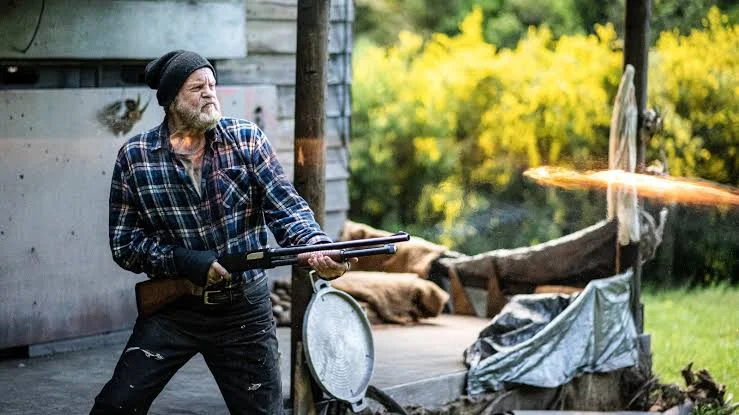
His fortified home may repel intruders, but it has done little to protect the people closest to him from his own cruelty. The threats at its perimeter are tied, at least partly, to damage originating inside the family. Shell now approaches the same cabin Kellan has agreed to defend, seeking medicine from the father who mistreated her.
Kopae brings an unruly presence to Shell, whose grievance punctures the authority Summers exercises so confidently over Kellan. Yet the film gives that history less attention than another round of men approaching the property. It repeatedly asks the audience to register Shell as a danger before spending enough time with the implications of what she has endured.
Melinda’s predicament offers a different account of what surviving demands. Away from the fortified cabin, her worsening health makes Kellan’s bargain urgent, but she has troubles of her own, including a threatening intrusion at home and responsibility for a newly orphaned child. Tabron plays her isolation as a tangible vulnerability rather than an abstract incentive for the hero.
The contrast between the couple’s cultivated patch of domestic order and the armed suspicion outside it gives these scenes their uneasy force. A house and garden promise continuity, yet neither can keep danger beyond the door. Even as her condition deteriorates, Melinda continues caring for a child who has lost the protection of a family.
The orphaned Tia (Nell Fisher) and Robbie (Rama Marrow) extend that concern to children living amid the consequences of adult violence. Fisher brings an unforced immediacy to her scenes, but the screenplay too readily treats the children as reminders that compassion still exists. Their presence invites a difficult question about the lives this society is handing down. Before the film can give their relationships sufficient attention, another confrontation at Summers’s property takes precedence.
New Zealand’s rural landscape helps make that failure especially frustrating. Rolling country, isolated houses and wooded approaches give the story a striking physical setting, with the open air surrounding people who have made their lives increasingly enclosed. The garden, fences and fortified cabin tell a precise story about social collapse: familiar places have become territories to guard.
Falvey’s modest production benefits from that rough materiality. Some encounters are messy and close enough to feel frightening rather than glamorous. Elsewhere, the staging looks conspicuous, and fragmented action coverage makes it difficult to tell who occupies which part of the defended ground. The film needs the geography of the cabin to carry suspense, particularly as the number of confrontations grows.
Those confrontations begin to resemble one another. An attacker appears, violence erupts, the defenders regroup, and the underlying relationships have barely shifted before the next threat arrives. At roughly 100 minutes, the film spends much of its middle stretch reinforcing conditions already established by Kellan’s bargain. A siege can reveal character through attrition, but here the repetition dulls the significance of each choice to fight. Even the occasional turn toward faith, forgiveness and the possibility of rebuilding cannot fully recover the attention squandered on interchangeable clashes.
The later emphasis on parents and children makes the earlier treatment of Shell harder to overlook. The film recognizes that wounds inflicted within a family can survive the collapse of the society surrounding it, yet it keeps granting the strongest dramatic position to the man with the medicine, the guns and the defended house. Kellan’s growing ability to fight protects his chance of returning to Melinda. The film has much less to say about what he may have absorbed from the person who taught him, especially when Summers’s daughter comes looking for a reckoning of her own.
Battle Cabin (originally released in New Zealand in 2022 as Northspur) arrived on digital and streaming platforms via Lionsgate on September 29, 2026, and is available to rent or watch on digital storefronts such as Prime Video and Apple TV. Directed by Aaron Falvey and written by Justin Eade, the post-apocalyptic action-thriller follows a man in a lawless, post-collapse world who sets out to obtain life-saving medication for his ailing wife and becomes entangled in defending a remote cabin from violent raiders.
Full Credits
Title: Battle Cabin (Northspur)
Distributor: Lionsgate
Release date: 2022 (New Zealand premiere as Northspur), September 29, 2026 (U.S. digital/streaming release as Battle Cabin)
Rating: R
Running time: 1 hour 40 minutes (100 minutes)
Director: Aaron Falvey
Writers: Justin Eade
Producers and Executive Producers: Emily Thompson, Justin Eade, Aaron Falvey, Timothy Hawthorne, Barry Sangster, Kevin Weisberg, Patrick Garcia
Cast: Josh McKenzie, Delaney Tabron, Marshall Napier, Kali Kopae, Michael Hurst, Nell Fisher, Rama Marrow
Director of Photography (Cinematographer): Kent Belcher
Editors: Jack Brown
Composer: Jonny Higgins
The Review
Battle Cabin
Battle Cabin finds its strongest drama in the uncomfortable relationship between survival, authority, and family violence. Marshall Napier's commanding performance and Josh McKenzie's reluctant transformation give its bleak New Zealand setting genuine human tension. Yet repeated gunfights overwhelm the damaged relationships that deserve closer attention, particularly Summers's history with his daughter. The film understands how cruelty survives the collapse of civilization but struggles to examine its consequences. Its modest ambition earns respect, though its execution offers only a qualified recommendation.
PROS
- Marshall Napier's imposing performance
- Convincing tension between Kellan and Summers
- Atmospheric rural New Zealand locations
- Thoughtful treatment of family violence
CONS
- Repetitive cabin assaults weaken suspense
- Underdeveloped family relationships
- Unconvincing post-apocalyptic world-building
- Uneven action staging and editing