






















Jocko Willink’s 2017 children’s novel gives a screenwriter a remarkably tidy blueprint: identify a child’s problem, put him through a series of demanding lessons, then test what he has learned. Director McG and writer Will Staples handle the first two stages with considerable assurance. The third is where Way of the Warrior Kid starts treating a manageable coming-of-age story as though its final examination requires emergency services.
The blueprint’s first advantage is a problem the audience can measure. Marc (Jude Hill) is an eleven-year-old living near San Diego with his widowed mother, Sarah (Linda Cardellini). At school, Kenny (Levi McConaughey) and his friends have made tormenting him a regular activity.
They give him the social-media nickname G.L.O.A.T., or Greatest Loser of All Time, and at one point his bicycle ends up in a river. Sarah is aware that he is suffering, but Marc begs her not to intervene. The arrival of her brother Jake (Chris Pratt), a Navy SEAL recuperating from an injured hand, introduces a form of help Marc might actually accept.
For much of its running time, this is a persuasive family film, familiar in design but attentive to the way confidence is built. Jake calls his plan Operation Warrior Kid, and the name tells you precisely how much subtlety to expect from the packaging. Fortunately, the relationship underneath it is better judged. The film is worth recommending to families with an appetite for earnest underdog stories, though its insistence on expanding the stakes eventually makes that recommendation qualified.
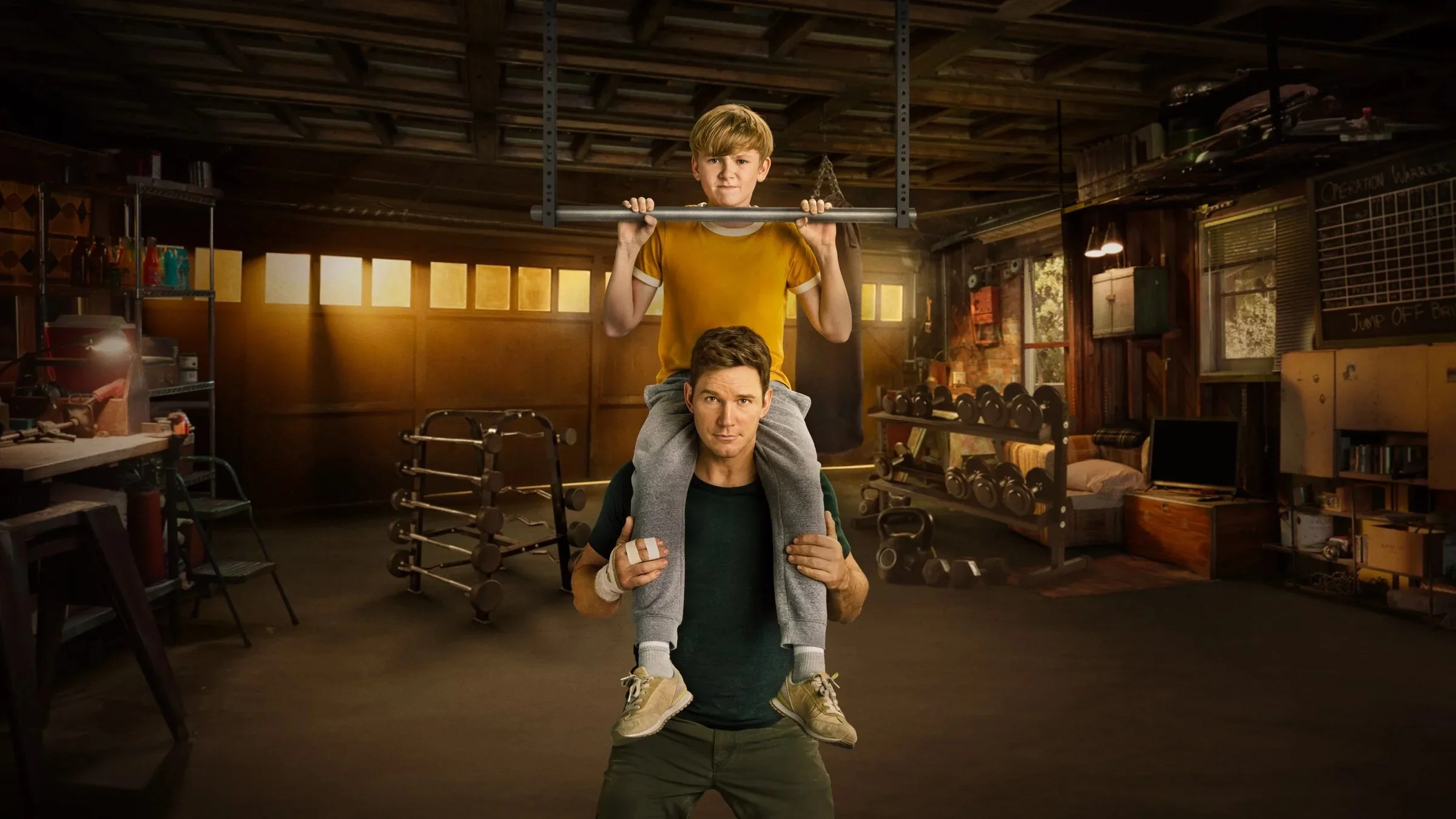
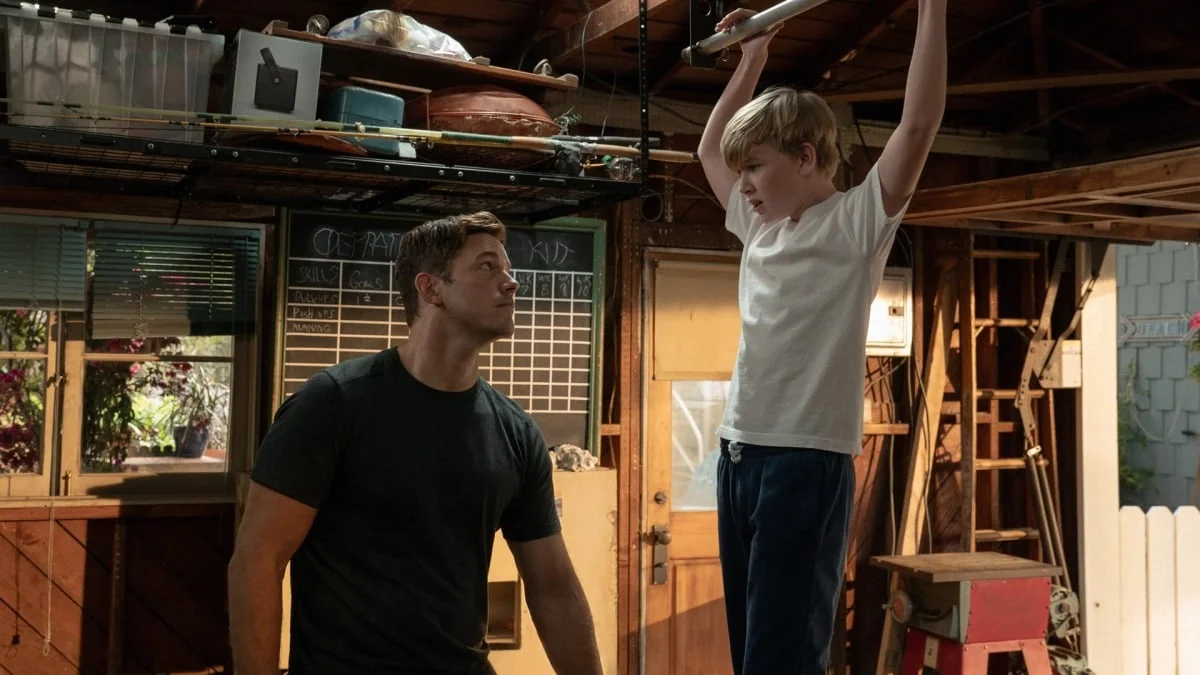
The training provides the story with a practical middle act. Jake gets Marc out of bed at six in the morning, puts him through pull-ups, makes him memorize the American presidents in order, and takes him to martial arts classes. The range of tasks matters. Physical ability is one part of the lesson; preparation, repetition, and mental effort are the others.
Marc initially resists, then begins participating willingly. By making improvement incremental, the screenplay allows his behavior to change before announcing that he has become a different person. There is a useful moment when Marc is ready to take on Kenny and his two friends, only for Jake to stop him. The adult who has taught him to fight understands that a fight would be a poor measure of what he has learned.
Hill makes those stages credible. He plays Marc’s early helplessness with enough resentment to keep the character from becoming a specimen of innocent suffering. His growing confidence is most convincing in the smaller social developments, including the way martial arts brings him closer to Nora (Ava Torres), the classmate he likes. The screenplay supplies a sequence of achievable steps, and Hill makes us believe that taking them costs Marc something. It is a better use of a young actor than asking him to deliver speeches about courage.
Not every step earns its place. A clothing-store montage in which Marc tries on increasingly unsuitable outfits before a carnival date with Nora seems designed to provide comic relief, though the film has already found humor in Jake’s stern instruction and Marc’s resistance. The routine stops his development so everyone can examine his wardrobe. It is a detour dressed as character work.
Jake’s own story creates a more substantial interruption. He has returned from a failed mission to rescue child hostages, a mission that injured him and killed a fellow serviceman. Flashbacks revisit the operation, and scenes with his commander (Darien Sills-Evans) find him trying to secure permission to return to duty. The parallel is clear: Marc must overcome his fear of confrontation, and Jake must cope with a failure that has shaken his confidence. The problem is where these pieces sit.
The training scenes turn Jake’s experience into something valuable for Marc; the military scenes repeatedly detach him from the relationship that makes the film work. The Navy has given Jake leave, but the screenplay keeps calling him back to duty. By the time the film returns to the boy, it has often left its strongest source of dramatic momentum waiting.
Pratt is effective when Jake has someone to instruct. His physical presence makes the drills believable, and the dry humor he brings to his exchanges with Hill suggests an uncle finding a way to care for a child he cannot protect by force. Left alone with the mission flashbacks and his desire to rejoin his unit, he settles into a much narrower register of grim determination.
The script asks him to carry a second emotional story but gives him fewer changes to play than Hill gets from a single training session. Cardellini, meanwhile, lends Sarah genuine concern in her scenes about the bullying, yet the film gradually reduces her part in the solution. She begins with the central parental dilemma and watches her brother take command of it.
One of the screenplay’s better turns complicates the neat division between victim and bully. During an ill-advised reconnaissance trip to Kenny’s home, Marc discovers that his tormentor has an abusive, alcoholic father. A Rottweiler then chases Marc into a trash bin, leaving Jake to explain their presence with a hasty story about moving the container. The episode is ungainly, but its purpose is sound. Marc is learning that understanding another child’s aggression may be as important as developing the power to resist it.
The family pattern is equally revealing: Marc’s father has died, Kenny’s father is a source of harm, and Jake is trying to become a dependable male guide. These relationships give the film something substantial to say about the difference between authority and intimidation.
Jake’s best lessons involve patience and restraint, qualities that distinguish his guidance from the bullying Marc experiences. Yet Kenny remains a relatively simple antagonist, and the film moves toward resolving their conflict before it has fully explored what Marc’s discovery about his home life might mean for their next encounter.
Then comes the final act, where the screenplay changes the test. A school bus crashes and catches fire, leaving Marc to rescue other students and the principal. McG stages the danger with an urgency that the action material can sustain, and the sequence is exciting on its own terms.
As the payoff to this particular story, however, it is an extravagant substitution. Marc has spent the film learning to master his fear, to judge a confrontation, and to recognize that hurting someone is no proof of strength. His reward is a crisis that allows him to demonstrate heroism in the most literal, spectacular terms available. Apparently a difficult conversation with a bully would not have photographed sufficiently well.
The bus rescue does prove that Marc can act under pressure. What it cannot establish nearly as well is how he will behave when he returns to the ordinary life that made him feel powerless in the first place. The earlier decision to hold back from fighting Kenny offered a quieter, sharper answer.
After building that answer through six-in-the-morning alarms, pull-ups, and hard-won self-control, the screenplay shifts its attention to an emergency that could have tested almost any young protagonist. The school, the bully, and the everyday challenges that gave Marc’s training its purpose have become secondary to the spectacle of getting everyone off a burning bus.
Way of the Warrior Kid premieres exclusively on Apple TV on November 25, 2026. Directed by McG and adapted by Will Staples from former Navy SEAL Jocko Willink’s bestselling novel, the coming-of-age family drama follows a bullied 11-year-old boy named Marc (Jude Hill) whose life changes over one summer when his injured Navy SEAL uncle Jake (Chris Pratt) moves in to recuperate and trains him to build discipline, confidence, and inner strength.
Where to Watch Way of the Warrior Kid (2026) Online
Full Credits
Title: Way of the Warrior Kid
Distributor: Apple TV
Release date: November 25, 2026
Rating: PG-13
Running time: 1 hour 46 minutes (106 minutes)
Director: McG
Writers: Will Staples, Jocko Willink (novel)
Producers and Executive Producers: McG, Mary Viola, Chris Pratt, Ben Everard, Jocko Willink, David Ellison, Dana Goldberg, Don Granger, Will Staples, Steven Bello, Cliff Lanning
Cast: Chris Pratt, Jude Hill, Linda Cardellini, Levi McConaughey, Ava Torres, Darien Sills-Evans, Carl McDowell, Parker Young, Timothy Flood, Arlan Ruff, Ellis Hobbs IV
Director of Photography (Cinematographer): Shane Hurlbut
Composer: Steven Price
The Review
Way of the Warrior Kid
Way of the Warrior Kid succeeds when it trusts the simple progression of a bullied child learning discipline and self-respect. Jude Hill's convincing performance and his chemistry with Chris Pratt give the familiar formula genuine warmth. Yet Jake's military subplot repeatedly interrupts that development, and the spectacular bus-crash climax replaces a potentially satisfying personal resolution with manufactured heroics. McG delivers an entertaining family film whose strongest storytelling choices are considerably quieter than its biggest spectacle.
PROS
- Jude Hill's believable character development
- Strong chemistry between Hill and Pratt
- Effective training sequences built around gradual progress
- Thoughtful lessons about restraint and self-confidence
CONS
- Jake's military subplot disrupts the central story
- An unnecessary clothing-store montage
- An exaggerated climax that weakens Marc's character arc
- Kenny's bullying storyline resolves too quickly