























What happens to a person’s inner life when every attempt to give it sound is treated as an interruption? The opening minutes of Everything Else Is Noise offer a strange, almost unbearable answer. From a window overlooking a Mexico City intersection, Nicolás Pereda watches traffic accumulate in a slow, disorderly procession. Cars obstruct one another, drivers insist upon impossible passages, and horns rise from the congestion like the cries of animals trapped together.
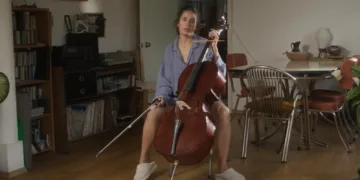
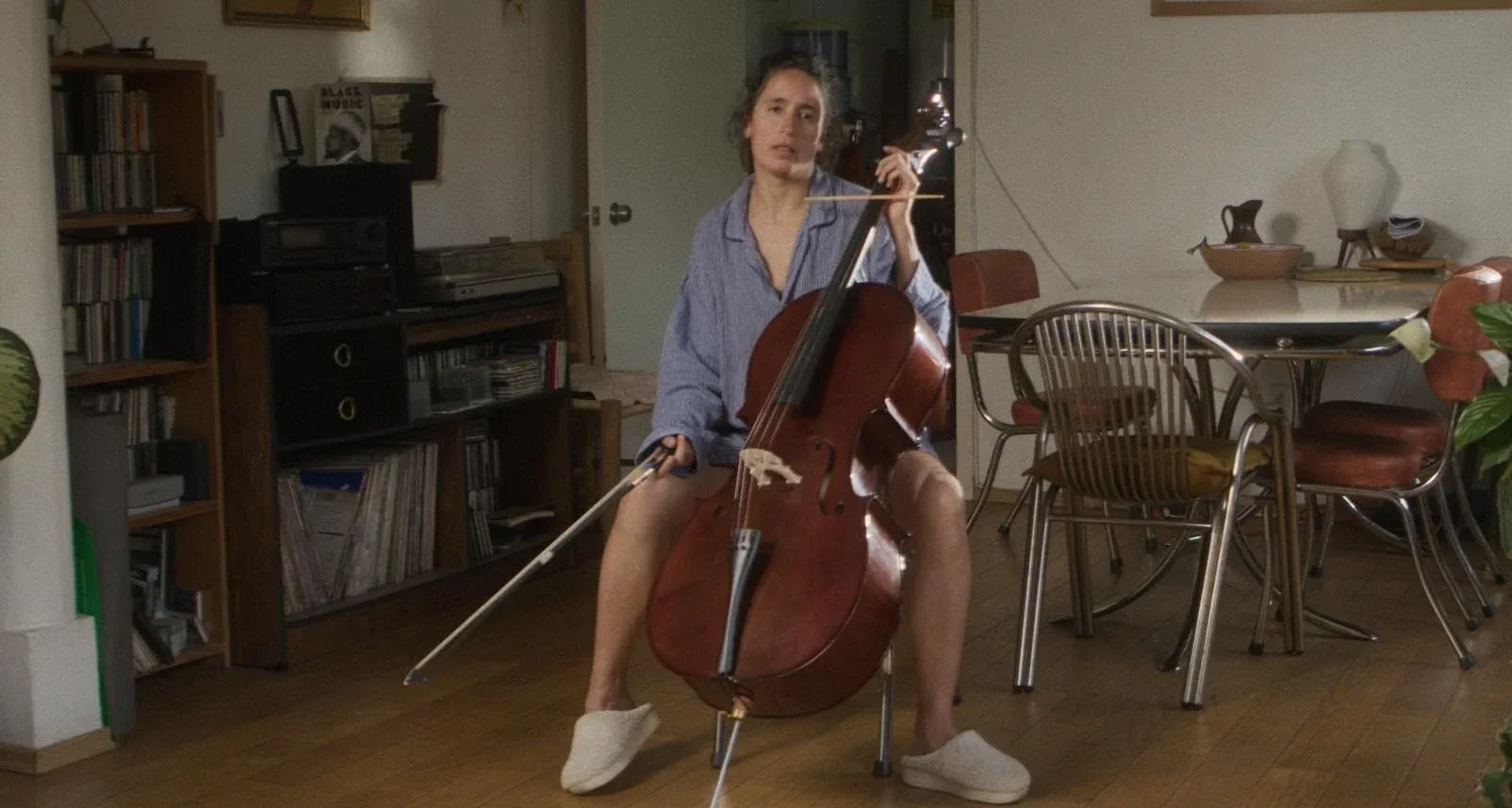
Somewhere behind this spectacle, a cello is playing. Its sustained notes drift across the mechanical uproar, fragile yet persistent, until the distinction between music and disturbance becomes difficult to maintain. The camera barely moves. Time stretches. There is something terribly familiar about this accumulation of frustrated human intentions.
Inside the apartment, the musician responsible for those notes, Tere (Teresita Sánchez), receives a complaint from a neighbor whose baby needs to sleep. Another resident has already restricted her afternoon practice. The traffic outside apparently presents no comparable problem. Tere listens, negotiates, and returns to a life increasingly arranged around other people’s requirements. Sánchez gives these exchanges an exhausted patience that suggests years of similar accommodations, her composure revealing the effort needed to preserve even this modest territory of personal freedom.
Pereda’s film, a minimalist comedy unfolding across approximately seventy minutes, is an unusually perceptive and frequently beautiful examination of artistic invisibility. Its deliberate rhythms demand patience, and some of its characters remain disappointingly shallow. Still, Everything Else Is Noise deserves attention for the extraordinary sensitivity with which it transforms ordinary domestic frustrations into an experience of loneliness. Its humor grows from the same circumstances that make it painful. Every absurd interruption carries the suspicion that something irretrievable is being lost while everyone waits for permission to continue.
The day’s principal event is a television interview with Rosa (Rosa Estela Juárez Vargas), a composer and cellist using Tere’s plant-filled apartment for the recording. Interviewer Lázaro (Lázaro G. Rodríguez) and cameraman Paco (Francisco Barreiro) arrive equipped to document an artistic life, but their professional preparations dissolve almost immediately into a series of small disasters.
The power fails, audio equipment malfunctions, and a neighboring dog contributes its relentless barking. The apartment becomes a place where the simplest human exchange requires an exhausting amount of negotiation. Pereda observes these complications with a patience that gradually turns their ridiculousness into something oppressive. The plants remain still, daylight rests across the mismatched furnishings, and the people inside repeatedly prepare to begin a conversation that circumstances refuse to permit.

What makes these interruptions particularly cruel is the poverty of attention awaiting Rosa once the equipment finally functions. Lázaro approaches her artistic experience through conventional questions, apparently satisfied by answers that barely penetrate the surface of her work. When Tere offers an improbable account of how the smell of a rat influenced her musical calling, he accepts the story with remarkably little curiosity.
He has encountered something unexpected and responds as though an adequate entry has been made in his notes. An interview should provide evidence that another person considers your existence worthy of examination. Here, the machinery of recognition keeps operating after the desire to understand has disappeared.
Pereda gives this failure its most precise cinematic expression when the two men step outside during a technical interruption. The camera remains with the women in the apartment, yet the soundtrack follows the men’s conversation elsewhere. We look at the people whose experiences interest us and hear instead the casual talk of those who have temporarily abandoned them.
The separation is disorienting. Faces remain visible, gestures continue, and a conversation seems to be taking place within the room, but its substance has been taken away from us. The women are present in the image and absent from the sound. For several minutes, the audience occupies the same frustrating position that the interview has imposed upon them.
Guido Berenbaum’s sound design gives the traffic, the barking, and the interruptions an insistent physical presence, yet Pereda seldom tells us how to interpret them. Their accumulation becomes exhausting through duration and repetition. Even silence seems conditional, another temporary arrangement that might be interrupted by a knock at the door.
Tere’s daughter Luisa (Luisa Pardo) responds to this atmosphere with an impatience her mother rarely permits herself. She appears considerably less interested in accommodating the interviewers’ expectations, observing their performance of professional seriousness with an indifference that becomes quietly comic. When she prepares to play her cello, she asks the others to close their eyes.
What follows is a harsh, abrasive performance that denies the reassuring beauty they might have anticipated. The gesture carries a peculiar sadness beneath its provocation. Luisa demands that people listen, then offers something they may find intolerable. She seems determined to discover what remains of artistic expression once the obligation to please has been discarded.
Yet the distance separating these women from the men around them is almost reassuringly simple compared with the divisions within their own relationships. Tere and Luisa share an intimate history that offers no guarantee of understanding. Their conversation eventually turns toward the circumstances of Luisa’s birth, when Tere was eighteen, and the independence her mother sacrificed.
Tere, meanwhile, questions her daughter’s uncertain relationship with artistic vocation. These accusations emerge partly through an uncomfortable exchange conducted in the third person, as though speaking directly might expose feelings neither woman can safely contain. The tenderness of their connection is inseparable from the knowledge each possesses of the other’s disappointments.
Sánchez and Pardo make this encounter painful through the contrast between their temperaments. Tere’s practiced composure begins to seem like a way of surviving a life of compromised ambitions, whereas Luisa’s refusal to conform carries its own uncertainty about what she intends to become. Their shared musical gifts have provided a language for expression, but their resentment shows how easily that language fails in ordinary human intimacy. There are experiences a daughter cannot forgive and sacrifices a mother cannot explain without turning love into an accusation.
I am less certain that Pereda gives this relationship the space it needs. The argument exposes years of emotional history, then the film returns to its larger arrangement of professional vanity and interrupted conversations. Its observational distance preserves the discomfort of unresolved feelings, yet something in Tere and Luisa’s exchange seems to require sustained attention. The brevity protects the film’s delicate construction at the expense of its most intimate possibilities.
The same restraint begins to work against the comedy. After several interruptions, the recording’s repeated failures become increasingly predictable, and the male characters offer limited psychological resistance to the film’s criticism of them. Paco and Lázaro display recognizable forms of arrogance, but their foolishness rarely conceals a complicated inner life. Lázaro’s growing fascination with the famous composer Estevez, Luisa’s father and Tere’s former lover, makes his priorities unmistakable. By then, the audience has already understood how little interest he possesses in these women’s independent achievements.
As evening arrives, however, the apartment undergoes a transformation. The natural light that once rested gently across its plants and furniture disappears, leaving the inhabitants gathered in the wavering uncertainty of candlelight. Estevez (José Rodríguez López) has entered the room, and the celebrated composer’s arrival produces the attention that Rosa and Tere have struggled to secure throughout the day. He speaks confidently about his accomplishments and projects, occupying the conversation with the ease of someone who has rarely needed to justify his presence. The women listen. The light catches their faces, revealing expressions of fatigue and disbelief that the daylight’s ordinary domestic clarity had seemed to conceal.
There is something especially bleak about this late encounter. A whole day has been spent attempting to document women’s artistic lives, and the arrival of a famous man threatens to make their experience secondary once again. Estevez’s self-regard is exaggerated enough to become caricature, but Sánchez’s response supplies the human feeling his characterization lacks. Her face registers the accumulated indignity of another conversation in which her own work has become incidental.
Luisa urges her mother to stop caring so much about other people’s expectations. Their laughter offers a release from the solemn authority the men have assumed, and for a moment the room seems to belong to the women again. I cannot decide if their amusement represents an emerging freedom or the weary recognition that the world has given them few other ways to endure its absurdities. Pereda allows both possibilities to remain present. After the long day of failed recordings, barking dogs, interrupted music, and questions that never reached the lives beneath them, the women can at least hear one another laughing in the candlelit room.
Everything Else Is Noise (Lo demás es ruido) had its world premiere in the Forum section of the Berlin International Film Festival on February 14, 2026, before screening at festivals including TIFF and NYFF and opening for its UK run at the ICA in London on November 27, 2026. Written, shot, edited, and directed by Nicolás Pereda, the docufiction comedy-drama follows a cellist and composer in Mexico City whose home television interview with a fellow musician and a television crew derails into wry, deadpan exchanges and unexpected interruptions.
Full Credits
Title: Everything Else Is Noise (Lo demás es ruido)
Distributor: En Chinga Producciones, Weltfilm
Release date: February 14, 2026 (Berlin International Film Festival world premiere), September 2026 (Toronto and New York Film Festival screenings), November 27, 2026 (UK premiere at ICA London)
Running time: 1 hour 11 minutes (71 minutes)
Director: Nicolás Pereda
Writers: Nicolás Pereda, Juan Francisco Maldonado
Producers and Executive Producers: Catalina Pereda, Kristina Konrad
Cast: Teresita Sánchez, Rosa Estela Juárez Vargas, Luisa Pardo, Lázaro G. Rodríguez, Francisco Barreiro, José Rodríguez López, Andrew Leland Rogers, Juan Francisco Maldonado
Director of Photography (Cinematographer): Nicolás Pereda
Editors: Nicolás Pereda
Composer: Violeta García
The Review
Everything Else Is Noise
Everything Else Is Noise finds a peculiar sadness in the ordinary experience of being unheard. Nicolás Pereda transforms traffic, barking dogs, and interrupted conversations into a quietly devastating portrait of artistic invisibility. His patient camera and expressive sound design give the film an emotional weight that its sparse narrative sometimes struggles to sustain. Repetitive interruptions, thinly drawn male characters, and an underexplored mother-daughter relationship limit its reach. Yet its melancholy humor and moments of intimate observation linger, particularly when laughter becomes the women's final refuge from indifference.
PROS
- Expressive, inventive sound design
- Beautifully restrained visual storytelling
- Poignant mother-daughter performances
- Melancholy humor with emotional depth
CONS
- Repetitive interruptions weaken the pacing
- Male characters lack complexity
- Mother-daughter relationship needs greater development