



























Can a film build a satisfying dramatic arc around a conversation its characters repeatedly refuse to have? Takuya Kato’s The Day After Sunday finds a surprisingly effective answer for much of its running time, although the limitations of that approach eventually become difficult to ignore.
The story establishes an urgent problem, places a deadline on its resolution, and then watches two people respond to the approaching moment in fundamentally incompatible ways. It is a straightforward dramatic construction, complicated by a screenplay that treats emotional avoidance as both its primary subject and its principal storytelling method. For a considerable stretch, the arrangement creates tension.
Mai (Haru Kuroki) and her husband Koichi (Atsushi Hashimoto) are expecting a child following fertility treatment, but the results of prenatal screening tests are still pending. They are due on Monday, a specific date that gives the story its underlying sense of urgency. Mai wants to discuss the possible outcomes and their implications. Koichi prefers to carry on normally until they have something definite to confront.
Their disagreement precedes a trip to a secluded luxury resort outside Tokyo, where Mai’s aunt Yumi (Yoh Yoshida) and her husband Tetsuya (Kanji Furutachi) will join them. Kato establishes the central conflict before the couple reaches the hotel, making the subsequent vacation an opportunity to examine how deeply their inability to communicate has already damaged the marriage.
The result is an accomplished, sometimes frustrating relationship drama that earns a recommendation through its performances and visual precision, despite a screenplay that struggles to develop its central conflict. Kato understands how silence can expose character, and Kuroki gives him an exceptionally expressive protagonist. The problem is that the film occasionally confuses the persistence of an emotional condition with its progression.
The opening disagreement establishes an effective imbalance between the characters. Mai is already living with the consequences of uncertainty, while Koichi approaches uncertainty as something he can temporarily exclude from his life. Their different responses are credible, particularly given the frightening possibilities surrounding the pregnancy.
Kato’s writing is strongest when it allows their positions to emerge through unsuccessful attempts at ordinary conversation. Each postponement increases Mai’s frustration because the approaching test results make her husband’s reassurance increasingly inadequate. Pregnancy has exposed an existing weakness in the relationship rather than creating an entirely new one.
That foundation should give the film room to develop. Instead, the middle portion repeatedly returns to the same arrangement, with Mai seeking engagement and Koichi retreating from it. Their conversations end before anything meaningful can be settled, and their relationship remains suspended in a recognizable pattern of frustration.
The repetition is clearly intentional, reflecting the exhausting reality of living with someone who refuses to address an uncomfortable subject. Yet dramatic repetition needs to accumulate information or alter the stakes. Here, several exchanges reinforce what earlier scenes have already established. Koichi’s avoidance becomes so reliable that it begins to resemble a standing appointment.
The arrival of Yumi and Tetsuya offers a welcome change to this pattern. Their presence introduces the social obligations of a family gathering, forcing Mai and Koichi to maintain an appearance of normality before people who have their own expectations about the pregnancy.
Yumi’s frequently cutting attitude toward Mai contributes another source of discomfort, suggesting that the younger woman’s anxieties exist within a family environment where personal concerns are not necessarily treated with sympathy. Yoh Yoshida gives that hostility an unsettling familiarity.
One of the film’s most effective scenes involves the family ordering and drinking wine while Mai sits among them, unable to participate because of her pregnancy. The interaction requires no dramatic confrontation to establish her isolation. Everybody else can enjoy an ordinary holiday ritual, while Mai is reminded that her circumstances have already changed the rules governing her life. Kato briefly finds a particularly effective way to develop his subject: the characters’ behavior communicates the imbalance without requiring another discussion about the screening results.
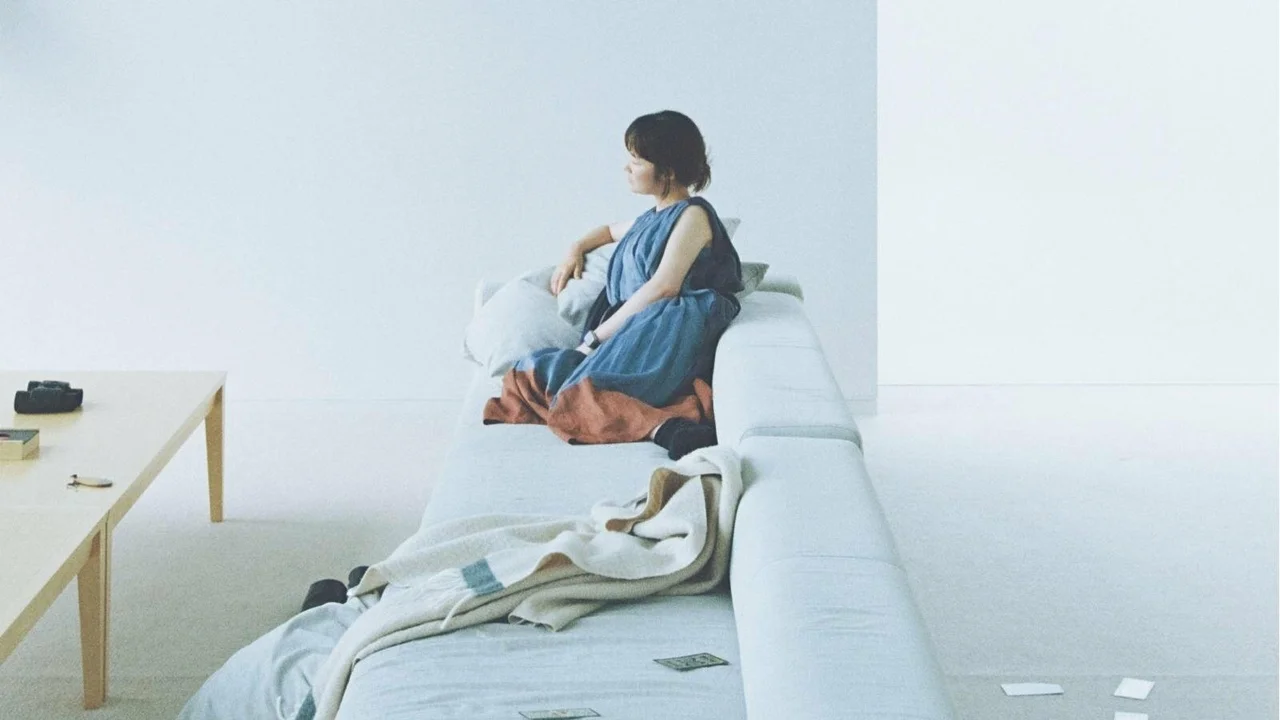
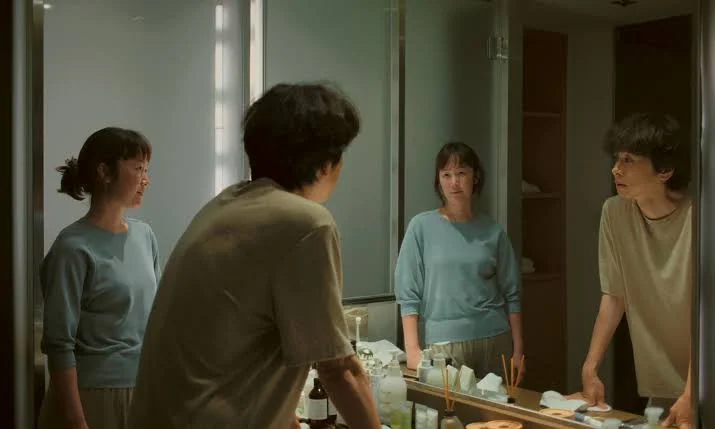
The hotel’s architecture performs a similar function throughout the film. Cinematographer Toshihiko Kizu makes excellent use of its austere interiors, geometric arrangements, and expanses of empty space. Characters frequently occupy the same rooms while appearing visually disconnected, their positions within the compositions reinforcing the emotional separation that the dialogue establishes.
The resort’s luxurious surfaces offer little warmth, and the surrounding landscape does nothing to diminish the sense of confinement. Kato’s background in theater is apparent in his attention to the placement of bodies within carefully organized spaces. Yet these arrangements retain a distinct cinematic purpose, allowing the camera to describe relationships through distance and composition.
Kuroki’s performance gives these passages an additional dimension. She communicates Mai’s mounting distress through changes in posture, prolonged stillness, and expressions that frequently reveal feelings her character is unwilling to articulate. The screenplay asks Mai to contain her anxiety through much of the vacation, a restriction that could easily make her appear passive.
Kuroki instead conveys the considerable effort required to maintain that composure. Her occasional expressions of frustration become effective because the preceding scenes have established how much she has been suppressing. The performance supplies a discernible emotional progression during stretches when the writing remains comparatively static.
Atsushi Hashimoto faces a different challenge. Koichi’s defining behavior is his refusal to engage, leaving the actor with fewer opportunities to reveal the character’s interior life. Hashimoto makes his discomfort credible, particularly as the film gradually suggests that his attitude toward fatherhood involves insecurity rather than simple indifference.
His passivity remains frustrating, but the performance allows glimpses of someone frightened by responsibilities he cannot comfortably acknowledge. The later complications in his characterization prevent Koichi from becoming a convenient villain. Even so, the screenplay relies heavily on withholding information about him, and the eventual disclosures have to compensate for substantial earlier inactivity.
This is where Kato’s construction begins to show its greatest weakness. The film eventually introduces deeper questions surrounding the marriage, parental responsibility, and Mai’s freedom to determine the direction of her own life. These concerns have been present beneath the surface, but their fuller emergence arrives relatively late. The revelations complicate the initial conflict without receiving enough dramatic development to transform it.
A screenplay that has spent so much time postponing difficult conversations finds itself with several important subjects to address and comparatively little space left to examine them. The new material arrives with the dramatic weight of a major turning point, then receives something closer to an extended afterthought.
At approximately 82 minutes, The Day After Sunday is admirably concise, although its short duration cannot completely disguise the flatness of certain stretches. Kato maintains a consistent atmosphere through restrained performances, measured editing, and the recurring visual isolation of his characters. Those qualities sustain the film’s tension, but they also make the middle section feel surprisingly uniform. There are few substantial changes in dramatic rhythm between the initial establishment of the marital conflict and the later moments when Mai begins openly questioning her future.
Mai’s growing willingness to confront the possibility of ending her marriage, along with her uncertainty about the pregnancy, provides the story with its strongest late development. What initially appeared to be a disagreement about medical information gradually reveals a relationship in which the couple’s understanding of responsibility and personal choice may be fundamentally incompatible. Koichi’s eventual complexity matters, although the emotional consequences of his earlier behavior remain unmistakable. Mai has spent much of the film attempting to begin a conversation that her husband repeatedly prevents from taking place.
The deliberately ambiguous closing images preserve that uncertainty, leaving significant questions about the characters’ futures unanswered. Such restraint is consistent with Kato’s approach, and a tidy reconciliation would hardly suit a marriage whose difficulties extend beyond the immediate pregnancy. The lingering reservation concerns the amount of development preceding that ambiguity.
Mai reaches a recognizable breaking point, and Kuroki makes its emotional cost convincing. Koichi’s position becomes less straightforward, but his changing circumstances receive comparatively limited examination. By the time the film relinquishes its characters, Mai has finally begun articulating decisions that the earlier scenes repeatedly denied her the opportunity to discuss, leaving the consequences of that change largely outside the film’s dramatic reach.
The Day After Sunday had its world premiere in competition at the 31st Busan International Film Festival in October 2026 before opening in Japanese theaters on November 20, 2026, with international sales handled by Comme des Cinémas Japon. Written and directed by Takuya Kato and starring Haru Kuroki and Atsushi Hashimoto, the Japanese domestic drama follows a couple awaiting prenatal screening results during a weekend hotel stay, where rising anxiety and passive avoidance expose the deep fractures in their marriage.
Full Credits
Title: The Day After Sunday (Nichiyōbi no Tsugi no Hi / 日曜日の次の日)
Distributor: Comme des Cinémas Japon (International Sales), Amuse Creative Studio
Release date: October 2026 (31st Busan International Film Festival world premiere), November 20, 2026 (Japan theatrical release)
Rating: G (Japan Eirin)
Running time: 1 hour 22 minutes (82 minutes)
Director: Takuya Kato
Writers: Takuya Kato
Producers and Executive Producers: Manabu Yamauchi, Masahiro Handa, Takafumi Imai, Fumitake Anan, Yuka Jimbo, Hiroyuki Araki, Yasushi Horie, Katsuyuki Fuji, Tomoaki Iwao, Masa Sawada
Cast: Haru Kuroki, Atsushi Hashimoto, Kanji Furutachi, Yoh Yoshida
Director of Photography (Cinematographer): Toshihiko Kizu
Editors: Sylvia Lager
Composer: Frédéric D. Oberland, Romain Barbot, Paul Régimbeau (FOUDRE!)
The Review
The Day After Sunday
Takuya Kato builds an effective marital drama around a conversation that never quite happens, though the repetition eventually exposes the screenplay's limitations. Haru Kuroki gives Mai an emotional progression that the writing sometimes struggles to provide, and Toshihiko Kizu's precise cinematography makes the couple's isolation tangible. The family interactions offer the film's sharpest observations, but late revelations receive insufficient development. Despite its uneven dramatic momentum, The Day After Sunday remains a carefully constructed, rewarding character study whose performances frequently surpass its narrative ambitions.
PROS
- Haru Kuroki's expressive, controlled performance
- Precise cinematography and spatial composition
- Credible marital tensions and family dynamics
- Effective use of silence and everyday interactions
CONS
- Repetitive middle section
- Important revelations arrive too late
- Limited dramatic progression despite sustained tension
- Underdeveloped consequences of the final character shifts