
























![Kingdom Hearts Collection [I-III] Review](https://gazettely.com/wp-content/uploads/2026/10/Kingdom-Hearts-Collection-I-III-1-360x180.webp "Kingdom Hearts Collection [I-III] Review: KHII Holds Steady as Newer Entries Fluctuate 37")




You may know Mauritanian director Abderrahmane Sissako from his acclaimed 2014 film Timbuktu, a heartbreaking look at a village under militant rule. After a decade away, Sissako returns with Black Tea, a change of pace that trades stark drama for a more romantic vision.
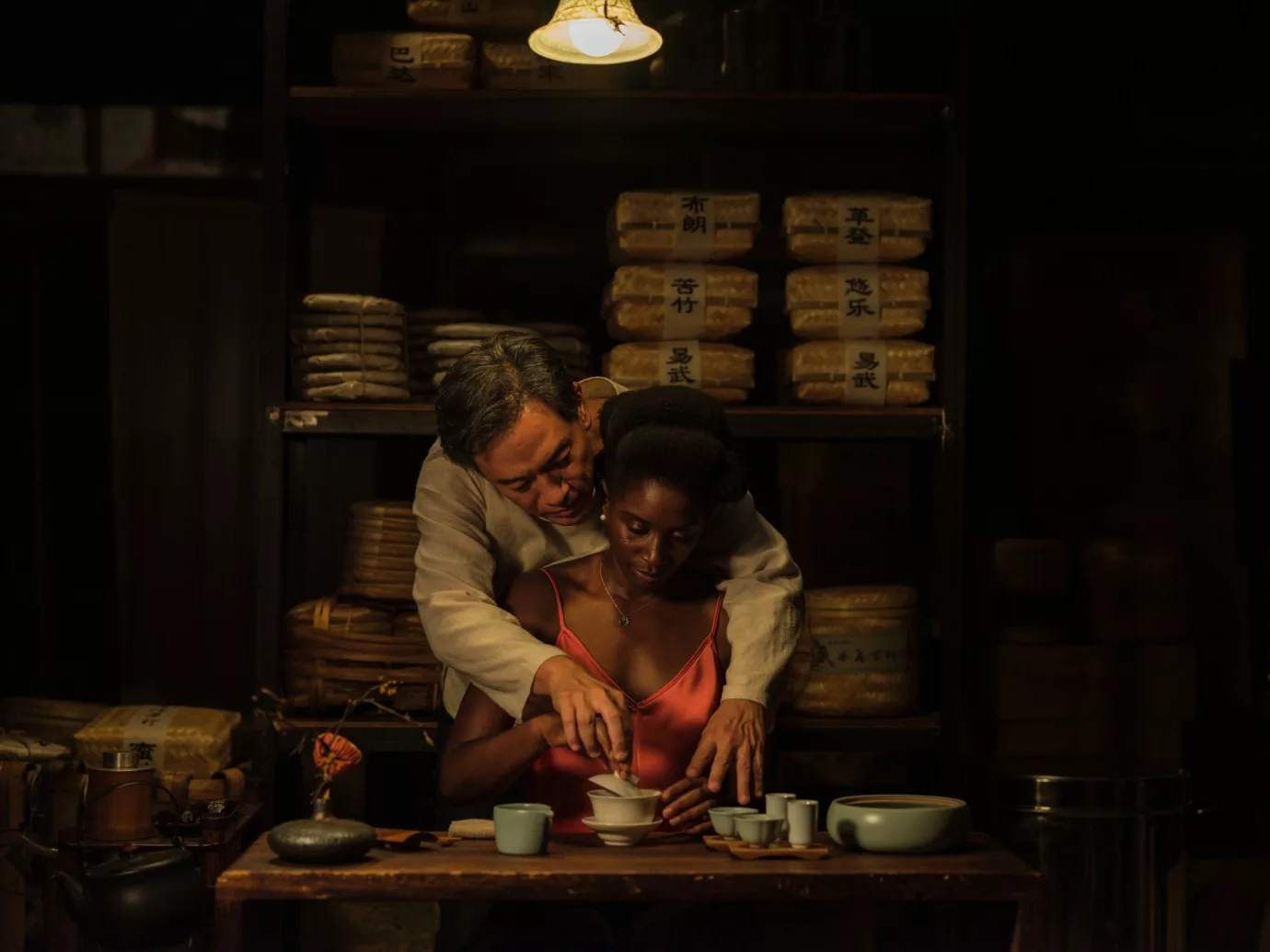
The story follows Aya, a young Ivorian woman who leaves her cheating fiancé at the altar. She resurfaces in the bustling Chinese city of Guangzhou, where a community of African immigrants has taken root. Sporting flawless Mandarin, Aya now works at an elegant tea shop run by middle-aged owner Cai. He takes her under his wing, schooling Aya in intricate Chinese tea rituals. An intimacy blooms between the two lonely souls as they bond over steaming cups of oolong and pu’er.
Yet their cross-cultural love faces obstacles old and new. Cai remains haunted by family demons – an estranged mixed-race daughter, a tense relationship with his ex-wife. When his traditional in-laws bring long-simmering prejudices to the surface, Aya and Cai must navigate their budding romance through stormy waters.
Sissako leaves behind the sun-scorched vistas of Timbuktu for a moody urban tableau brimming with warmly-lit tearooms, mist-shrouded night markets, and verdant tea plantations. If the story sounds steeped in romance and metaphor, that’s likely the intention – Sissako aims more for swoons than shivers with this mellifluous tone poem. But does Black Tea deliver the richness to match its lush images? Critical opinion remains divided…
A Runaway Bride in Chocolate City
The opening scenes unfold like a fable, simple yet symbolic. It’s Aya’s wedding day in the Ivory Coast when tiny turmoil foreshadows towering troubles ahead – an ant crawls across her bridal gown before meeting a swift end. Mere moments later, Aya stuns her guests by ditching her cheating groom at the altar. Rather than weep or wallow, she steels her resolve and sets forth on a solitary journey east.
When next we meet Aya, she’s halfway across the world, walking the neon-streaked streets of Guangzhou’s “Chocolate City.” This vibrant quarter brims with African migrants mingling amongst Chinese denizens. How did Aya wind up here in China? What path led her to such flawless Mandarin and a tight-knit community so far from home? Sissako leaves the answers vague, preferring to plunge us straight into Aya’s new life.
Her days now center around an elegant tea shop run by middle-aged owner Cai. He schools her in the intricacies of Chinese tea culture, the intricate ceremonies involved in selecting ingredients, brewing batches, and serving customers. Aya soaks up Cai’s sage lessons, becoming his star pupil in the world of white, black, green and oolong teas.
When the last teacups get put away each night, another ritual begins. Cai and Aya share furtive glances over simmering pots of water, gentle caresses over bags of loose leaves. A courtship buds through their bond over tea, though Cai keeps his home life veiled in secrecy.
Until one day Aya follows Cai back to his apartment, only to find a shocking surprise – a living, breathing wife named Ying. While Ying deals her discovery with grace and poise, Cai remains torn between the two women.
The entanglements only multiply from there. Midway through the film, Cai abruptly departs for Cape Verde to visit the mixed-race daughter he abandoned years ago. Scenes on the islands unveil a wistful daughter who sings Mandarin songs in tribute to her absentee father.
Back in Guangzhou, Ying stumbles into a new romance of her own – with another woman. But just when six degrees of separation doesn’t seem sufficient for this drama, the family friction comes to a head. Cai’s tradition-bound father catches wind of his son’s taboo affairs. Over a tense family dinner, the bitter patriarch spews venom towards his son’s African migrant lovers.
Will Cai stand up to his domineering dad and fight for tolerance? Can Aya and Ying overcome the roadblocks on their unlikely sisterhood? As with any fable, the answers don’t come easy. But Sissako leaves us with hope that his globetrotting characters may yet discover their own version of “happily ever after.”
Exploring Identity and Culture Clashes
Sissako sprinkles his signature style across a fresh canvas with Black Tea, conjuring intrigue through implication rather than exposition. By glossing over specifics on plot points and backstories, he creates gaps for viewers to fill with our imaginations – and assumptions. Rather than clarity, Sissako pursues ambiguity.

This visualized Rorschach approach fuels the film’s predominant themes. Black Tea explores notions of identity and reconciliation while holding up a mirror to globalization’s inexorable cultural collisions.
Though the central storyline revolves around Aya and Cai’s cross-continental affair, the diverse supporting characters prove equally pivotal. The film spends nearly as much time with the vibrant African migrant community as it does inside Cai’s tea shop. We get glimpses into their bonding rituals – greeting each other like family inside a packed hair salon, dancing together at an Afro-pop infused class. Their effortless integration delivers a utopian take on the immigrant experience.
Cai also confronts his own hyphenated identity midway through the film, traveling to Cape Verde for an emotional reunion with his long-lost daughter Eva. Though the scenes of fado musicians and verdant islands feel vaguely shoehorned in, they foreground essential questions. When Eva sings Chinese songs in tribute of her absent father, what stigma and struggles has she endured over her mixed blood?
Back in Guangzhou, Cai’s father provides the mouthpiece for a more regressive perspective. His vitriolic opposition to Cai’s affair with a black woman provides the film’s only hints of racial tensions simmering beneath that utopia. But even this hateful grandpa gets humanized to some degree – Sissako is more interested in understanding all sides rather than reductive finger-pointing.
That grace and nuance spills over into the film’s central relationship as well. Though we see both Aya and Cai betray and get betrayed, Black Tea argues nothing explanatory excuses exist – only empathy. Cai’s ex-wife Ying emerges as the story’s moral compass, showing compassion for both her husband and his lover.
Just as tea leaves transform from dried flakes to saturated vitality, the characters seek regeneration too, steeping in new cultures and mindsets. It seems Sissako wants viewers to ask ourselves similar questions. What old traditions, assumptions and grudges might we abandon to enhance the flavor of our own lives?
Lighting Up the Frame, Losing the Steam
Visually speaking, Black Tea often lives up to its titular brew, projecting moody elegance and violet-tinted mystique. Several critics single out the evocative cinematography and transportive sense of atmosphere as highlights in an otherwise underwhelming drama.

Cinematographer Aymerick Pilarski lenses Guangzhou through an Instagram filter of perpetual magic hour, the saturated cityscapes doubling down on seductive mood over geographic specificity. The decision to shoot in Taiwan likely plays a role here too. Approximating China without the access lends scenes an intriguing but ephemeral sense of place – we could be anywhere, and isn’t that the point when exploring globalization? Pilarski works similar wonders with interiors as well, spot-lighting tea tables with warm, honeyed tones while swathing the surrounding rooms in velvety darkness. It’s the visual equivalent of smooth jazz – too atmospheric for its own good.
As with the larger narrative, Pilarski focuses attention around tea preparation, circling round copper pots, glazed bowls and dangling spoons. Sissako luxuriates in the elegant ceremonies, the unwrapping of leaves, the decanting of hot water, and steam rising in lyrical wisps. Accenting objects over characters makes for entrancing still photography but often tedious cinema. Too many shots outstay their welcome, either obscuring actors’ faces outright or framing them headless like decapitated mannequins.
Those miscalculations speak to a larger tension critics cite in the film – between half-formed artistry and casual amateurism. One review even compares Black Tea to late night infomercials, where viewers get seduced less by slick production than by drowsy, dislocated hazes. In the lack of narrative momentum or identifiable settings, Pilarski’s visuals feel like another missed opportunity. Sissako wants to envelop us like a waking dream but can’t reconcile style over substance. What should be verdant oolong tastes more like weak leaf water – perfectly pleasant until you remember what real tea tastes like.
A Low-Key Cast Anchors the Mood
While critiques of Black Tea tend to highlight directorial deficiencies over performer talent, the actors emerge relatively unscathed from the lukewarm reactions.

In the lead role, newcomer Nina Mélo draws consistent praise for her nuanced turn as the enigmatic Aya. Despite thin characterization on the page, she conveys volumes through subtle gestures and glances. We believe her contentment, heartbreak and resilience because Mélo locates the humanity beneath the opacity. If Aya feels more metaphor than fully-realized person at times, that‟s hardly the actor‟s fault.
Mélo finds an fitting counterpoint in Chang Han‟s reserved performance as her lover Cai. Their subdued chemistry nicely captures the cultural reservations bubbling beneath their affair even as passion seeps through. Han communication as much through solemn looks and weary body language as he does through dialogue. The scenes of him preparing and discussing tea bear a hushed intimatcy that works better than any grand declarations could.
The supporting players follow suit with naturalistic performances that complement the somnolent atmosphere. As Cai‟s ex-wife Ying, Wu Ke-Xi injects striking grace notes, particularly an a cappella rendition of the Chinese folk classic “Jasmine Flower” that she sings with poetic melancholy. Anchored by Mélo and Han, the actors craft well-rounded characters from half-etched outlines.
On the sonic front, Sissako complements his eye for arresting frames with an eclectic and surprising soundtrack. Nina Simone bookends the film, crooning in English at the start and a lilting Bambara cover over the end credits. In between, selections range from traditional fado music to Afro-pop infused dance beats. An original score by Armand Amar also swoops in occasionally with weepy strings seemingly on loan from a Pedro Almodóvar drama. The musical choices can feel jarring at times, but ultimately serve to reinforce Black Tea‟s fluid global influences.
A Lukewarm Last Sip
So does Black Tea deliver a robust flavor profile or weak leaf juice? Critical opinion lies closer to the latter, though most reviews concede moments of grace between the murkier waters.

There’s no denying Sissako’s talents as a visual poet. Working again with cinematographer Aymerick Pilarski, he conjures up entrancing images – moodlit tearooms, harmonic snapshots of Guangzhou’s African quarter, mist-cloaked reveries. Meanwhile, lead actress Nina Mélo announces herself as a rising star with luminosity to burn.
Yet as with any intricate tea ritual, precision matters. What honeyed nuance the aesthetic details bring gets undermined by slipshod storytelling. Sissako bounces between characters and subplots like a jittery first-time waiter, spilling more threads than he resolves. promised emotional payoffs wilt into lukewarm half-measures.
Perhaps that’s why the Critical opinion skews mixed to negative – Black Tea simply can’t deliver on the expectations set by Sissako’s towering reputation. Coming after his shattering masterwork Timbuktu, this globetrotting trifle almost feels like a palate cleanser, conceived to reorient himself towards lighter material. There’s enough lyricism sprinkled throughout to pique curiosity from the director’s fanbase, but newcomers may find the experience less welcoming.
Yet like studying the leaves at the bottom of a cup, there are signs embedded within Black Tea’s flaws too. We get glimpses at compelling themes of identity, empathy, and reconciliation in our polarized moment. One hopes Sissako steeped in enough new creative flavors here to distill them into a more refined blend next time. This soothing but muddled cup won’t linger long in memory, but patient viewers may still detect notes worth savoring.
The Review
Black Tea
For all its sensual imagery and thematic ambitions, Black Tea leaves a faint impression unlikely to satisfy viewers craving either sweeping romance or cultural specificity. Sissako steeps intriguing ideas here but fails to properly brew a cohesive narrative, resulting in tepid characterization and emotional detachment. Diehard fans may sip enough lyricism to pique their interest, but overall Black Tea feels less like a finely-aged oolong than yesterday’s forgotten cup, grown cold on the countertop.
PROS
- Stunning cinematography creates an alluring, atmospheric mood
- Lead actress Nina Mélo gives a promising breakthrough performance
- Explores thoughtful themes around globalization and cultural identity
CONS
- Confusing, disjointed plot with unsatisfying character arcs
- Fails to deliver emotional resonance or narrative payoff
- Doesn't fully capture the realism of African diaspora experiences







