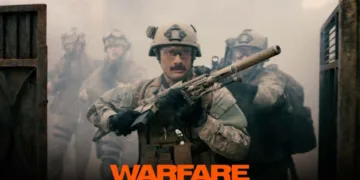























The film situates itself within a stark reenactment of a 2006 Navy SEAL mission in Iraq. Its events unfold inside a commandeered residential building in Ramadi—a claustrophobic arena where every echo and shadow amplifies the palpable tension. This confined setting transforms the narrative into an almost suffocating experience, underscoring the relentless anxiety of life on the edge of warfare (a situation as monotonous as it is explosive).
The story proceeds in real time, meticulously following soldiers in moments of static anticipation and sudden mayhem. There is an absence of conventional dramatic devices; instead, the unfolding hours mirror the soldiers’ lived reality, where each minute is a careful observation of survival rather than a scripted spectacle. The film’s architecture derives directly from the unfiltered recollections of those who witnessed the events, making its structure as raw as it is methodical.
Modern combat, as depicted here, emerges as a paradox: a blend of mundane routines punctuated by catastrophic ruptures. The attention to detail in recreating the oppressive stillness before a storm (a silence that is almost a character itself) offers a sober reflection on the nature of warfare—a state where the quiet is as instructive as the chaos.
Directorial Vision and Filmmaking Techniques
The directors opt for a raw, first-person style that resembles a found-footage account, invoking the unfiltered recollections of those who experienced conflict firsthand. Their method casts war as a sequence of unmediated instants (if that isn’t a novelty in modern filmmaking, nothing is). The narrative unfolds without embellishments or heroic posturing, leaving the viewer to confront the chaotic immediacy of each moment.
The film’s visual design is marked by cramped interiors and persistent close-ups, where every narrow corridor and shadowed corner intensifies a feeling of confinement. Meticulous production design recreates the milieu of a 2006 mission with such scrupulous detail that one might question whether the sets could serve as historical replicas. Practical effects and period-appropriate touches infuse the environment with a sense of verisimilitude that is hard to ignore.
Extended takes—some lasting up to 15 minutes—contribute to an almost hypnotic tempo, capturing prolonged periods of anxious waiting before an explosion shatters the calm. The deliberate pacing, marked by intervals of near-silence, sets a rhythm that contrasts sharply with bursts of sudden, visceral violence. The resulting effect can provoke both admiration and exasperation (one might even chuckle at the absurdity of tension stretching into the mundane).
Sound design plays a pivotal role, stripping away a traditional musical score in favor of an audio landscape where every radio murmur and ambient clatter stands out. The cacophony mirrors the tumult of combat and challenges the audience’s sensory endurance. In this approach, the directors transform silence into a vehicle for dread, making the absence of conventional soundtracks a powerful narrative tool.
The choices made here prompt reflections on historical portrayals of conflict, and on our cultural appetite for realism in recounting human strife. This filmmaking style—at once meticulous and bracingly blunt—invites viewers to question the portrayal of war in popular media.
Narrative Architecture and Storytelling Dynamics
The film unfolds in a manner that mirrors the stark realism of its subject matter—quiet moments of vigilant waiting punctuated by sudden, explosive shifts in violence. Its structure is an exercise in minimal exposition: the stakes and mission details reveal themselves gradually, almost as if the narrative itself were a slowly developing photograph (one that isn’t filtered to hide the grime). This measured pace creates an atmosphere where every hushed second carries the weight of impending catastrophe.

Dialogue in the film is sparse and technical, echoing the clipped exchanges of military communication. Code words and procedural language replace conventional character development, lending an impersonal air to interactions that, paradoxically, intensifies the immediacy of the situation. This style of communication, while perhaps distancing on a personal level, magnifies the raw realism of combat (a sort of linguistic efficiency that mirrors historical military briefings).
By employing a real-time framework and relying on first-person recollections, the film reconstructs events as raw memories—a method that strips away any polished narrative veneer. The effect is both jarring and mesmerizing, forcing viewers to witness history’s unvarnished moments as they happen.
In doing so, the storytelling method challenges traditional narrative conventions, offering a perspective that is as unedited as the accounts it portrays. Here, silence speaks volumes and every pause is pregnant with tension. This approach, which might be labeled as “memory cinema,” opens a dialogue about the nature of recollection and the cultural impact of witnessing events in their most unrefined form.
Faces in the Fray: Character Portrayals and Ensemble Dynamics
The film opts to identify its figures by their roles—officer in charge, sniper, medic, communications specialist—eschewing conventional backstories in favor of a depiction that feels purely functional. Each character serves as a building block in a collective experience where the individual dissolves into a unit.

The actors, having immersed themselves in rigorous on-set training, channel a raw sincerity that is both disarming and unexpectedly layered (with a touch of wry humor punctuating moments of stark realism). Their performances capture fleeting, unguarded emotions that reveal a spectrum of human responses in extreme conditions.
Brief exchanges—a shared glance, a half-smile in the midst of tension—hint at bonds formed in the crucible of danger. Such moments, though subtle, carry an unspoken weight reminiscent of historical military brotherhoods forged under fire. The deliberate choice to forgo detailed personal narratives directs focus to the collective rhythm of survival.
This approach strips away any superfluous sentimentality and leaves a study in trust, fear, and duty that mirrors the austere realities of armed conflict. The interplay between the disciplined exterior demanded by military life and the spontaneous vulnerability that creeps in when danger looms becomes a quiet commentary on human resilience. Here, the ensemble works as a single organism—a unit whose synergy becomes the pulse of the film’s narrative.
Tactics in Turmoil: Military Realism and Tactical Execution
The film lays out its operational sequence with a precision that mirrors real-life military engagements. It opens with painstaking surveillance and the detailed minutiae of routine—a scene where every measured movement speaks to the discipline of armed service.

Then, without warning, an explosion shatters the fragile calm, marking a turning point that brings chaos into sharp focus. Specialized equipment and strict protocols play their roles with an almost clinical exactness, reflecting the careful choreography of a mission executed under constant threat (a scene that echoes historical battles fought in similarly confined quarters).
The buildup is methodical: long stretches of almost unbearable quiet lead into moments when tension bursts into violent action. Radio exchanges—brief and coded—add a staccato urgency to the unfolding events. The confined setting amplifies each decision and gesture, making the entire operation feel like a high-stakes game of chess played in a pressure cooker.
Every precise move and technical term reinforces the film’s commitment to authenticity, underscoring the inherent brutality of combat. This detailed portrayal of tactical procedures leaves a lingering impression of a world where split-second decisions can shift the balance between order and chaos, offering viewers a raw glimpse into the demanding nature of modern warfare.
Emotional Reverberations and the Cost of Conflict
The film lays bare the raw brutality of combat, forcing us to stare into the abyss of violence, pain, and chaos. Its visual and aural elements—sudden explosions, shattered silence, and claustrophobic shots—combine to create a sensory overload that can leave one both mesmerized and unsettled (think of it as an emotional shock therapy session). There are scenes where the cacophony of radio chatter intermingles with the metallic clangor of weaponry, crafting a visceral experience that resonates like a distant drumbeat from a long-forgotten battle.

This portrayal of warfare peels away the myth of invincible heroes, instead presenting young soldiers grappling with fear and uncertainty. They are neither paragons of strength nor embodiments of despair but rather ordinary individuals confronting extraordinary circumstances.
The tension between the detached professionalism required in the field and the deeply personal, almost raw reactions to witnessing mortality is palpable—each glance, each pause, is loaded with unspoken sorrow and reluctant duty.
The film does not shy from the harsh realities of physical injury and psychological trauma. Gritty depictions of shattered limbs and broken spirits are interwoven with moments of almost unbearable silence, evoking memories of historical conflicts where the cost of war was measured not in medals, but in scars and lost futures. This visual narrative forces the audience to reckon with the idea that modern warfare strips away individuality, reducing men to mere cogs in a relentless machine of destruction.
Moral ambiguity is a recurring motif, where ethical dilemmas arise without clear resolution. The actions of the soldiers—and the collateral damage inflicted upon innocent bystanders—invite viewers to question conventional notions of sacrifice and duty. In this stark canvas of survival, the film becomes a mirror reflecting our collective discomfort with the inescapable human cost of conflict.
The Review
Warfare
Warfare stands as a piercing, unvarnished exploration of modern warfare—a stark, uncompromising portrayal that unsettles while provoking thought. Its commitment to authenticity and the raw depiction of both valor and vulnerability offer a transformative experience, one that refuses to idealize conflict. It’s a cinematic mirror reflecting our discomfort with the human cost of war.
PROS
- Authentic, raw depiction of modern combat
- Immersive real-time narrative
- Strong ensemble cast with convincing performances
- Meticulous production design
- Powerful sound design that intensifies tension
CONS
- Minimal character backstory may feel impersonal
- Deliberate pacing might test viewer patience
- Sparse dialogue could lead to emotional detachment