





























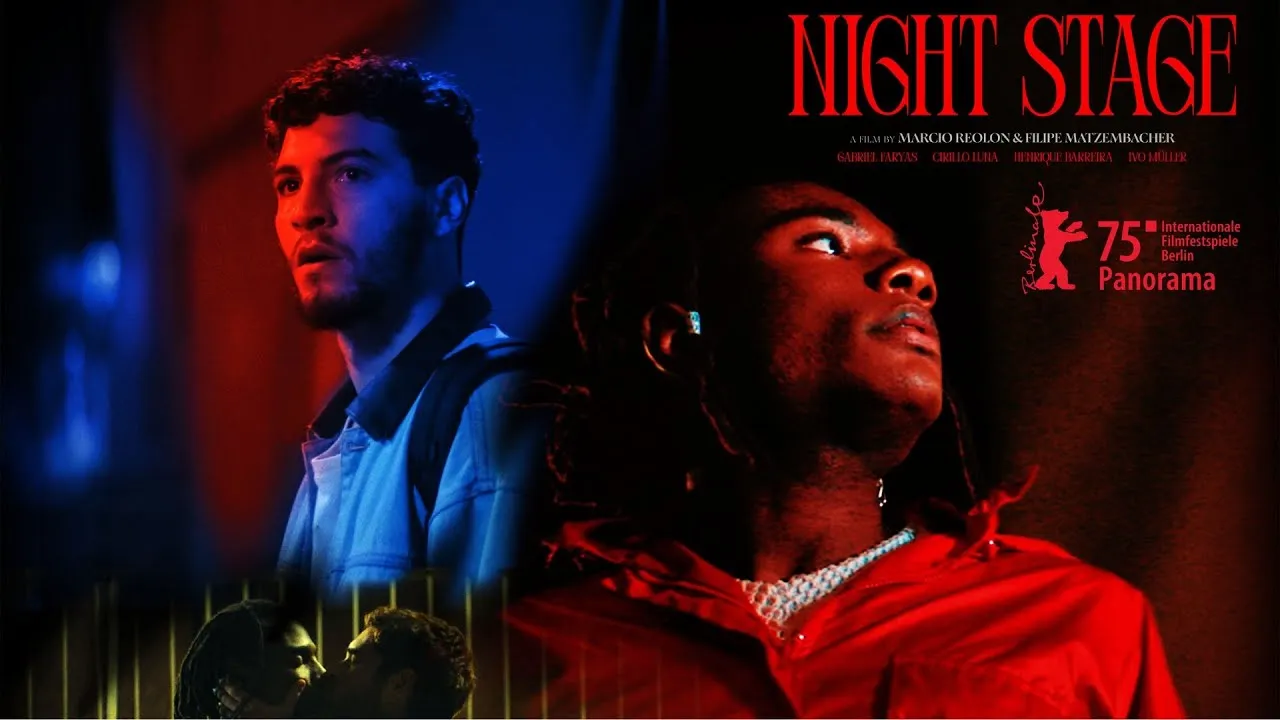

Right from its opening frames, Night Stage stakes its claim in the erotic thriller canon by weaving raw longing into every shadowy corridor and heated glance. Directors Marcio Reolon and Filipe Matzembacher—whose previous work quietly reshaped queer storytelling—turn the city at night into both playground and trap, where every hidden corner pulses with risk.
In this 2025 release, we meet Matias (Gabriel Faryas), a young actor brimming with promise yet stifled by an industry that demands conformity, and Rafael (Cirillo Luna), a polished politician whose carefully crafted public persona hides a hunger for danger. Their brief encounter in a deserted parking lot spirals into something dangerously addictive: a series of public trysts that link erotic thrill to personal ambition.
The film doesn’t merely borrow the mechanics of its ’80s forebears—it refashions crash‑zoom tension and split‑screen voyeurism to explore how performance seeps into real life. Matias’s rapid rise on screen mirrors his rush of adrenaline when caught in the act, while Rafael’s cool veneer cracks under the weight of his dual roles. This collision of stagecraft and genuine emotion fuels a narrative momentum that grips you—each scene paced like a timed challenge, daring both characters and audience to confront how far they’ll go before the final curtain.
Mapping the Descent: From Stage to Shadow
The first act drops us into Matias’s rehearsal room, where the dynamic with his roommate Fabio—brimming with effortless masculinity—sets a clear standard Matias must meet. When the casting director opts for Fabio over him, it’s more than professional rejection; it’s a challenge to Matias’s identity. That bruise leads him to Rafael, and their anonymous meeting in a deserted parking lot feels like unlocking a new game level: one where exhibitionism becomes both weapon and reward.
As the story shifts into its second act, Matias and Rafael unearth a shared thrill in public sex—“dogging” operates as a narrative mechanic that steadily raises stakes. Rafael’s mayoral campaign looms in the background like a ticking clock, and Matias’s sudden TV breakout—granted through Rafael’s pull—mirrors a character progression system, where each unlocked achievement demands a higher risk. Their secret encounters blur the line between player and spectator: every crash zoom and split‑screen sequence feels like the UI flashing a warning before a boss fight.
Key moments in this section feel scripted for maximum tension. In the discotheque scene, leather and gimp masks introduce a dom/sub undercurrent that tests both characters’ boundaries. Later, Matias’s hopeful turn toward another partner in a moonlit park ends in rejection, a reminder that not every side quest yields reward.
By the third act, narrative threads converge in a sudden exposure or violent rupture—left deliberately vague here, like a hidden ending players must discover. The final scenes unfold with operatic chaos, careers and bodies on the line. As the credits approach, you’re left pondering how far our protagonists are willing to risk both their public facades and innermost urges—and whether the thrill of being seen is worth the price of being found out.
Reframing Desire: How Night Stage Rewrites an Old Template
Night Stage hooks into the erotic thriller’s core mechanic—sex as a trigger for danger—but reroutes that energy through queer perspectives. In classic ’80s titles like Body Double, the camera’s voyeurism and split‑screen reveals turn peeping into suspense. Here, every public encounter becomes a deliberate stunt: the discotheque’s crash zooms amplify the power shift when Rafael dons leather and a gimp mask, then pull back to show Matias’s racing pulse. It feels less like a stunt and more like unlocking a hidden level in a familiar game.

At its heart, the film plays a meta‑match between desire and ambition. Matias’s breakthrough TV role and Rafael’s mayoral campaign serve as parallel progression bars—each success feeds their craving for risk. You start to wonder which meter they’re really filling: professional status or primal need? That tension deepens when Matias trades away parts of his true self—cleaning up his social media—to climb the career ladder, much like choosing a sub‑optimal build in an RPG for a quick XP boost.
Public versus private selves emerge as both shield and weapon. Exhibitionism offers Matias moments of liberation under neon city lights, yet it also exposes him to ruthless judgment—his shame in a moonlit park stingier than any button‑mashing defeat. Literal masks in fetish scenes contrast with the figurative masks they wear online and on stage, reminding us that performance underpins every interaction.
Masculinity isn’t presented as a fixed stat. Matias’s fluid style clashes with Rafael’s rigid, voter‑friendly persona, spotlighting how cis‑hetero norms govern both casting calls and campaign speeches. The film even riffed on queer thrillers like The Fourth Man, where danger sprang from taboo desire, but instead of disease‑driven fear, the real menace here is systemic repression—capitalism’s insistence that queer identity be shelved for “professionalism.”
Finally, dogging isn’t just an erotic gimmick; it’s a commentary on spectatorship. Like a stealth mission that can end in discovery or death, every risk highlights our collective urge to watch and be watched. Night Stage pauses on that last frame—asking whether the thrill of exposure is worth the price of survival.
Embodied Conflict: Performances That Blur the Line
Gabriel Faryas’s Matias carries the weight of an RPG protagonist forced into a side quest he never asked for. After the casting snub in rehearsal, you sense his disappointment in every tightly framed close‑up, where a flicker of vulnerability undercuts his bravado.
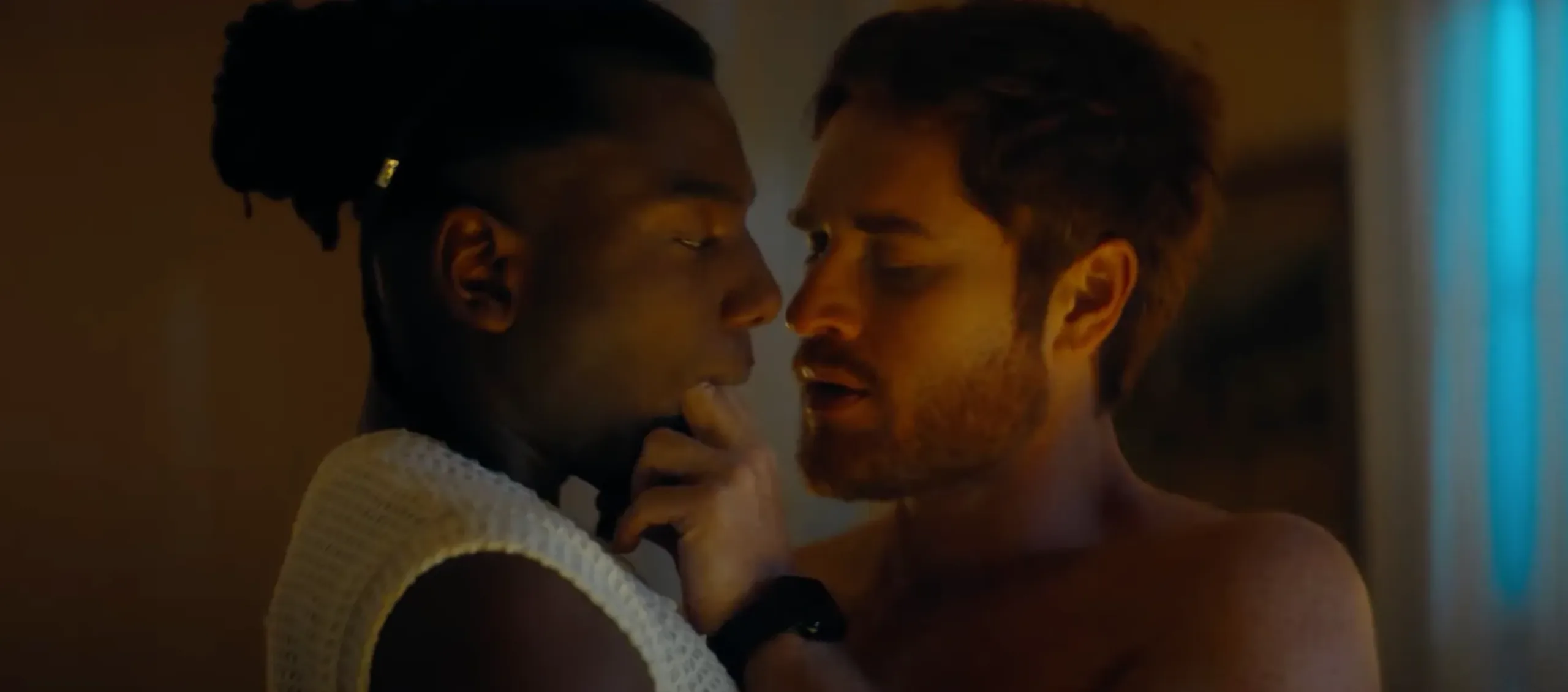
As Matias embraces exhibitionism, Faryas loosens up—his posture shifts, breath quickens—and you can almost hear the leveling‑up chime of reckless abandon. That physical evolution, from tense shoulders to open, exposed stance beneath neon lights, fuels the emotional stakes more than any plot twist.
Cirillo Luna’s Rafael is the perfect study in dual‑wielding masks. By day, he delivers polished speeches with surgical precision; at night, a half‑smile and a subtle nod signal the predator beneath the suit. Luna’s micro‑expressions—an eyebrow raise before slipping into leather, a tightening jaw when the political lens flickers off—feel like hidden variables in a well‑tuned game engine. You never doubt his authority until the moment he swaps his tailored blazer for a gimp mask, and that flip pulls the rug from under everything you thought you understood about his character.
Henrique Barreira’s Fabio stands as both narrative checkpoint and personal crucible. He embodies the heteronormative ideal Matias must surpass: confident, unguarded, rewarded by the system. Fabio’s ease in the audition room heightens Matias’s frustration, while his later disappearance from the thriller arc underscores how tempting it is to abandon side characters once the main campaign accelerates. Casting director Pamela (Kaya Rodrigues) and theatre director Larissa Sanguiné serve as the game’s rigid gatekeepers, their off‑hand comments acting like quest markers directing Matias toward or away from authenticity.
What really resonates is the electric chemistry between Faryas and Luna—it zaps across split screens and shared frames, pulling power back and forth like a tug‑of‑war minigame. Their whispered city‑lights confession feels as intimate as unlocking a hidden cutscene, while the raw intensity of their public encounters crashes over you like a high‑stakes boss fight. Each emotional beat—rejection in the park, adrenaline‑fueled rendezvous—lands with the impact of a perfectly timed script cue. It’s enough to make you question how many layers of performance we carry through our own lives.
Visual Mechanics and Narrative Flow
Reolon and Matzembacher approach Night Stage like co‑directors tuning a game engine: they layer genre callbacks—split screens and crash zooms straight out of De Palma—with fresh queer energy. Early on, a rehearsal space doubles as tutorial level, where stage motifs hint that life and art are interchangeable. Later, parking lots and park benches become open‑world arenas, each location offering new mechanics of risk and reward.
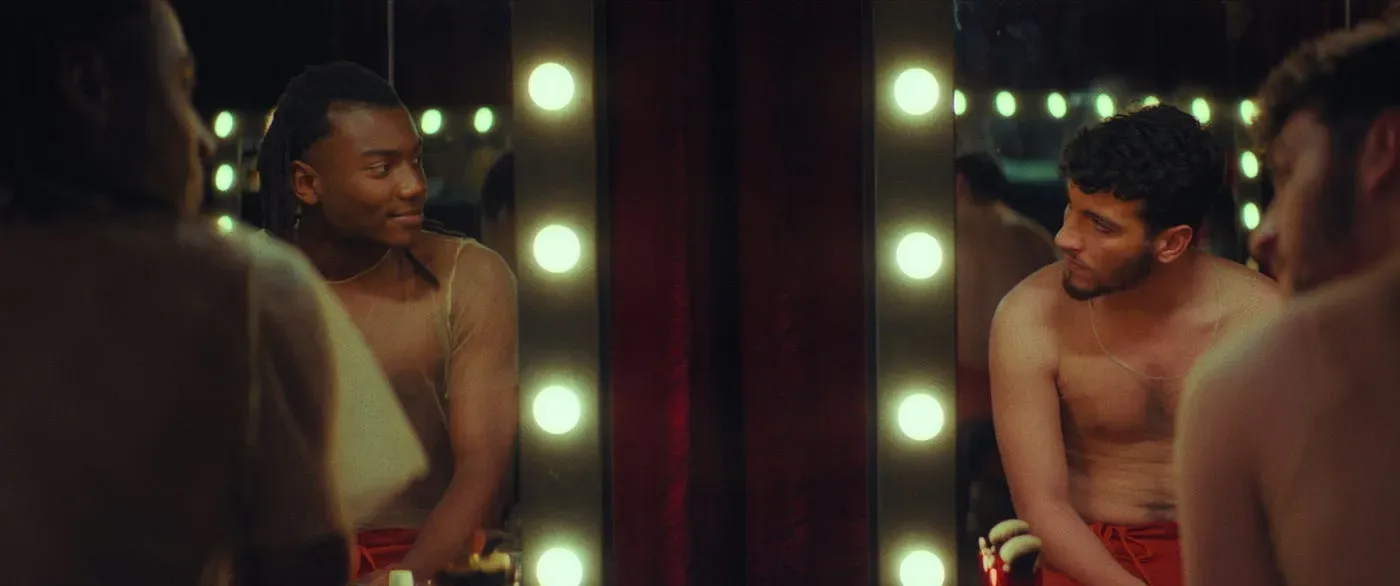
Luciana Baseggio’s camera work feels custom‑built for this narrative. She alternates between widescreen tableaux—long takes of neon‑lit streets that establish mood—and tight close‑ups that capture Matias’s quickening heartbeat. In sex scenes, Baseggio leans into rapid cuts, echoing the pulse‑pounding intensity of a well‑timed combo in a fighting game. Then, in quieter moments—like Matias’s confession under city lights—the pace slows, allowing us to absorb emotional changes like reading a dialogue tree.
Color plays a strategic role. Nocturnal blues and pops of neon reinforce the film’s “night mode” aesthetic, in contrast to the harsh whites of daytime casting rooms. That contrast reads like switching between stealth and combat modes: characters feel liberated in darkness but exposed in daylight.
Production design further cements the public‑private divide. Rafael’s tailored suits and campaign podiums feel like armor plating, while fetish gear and leather in the club scenes act as power‑up skins. Props—from the theatre’s worn wooden ledge to the politician’s branded microphone—serve as environmental storytelling, each item marking a checkpoint in the protagonists’ journey.
By treating visual style as interactive systems rather than mere decoration, Night Stage keeps you attuned to narrative beats in every frame—and makes you wonder what hidden Easter eggs it’s hiding just out of sight.
Timing the Thrill: Pacing and Tension
Narrative pacing here functions much like a game’s escalating difficulty curve: early public‑sex scenes establish a pattern, then each subsequent encounter raises the stakes. Those first clandestine moments in the parking lot feel almost routine, but by the third sequence—underscored by elegant strings clashing with piercing synths—you sense the warning flags. The score acts like a heartbeat monitor, spiking when Matias and Rafael skirt exposure and settling only in quieter, contemplative interludes.
The script scores points with sharp, memorable lines—“No one hides from the stage” cuts straight to the film’s core mechanic, using theatrical rehearsal as a mirror for real‑world performance. Symbolism layers smoothly: the staged play within the film reinforces how the characters constantly switch roles, much like players toggling avatars. In the discotheque scene, power‑play exchanges play out in fleeting looks and camera shifts, proving that withholding information can ratchet up suspense more effectively than any explicit reveal.
Yet the third act demands a bigger leap than the story earns. Matias’s rocket‑fast ascent to TV fame strains credibility—akin to unlocking a top‑tier skill without the necessary side quests. Fabio’s subplot, which germinates potential drama early on, is dropped almost entirely, leaving narrative gaps that feel like unfinished side missions. And when the tension relies on familiar musical cues—those melodramatic synth pulses—you’re reminded of other thrillers that lean too heavily on auditory shortcuts.
Still, every rendezvous manages to push both career and personal safety meters higher, culminating in the political rally sequence where erotic game and public spectacle crash together. Early on, the film nails the fusion of danger and desire; later, conventional thriller beats sometimes overshadow character motivations. It leaves you wondering which element—sexual risk or narrative payoff—is the real reward.
Ripples Beyond the Final Act
Night Stage delivers a potent fusion of suspense and eroticism, harnessing stylistic flair to reintroduce queer thrill into today’s cinema landscape. Its fearless staging of public encounters and polished camera work bring an energy that recalls ’80s classics while channeling modern sensibilities. By centering two men whose ambitions parallel their desires, the film interrogates how public personas and private impulses collide under the spotlight.
From the measured build‑up of clandestine meetings to abrupt tonal shifts, pacing keeps viewers perched on edge, mirroring the characters’ racing pulse. The score—at moments tinged with nostalgic synth—underscores each leap into uncertainty, anchoring extravagant set pieces so they resonate beyond spectacle.
This cinematic revival of the gay erotic thriller speaks up against rigid norms: exposure becomes resistance to patriarchal and capitalist pressures. Scenes like the moonlit park confession and the leather‑masked pursuit in a crowded club act as vivid checkpoint markers in memory.
Fans of cult titles such as The Fourth Man will find familiar thrills refreshed by contemporary context, while under‑the‑radar indie enthusiasts may champion Night Stage as a hidden gem.
As credits roll, one question lingers: will our own masks ever come off when risk and desire merge?
Full Credits
Directors: Filipe Matzembacher, Marcio Reolon
Writers: Filipe Matzembacher, Marcio Reolon
Producers: Jessica Luz, Paola Wink, Filipe Matzembacher, Marcio Reolon
Cast: Gabriel Faryas (Matias), Cirillo Luna (Rafael), Henrique Barreira (Fabio), Ivo Müller (Camilo), Kaya Rodrigues (Pamela Almeida), Larissa Sanguiné (Larissa), Gabriela Grecco (Sofia Alcântara), Antonio Czamanski (Dr. Otávio)
Director of Photography (Cinematographer): Luciana Baseggio
Editor: Germano de Oliveira
Composers: Thiago Pethit, Arthur Decloedt, Charles Tixier
The Review
Night Stage
Night Stage boldly reclaims the erotic thriller by marrying electric performances and daring visuals with a storyline that pits ambition against desire. Though a few narrative leaps undercut its momentum, the film’s emotional charge and stylistic verve make it a captivating, boundary‑defying ride.
PROS
- Electric lead performances that evolve with the story
- Bold, kinetic cinematography and memorable set pieces
- Fresh queer perspective on classic erotic‑thriller tropes
- Taut pacing in early and mid‑sections
- Thematic resonance around identity and public vs. private selves
CONS
- Abrupt narrative leaps in the third act
- Underused subplot around Fabio
- Occasional reliance on familiar musical cues
- Some thriller elements overshadow character depth







