

























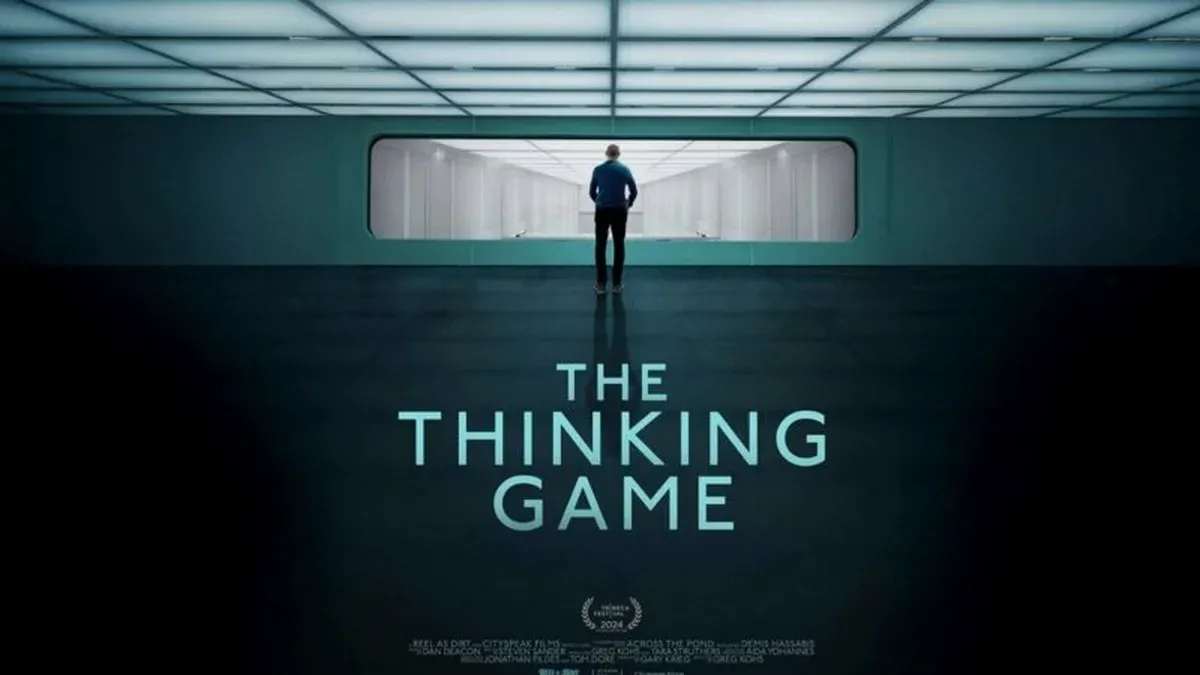

A hush falls over the laboratory just before the screen lights up with the swirl of colored chains representing protein structures. In one moment, you catch the gleam of excitement in Demis Hassabis’s eyes as AlphaFold delivers its first accurate fold prediction. This is where The Thinking Game begins: a portrait of a London startup transforming puzzles into progress.
The film charts DeepMind’s rise from a scrappy group of game enthusiasts into a powerhouse chasing a machine that thinks like us—artificial general intelligence. At its center stands Hassabis, part chess prodigy, part visionary researcher, whose calm confidence anchors every sequence. Director Greg Kohs stitches together interviews, archival clips, and playful animations with a precision that makes complex algorithms feel as familiar as a childhood board game.
Unfolding over crisp, deliberate chapters, the documentary debuted in UK theaters on 21 March. It arrives at a moment when headlines about AI breakthroughs have become commonplace—but Hassabis’s journey reminds us why each achievement still feels extraordinary. In an age of hype, this film invites us to watch ideas take shape, one line of code at a time.
Building Momentum and Timing
From the moment DeepMind’s founders sketch code on a whiteboard, the film moves in a clear line: 2010 startup dreams → 2014 Google takeover → headline-making victories with AlphaGo and, finally, AlphaFold. That straightforward timeline keeps viewers grounded even as the subject matter grows denser.
The rising action unfolds through scenes of self-playing chess engines and “agents” conquering Go. These early experiments provide a playful counterpoint to the lab’s later sterile corridors. When Hassabis’s team first sees a correct protein fold on screen, the film hits its peak. The reveal is earned: you’ve sat through incremental heats of algorithmic sparring, so the payoff lands with genuine thrill. Afterward, rather than tying off every scientific loose end, the documentary drifts into open questions—what happens once machines can learn anything we can? This choice feels deliberate, leaving a faint hum of uncertainty.
Quick edits punctuate the competitive game footage, while lengthy interviews give enough breathing room for complex chemistry. Animation steps in precisely where jargon might stall the viewer—tubes and ribbons unfold in 3D, and suddenly you grasp how amino acids knot themselves. It’s a careful mix: rapid sequences to spark excitement, deeper dives when explanation demands it.
Games recur as a motif. From chessboards to virtual mazes, Kohs returns again and again to play as thinking made visible. Even when sceptics like Kenneth Cukier appear, their comments are inserted at pivot points—just as the film teases utopian promise, a quiet warning slides in. These structural choices create a rhythm that feels both purposeful and dynamic.
Core Themes and Intellectual Stakes
At its heart, the film poses a simple question: can a machine ever truly think? Early on, it draws a clear line between narrow AI—systems trained for single tasks like chess—and the elusive goal of artificial general intelligence, which Hassabis describes as “thinking itself.” This distinction sets the stage for every experiment and interview that follows, framing DeepMind’s work as more than code—it’s a philosophical probe into cognition.

Next comes the tension between ambition and caution. The researchers speak with contagious fervor about using AI to tackle climate change or accelerate drug discovery. Yet whispers of “dual-use” concerns slip in, a reminder that powerful tools can be repurposed as easily as firepower. The analogy to gunpowder feels earned in these moments, a warning that scientific zealotry sometimes ignores darker possibilities.
The film frequently draws parallels between human learning and algorithmic training. We watch agents teaching themselves to navigate virtual mazes much like toddlers exploring playgrounds. It’s a clever mirror: human creativity is messy and unpredictable, while code follows strict rules—yet both arrive at surprising solutions. These scenes underscore an uneasy truth: synthetic minds can surprise us, but they lack the spontaneity of human imagination.
Ambition threads through every breakthrough. References to Oppenheimer’s atomic quest remind us that world-altering inventions come with moral fallout. Hassabis seems aware of this tightrope, but the documentary occasionally flirts with triumphalism—presenting each milestone as if it were the moon landing. Those moments of grandiosity sit uneasily alongside the sober warnings, highlighting how close visionary science can edge toward unchecked hubris.
Visual Style & Technical Craft
Greg Kohs adopts a hands-on stance behind the camera, blending fly-on-the-wall footage with carefully staged interviews. The vérité moments—scientists hunched over keyboards, fingers dancing across code—feel raw, as if we’ve slipped into a late-night lab session. Then, almost without warning, we cut to a crisp, composed shot of Hassabis in his office, delivering exposition with serene confidence. That interplay keeps the visuals lively, never allowing the formality of talking heads to calcify.
Editing plays a starring role. Rapid-fire montages of game simulations segue into lingering sequences focused on protein structures. Timing here is crucial: a frantic sequence of AlphaGo victories primes the viewer for the more deliberate unveiling of AlphaFold’s results. Kohs times each transition with precision, letting excitement build before easing off to absorb complex details.
Animation and graphics enter when words might fail. Neural networks unfold in three-dimensional space, their glowing layers drifting like abstract sculptures. Protein chains twist in vivid color, turning a once-impenetrable topic into something almost poetic. Infographics appear with economy—simple labels and arrows guide us through the process without overwhelming the frame.
Audio choices bolster the mood. A pulsing score underscores high-stakes matches, while the hum of servers and distant conversations ground us in the lab’s reality. Voice-over snippets—ranging from enthusiastic team members to a sceptic’s measured caution—are woven into the soundscape, offering informal commentary that feels earned rather than inserted.
Archival material adds texture. Footage of chess tournaments and early video-game studios reminds us of Hassabis’s roots. Investor testimonials carry a different energy, their optimism tempered by corporate polish. Together, these elements create a layered portrait: part scientific case study, part human story, all rendered with technical finesse.
Character Study: Demis Hassabis & Team
Demis Hassabis emerges as more than a tech CEO; he’s framed as a modern-day explorer charting the frontier of thought. Early footage of a twelve-year-old Hassabis intently navigating a chessboard foreshadows his lifelong fascination with problem-solving. Transitioning from video-game designer to neuroscientist, he carries both playful curiosity and academic rigor into DeepMind’s corridors. On camera, he radiates earnest optimism—yet a subtle reserve hints at the weight of his ambitions.
John Jumper, Hassabis’s collaborator on AlphaFold, appears as the film’s quiet counterbalance. His explanations of protein-folding algorithms convey genuine excitement without slipping into jargon. Other team members—fleetingly introduced—serve as specialist pillars: a reinforcement-learning expert whose laser focus contrasts with a behavioural scientist’s broader questions about machine ethics.
Google’s 2014 acquisition injects palpable tension. Lab shots switch between open-plan whiteboards and glass-walled boardrooms, underscoring the push-and-pull between academic freedom and corporate targets. Fresh funding accelerates experiments, but occasional offhand comments reveal researchers wary of investor deadlines.
Cukier’s cameo offers a welcome jolt of scepticism, reminding us that even well-intended breakthroughs invite risk. A brief appearance by an AI ethicist deepens that note, framing Hassabis and team as pioneers whose toolkit also demands caution.
Ethical Dynamics and Social Stakes
DeepMind’s protein-folding program offers a glimpse of tangible benefits. When AlphaFold predicted structures for nearly the entire human proteome, researchers gained a tool for faster drug discovery and eco-friendly enzyme design. During the pandemic, the lab’s algorithms sifted through molecular data to suggest potential treatments, highlighting how machine-driven insights can speed up work that once took months.

Yet every innovation carries a shadow. Military planners eye adaptive AI for autonomous drones, while corporations may deploy predictive models to manipulate consumer behavior. Algorithms trained on historical data risk reinforcing existing biases, and mass deployment of surveillance tools raises uneasy questions about privacy. The film captures both exhilaration and unease as lab breakthroughs brush against potential misuse.
On screen, Hassabis affirms that DeepMind won’t participate in weapons contracts, offering a pledge rarely heard in tech circles. Still, casual remarks about sponsorships and investor timelines suggest limits to self-policing. Interviewees mention proposals for independent watchdog bodies, hinting that research labs alone cannot safeguard powerful technologies. The documentary lingers on discussion panels where experts sketch out possible frameworks for oversight, though details remain sketchy.
In public forums, headlines about thinking machines alternate between breathless acclaim and alarmist warnings. Watching early footage of Oppenheimer press briefings juxtaposed with recent AI demos underscores a pattern: society greets each new invention with a blend of optimism and dread. By tracing echoes of the atomic era and the dawn of industry, the film reminds us that breakthroughs reshape culture as much as science.
Final Verdict and Reflections
The Thinking Game excels at translating dense science into clear storytelling. Explanations of neural networks and protein folding unfold with effortless clarity, aided by well-timed animations that feel instructive rather than condescending. Demis Hassabis and his colleagues emerge as engaging protagonists—each with a defined role in the lab’s journey—which keeps the narrative grounded in human drive. Visually and structurally, the film balances kinetic sequences of algorithmic competition with quieter moments of thoughtful explanation, sustaining interest without sacrificing depth.
At times, the documentary leans into DeepMind’s corporate messaging, offering a sheen of promotional polish that undercuts the tension it briefly raises. A few segments linger on technical minutiae—slides of code or molecular diagrams—long enough to risk losing viewers unaccustomed to laboratory jargon. These detours, while informative, may feel excessive in a feature intended for a general audience.
As an introduction to the quest for general machine intelligence, this film stakes a clear claim: understanding AI’s potential starts with its pioneers. By chronicling DeepMind’s milestones, it stakes out a place in the evolving canon of science documentaries—one that pairs human ambition with algorithmic discovery.
Best suited for curious minds new to AI or seasoned tech watchers seeking a narrative-driven primer. Whether seen on the big screen or streamed at home, this documentary rewards both first-time learners and those looking to revisit the origins of today’s most ambitious research.
Full Credits
Director: Greg Kohs
Writer: Greg Kohs
Producers: Gary Krieg, Greg Kohs
Executive Producers: Tom Dore, Jonathan Fildes
Cast: Demis Hassabis, Eleanor Maguire, Shane Legg, David Gardner, Helen King
Director of Photography (Cinematographer): Greg Kohs
Editor: Steven Sander
Composer: Dan Deacon
The Review
The Thinking Game
The Thinking Game offers a lucid, character-driven look at AI’s most ambitious lab, making complex breakthroughs feel both thrilling and human. Its balanced blend of dynamic visuals and clear explanations keeps viewers invested, even when technical detail stretches patience. Despite a hint of corporate polish, it stands as a compelling primer on artificial general intelligence.
PROS
- Clear explanations make complex science accessible
- Demis Hassabis’s story feels genuinely engaging
- Dynamic mix of interviews, archival footage, animation
- Well-paced balance of excitement and reflection
- Contextual nods to AI’s broader impact
CONS
- Occasional gloss of corporate polish
- Dense technical segments may test casual viewers
- Sceptical voices receive limited screen time
- Brief moments where pacing stalls
- Some visuals simplify nuances too much