


















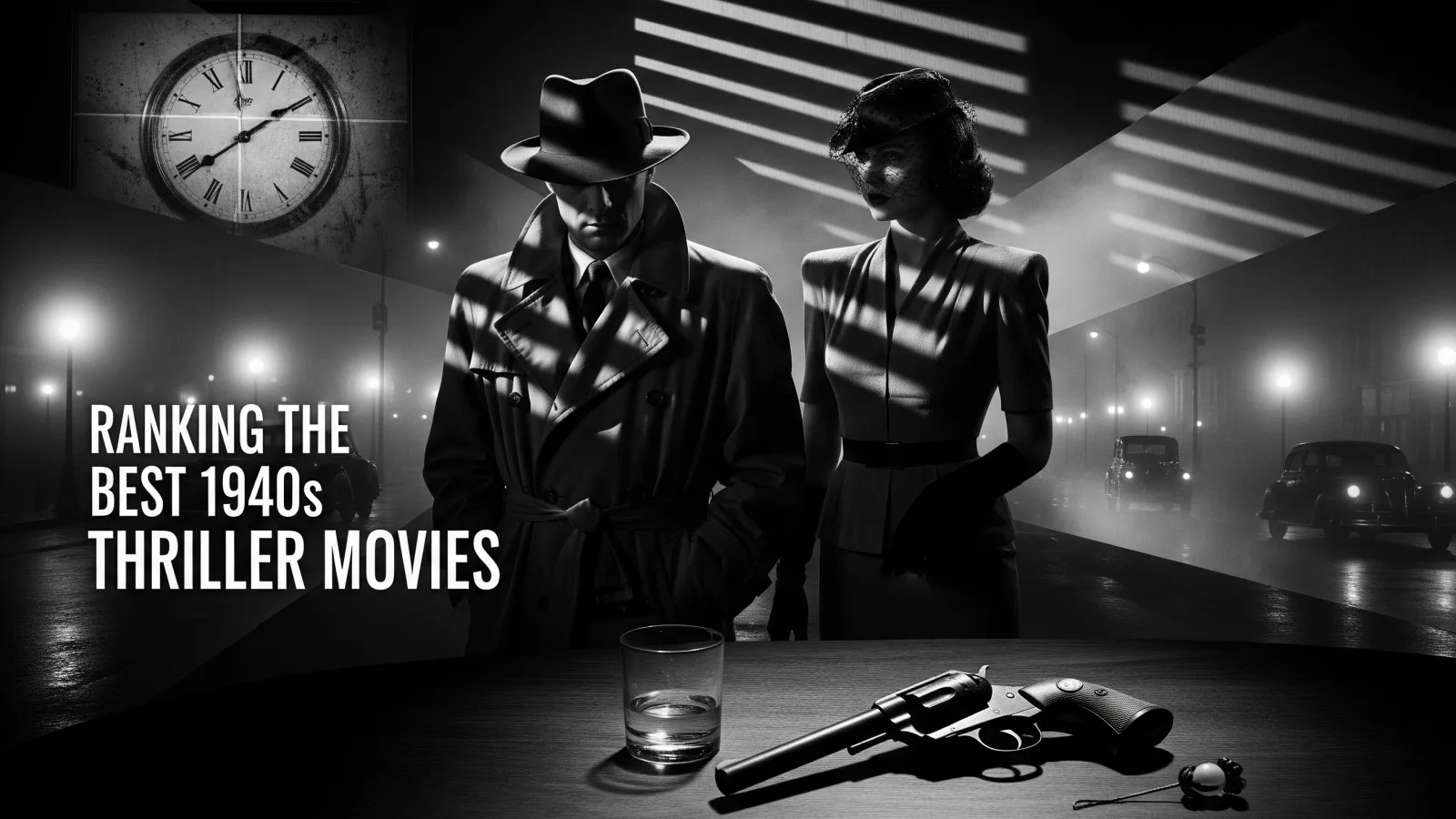

The 1940s represent the absolute pinnacle of suspense cinema. This was a decade shaped by global conflict and societal anxiety, conditions that created the perfect storm for stories of paranoia, betrayal, and psychological torment. From this crucible of uncertainty emerged the shadowy world of film noir, the sophisticated psychological thriller, and the modern spy film.
This definitive ranking showcases the ten greatest thrillers of the decade, films that entertained audiences and rewrote the rules of suspense cinema. Each entry on this list combines critical acclaim, box office success, and lasting cultural impact, representing the very best of what made 1940s thriller movies so enduringly powerful.
10. The Stranger (1946)
Director: Orson Welles
Stars: Orson Welles, Edward G. Robinson, Loretta Young
Orson Welles’s brutally effective post-war thriller operates on a premise both simple and terrifying: one of the architects of the Final Solution has escaped justice and now lives as a beloved prep school teacher in small-town Connecticut. Franz Kindler (Welles) has built the perfect American life, complete with an unsuspecting wife, until War Crimes Commission investigator Mr. Wilson (Edward G. Robinson) arrives to hunt him down.
What makes The Stranger special is Welles’s unflinching confrontation with the horrors of the Holocaust. The film’s most audacious moment comes when Wilson screens actual concentration camp footage for the townspeople. This raw, documentary evidence was still an open wound for 1946 audiences. This shocking injection of historical reality grounds the thriller’s melodrama in unbearable truth, reminding viewers that the charming neighbor might literally be the devil next door.
Welles portrays Kindler as a man of chillingly precise intellectual evil, obsessed with repairing the local clock tower. The clock becomes a perfect symbol of the rigid order he fanatically craves.
9. Rope (1948)
Director: Alfred Hitchcock
Stars: James Stewart, John Dall, Farley Granger
Hitchcock’s Rope is both a technical marvel and a claustrophobic nightmare. Shot to appear as one continuous take in a single Manhattan apartment, the film follows two young intellectuals who strangle a former classmate for neither passion nor profit, but as a philosophical exercise in Nietzschean superiority. Their twisted brilliance? They hide the body in a wooden chest and host a dinner party around it, with the victim’s father and fiancée as unwitting guests.
Based on the infamous Leopold and Loeb murder case, Rope traps audiences in real-time horror. Every conversation, every casual gesture revolves around the macabre centerpiece. The camera becomes a silent accomplice, gliding through the apartment as tension builds with each near-discovery. James Stewart’s former teacher, who had planted dangerous philosophical seeds in his students’ minds, slowly begins to suspect the horrifying truth.
This is Hitchcock at his most experimental. The film proves suspense doesn’t need exotic locations or elaborate set pieces, just the suffocating weight of a terrible secret.
8. Laura (1944)
Director: Otto Preminger
Stars: Gene Tierney, Dana Andrews, Clifton Webb
Here’s a murder mystery where the detective falls in love with the victim. Or rather, with the idea of her. Laura is a ghost story masquerading as a police procedural, set in the opulent world of Manhattan’s cultural elite.
Detective Mark McPherson (Dana Andrews) investigates the brutal murder of Laura Hunt (Gene Tierney), a beautiful advertising executive. As he interviews the men in her life, particularly the acidic columnist Waldo Lydecker (Clifton Webb in a career-defining performance), he becomes obsessed with the dead woman. He gazes at her portrait as if he could will her back to life.
The film unfolds in a world of sophisticated surfaces hiding rotten cores. Lydecker, crackling with venomous wit, paints Laura as his personal creation, a Galatea he sculpted from obscurity. The investigation becomes less about clues and concerns absorbing conflicting testimonies of a woman who seemed to be everything to everyone.
Laura‘s legendary plot twist reconfigures the entire narrative, transforming what could have been a simple story of necrophiliac obsession into something far stranger. The film explores identity and the male desire to possess the feminine ideal through stylish, dreamlike imagery.
7. Ministry of Fear (1944)
Director: Fritz Lang
Stars: Ray Milland, Marjorie Reynolds
Fritz Lang’s Ministry of Fear transforms wartime London into a paranoid nightmare where nothing is as innocent as it seems. Stephen Neale (Ray Milland), recently released from a psychiatric asylum, wins a cake at a village fête. This seemingly harmless prize makes him the target of a Nazi spy ring operating in Blitz-torn Britain.
Lang, the German Expressionist master behind Metropolis and M, fills every frame with disorientation and dread. A quaint country fair becomes a stage for espionage. A séance turns deadly. Even a tailor shop conceals life-or-death secrets. The film excels at weaponizing the mundane, turning everyday English settings into landscapes of terror.
Based on Graham Greene’s novel, the narrative becomes a maze of mistaken identities and shadowy pursuers. The story perfectly reflects both Neale’s fragile mental state and a nation’s wartime anxiety. This underrated masterpiece of 1940s spy cinema proves that in wartime, paranoia becomes a survival skill rather than a mental illness.
6. Green for Danger (1946)
Director: Sidney Gilliat
Stars: Alastair Sim, Sally Gray, Trevor Howard
This brilliant British thriller fuses a classic locked-room mystery with the tension of wartime. Set in a rural emergency hospital during August 1944, Green for Danger unfolds as German V-1 flying bombs terrorize the countryside. But the real danger comes from within the operating theater.
When a patient dies under anesthesia, followed by a nurse who claimed to know the killer’s identity, Scotland Yard’s Inspector Cockrill (Alastair Sim) arrives to investigate. The hospital staff become suspects. Surgeons and nurses played by stars like Trevor Howard and Sally Gray have their personal dramas and professional jealousies unfolding under Cockrill’s sardonic gaze.
What makes Green for Danger special is its perfect balance of genuine suspense and dark humor. Sim’s eccentric detective delivers the film’s wit while methodically peeling back layers of deceit. The operating theater murder scene stands as one of the most chilling moments in 1940s cinema, proving that British filmmakers could match Hollywood’s psychological sophistication while adding their own distinctive flavor.
5. Gaslight (1944)
Director: George Cukor
Stars: Ingrid Bergman, Charles Boyer, Joseph Cotten
Some films capture a moment in time. Gaslight captured a psychological condition so perfectly that it gave the English language a new verb. To “gaslight” someone means to manipulate them into questioning their own sanity, and George Cukor’s film remains the definitive depiction of this insidious form of abuse.
Ingrid Bergman delivers an Oscar-winning performance as Paula, a young opera singer who marries the charming Gregory Anton (Charles Boyer) and returns to the London townhouse where her aunt was mysteriously murdered. Soon, strange things begin happening: objects disappear, noises echo from sealed rooms, and the house’s gaslights dim and flicker inexplicably. Gregory insists Paula is imagining everything. He tells her she’s becoming as mad as her late mother.
The film creates a masterfully claustrophobic atmosphere. We’re trapped with Paula inside the oppressive Victorian house, feeling her grip on reality loosen with each of Gregory’s subtle manipulations. Boyer is terrifyingly good as the tormentor, his affection a thin veneer over calculating cruelty.
Gaslight‘s power lies in recognizing a horror that is entirely domestic. Terror comes from the person you trust most, not from monsters in shadows. The film reminds us that the most frightening prisons are built inside the mind.
4. Double Indemnity (1944)
Director: Billy Wilder
Stars: Fred MacMurray, Barbara Stanwyck, Edward G. Robinson
“I killed him for money and for a woman. I didn’t get the money and I didn’t get the woman.”
This opening line, spoken by dying insurance salesman Walter Neff (Fred MacMurray) into a Dictaphone, sets the tone for the most perfectly crafted film noir ever made. Directed by Billy Wilder and co-written with hardboiled master Raymond Chandler, Double Indemnity tells the story of a perfect crime gone perfectly wrong.
Neff walks into the home of sultry Phyllis Dietrichson (Barbara Stanwyck) to discuss insurance. She wants to take out an accident policy on her husband without his knowledge. Both know what she’s really after. Soon they’re lovers and co-conspirators in a scheme to murder her husband and collect on a “double indemnity” clause that pays out double for accidental death.
The film is a masterpiece of fatalistic storytelling, told entirely in flashback by a man who knows he’s already doomed. The dialogue is pure acid, a symphony of wisecracks and sexual innuendo. Stanwyck’s Phyllis, with her cheap blonde wig and ankle bracelet, became the archetypal femme fatale. But the film’s secret weapon is Edward G. Robinson as Barton Keyes, Neff’s mentor and claims adjuster who can smell fraud from miles away.
Double Indemnity established the visual and thematic template for film noir: venetian blind shadows, cigarette smoke, and the inexorable descent into moral darkness. The film remains the genre’s undisputed masterpiece.
3. Shadow of a Doubt (1943)
Director: Alfred Hitchcock
Stars: Teresa Wright, Joseph Cotten
Hitchcock called this his personal favorite among his own films, and the movie represents his most unsettling exploration of the duality of human nature. The film suggests that monsters aren’t foreign invaders. They’re sitting beside you at the family dinner table.
Set in the sun-drenched, idyllic town of Santa Rosa, California, the story follows young Charlie (Teresa Wright), a bright teenager who feels a telepathic connection to her sophisticated Uncle Charlie (Joseph Cotten). When he arrives for a visit, the family is overjoyed. But his timing coincides with a nationwide manhunt for the “Merry Widow Murderer,” a serial killer targeting wealthy widows.
Hitchcock builds suspense through subtle clues and increasingly unsettling conversations rather than overt threats. Uncle Charlie’s charm begins to curdle, revealing deep-seated misogyny and nihilistic contempt. Young Charlie becomes the first to piece together the horrifying truth, leading to a desperate psychological battle for the soul of the family and town.
Joseph Cotten’s performance is magnificent. He makes Uncle Charlie both seductively charming and reptilian. Shadow of a Doubt tears away small-town American innocence to reveal the darkness that can fester beneath, suggesting that evil is an integral part of the human condition rather than an outside intrusion.
2. Notorious (1946)
Director: Alfred Hitchcock
Stars: Cary Grant, Ingrid Bergman, Claude Rains
Notorious represents Hitchcock at his most psychologically perverse. The film is a toxic cocktail of espionage and romance that remains one of cinema’s greatest spy thrillers. Ingrid Bergman plays Alicia Huberman, the “notorious” hard-drinking daughter of a convicted Nazi spy. She’s recruited by cold government agent T.R. Devlin (Cary Grant) to redeem her family name by seducing Alex Sebastian (Claude Rains), a Nazi fugitive hiding in Rio de Janeiro.
The central cruelty is that Devlin and Alicia fall in love, but his rigid professionalism (and perhaps sadism) prevents him from stopping her dangerous assignment. He watches as the woman he loves marries another man to infiltrate a uranium smuggling operation hidden in wine bottles.
Notorious operates on multiple levels of suspense. There’s the spy mission danger, exemplified by the nail-biting wine cellar sequence where Alicia and Devlin search for uranium samples. Beneath this lies excruciating emotional tension between lovers whose relationship is poisoned by duty and deception.
Hitchcock’s camera work is immaculate. He builds suspense through lingering close-ups on coffee cups, skeleton keys, and wine bottles. The film’s complex moral ambiguity and sophisticated character development helped define the modern spy genre, proving that the greatest stakes in espionage are often matters of the heart.
1. The Third Man (1949)
Director: Carol Reed
Stars: Joseph Cotten, Orson Welles, Alida Valli
The Third Man stands as the best thriller of the 1940s and one of cinema’s greatest achievements, period. Set in post-war Vienna, a city carved into rubble and occupation zones by Allied powers, the film creates a world so immersive you can feel the damp chill of its cobblestones.
American pulp novelist Holly Martins (Joseph Cotten) arrives in Vienna to visit his old friend Harry Lime, only to learn that Harry died in a traffic accident. But witness accounts don’t match, and there was a mysterious “third man” at the scene. Martins’ amateur investigation leads him into Vienna’s black market underworld and toward a devastating truth about friendship and moral corruption.
Director Carol Reed and cinematographer Robert Krasker create a visual masterpiece using German Expressionist techniques. Canted angles, looming shadows, wet streets that reflect the city’s fractured soul. Anton Karas’s haunting zither score perfectly complements the film’s mood of melancholy and dread.
Then there’s Harry Lime. Orson Welles’s entrance, emerging from shadows in a doorway with his face illuminated by a shaft of light, remains one of cinema’s most iconic character reveals. His presence dominates the film despite limited screen time. Welles makes Harry a figure of immense charm and absolute nihilism, a man who’s profited from the city’s misery by selling diluted penicillin to children’s hospitals.
The philosophical confrontation between Martins and Lime on the Wiener Riesenrad Ferris wheel serves as the film’s thematic centerpiece. Lime’s famous “cuckoo clock” speech dismisses Switzerland’s peaceful prosperity while defending Italy’s violent Renaissance creativity. The speech crystallizes his chilling worldview.
The Third Man works as both a gripping thriller and profound meditation on friendship, loyalty, and moral disillusionment in a world emerging from war’s shadow. The film captures the soul-sickness of a continent trying to rebuild from devastation, making it the decade’s finest thriller and one of cinema’s greatest achievements.
Why These Films Define 1940s Thriller Cinema
The 1940s thriller emerged from a perfect storm of historical circumstances. Global war created widespread anxiety and paranoia that filmmakers channeled into stories of betrayal, deception, and psychological torment. The decade’s rapid technological advances in cinematography, particularly low-key lighting techniques, allowed directors to create the shadowy, morally ambiguous worlds these stories demanded.
These ten films represent the full spectrum of 1940s thriller excellence: Hitchcock’s psychological masterpieces, the cynical sophistication of film noir, the paranoid atmosphere of wartime spy stories, and the innovative techniques that would influence decades of cinema to come. Each remains as gripping today as when first released, proving that truly great suspense is timeless.
If you’re discovering these classics for the first time or revisiting old favorites, this collection represents the absolute pinnacle of thriller cinema. These are films that entertained audiences and fundamentally changed how stories of suspense could be told.