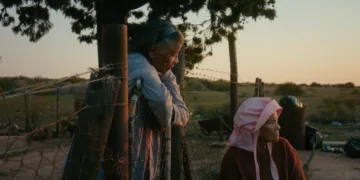

















A disheveled man watches a teenage girl from a rusty pickup truck. This image, thick with foreboding, opens Mia and immediately establishes the grammar of a thriller. The man, Aaron, soon abducts the girl, Emma. What follows, however, is not a typical story of a crime and its resolution.
Aaron makes no demands for money. Instead, he presents a shocking claim: he is Emma’s father, and she is Mia, his daughter who vanished fourteen years prior. This startling turn shifts the film’s foundation from physical danger to psychological torment. The audience is immediately confronted with a difficult question. Is Aaron a violent man lost in a dangerous delusion, or is he a broken father enacting a desperate, tragic reunion?
The story locks us inside a claustrophobic world with these two figures, Aaron (Shah Motia) and Emma (Emiliana Jasper), who represent the two poles of a terrifying possibility. Mia is a thriller built from pure ambiguity, a film that promises to destabilize a viewer’s sense of certainty from its very first frames.
A Duet of Desperation and Dread
Shah Motia gives Aaron a terrifying sincerity. He inhabits Aaron’s worn-out frame completely, his performance etched with the physical exhaustion of a man who has lived out of his truck for years on a singular, corrosive mission. His eyes hold both a wild, desperate hope and a frightening emptiness.
His actions are monstrous, yet his belief that he is acting from a place of profound love makes him a complicated figure. Motia’s delivery of Aaron’s rambling monologues, full of fractured memories and appeals to a shared past Emma cannot recall, paints a portrait of a mind that has collapsed under the weight of grief. He is a man who is simultaneously pathetic and deeply menacing.
Opposite him, Emiliana Jasper gives Emma a resilience that grounds the story’s high-wire tension. Her fear is not a static state; it is a fluid, calculating thing. We see her initial terror give way to a watchful intelligence as she begins to probe her captor’s psyche for weaknesses or inconsistencies.
Jasper portrays this shift with subtle grace, showing a maturity far beyond her character’s years. Her performance is the audience’s anchor in a sea of uncertainty. A fleeting detail, like the discovery that both she and Aaron crack their knuckles, is loaded with immense weight, a tiny splinter of potential connection in an otherwise horrifying ordeal.
The film’s narrative power is generated almost exclusively by these two. Their dynamic is the film’s entire architecture, a tense psychological chess match where Emma’s quiet probes are met with Aaron’s emotional appeals. The success of the film rests on the chemistry and sustained pressure generated by its two formidable leads.
A Murky, Obscured Reality
Director Luis Ferrer plunges the audience into a visual gloom that mirrors the story’s central predicament. The color palette is a desaturated wash of roadside browns, murky greens, and the grimy wood of a remote cabin, creating a world that feels as worn down as its protagonist.
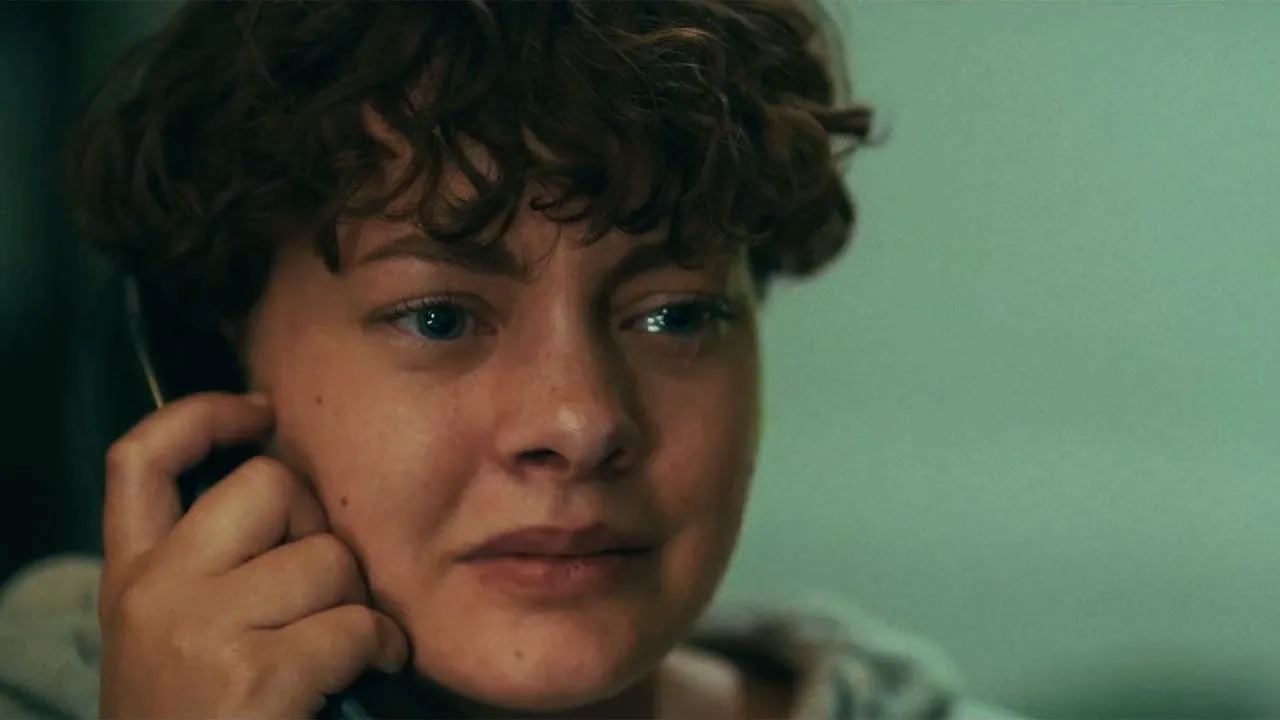
The cinematography is defined by its persistent darkness, a choice that denies the viewer the comfort of clarity and keeps the truth, like the characters, steeped in shadow. The camera refuses a stable, omniscient viewpoint. Instead, it adopts tortured angles and unsettling frames that feel deliberately antagonistic. Much of the action happens just beyond the edge of the screen, or is seen only from behind a character’s head, forcing us to lean in, to strain to see.
The camera might linger on a character’s trembling hands as they speak, or fixate on an ear, a choice that severs the connection between word and speaker and forces the audience to piece together the emotional truth. This is a brilliant strategy of disorientation, making the viewer feel as trapped and confused as Emma.
This visual claustrophobia is amplified by the sound design. The electronic drone that permeates the film is less a musical score and more an extension of Aaron’s fractured consciousness, the sonic equivalent of his unrelenting obsession. The silences are just as potent, creating pockets of unbearable tension where the only sounds are the creak of the cabin floor or the ragged breathing of the two characters.
Combined with the film’s lean 80-minute runtime, this oppressive atmosphere ensures the viewer is never allowed to feel settled or safe. The film’s style is its substance, creating a world where seeing is not believing, and every sensory detail contributes to a profound sense of unease.
The Persistence of Doubt
Mia’s chief concern is the fragile nature of truth itself. The film interrogates the very bedrock of identity. If memory can be contested, if a person’s history can be rewritten by a narrative powerful enough, what is left of the self? The narrative is constructed as a puzzle with essential pieces withheld, requiring the viewer to become an active participant in sorting fact from fiction.
By refusing a simple verdict on Aaron’s claims, the film suggests the emotional damage is the same regardless of the facts. The terror for Emma is absolute, whether her captor is her father or a stranger. The film’s slow-burn approach is not a lack of incident but a method for building psychological weight, allowing the deep uncertainty of the situation to fester.
The story finds its power in suggesting that delusion and a fractured truth might not be mutually exclusive. It poses the difficult question: could Aaron be both mentally broken and correct? It is a difficult and unnerving picture, one that is rewarding for audiences who appreciate cinema that challenges them to sit with discomfort. Its strength lies in its unwavering commitment to its ambiguous premise.
The film’s final moments are both intense and heartbreaking, offering not a resolution but a profound emotional resonance that lingers long after the screen goes dark. It offers no comfort, only the disquieting echo of a question about how fiercely desperation can bend the shape of the world.
Mia, also titled MIA, is a 2024 psychological thriller. It was written and directed by Luis Ferrer. The film premiered in the United States on November 21, 2024, and was released on digital platforms on July 8, 2025.
Full Credits
Director: Luis Ferrer
Writer: Luis Ferrer
Producers: Luis Ferrer, Robbie Dias
Cast: Shah Motia, Emiliana Jasper, Julie Lucido, Eden Ferrer, Tim Willis, Robbie Dias, Jeffrey Sarceno, Bryan Ricke, Katherine Nilsen
The Review
Mia
A tense and masterfully crafted psychological thriller, Mia is an unsettling experience that thrives on ambiguity. Powered by two phenomenal lead performances and a directorial vision that weaponizes disorientation, the film is a difficult but rewarding watch. It forgoes easy answers in favor of a lingering, claustrophobic dread that questions the very nature of truth and memory. It is a potent piece of filmmaking for those who appreciate a true challenge.
PROS
- Shah Motia and Emiliana Jasper deliver compelling and deeply felt performances that anchor the film.
- The claustrophobic cinematography, oppressive sound design, and deliberate pacing create a sustained feeling of dread.
- The film's central mystery is ambiguous and intelligently constructed, leaving the audience to grapple with complex questions.
CONS
- The slow-burn pace and deliberately obscured visuals may frustrate viewers seeking a more conventional thriller.
- The grim tone and lack of emotional release can make for an exhausting viewing experience.
- The commitment to ambiguity means the film offers little in the way of narrative closure, which could be unsatisfying for some.