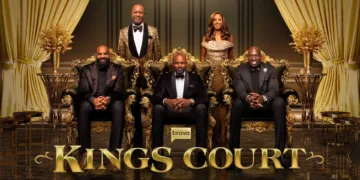






























In the ever expanding universe of reality dating, where romance is both the prize and the premise, comes “Kings Court.” The series presents a seemingly straightforward proposition. Three famous bachelors, supermodel Tyson Beckford, NBA veteran Carlos Boozer, and WWE ambassador Thaddeus “Titus O’Neil” Bullard, are looking for love.
Guided by the capable hands of hosts Holly Robinson Peete and Rodney Peete, these men are presented with a curated selection of 21 accomplished women, each hoping to become a “queen.” This spinoff from Peacock’s “Queens Court” enters a crowded marketplace, positioning itself as a high-stakes search for authentic connection.
It places its celebrity leads in a carefully constructed ecosystem designed to produce drama, feeling, and perhaps even a lasting relationship. The show asks a familiar question: can true love be found when cameras are rolling?
Profiling the Bachelors
The show’s texture comes from the distinct personalities of its three leads, each man representing a different facet of modern celebrity masculinity. At 54, Tyson Beckford carries himself with the quiet confidence of a man who has nothing left to prove. He adopts a discerning, almost clinical approach, likening himself to James Bond waiting for a singular figure to capture his attention.
This “Bond” persona is more than just a cool affectation; it is a shield forged from experience, a way to navigate a manufactured environment while searching for something real. His history makes him a quick study of character, scanning for “red flags” with an efficiency born of past disappointments. He even slips into the role of a “house counselor,” a testament to his perceived seniority and a sign of the emotional weight he feels in a space designed for romantic chaos.
In contrast, former NBA star Carlos Boozer embodies a more relaxed, observational style. His professional sports background, which demanded court awareness and strategic patience, seems to inform his method. He is less about grand pronouncements and more about quiet assessment, exemplified by his immediate interest in Janaye. Her down-to-earth appeal stands out in a sea of performative personalities, suggesting his search is for substance that can exist beyond the camera’s glare.
Then there is Thaddeus “Titus O’Neil” Bullard, whose WWE background informs a comfort with big personalities. Professional wrestling is a world of spectacle, and he appears drawn to women who can match that energy, such as the assertive Dr. Shawonna. His attraction suggests a desire for a partner who is not intimidated by his public image, but who can hold her own ground with commanding presence.
The Competition for the Crown
The architecture of “Kings Court” is built on familiar reality television blueprints, meticulously designed to generate conflict and connection in equal measure. The competition begins with a runway walk, a telling choice that frames the women as contestants first and potential partners second. This opening act immediately establishes a power dynamic and a culture of aesthetic judgment, reducing complex, accomplished women to a visual first impression. From there, the path to love is paved with manufactured scenarios.
A skydiving date with Tyson is not just an outing; it is a high-stakes trust fall designed to create a hormonal rush that mimics romantic excitement. A yoga session with Carlos becomes a performance of tranquility and forced intimacy. These activities are shortcuts, meant to accelerate emotional bonds that might otherwise take months to form in the real world.
The show’s primary engine, however, is the dynamic among the women. While the kings remain relatively composed, the female cast supplies the expected chaos. The producers have assembled a wide spectrum of personalities, ensuring that friction is inevitable. The confession of one woman who lied about her dating preferences simply to prolong a conversation is a perfect microcosm of the show’s environment; it reveals the intense pressure to be constantly engaging.
The contestants must become amateur strategists, navigating a precarious space between being their “authentic selves” and being entertaining enough to secure another week. Intimate elimination dinners, where only those on the chopping block are present, serve as tense punctuation marks, ensuring the pressure never fully dissipates and that every action has potential consequences.
The Royal Verdict
What, then, is the cultural contribution of “Kings Court”? Its most notable feature is its unambiguous celebration of successful Black men actively seeking committed relationships, a portrayal that offers a welcome alternative to pervasive stereotypes. The show allows its leads to exist outside their professional arenas, placing them in a context of emotional consideration. This shift in focus is a significant, if quiet, statement.

The spectacle is undeniably watchable, fueled by the classic reality show algorithm that pits the relaxed confidence of the men against the engineered drama of the women. Fans of the genre will find all the requisite elements: budding romances, personal conflicts, and the weekly suspense of elimination.
Yet the show’s structure rarely challenges the conventions of its predecessors. It operates safely within the established lines of the dating competition format, missing an opportunity to innovate. The series exists in a strange paradox: it offers a novel and important cast but places them in a very old story. Does it truly explore the depths of its leads’ vulnerability, or does it keep them on a pedestal as untouchable “kings,” thereby limiting a deeper emotional journey?
Its existence speaks to a broader industry trend toward niche content and the power of the spin-off. It proves the financial viability of hyper-specific reality programming for targeted demographics. Its impact is therefore less about revolutionizing television storytelling and more about reinforcing a model where representation is delivered through familiar, commercially safe containers rather than through bold, new narrative structures.
Full Credits
Directors: Ty Foard, Gin Blanton, KayDee Carr
Producers: Will Packer, Kate Vollum
Executive Producers: Chandachevannes, Richard Brown, Omid Kahangi, Rob LaPlante, Jeff Spangler
Cast: Holly Robinson Peete, Tyson Beckford, Thaddeus Bullard, Rodney Peete, Carlos Boozer, Jenny Jackson
Composer: Aaron Paris
The Review
Kings Court
"Kings Court" is a notable entry in the dating genre for its positive portrayal of successful Black men seeking commitment. The series offers a refreshing cast, yet places them within a disappointingly familiar and formulaic structure. It relies on manufactured drama and well-worn reality TV tropes instead of exploring deeper emotional truths. While providing a watchable and sometimes fun diversion, it ultimately chooses the safety of the conventional over the potential for genuine innovation. It's a step in the right direction for casting, but a lateral move for the genre itself.
PROS
- Provides positive and nuanced representation of successful Black men looking for committed relationships.
- The three leads are engaging, with distinct personalities that create interesting dynamics.
- Follows a classic reality TV formula that is reliably entertaining for fans of the genre.
CONS
- The structure is unoriginal and relies heavily on predictable dating show tropes.
- Much of the drama feels manufactured and focuses on conflict among the female contestants.
- Misses the opportunity to innovate the genre, despite its progressive casting choices.