


























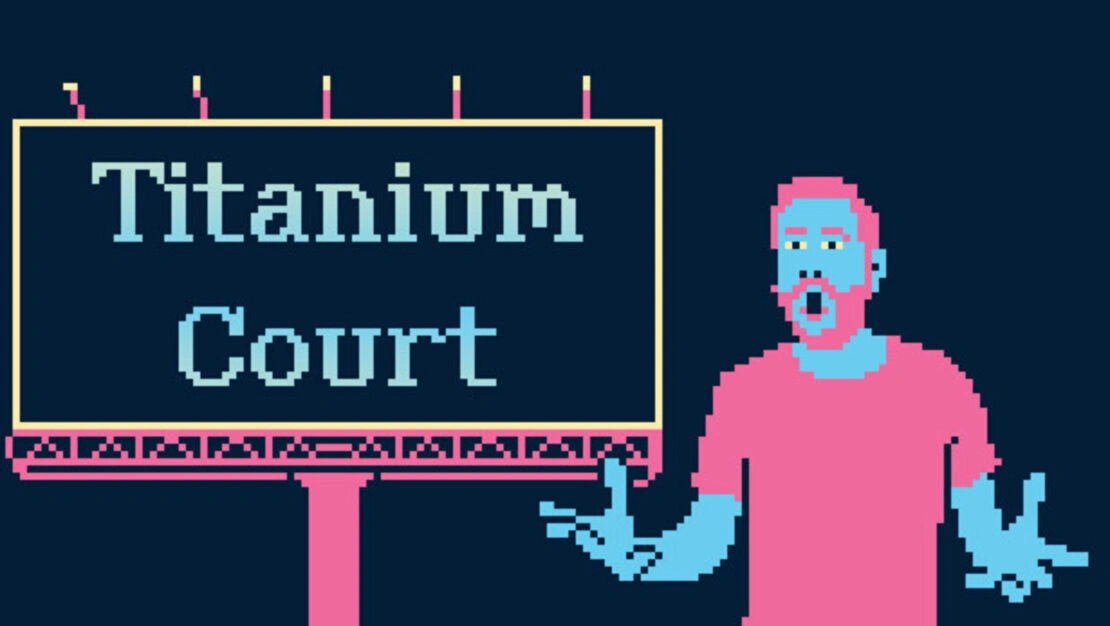

Titanium Court sounds like something explained during a fever dream after too much time with Candy Crush, Into the Breach, and a Shakespeare paperback left open in the rain. It is a roguelite puzzle-strategy game where match-three tile sliding determines military survival, where a faerie court goes to war after breakfast, and where absurdity is treated as a design principle rather than a decorative flourish.
The player controls a nameless protagonist pulled into a strange alternate world and crowned queen of the Titanium Court, a faerie faction trapped in a daily conflict against a rival red court. Each cycle carries the rhythm of a ritual: wake, wander, learn, prepare, fight, fail or survive, then return to the court with new wrinkles in the story and new possibilities in play.
That loop could have collapsed under its own eccentricity, yet Titanium Court gives its chaos a clear mechanical spine. Every joke, tile, route choice, shop, enemy, curse, and stray bit of faerie nonsense seems to feed into the sensation that this court is alive, confused, self-important, and always seconds away from disaster.
A Court Where Nonsense Has Its Own Internal Law
The setup places the player inside a world ruled by magical logic that rarely bothers to explain itself in a straight line. Puck, wine-soaked and meddlesome, names the protagonist queen almost by accident, placing her at the head of a court she barely understands.
The role sounds grand, then immediately becomes ridiculous. Leadership here means attending breakfast, wandering through strange rooms, fielding cryptic conversations, and preparing for another day of combat whose purpose feels ritualistic rather than moral.
That absence of a clear reason for the war is part of the game’s flavor. The conflict between the Titanium Court and the red court feels ancient, habitual, and absurd. Nobody seems especially equipped to explain why bloodshed happens every day, which makes the war feel less like a political struggle and closer to a theatrical curse. The game’s connection to A Midsummer Night’s Dream comes through in its courtly disorder, its slippery identities, and its sense that the player has wandered into a performance already in progress.
Between battles, the court becomes a compact hub of discoveries. Breakfast can teach you something. A shower can become a hint system. A library may offer lore, misdirection, or a new thread to follow. Rooms, gardens, portraits, magic lessons, and strange characters all add to the feeling of a world where every object is waiting to become either a punchline or a rule.
The writing is dense, playful, and often wonderfully odd. Characters speak in riddles, corporate fragments, poetic nonsense, and warped common sense. Road signs become mysterious symbols because faeries do not understand cars. Domestic routines gain magical importance. A missing key can feel like a metaphysical condition. At its best, Titanium Court captures the comedy of encountering human culture from the wrong angle.
There is a cost to this density. The game throws out names, systems, lore, gags, mechanical hints, and tonal feints at a rapid clip. Some players will find the cast hard to hold in memory, and some threads blur before they settle. The writing can feel overstuffed, especially early on, when the player is still learning how the court, the war, and the board all connect. Yet that overabundance is also where much of the game’s personality lives. Titanium Court would lose a great deal if it behaved itself.
High Tide, Low Tide, and the Comedy of Tactical Collapse
Titanium Court’s daily loop is easy to describe and much harder to master. You wake in the court, explore for clues or resources, enter a battlefield, choose a route through an overworld grid, and attempt to survive a sequence of fights leading toward a boss. Loss sends you back, while small forms of progress carry forward through buffs, unlocks, and growing knowledge of the court’s strange rules.
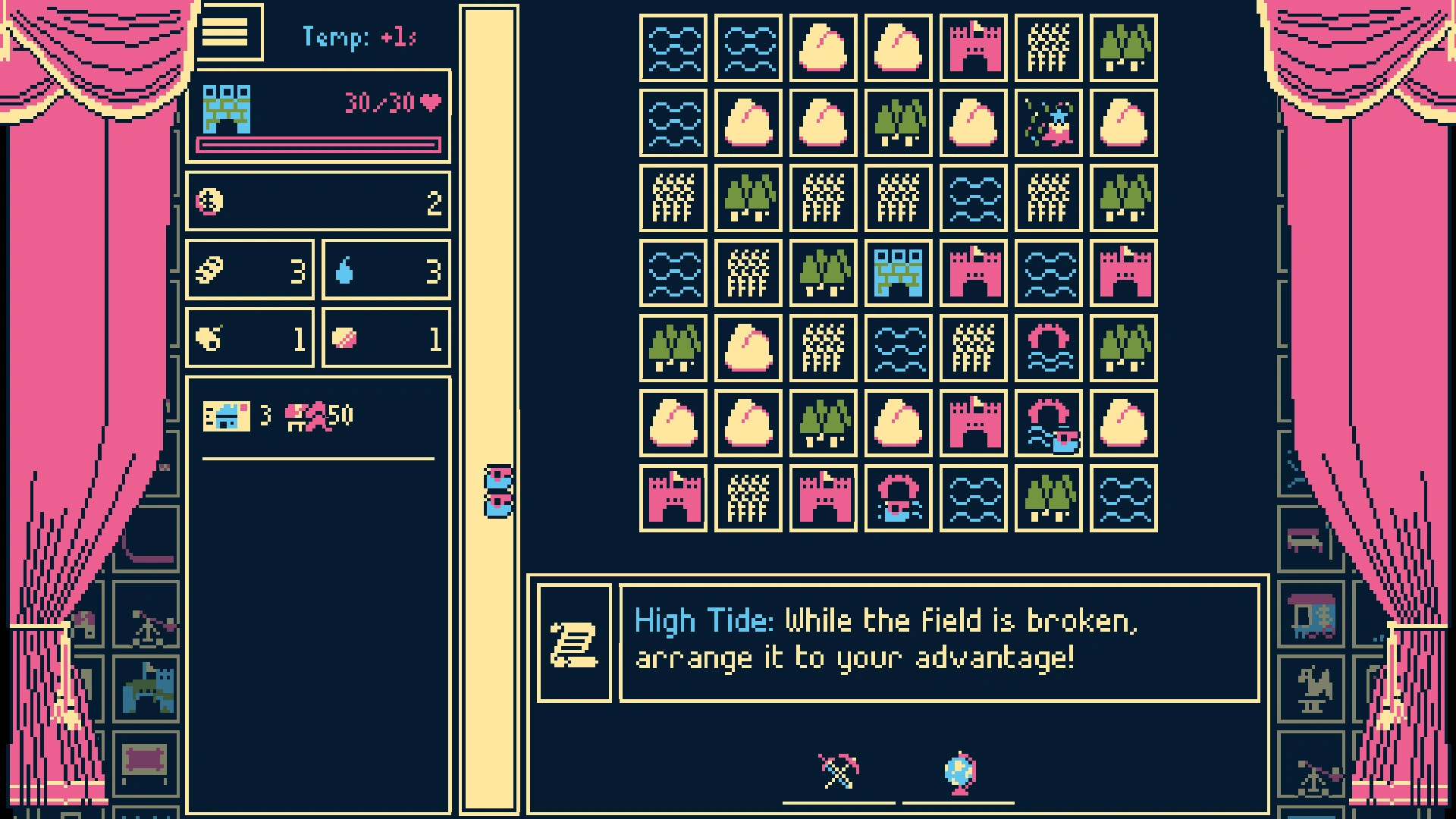
The heart of each battle sits in the shift between High Tide and Low Tide. High Tide is the preparation phase, where the game turns match-three play into tactical planning. Tiles represent both resources and terrain. Trees provide wood, rocks provide stone, rivers provide water, crops provide food, and enemy bases can be matched away before combat begins. This means a simple tile swap can have several consequences at once.
That is the clever trick. Matching water may provide a resource, yet removing that river might open a path to your court. Clearing mountains might give you stone, yet those same mountains may have been slowing enemy units. Matching crops may feed your army, while ignoring enemy bases could leave you swarmed seconds later. A shop, chest, market, or hospital attached to a tile can be saved for later or accidentally erased by your own clever move.
The match-three structure gives every decision a physical immediacy. You are sliding pieces on a grid, chasing matches, watching cascades, and hoping the board cooperates. The same cascade that gives you a lucky resource windfall can also tear away the river defense you had built around your court. Titanium Court understands that strategy games often become most memorable when a plan fails in a way that feels partly your fault and partly the universe laughing at you.
Low Tide turns the prepared battlefield into an auto-battler. With tiles locked in place, you spend resources on units and cards: soldiers, defenders, gatherers, and various special tools. You can use spells, potions, barriers, floods, or distractions before the fighting begins. Once the battle starts, control slips away. Your setup has to speak for you.
This could have made each failure feel slow and punishing, yet the fights resolve quickly. That pacing matters. Titanium Court lets you absorb the result, wince at the mistake, laugh at the absurdity, and start thinking about the next attempt. Centaurs, catapults, warships, wormholes, basic troops, and other threats each ask for a different kind of response. A map full of water may be a gift against some enemies and a death sentence against boats. Catapults demand cover. Wormholes create pressure that simple walls cannot always solve.
Route choice adds another strategic layer before the board even appears. Each path can lean toward certain terrain, events, resources, or enemy types. Your chosen job affects which route seems wise. A court built around barriers might welcome rocky maps. A resource-starved run may chase chests or shops. A low-health run may desperately search for a hospital and settle for a cursed mess instead.
Bosses push that flexibility further. Each major foe comes with distinct conditions and can be beaten through offensive, defensive, or economic methods. That variety gives the campaign a pleasing elasticity. You are rarely pursuing one fixed solution. You are trying to read the shape of a run, then bend your court around it before the next catastrophe arrives.
Jobs, Resources, and the Thin Line Between Strategy and Luck
The court’s jobs operate like classes, changing the rhythm of each run in meaningful ways. One job may reward destroying enemy bases. Another might generate money from destroyed barriers. A riskier role can encourage placing extra enemy bases on the board for greater rewards. These are not minor stat tweaks. They alter how you read the map, which resources matter most, and which threats feel survivable.
That variety gives Titanium Court strong replay value. A safe strategy in one job may become useless in another. Some roles push aggressive clearing. Others encourage defensive structures, economic patience, or reckless manipulation of the battlefield. Starting units and cards further shape the opening minutes, making early decisions feel responsive to your chosen identity rather than generic roguelite housekeeping.
Resource management carries much of the pressure. Wood, stone, water, food, money, health, and unit availability all compete for attention. Spending now can save a fight. Saving now can save a run. A shop item might offer the exact buff you need, or it might drain funds you later wish had gone toward healing. A chest might be worth preserving, unless keeping it blocks the match that would erase a dangerous enemy base.
Titanium Court shines when these systems collide in funny, painful ways. A toll-demanding goat can become a bigger threat than an army. A giant jar can distract your soldiers from the urgent matter of defending their home. A market or shop might become a tactical asset, a temptation, or a casualty of your own tile-clearing greed. The game’s best moments come from these overlapping demands, where strategy feels less like clean calculation and closer to crisis management under magical office lighting.
Randomness is the game’s greatest spark and its most persistent irritant. Battlefields, enemy layouts, shop stock, tile drops, cascades, events, and route options all arrive with a degree of uncertainty. This keeps runs lively. It also creates moments where the player can see the right answer and still lack the board state to perform it.
That friction can sting. Match-three systems are tactile and immediate, yet they are imprecise tools for long-term planning. A strategy game asks the player to prepare, predict, and control risk. A match-three board loves disruption.
Titanium Court tries to make those instincts cooperate, and often succeeds through sheer imagination. At times, though, the player’s agency feels squeezed between bad tile luck and harsh enemy pressure. A poor set of route options near a boss can feel especially brutal after a long run.
That flaw matters because the game is smart enough to make you care about your plans. Losing to a foolish decision can be funny. Losing because the board refuses to yield the one match that would make your strategy function can be harder to laugh off.
Kitsch, Corporate Faeries, and Music From a Stranger Dimension
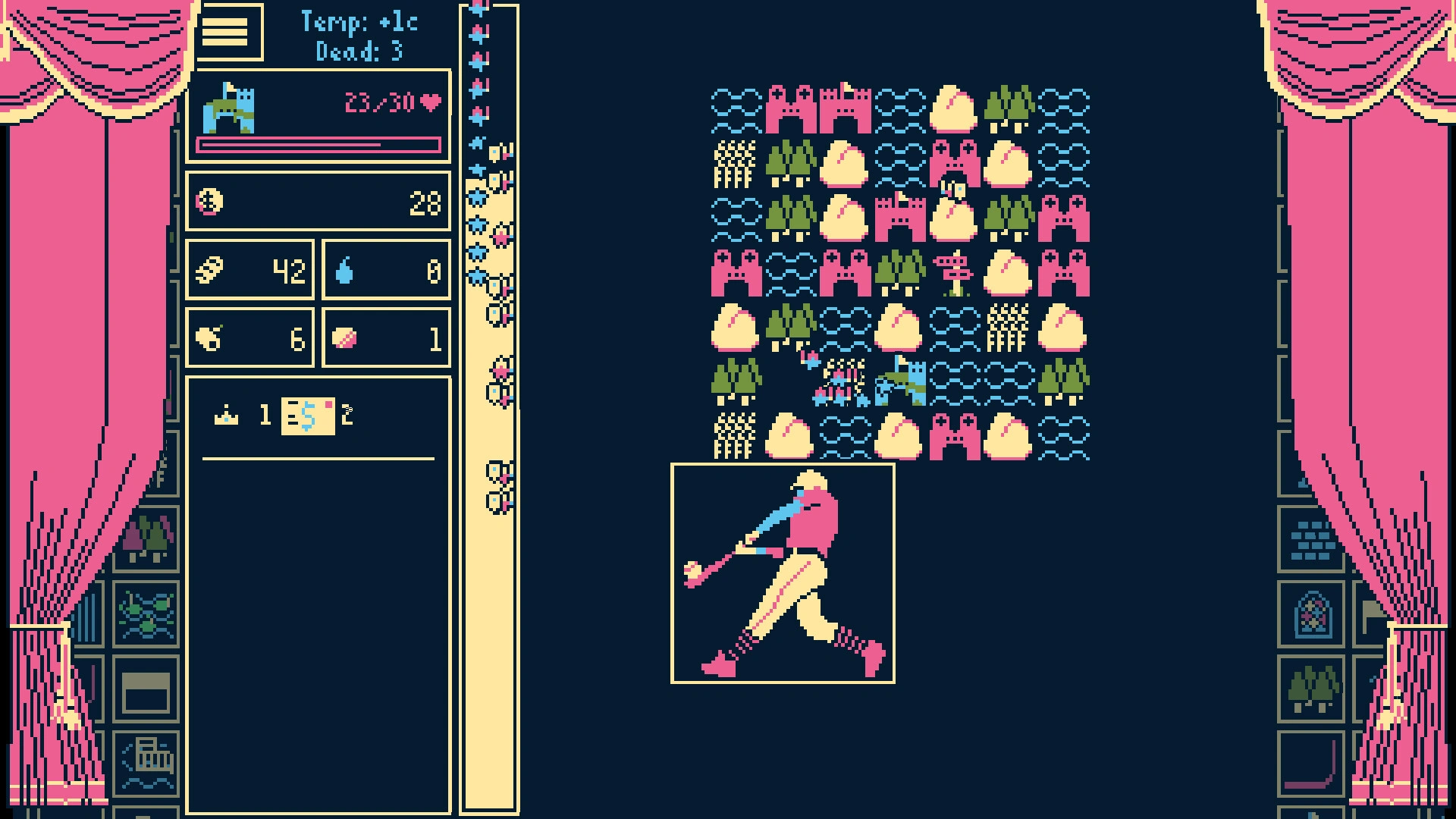
Titanium Court has one of the strangest visual identities in recent indie games. Its world is rendered through tiny buildings, stick-like figures, sharp portraits, little court spaces, and sudden pop-up illustrations that appear during moments of victory or emphasis. The style feels lo-fi, retro, and oddly polished at the same time, like an old computer interface possessed by faerie bureaucracy.
The aesthetic mixture is wonderfully specific. There is theatrical faerie pageantry, corporate training imagery, Windows-era nostalgia, soft pastel coloring, and a recurring taste for kitsch. The battle grid resembles candy-colored terrain, with fields, rivers, mountains, and enemy structures arranged like edible tactical geometry. Character portraits often carry the energy of stage magicians or eccentric office managers, all formal poses and strange authority.
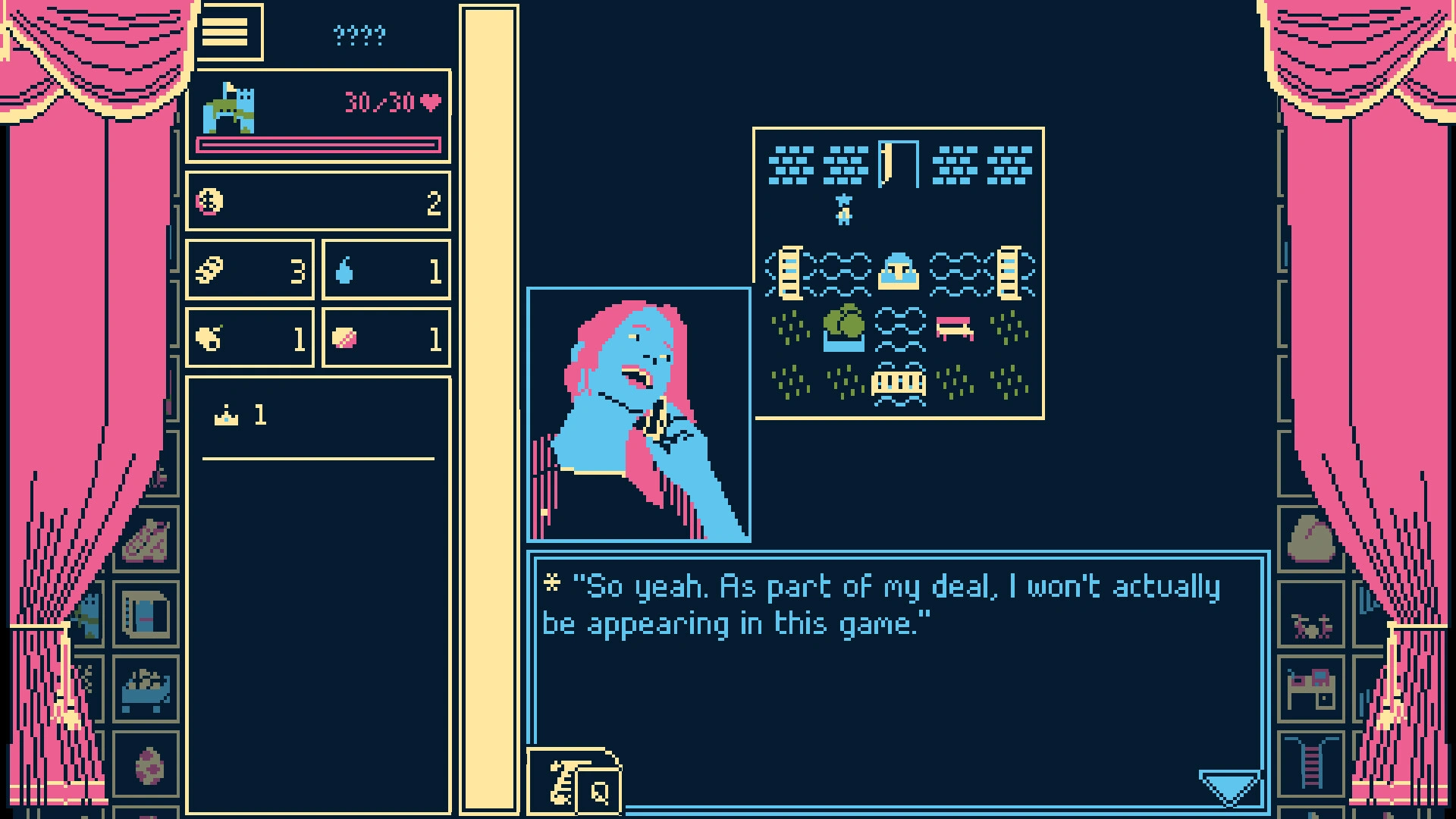
Victory images are one of the game’s funniest touches. A successful moment might be marked by a baseball swing, a cat knocking something from a table, or a basketball dunk. These images should feel random, yet they give battles a peculiar sense of ceremony. The court celebrates violence through motivational clip art from a universe with different priorities.
The audio follows the same private logic. The soundtrack can be jazzy, surf-like, folk-adjacent, handmade, and faintly unwell in the best sense. It softens the violence of the daily war and gives the battles a breezy, almost nonviolent quality. The court may be fighting for survival, but the music often sounds like it wandered in from a lounge where nobody has noticed the building is cursed.
The game also makes space for odd musical interludes, including comic performances that feel both indulgent and perfectly in character. Titanium Court’s soundscape strengthens the idea that this world is not simply quirky. It has its own rhythm, its own rituals, its own sense of what counts as drama.
Accessibility options deserve credit. Controller remapping, pixel and high-resolution font choices, a hyper-legible font, reduced screen shake, and the ability to disable animated text all help make the game easier to handle. That matters in a work so text-heavy and mechanically layered. The interface can still feel busy, yet these options show care for players who want the strangeness without extra friction.
A Brilliant Mess for Players Who Like Their Strategy Games Haunted by Bad Ideas
Titanium Court’s strongest achievement is how coherently it fuses parts that should resist each other. Match-three puzzling, roguelite progression, terrain control, auto-battler combat, visual novel writing, surreal comedy, and courtly mystery all feed into one distinct identity. Many games combine genres. Far fewer make those combinations feel emotionally aligned.
The emotional effect is unusual. Titanium Court can be funny, stressful, confusing, and oddly tender in the same run. The court’s nonsense creates attachment because the player is constantly asked to participate in it. You are not simply reading absurd dialogue between fights. You are making absurd decisions within systems that treat a jar, a goat, a river, a road sign, and a boss as parts of the same unstable world.
Failure often becomes part of the pleasure. A bad cascade can destroy a perfect defense. A greedy purchase can leave you unable to heal. A strange event can turn a safe route into a disaster. The game gives these failures texture, so they feel like stories rather than dead ends. That quality places Titanium Court near puzzle roguelites such as Balatro, where the urge for one extra run comes from the suspicion that the next attempt will create a new kind of absurd logic.
The frustrations are real. The narrative can crowd itself. The systems can pile up faster than the player can absorb them. Tile-matching drives a large share of the experience, so anyone allergic to that core action may find the game’s brilliance trapped behind a mechanic they do not enjoy. Strategy-minded players who prefer clean control may bristle at how often randomness interrupts careful planning.
Still, Titanium Court feels like the kind of indie work worth defending: peculiar, generous, overexcited, mechanically dense, and full of personality. It is best suited to players who enjoy experimental roguelites, puzzle-strategy hybrids, strange writing, and games that reward curiosity outside combat.
It asks for patience and a tolerance for chaos. In return, it offers something rare: a tactical game where every system feels like it has been infected by the court’s strange sense of humor, and where the flaws come from the same restless imagination that makes the whole thing so memorable.
The Review
Titanium Court
Titanium Court is a strange, clever, and often exhilarating puzzle-strategy roguelite that turns match-three play into a battlefield of resources, terrain, risk, and faerie nonsense. Its writing is sharp, its systems are packed with personality, and its lo-fi presentation gives the whole game a wonderfully odd identity. The randomness can frustrate, especially when smart plans collapse under bad tile luck, yet its creativity keeps pulling the player back.
PROS
- Inventive fusion of match-three, roguelite, auto-battler, and visual novel systems
- Distinctive faerie-court setting with sharp surreal humor
- Strong replay value through jobs, bosses, route choices, and hidden outcomes
- Fast combat keeps failed runs from dragging
- Excellent lo-fi art direction and offbeat soundtrack
- Useful accessibility options, including font choices and reduced screen shake
CONS
- Randomness can undercut careful strategy
- Match-three mechanics may fatigue players who dislike the genre
- Dense writing and many systems can feel overstuffed
- Some narrative threads are hard to track
- Bad map options near bosses can feel punishing