

























![Kingdom Hearts Collection [I-III] Review](https://gazettely.com/wp-content/uploads/2026/10/Kingdom-Hearts-Collection-I-III-1-360x180.webp "Kingdom Hearts Collection [I-III] Review: KHII Holds Steady as Newer Entries Fluctuate 37")



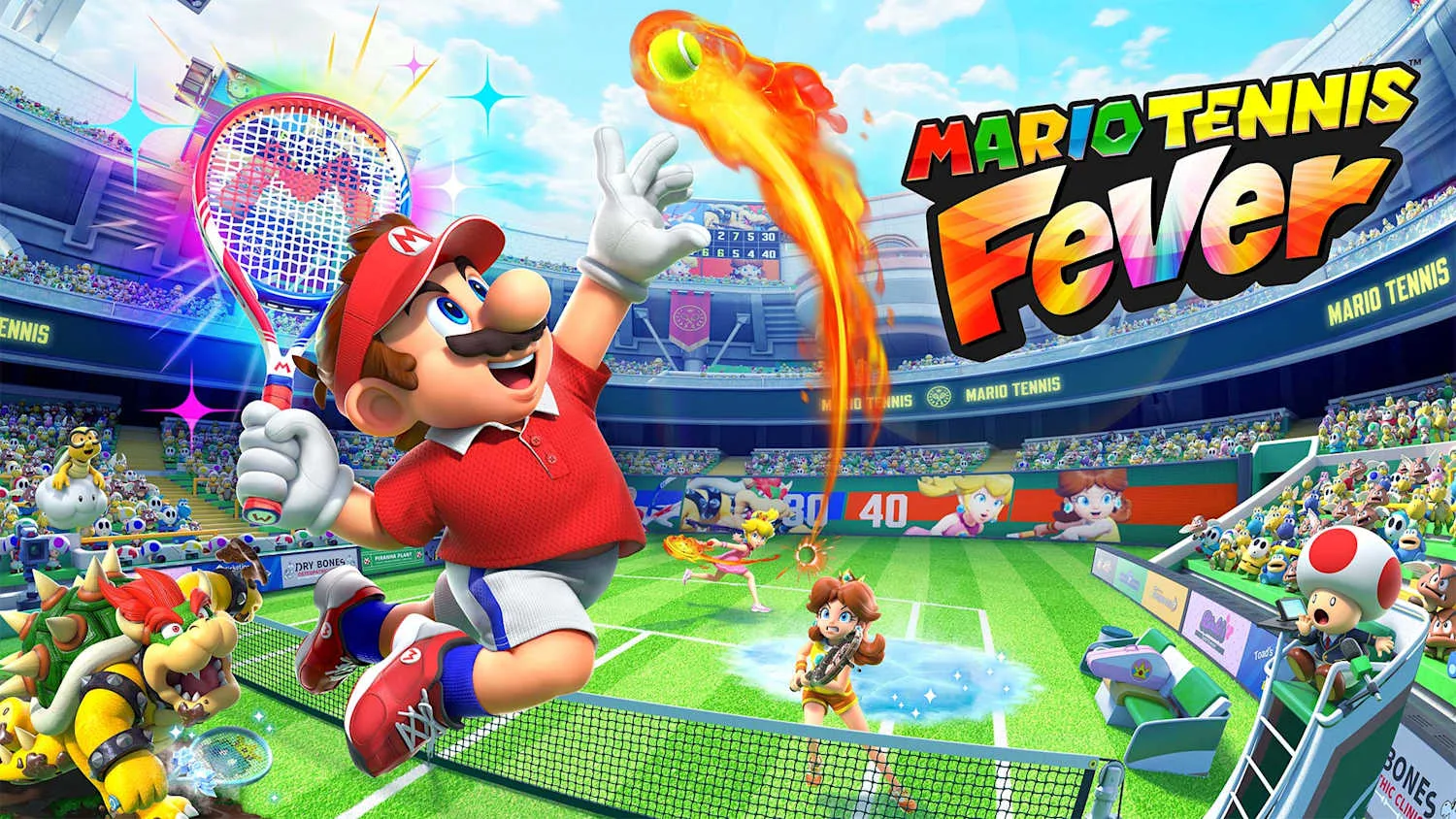

Mario Tennis Fever marks Camelot’s debut for Switch 2 and the studio has set a distinct direction for the series. The Fever Rackets mechanic stands at the center of the design and brings 30 special rackets that can call forth Fire Bars, lay ice patches, or shrink opponents with Mini Mushrooms. That emphasis on chaotic, item-driven play places Fever closer to Mario Kart’s item dynamics than the precision-focused model of Mario Tennis Aces.
The roster expands to 38 playable characters, each arriving with their own stat profile and character animations. Local and online multiplayer constitute the primary draw, while single-player offerings struggle to sustain extended engagement. Adventure frames a baby-transformation tale around extended tutorials, and Tournament mode suffers from an announcer who remarks on nearly every exchange.
The visuals meet expectations for the new hardware and matches run at a steady 60 frames per second. Fever functions best as a social multiplayer diversion, pairing approachable tennis fundamentals with unpredictable special abilities. Players seeking long solo campaigns or carefully balanced competitive play will be disappointed, but groups after chaotic couch sessions will find a reliable party option.
Refined Fundamentals With Simplified Ambitions
Fever builds on decades of tennis iteration and presents a compact set of systems at its base. Five primary shot types cover most on-court situations: topspin for offensive pressure, slice for defensive control, flat for raw power, lob for overhead arcs, and drop shot for soft placements near the net. Face buttons handle the three main shot inputs while two-button combinations trigger specialty moves. Holding a shot button charges a stronger hit and double-tapping performs power shots when your timing and positioning align. The control scheme remains approachable for newcomers and still rewards players who read court position and ball trajectory.
The game intentionally slows the tempo relative to Aces. Ball motion feels lighter and more floaty, which lengthens rallies. Slightly reduced court dimensions make cross-court coverage easier without perfect positioning. Last-moment diving saves occur more often and prevent mistakes that would have ended points in prior entries. A high-speed ball option exists for players wanting a quicker pace, though it does not fully recreate the aggressiveness of Aces. Aces included trick shots, racket durability mechanics, and time-altering zone abilities that pushed play toward a high-skill, fighting-game-like structure. Fever removes those layers and lowers the skill floor to make matches more accessible, at the cost of removing systems that gave long-term competitive players a high skill ceiling.
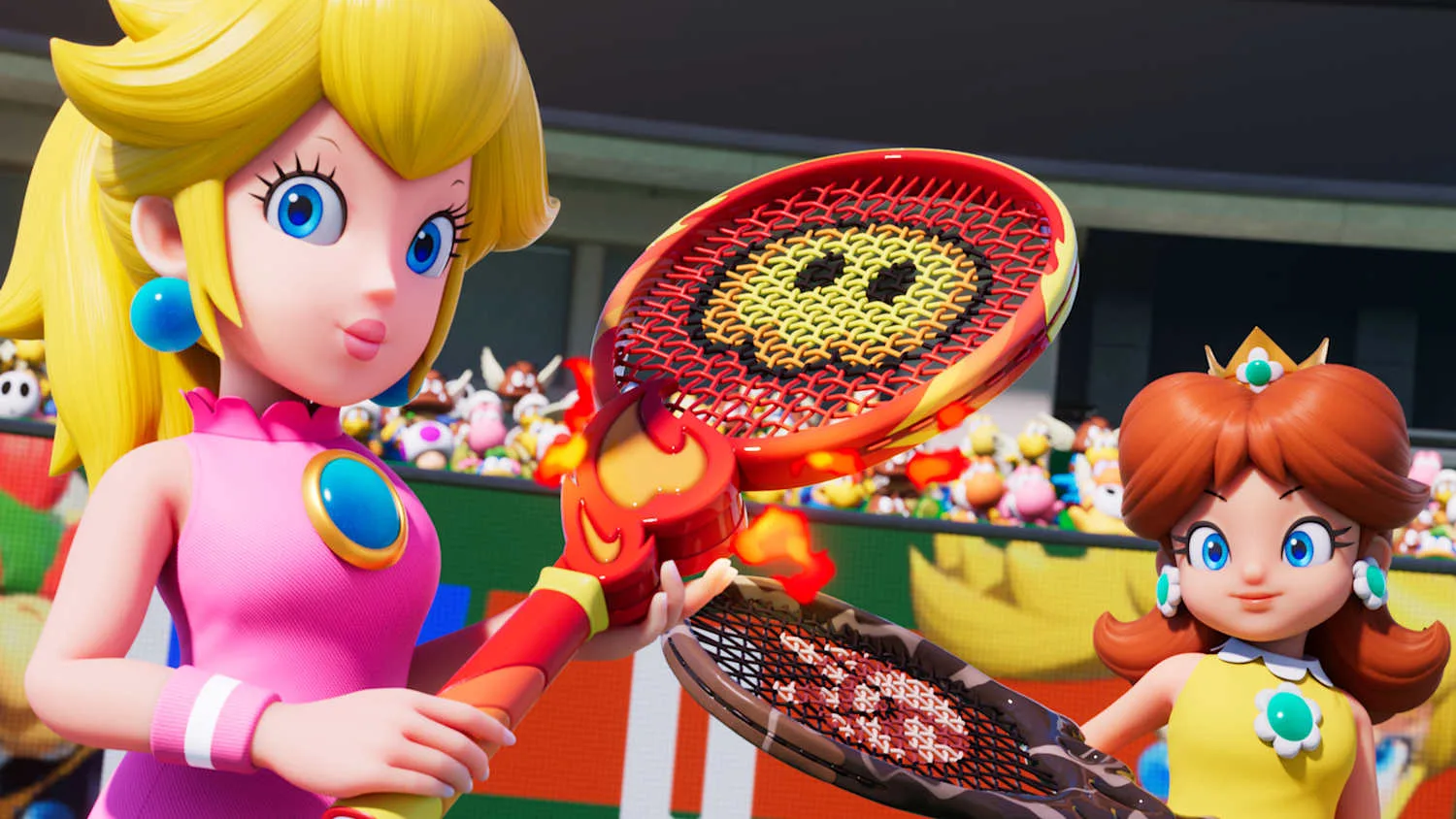
Character variety is present but often registers in subtle ways. Bowser moves with heavy, punishing power. Peach offers quick movement and added curve on returns. Baby Waluigi has emerged as a strong online pick, surprising given his small stature and powerful flat shots. The 38-character roster mixes franchise stalwarts with additions such as Baby Wario, whose charged topspin shifts rally pacing. Visual redesigns for Donkey Kong and Diddy Kong add personality, and walk-on animations inject small touches: Peach enters with royal guards who carry her racket, Spike rolls onto court, and Boom Boom arrives by airship anchor. Rosalina retains a distinctive lob that functions as a signature play option.
Many mid-tier characters feel interchangeable in play. Stat differences look significant in menus but blur during actual matches. The game lists attributes like speed and power, yet those numbers rarely produce obvious, consistent distinctions in normal play.
Visuals show careful polish in character models; Luigi’s shirt texture and Mario’s mustache detail receive clear attention. The cartoon art direction is clean and cohesive with the series’ identity. Performance targets 60 frames per second and consistently holds that target during rallies, even when multiple Fever effects fill the screen. Splitscreen doubles can dip briefly before serves, but stability typically returns once play resumes. Audio feedback lands crisply, and fully charged topspin strikes have satisfying impact that makes proper timing feel rewarding.
The technical presentation feels competent without showcasing a generational leap. Switch 2 hardware handles the demands well, but the presentation does not suggest visuals that could not have been achieved on the original Switch with compromises.
Chaos by Design: How Fever Rackets Transform Matches
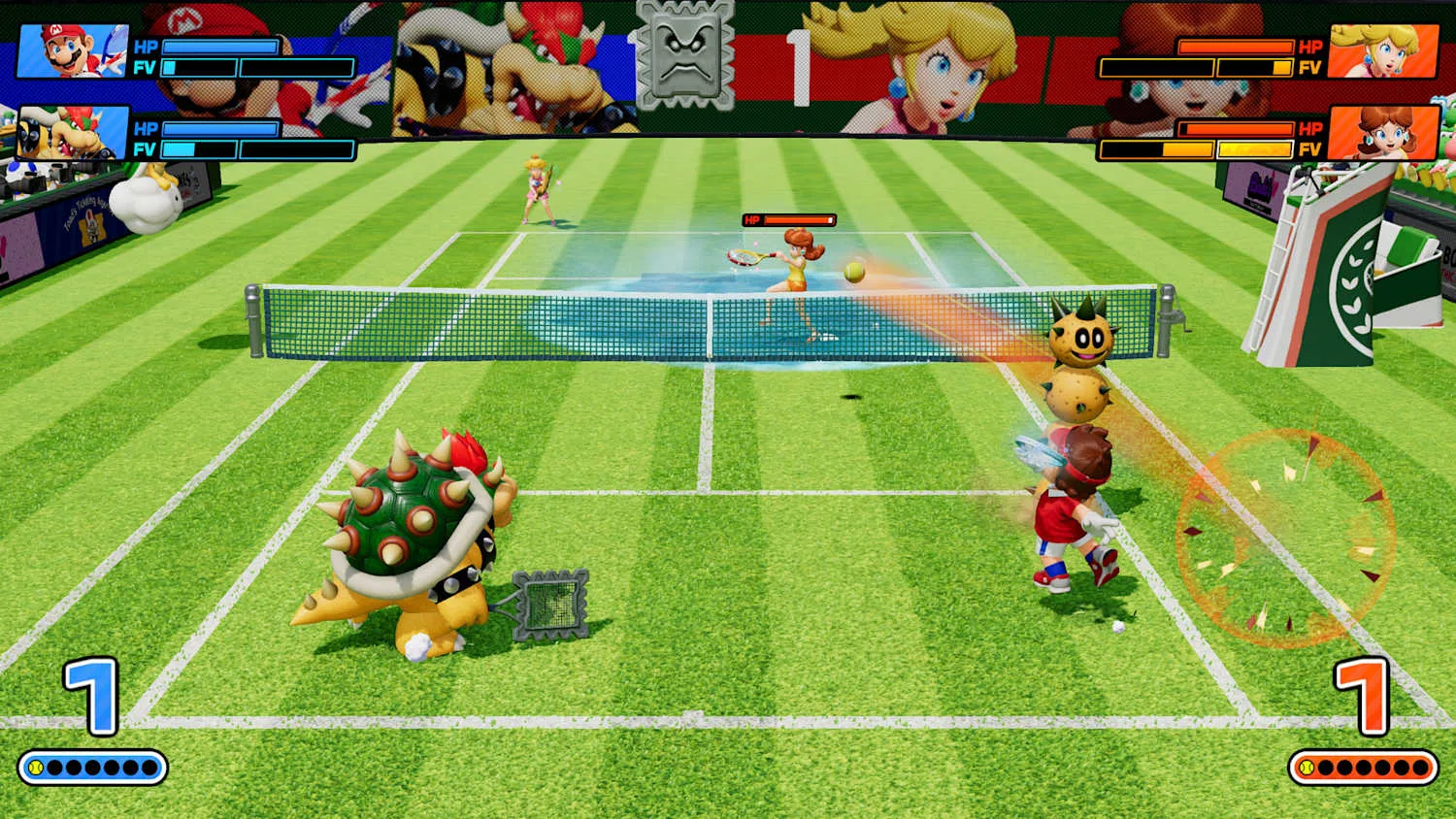
Fever Rackets are the title’s defining system. Each of the 30 special rackets carries a unique effect that activates once the Fever meter charges through regular rallying. The mechanic forces timing and tactical decisions about when to deploy abilities. Many offensive effects trigger after the ball bounces, which creates tense net exchanges where both opponents scramble to retain court position. Defensive options include a Shadow Racket that spawns a duplicate to cover more area, and a Golden Dash that grants a temporary speed burst for characters who otherwise move slowly. The rackets change how individual points develop.
Fire Bars sweep across the opponent’s side like moving hazards. Volcanoes erupt and leave damaging magma. Lightning fields appear where the ball lands. Banana peels litter the court and cause slips. Ice patches create sliding terrain. Sticky mud reduces movement speed. Ink spray obscures visibility. The Bullet Bill racket converts returns into blistering, straight line drives, though being close to the net can blunt that advantage. Mini Mushrooms shrink opponents on contact. Thwomps act as perched obstacles. Some rackets provide temporary numeric buffs, such as moments of increased shot curve. Each ability alters point flow and forces players to adapt standard tennis strategies to new, layered conditions.
Six basic rackets introduce these ideas during Adventure mode before the full set unlocks. Strategic complexity grows from learning counters and leveraging synergies. Pairing Golden Dash with slower powerhouse characters addresses mobility gaps. Deliberately placing hazards funnels opponents into predictable paths and opens mind-game opportunities. Shot selection evolves into exploiting chaos you have generated while responding to what the opponent deploys.
Balance problems appear in practice, and flame-based rackets highlight the issue. They combine visual distraction through fire effects, persistent hazardous zones on court, and projectile attacks that deal damage. That combination stacks multiple benefits into a single activation. The Metal Racket grants hazard immunity and can establish a strong counter that narrows strategic options. Certain rackets outperform others in competitive contexts and the mismatch in effectiveness can be difficult to overcome solely through player skill.
Doubles can turn into utter chaos. Four players with separate Fever effects can layer mud, fire, electricity, and banana peels across both sides of the court. The health system penalizes players who drop to zero by forcing them to sit out in doubles or move at reduced speed in singles. Damage often feels unavoidable rather than the result of opponent skill. A doubles partner’s Fever Shot can harm allies, which adds another unpredictable element. This design philosophy evokes the item-driven mayhem of Super Smash Bros. Ultimate when items are turned up to maximum intensity, favoring party energy over competitive balance.
Players can disable Fever Rackets. Online ranked mode offers distinct lobbies for traditional tennis without special abilities. Those options acknowledge that Fever’s core appeal rests in casual multiplayer sessions where spectacle outweighs precise balance. The title performs best when accepted as a party-oriented experience rather than a competitive simulacrum.
One omission stands out: the game lacks an option to randomly assign Fever Rackets to human players or CPU opponents. Random selection exists for characters and courts, which makes this absence feel arbitrary. A random racket option would encourage experimentation and extend replay value. That feature reads like a natural candidate for a patch.
Single-Player Stumbles Through Missed Opportunities
Adventure mode advertises a campaign but reads more like an extended tutorial spread over roughly three and a half to six hours depending on playstyle. The premise has Mario, Luigi, Peach, Wario, and Waluigi turned into babies. The quest to gather golden fruit that can cure Daisy supplies a narrative frame for what mostly becomes a sequence of basic training exercises. Baby Wario and Baby Waluigi contribute occasional comic beats, but the writing generally feels flat and utilitarian. High-quality cutscenes appear early, then give way to text-heavy dialogue for most of the mode.
The tennis academy occupies the opening 90 minutes and serves as a slow tutorial. Minigames isolate shot types to increase related stats. Repetitive text explanations revisit elementary information. Qualification matches remain laughably easy and gate progression. The game quizzes players on basic tennis categories, asking which character class corresponds to speed: all-around, defensive, or speedy. The content targets children experiencing a Mario Tennis game for the first time, and marketing the mode as Adventure feels misleading when its structure and pacing resemble a Tutorial.
Campaign progression confines you to Baby Mario, which limits roster appeal during solo play. Leaving the academy opens a deliberately small world map with a handful of challengers and a few boss fights. Boss encounters require tennis-based actions or light puzzle solving, such as volleying creatures out of the sky or extinguishing fires by hitting water orbs. The core tennis feel weakens when stretched to serve these gimmicks, weakening the grounded precision that makes standard matches satisfying. Matches built around these situations remain sparse across the campaign.
Boss arenas look visually inventive, which makes their absence from the multiplayer court list disappointing. Adding these arenas to the selectable multiplayer roster would have increased variety and used the design work more effectively. Instead, these locations appear only in Adventure before disappearing. The mode concludes abruptly as scenarios begin escalating, leaving a sense of truncated ambition.
Leveling appears throughout Adventure as Baby Mario gains experience and stats increase numerically. Speed and power rise on paper, but those gains feel imperceptible during gameplay. A level 10 Baby Mario behaves the same as a level 40 example in practice. The progression system functions mechanically but fails to produce an obvious sense of growth or mastery. Unlocking some characters and rackets through Adventure gives a concrete reward but little else beyond completion checks.
Tournament mode occupies a traditional series slot but falters in execution. Three separate tournaments run across singles and doubles knockout brackets. All occur in the same stadium layout with surface swaps between grass, clay, and hard courts. Running successive matches on a single stadium with surface variants reduces variety compared with marquee progression systems that move players across distinct tracks or arenas. Grand Prix-style variety creates momentum that the tournament structure cannot match when confined to surface changes alone.
The Talking Flower from Super Mario Bros. Wonder acts as the tournament announcer and quickly grows grating. The character comments on nearly every shot with a limited set of voice lines. Hearing repeated quips dozens of times during a single session becomes annoying. The flower is active by default across all modes, but the option to mute the announcer exists only in limited contexts. Locking that control to specific modes feels like an odd oversight when players would reasonably want consistent audio options.
Trophy rewards deliver minimal satisfaction. Victory screens are static and offer no distinct celebration or content. The tournaments feel like tasks to complete rather than compelling reasons to return.
Trial Towers emerge as the single-player highlight. Modeled after Super Smash Bros. Melee’s Event matches, each trial sets a specific condition: a permanently full Fever Gauge, three babies facing a giant Bowser, restricted racket pools, or unusual court effects. Short five-point matches keep encounters concise while forcing players to exploit the scenario. Optional completion achievements demand no-damage runs or perfect records. Three towers present 10 challenges apiece and failing three times resets progress.
This structure points at a stronger path for single-player design. Trial Towers prove that curated scenarios with unique constraints produce engagement more effectively than stretched tutorials or repetitive match types. Building future campaigns around varied challenge sets and character-specific encounters would better serve the series.
Multiplayer Flexibility With Content Concerns
Multiplayer is Fever’s strongest pillar. Online ranked splits into singles and doubles and separates Fever-enabled games from traditional tennis lobbies. A letter-grade ranking system tracks results and awards points for wins. Monthly ranking resets encourage continued play. Pre-launch testing reportedly smoothed early lag issues. GameChat supports voice for coordinating with friends or trading taunts.
Local play supports up to four players on a single console and allows two local participants to join online private matches for casual sessions. That flexibility suits varied group sizes and preferences.
Swing Mode reintroduces motion control with detached Joy-Cons, combining analog movement with physical racket swings. The coordination test proves demanding and will likely appeal to players who recall Wii Sports Tennis. Ring Shot returns as a mode that scores by sending balls through floating rings above the net. The Pinball court adds bumpers and paddles that alter ball trajectories. Wonder Court brings Wonder Effects such as floating hippos, shifting pipes, and singing Piranha Plants and changes scoring to seed collection.
Fourteen courts total feels limited. The three stadiums vary only by surface type: grass, clay, and hard. Six academy courts introduce gimmick surfaces like ice. Other stages offer stronger identity: the Airship supplies visual spectacle, and Waluigi Pinball and the Racket Factory modify gameplay through their mechanics. Boss arenas remain confined to Adventure mode and do not expand the playable rotation.
Mix It Up compiles score-attack minigames and gimmick variants. Some challenges, like aiming Fever Shots at Piranha Plants to grow an opponent’s court, present clever design. Other tasks devolve into repetition, for example repeatedly lobbing and dropshotting in ways that feel like padding. Quality varies across challenges and even the best options lose novelty after short exposure.
Standard matches that combine the full roster and rackets provide the most reliable entertainment. Roughly twenty hours of play highlights the game’s limited staying power. Special modes grow repetitive. Fever functions better as a short, energetic distraction for parties rather than a single game to anchor long play sessions. Against recent Nintendo multiplayer entries such as Kirby Air Riders and Super Mario Party Jamboree, Fever offers less long-term content. The systems work well for brief sessions, but extended play exposes the shallow pool of ideas supporting them.
Progression That Unlocks Without Grinding
Unlocks follow a GameCube-era Mario sports philosophy. Progress occurs through mode play, challenges, and Adventure progression. Nothing in the system requires online connection, reversing an emerging trend that tied rewards to internet-dependent systems in recent Mario sports entries. Starting the game reveals a clear set of reachable goals without needing continuous connectivity.
Characters unlock primarily through match counts. Accumulating 50 matches opens the full 38-character roster. A small number of characters unlock via tournament success or challenge tower progression. Adventure contributes a subset of unlocks. The design requires no grinding; playing different modes naturally reveals new options.
Fever Rackets unlock in a parallel pattern. Six basic rackets appear through Adventure and the remaining 24 unlock by playing across modes, completing challenges, and participating in special matches. Fully unlocking all 30 rackets requires engagement with multiple systems rather than repetition of a single activity.
Cosmetic palettes exist as unlockable options, though distribution across the cast feels uneven. Luma has one alternate palette. Koopa Troopa and Koopa Paratroopa each receive three. Shy Guy has six alternatives. Yoshi tops the list with eight palettes. Many characters lack alternates. Reaching 100 matches grants access to every palette and natural progression through tournaments and towers should achieve that threshold without intensive grinding. Adventure matches do not always count toward the total, which creates a confusing restriction in an otherwise straightforward system.
The unlock approach matches the party focus but will feel thin to dedicated players. The game still lacks random assignment for Fever Rackets even though randomization controls exist for characters and courts. This omission reduces experimentation and shortens replay lifespan. Compared with multiplayer-focused Nintendo titles that layer deeper progression and reward systems, Fever takes a minimalist route that meets basic expectations without expanding them.
Mario Tennis Fever is a high-energy arcade sports game released on February 12, 2026, as a key title for the Nintendo Switch 2. Developed by the genre veterans at Camelot, it serves as the ninth installment in the long-running Mario Tennis series and a centerpiece of the Super Mario Bros. 40th Anniversary celebration.
Full Credits
Director (Creative/Game Director): Shugo Takahashi, Tomohiro Yamamura
Writers (Lead Writer/Narrative Designer): Shugo Takahashi (Narrative Design)
Producers/Studio Leadership (Producers, Executive Producers, and Key Studio Heads): Hiroyuki Takahashi, Shugo Takahashi, Shinya Saito
Lead Voice Cast: Charles Martinet (archival/legacy recordings), Kevin Afghani (Mario, Luigi), Samantha Kelly (Peach, Toad), Talking Flower (Commentary)
Art Director/Lead Artist: Satoshi Tamai, Takeshi Tateishi
Key Engineering/Technical Leads: Yutaka Yamamoto (Lead Programmer)
Composer/Sound Director: Motoi Sakuraba
Developer, Publisher: Camelot Software Planning, Nintendo
Release Date: February 12, 2026
The Review
Mario Tennis Fever
Mario Tennis Fever delivers chaotic multiplayer entertainment through its creative Fever Rackets system and accessible tennis fundamentals. The 38-character roster and varied special abilities generate memorable party game moments. However, the disappointing Adventure mode feels like a tutorial masquerading as a campaign, Tournament mode suffers from an insufferable announcer, and limited court variety restricts long-term engagement. Trial Towers shows promise, but single-player content remains weak. Fever succeeds as a casual multiplayer distraction for game nights, yet lacks the depth and staying power to justify extended solo sessions or serious competitive play.
PROS
- 30 creative Fever Rackets add meaningful chaos to matches
- Solid, refined tennis fundamentals remain accessible and responsive
- 38-character roster with unique animations and personalities
- Trial Towers mode offers engaging single-player challenges
- Smooth online performance with flexible multiplayer options
- Unlocks not tied to online play
CONS
- Adventure mode is painfully basic tutorial stretched thin
- Talking Flower announcer becomes insufferable quickly
- Only 14 courts with limited meaningful variety
- Fever Racket balance issues favor certain options
- Single-player content lacks depth and creativity







