

























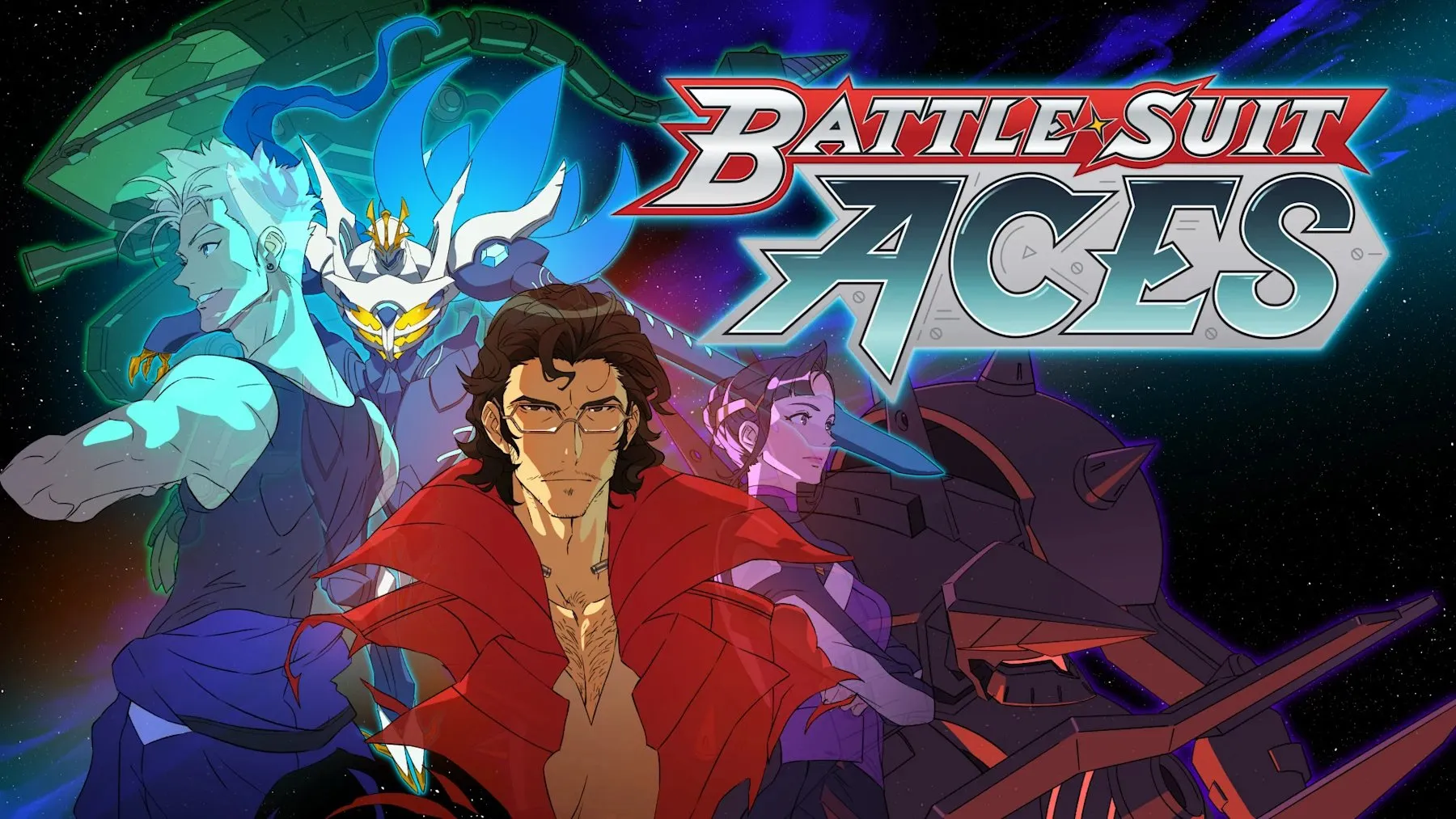

Trinket Studios, the developer behind Battle Chef Brigade, has crafted something special with Battle Suit Aces. This card-battling RPG brings together deckbuilding, turn-based strategy, and visual novel storytelling in a package that feels like watching a season of Mobile Suit Gundam or Neon Genesis Evangelion unfold before your eyes. The premise centers on humanity’s struggle against the Frenzied, alien threats consuming stars across the cosmos.
Your guide through this crisis is Heathcliff, an engineer whose quiet dreams of family life are shattered when the Frenzied attack. This tragedy leads to a discovery that might save everyone: the Blue Crest, a Relic Suit created by the extinct Pholian civilization. These ancient mechs possess technology far beyond what humans can produce, making them humanity’s best hope for survival.
Heathcliff assembles a crew aboard the USS Zephyr, and together you’ll travel the galaxy hunting for more Relic Suits. The game balances its dire stakes with a lighthearted, action-anime tone that keeps things entertaining even during darker moments. Available on Nintendo Switch, Battle Suit Aces delivers its mecha fantasy through hand-drawn art and enthusiastic voice performances that capture the genre’s spirit.
Episodic Storytelling and Character Chemistry
Battle Suit Aces structures its campaign like an anime series, complete with voice actors announcing episode titles before each mission segment. This episodic approach creates natural stopping points while maintaining momentum through the larger narrative. The story launches with Heathcliff’s peaceful existence crumbling during a Frenzied assault on his station. He and his colleague Felix barely escape, crash-landing on a nearby planet where they stumble upon the Blue Crest. This ancient Relic Suit becomes the catalyst for everything that follows, as the two are recruited to lead the Patchworks initiative aboard the USS Zephyr.
The narrative oscillates between weighty themes and surprisingly light diversions. You’ll face extinction-level threats one moment, then participate in starball tournaments or friendly faction sparring matches the next. This tonal flexibility mirrors classic mecha anime, where life-or-death battles coexist with everyday concerns and relationships. Between missions, you can explore the ship, chat with crew members, and accept side tasks. These optional conversations flesh out the cast, revealing backgrounds and motivations that inform their behavior during critical moments.
Player choices appear periodically, affecting how certain missions unfold and which story branches open up. The impact remains modest compared to branching-heavy RPGs, but the decisions feel meaningful in context. Special character-focused episodes unlock when you meet specific battle requirements, rewarding skillful play with deeper dives into individual personalities.
The crew itself drives much of the game’s appeal. Heathcliff leads as the pragmatic engineer thrust into command. Felix provides enthusiasm and natural piloting talent, forming an immediate bond with the Blue Crest that hints at deeper mysteries. Jules brings workaholic dedication to her role, while Daciana offers wit and combat prowess. Yes, some characters lean on familiar anime archetypes, but the writing gives them enough nuance to feel authentic. The way relationships form and strengthen under pressure recalls Persona’s social links or Fire Emblem’s support conversations, creating investment beyond just their combat utility.
The presentation leans heavily on hand-drawn anime aesthetics, with detailed character portraits and mech designs that pop off the screen. Animation is minimal, mostly limited to battle effects, but the static illustrations carry enough personality to compensate. English voice acting brings genuine energy to the dialogue, making the lengthy visual novel sections enjoyable rather than tedious. Technical performance on Switch is solid whether you’re playing handheld or docked, with no noticeable slowdown.
Two limitations mar the experience. First, the game lacks Brazilian Portuguese localization, requiring English fluency to follow the story. Second, quality-of-life features common in visual novels are absent. There’s no conversation log to review past dialogue, and no glossary to track the numerous faction names, planetary designations, and technical terms the game introduces early and often. These omissions don’t ruin the experience but make it harder to stay oriented during the dense expository sections.
Strategic Depth Through Position and Synergy
Combat in Battle Suit Aces revolves around a 5v5 grid where you deploy pilot cards against enemy formations. Each battle starts with both sides at 30 life points. Your goal isn’t necessarily to destroy every enemy card on the field but to reduce your opponent’s life total to zero by attacking their ship directly. This creates an interesting dynamic where positioning matters as much as raw power. Cards placed in a lane block attacks aimed at that position, turning your pilots into living shields when necessary.
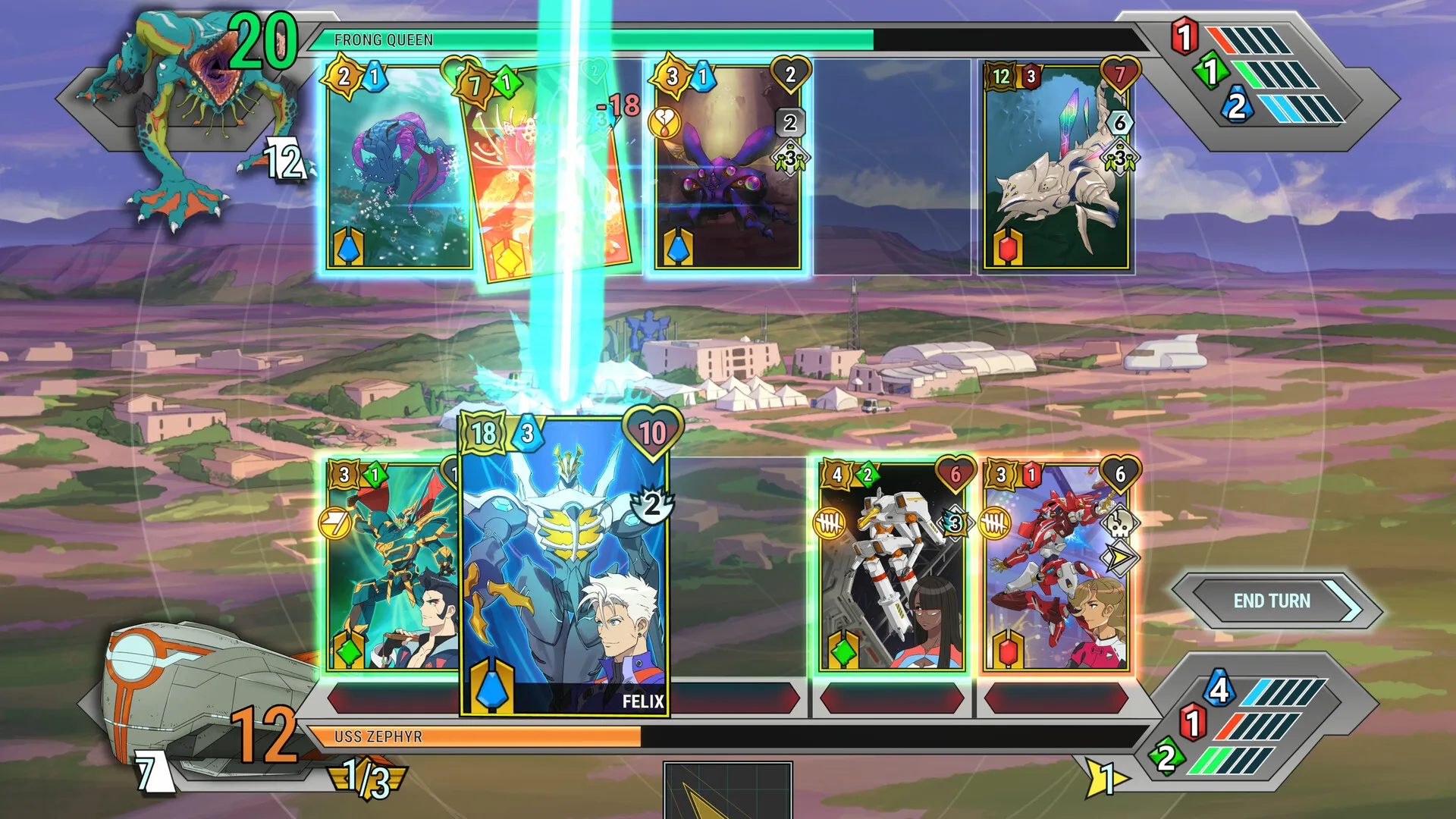
The energy system governs your actions each turn. Different colored energy types accumulate as turns progress, and each card requires specific energy to deploy and attack. You can place one card per turn and execute actions based on your available energy pool, meaning not every deployed unit will act immediately. The game telegraphs enemy intentions by highlighting which positions they’ll target next turn, giving you time to shore up defenses or reposition for counterattacks.
Pilot abilities introduce layers of tactical consideration. Yan, piloting the U-TECH2, damages both the card directly opposing her and the enemy life bar, making her excellent for simultaneous board control and direct damage. Daciana and Jaeger bring area-of-effect attacks that can clear clustered enemies in single strikes. Felix commands the Blue Crest as a heavy hitter with substantial HP, capable of absorbing punishment while dealing massive damage. Mirabell from the Tvashtr Suitsmiths faction grants armor to adjacent allies when she attacks, improving your team’s survivability. These varied abilities encourage experimentation with different pilot combinations to discover synergies that match your preferred playstyle.
Drones serve as cheaper, weaker units that fill empty spaces and prevent direct attacks from slipping through your defenses. Captain Command cards function differently, executing immediate attacks when played rather than waiting for subsequent turns. Understanding when to deploy drones for blocking versus saving energy for stronger pilots becomes critical as enemies grow more threatening.
The Workshop system lets you craft suit mods using materials earned from battles. These mods slot into your pilots’ suits, providing passive bonuses or new abilities. Some mod slots are available immediately, while others unlock through gameplay progression or by completing character-specific ambitions during fights. This customization allows you to double down on strategies you enjoy, transforming pilots who already fit your approach into even more powerful versions of themselves.
Faction points, earned through missions, unlock new recruits to join your deck. Here’s where the game diverges from typical deckbuilders: you can’t manually construct decks from scratch. Cards simply accumulate as pilots join your roster. This reduces strategic planning outside battles but streamlines the experience, keeping focus on tactical decisions during fights rather than deck optimization between them.
Optional content extends beyond the main campaign. Side missions provide extra resources and faction points. Puzzle battles challenge you to defeat enemies in a single turn, testing your understanding of card interactions and energy management. The Sim Chamber offers a space to experiment with different pilot combinations without campaign consequences. Three difficulty settings let you calibrate the challenge level, from accessible to genuinely demanding.
The game respects your intelligence from the start. After two tutorial battles that introduce basic concepts, you face the Frong Queen, a boss that requires careful synergy between Daciana and Belmot to overcome hostile native creatures. This early difficulty spike establishes that thoughtless aggression won’t carry you far. Enemies often have counterattack abilities or defensive triggers that punish reckless play, forcing you to read the field before committing to actions.
The learning curve is steep. Even veterans of similar games may find the mechanics initially confusing. Passive abilities are indicated by icons and brief text, but this information isn’t always sufficient to predict exact effects. I occasionally triggered abilities at inopportune moments because the interface didn’t clearly communicate their activation conditions. The game also fails to show who has already acted each turn or how certain penalties apply, leading to preventable mistakes. These interface quirks become manageable with experience, but they create friction during the crucial early hours when you’re still internalizing the systems.
Lasting Appeal Beyond the Campaign
Battle Suit Aces provides substantial reasons to return after completing the main story. Multiple difficulty levels transform familiar battles into fresh challenges that demand refined strategies. Special character episodes unlock when you fulfill specific combat conditions, rewarding mastery with narrative payoffs that deepen your understanding of individual crew members. These episodes aren’t just flavor text; they explore character motivations and relationships in ways that make subsequent playthroughs feel different as you prioritize different pilots.
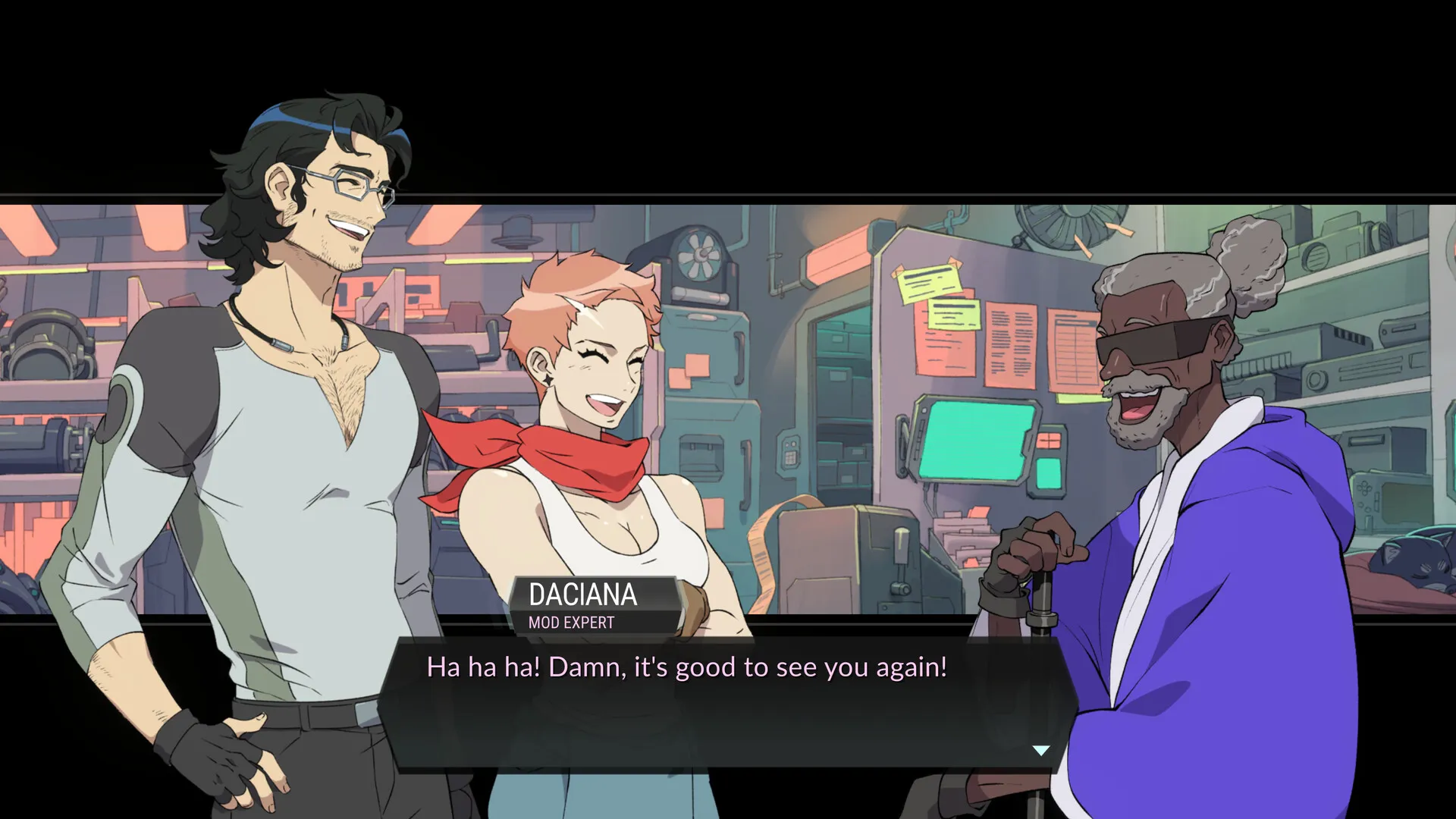
Optional missions and faction-specific storylines branch off the main path, expanding the universe and giving characters room to develop beyond their primary arcs. Puzzle battles and challenge modes test your mechanical understanding, asking you to optimize card combinations and energy usage in ways the campaign doesn’t always require. The Sim Chamber lets you theory-craft without consequences, perfect for players who enjoy perfecting their approach before committing to story battles.
Recruiting different pilots on subsequent runs changes your deck composition and available strategies. Since recruitment often involves choosing between multiple candidates, you can’t collect everyone in a single playthrough. This forces meaningful decisions about which factions to support and which playstyles to develop, giving each campaign a distinct tactical identity.
Side activities aboard the USS Zephyr between missions break up the combat rhythm without feeling like padding. These moments of downtime let you engage with characters in low-stakes situations that reveal personality details battles can’t showcase. The Switch’s versatility enhances this design; you can knock out a few dialogue scenes in handheld mode during a commute, then settle in for intense tactical battles on your TV later.
The game’s strengths coalesce into something that feels both familiar and fresh. Trinket Studios successfully merges visual novel storytelling with strategic card combat, creating a experience where both elements reinforce each other. The charismatic cast generates genuine chemistry that makes you care about their survival beyond just their combat statistics. Hand-drawn anime aesthetics faithfully honor mecha genre inspirations, delivering the visual spectacle these stories demand. The combat system rewards smart positioning and synergy building, making victories feel earned rather than inevitable. Suit mods and faction progression provide satisfying growth that keeps battles from becoming stale.
Weaknesses exist but rarely undermine the core experience. The steep learning curve and initially confusing mechanics may frustrate newcomers expecting gentler onboarding. Interface clarity issues regarding passive abilities and battle status create avoidable confusion. Missing quality-of-life features like conversation logs and glossaries make tracking the dense visual novel content harder than necessary. The inability to manually build custom decks limits strategic expression outside battles. Brazilian Portuguese localization would welcome a wider audience to this excellent game.
For fans of strategy, deckbuilding, and anime mecha, Battle Suit Aces stands as a strong recommendation. The combination of cards, mechs, and RPG elements works exceptionally well, creating an addictive loop of tactical battles and character development. Trinket Studios has delivered one of 2025’s most distinctive games, blending genres that rarely intersect with this level of polish. Whether you’re drawn to the strategic depth or the character interactions, there’s substance here worth experiencing. The USS Zephyr awaits its next crew member; this intergalactic adventure deserves your attention.
The Review
Battle Suit Aces
Battle Suit Aces brilliantly fuses tactical card combat with anime storytelling, creating a mecha adventure that respects player intelligence while delivering genuine charm. The charismatic crew and strategic depth make battles consistently engaging, though interface quirks and a steep learning curve create initial friction. Trinket Studios has crafted an experience that captures the essence of classic mecha anime through smart game design. Fans of deckbuilding and strategy will find plenty to love here.
PROS
- Deep tactical combat with meaningful positioning decisions
- Charismatic characters with genuine chemistry
- Beautiful hand-drawn anime aesthetic
- Satisfying customization through suit mods and faction system
- Episodic structure creates natural narrative flow
- Strong voice acting brings characters to life
CONS
- Steep learning curve with confusing initial mechanics
- Interface clarity issues for passive abilities
- No conversation log or glossary for visual novel sections
- Limited deck customization (cards accumulate automatically)
- Missing Brazilian Portuguese localization