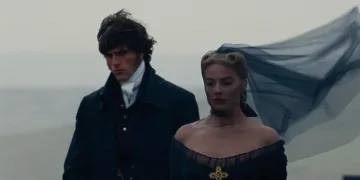





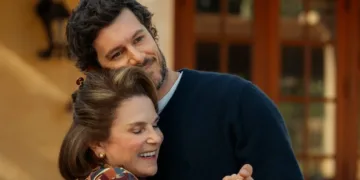














Emerald Fennell takes Wuthering Heights and treats it like a bruise you keep pressing to confirm it still hurts. The 2026 adaptation stars Margot Robbie as Catherine Earnshaw and Jacob Elordi as Heathcliff, and it plants their bond on the Yorkshire moors with the blunt certainty of weather. A young orphan enters the Earnshaw household, a daughter of the house clocks him as both threat and mirror, and the story becomes a long argument between desire and whatever society claims counts as “sense.”
Fennell’s big narrative choice is also her bluntest instrument: she commits to the first half of the novel and tosses the second generation. That decision tightens the film into an obsessive chamber piece, even while the images go operatic. It turns the romance into a closed circuit. No relief valve. No later-life accounting tricks where time tries to launder earlier cruelty.
The physicality is the point. The film’s style insists that sensation is ideology. The sting of a lashing, the texture of skin, the clench of a hand that wants to own, the way a room can feel like a verdict. Social structures and personal trauma crash into each other until intimacy starts behaving like psychological violence with better lighting.
This version values emotional recall over literal faithfulness, which sounds like a polite way of saying “it’s going to get messy.” It does. In Fennell’s hands, repression is less a background condition than a governing law, the kind of law that loves loopholes until it meets a body with a pulse.
VistaVision, Tactile Excess, and the Dollhouse Economy
Linus Sandgren shoots on 35mm VistaVision, and the format gives the film a lush, grain-heavy tactility that feels like you could scrape it under your fingernails. The camera lingers on microscopic details: yolk staining linen, scar tissue patterning a sweating back, the petty evidence of a life lived inside rules made by other people (and enforced by furniture).
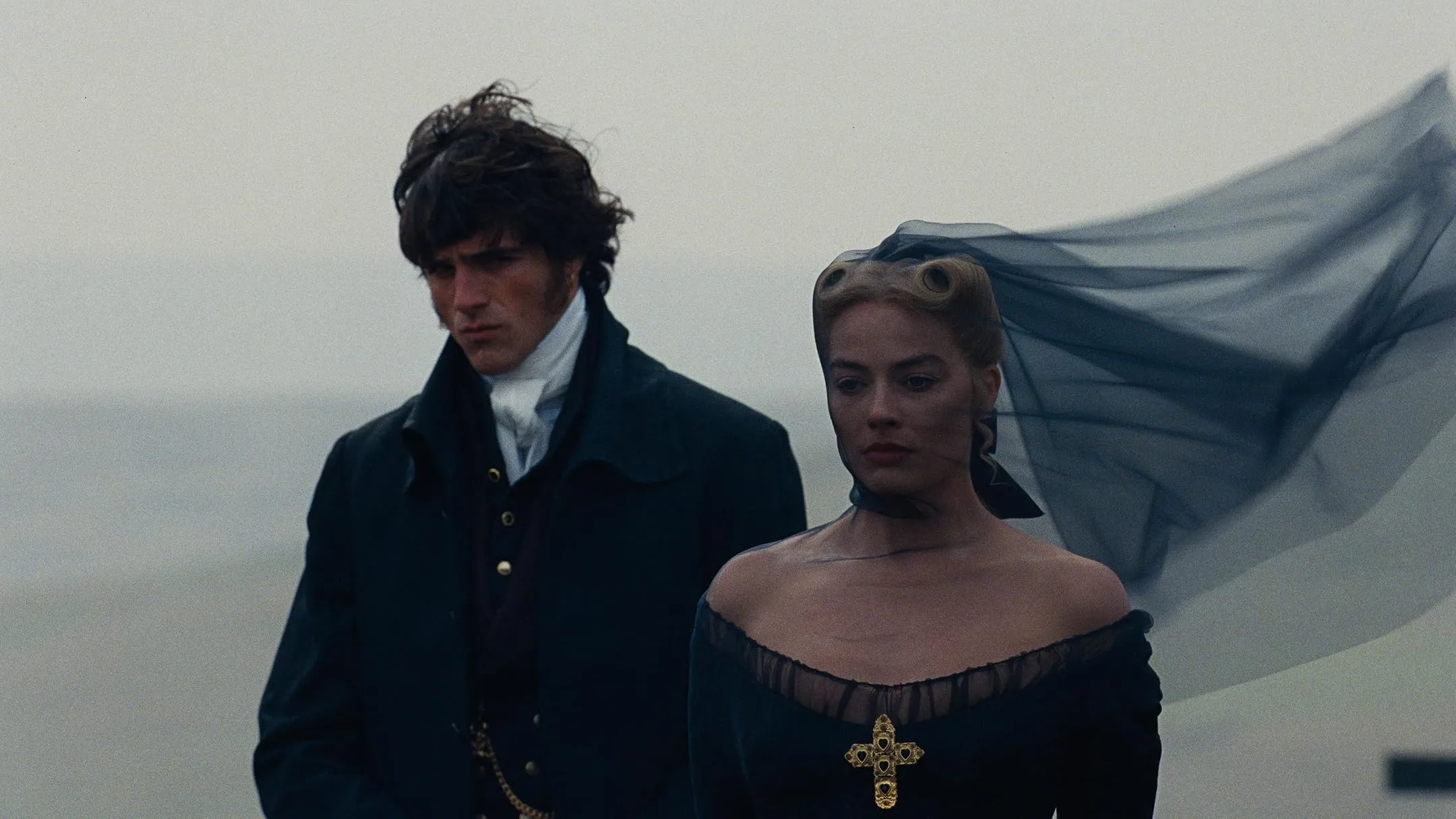
Light works like an emotional barometer. Heathcliff is frequently pushed into silhouette against a crimson sky, which reads as visual shorthand for a man who operates as shadow, as projection, as the part of Cathy’s id that refuses to behave. It’s melodramatic. It’s also weirdly clinical, like the film is labeling samples on slides.
Then comes the “aesthetic migration” when the setting shifts. Wuthering Heights begins in respectable squalor, all damp earth tones and rot that passes for tradition. Thrushcross Grange flips into garish plastic vibrancy, a dollhouse designed by someone with money, taste, and a private grudge against subtlety. Bubblegum pinks and blood reds crowd the frame. These colors don’t pretend to be historically plausible. They look like commodified life made visible.
I kept thinking of wealth here as a material that changes the laws of physics. Objects gleam too hard. Rooms feel airless. Even comfort has a synthetic aftertaste. The film’s maximalism turns décor into an argument: capitalism as interior design, class as a palette, privilege as a kind of glare.
Fennell leans into what you might call “haptic voyeurism.” She wants you to feel nails scratching plush walls and taste the bitterness of chocolate like it’s a moral event. The moors stop being geography and start behaving like a psychological entity. Fog and rain drench the characters until clothing becomes a transparent layer of social artifice, and the landscape seems less surrounding than consuming.
Cathy’s Survival Math and Heathcliff’s Rage Engine
Robbie plays Cathy with reckless energy that keeps sliding between genuine innocence and calculated entitlement. Cathy reads the room the way a trapped person reads exits. She knows her currency is marriageability, and she treats romance like an auction where she’s both item and bidder (a fun arrangement if you enjoy psychic nausea).
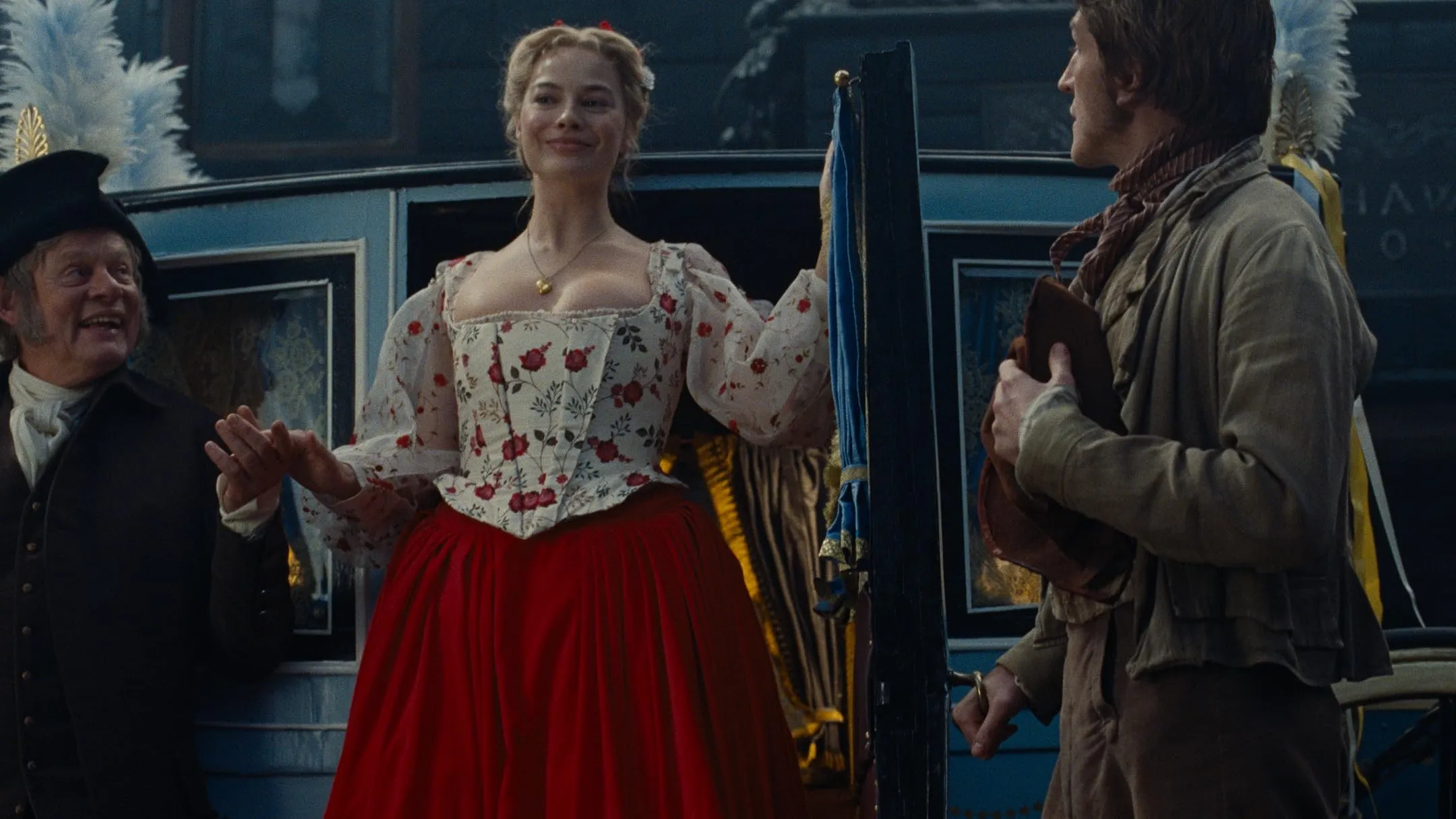
Her decision to marry Edgar Linton lands as a pragmatic “survivalist pivot.” It’s not romantic. It’s arithmetic. Security wins, and the cost arrives later with cruel punctuality. Robbie gives that regret a specific texture: the kind that starts as relief, curdles into self-disgust, then turns outward because it has to go somewhere.
Elordi embodies the Byronic hero as wounded brute, defensive and easily slighted, tuned to the humiliation of being a servant, even a “pet,” as the film repeatedly frames him. The stringy-haired wig is… a choice (the sort of choice that suggests a stylist lost a bet), yet Elordi still sells Heathcliff as a shirtless, sweaty engine of rage. He carries resentment like a second skeleton.
Their chemistry works because it’s built on mutual damage. They recognize each other as disaster with a familiar face. The eavesdropping scene where Heathcliff hears Cathy say marrying him would “degrade” her functions as a terminal point for childhood. After that, whatever they have becomes “lust-as-warfare,” a strategy for survival that keeps mistaking annihilation for intimacy.
Martin Clunes brings a grotesque anchor to the early acts as Mr. Earnshaw, a drunken figure whose so-called charity in bringing Heathcliff home reads as ownership. He treats the boy like a literal pet. It’s the kind of “kindness” that carries a receipt.
Cutting the Second Generation and Trapping the Present Tense
Removing the second generation changes the story’s moral geometry. In the novel, time brings a cyclical resolution, a sense that history has a way of repeating until it exhausts itself. Fennell refuses that release. The film stays locked in the eternal present of Cathy and Heathcliff, as if the narrative itself cannot imagine life beyond obsession.
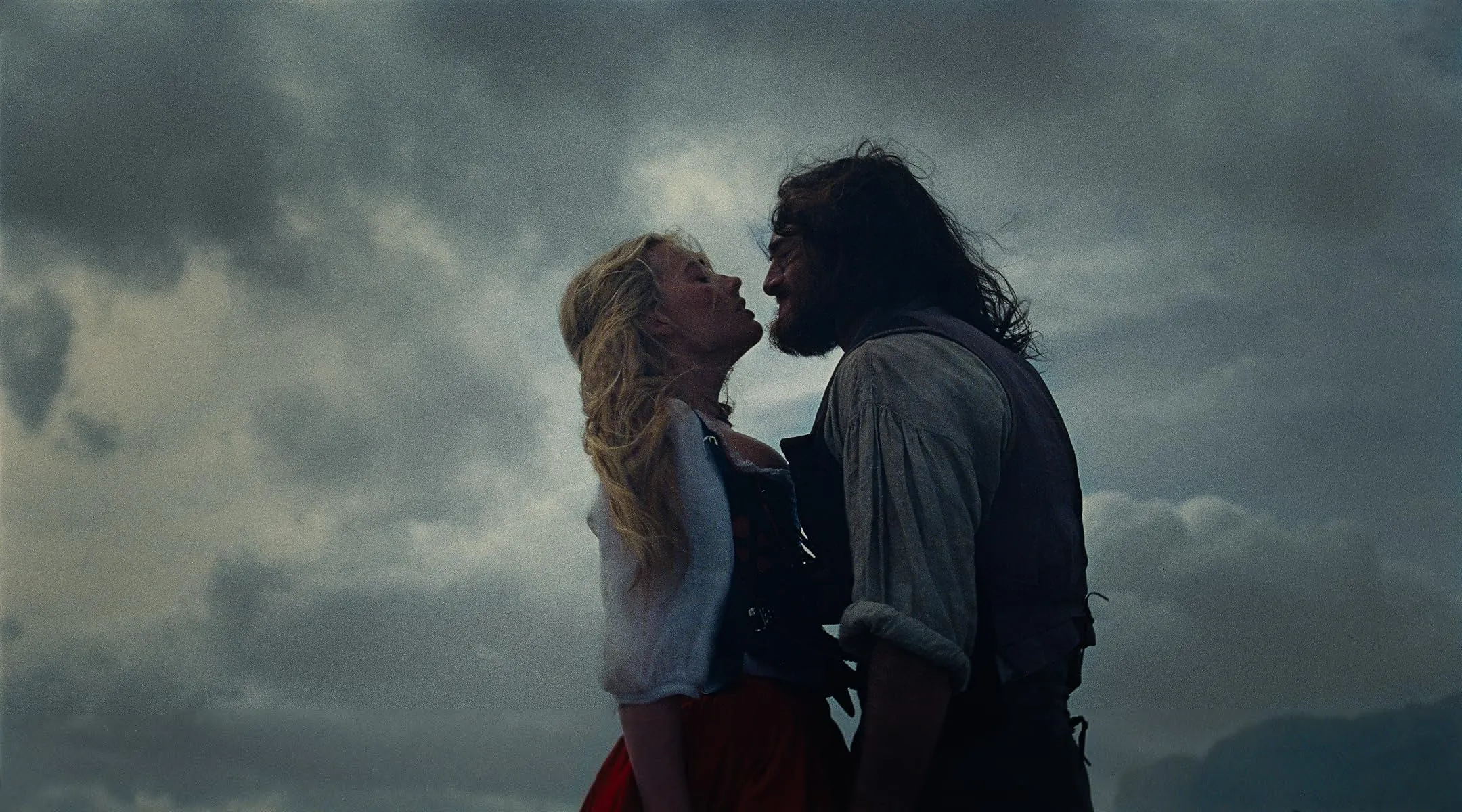
That narrowing creates a strange effect: it makes the romance feel both bigger and smaller. Bigger because it dominates the film’s reality. Smaller because it becomes a sealed ecosystem, feeding on itself without outside evolution. I admired the ruthlessness of that. I also missed the generational echo, then caught myself wondering if that longing is the point, a viewer’s desire for catharsis being denied on purpose.
The absence of Hindley is a quiet earthquake. In the source material, he’s a primary architect of Heathcliff’s degradation. Without him, Heathcliff’s bitterness blooms from generalized social rejection, and the film shifts motivation away from personal revenge toward class and money as ambient violence. It becomes a critique of status as a daily abrasion.
The film mostly bypasses the racial ambiguity of the book’s Heathcliff, focusing instead on internal psychological blockages in its white leads. That choice tightens the thematic focus on repression and class, though it also narrows the scope of what “otherness” can mean here. It’s a trade-off that will land differently depending on how you read adaptation as responsibility versus adaptation as obsession.
I kept returning to the idea of “currency of the heart” being devalued by merchant gold. Cathy and Heathcliff are framed as people trying to speak in a language that the world has already declared useless. Their sentences keep getting translated into property.
The Silent Archivist, the Collateral Damage, and Pop as Period Costume
Hong Chau plays Nelly Dean with quiet precision, and the performance feels like a locked drawer. She’s pragmatic, still, and watchful, an unreliable observer whose restraint hints at repressed loneliness that may be tinting the entire narrative. Nelly becomes the “silent archivist” of ruin, the witness who records tragedy because stopping it was never on the job description.
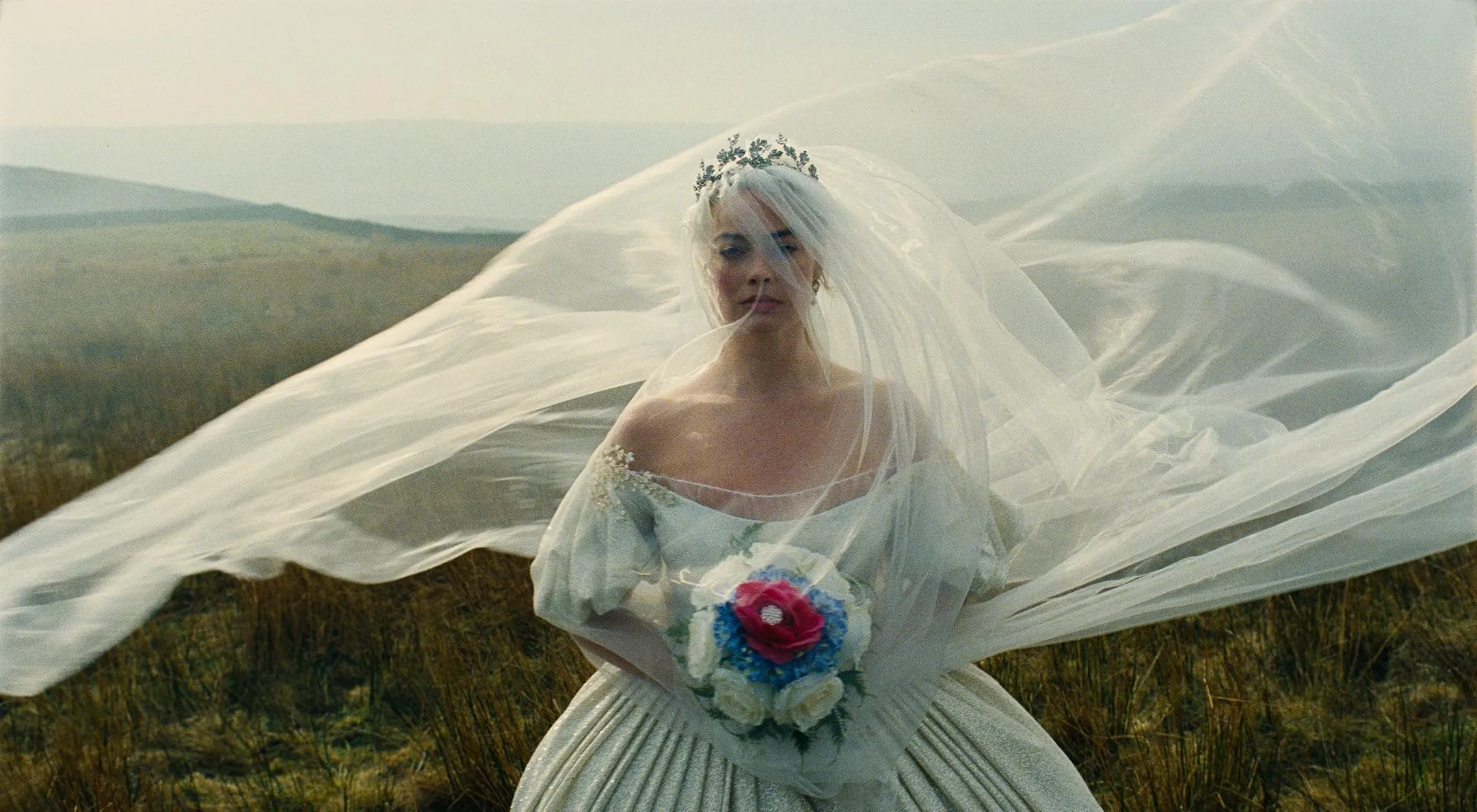
That watchfulness borders on predatory, which sounds harsh until you remember what this household teaches: observe, endure, survive, repeat. Chau’s gaze suggests she’s cataloging these people the way you might catalog symptoms.
Alison Oliver stands out as Isabella Linton, the film’s most tragic figure, a woman who degrades herself in desperate pursuit of Heathcliff. Her “unhinged” behavior, including weaving Cathy’s hair into a doll, lands as darkly comedic and genuinely horrifying, a portrait of obsession as contagious disease. She is collateral damage with a pulse.
Shazad Latif plays Edgar as decent, wealthy, and fundamentally dull. He represents the “polite prison” Cathy chooses, then grows to hate for being exactly what she asked for. There’s something almost funny about how civility becomes its own form of violence here, the violence of being smothered by good manners.
The sound design matches the visual maximalism. Anthony Willis delivers an operatic score heavy with longing, and the film overlays it with original songs by Charli XCX. The needle drop of Chains of Love during a montage of Cathy in her dollhouse bedroom is a sharp bridge between 18th-century melodrama and modern anxiety. The music doesn’t sit politely in the background. It floods the scenes, creating sonic entrapment that mirrors Cathy’s marriage. Pop as period costume sounds like a gimmick. Here it feels like diagnosis.
Pleasure, Punishment, and the Pet Metaphor as Social Contract
The film opens on a public hanging, communal violence staged as entertainment, with young Cathy watching in wide-eyed joy. That image establishes a world where pleasure and pain share a bloodstream. It also lands like a social thesis: cruelty is public here, normalized, even festive.
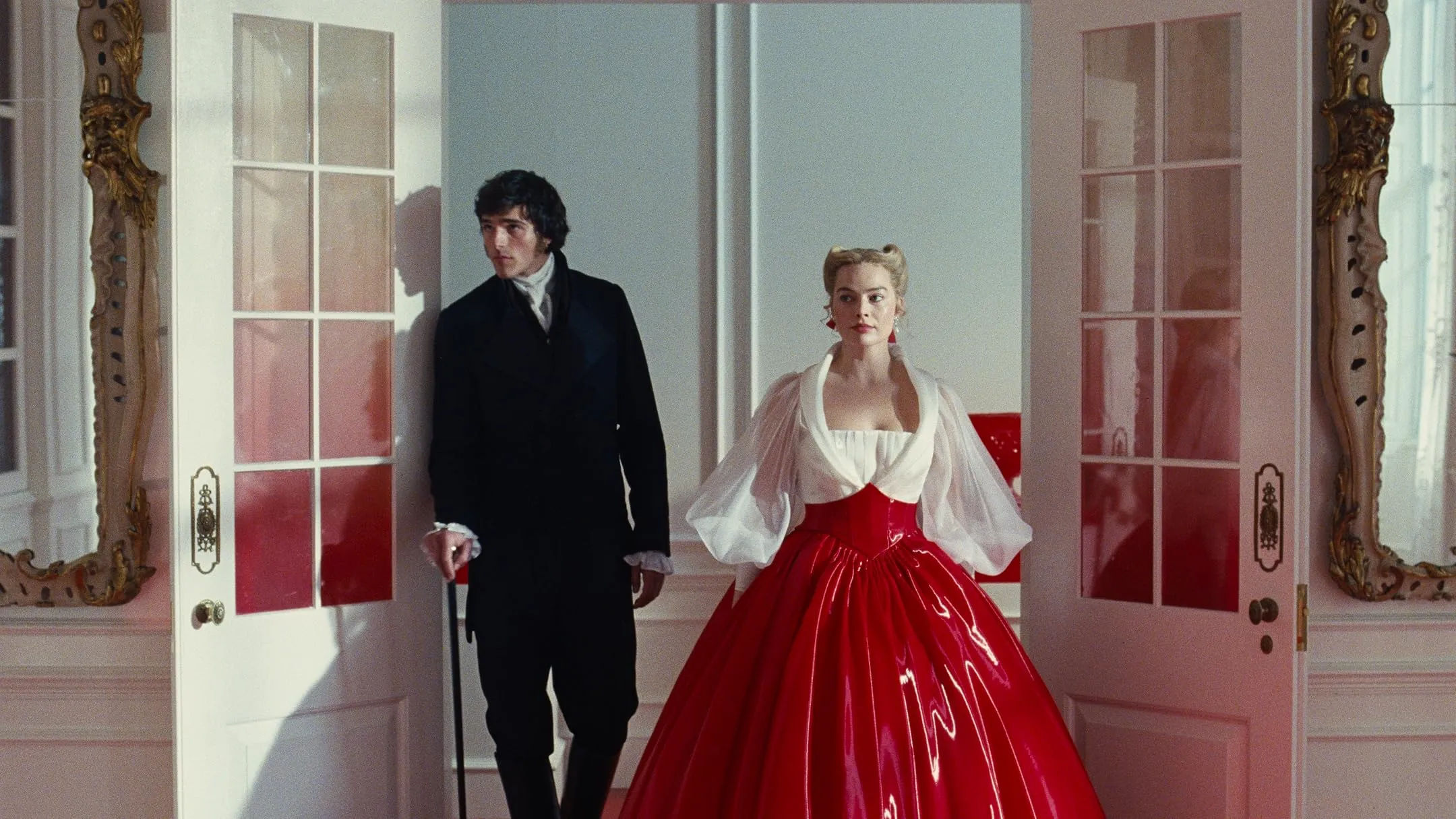
Repression becomes the primary antagonist. The film implies the era’s plague is the belief that pleasure equals sin, and sin demands punishment. Cathy masturbating behind a rock, then blaming Heathcliff for “corrupting” her, plays as a classic deflection of desire. Shame needs a scapegoat. Desire volunteers one.
This is where Fennell’s approach turns oddly historical. The film suggests that societies built on strict moral policing don’t eliminate appetite. They reroute it into control, possession, punishment. You see it in the crowd at the execution. You see it in the domestic spaces where love gets translated into ownership.
The “pet” metaphor is the film’s most pervasive symbol. Mr. Earnshaw’s framing of Heathcliff as pet, Isabella’s treatment as chattel, the way characters keep trying to own what they love. Objectification becomes a series of “dominance maneuvers,” and intimacy turns into a contract where one person signs and the other bleeds.
Cathy and Heathcliff feel cosmically right and morally wrong, bound by a “toxic essentialism” that ignores reason and self-preservation. Their love reads like weather, the kind you can predict and still fail to prevent. Two storms colliding over the moors. Any meteorologist will tell you storms are rarely healthy. They are still hard to stop watching.
Wuthering Heights arrived at Grauman’s Chinese Theatre for its world premiere on January 28, 2026. Audiences can experience the film in theaters starting February 13, 2026. Warner Bros. Pictures handles the distribution for this theatrical event. This project marks a significant collaboration between the director and her lead actors.
Full Credits
Title: Wuthering Heights
Distributor: Warner Bros. Pictures
Release date: February 13, 2026
Rating: R
Running time: 136 minutes
Director: Emerald Fennell
Writers: Emerald Fennell
Producers and Executive Producers: Margot Robbie, Josey McNamara, Emerald Fennell, Tom Ackerley, Sara Desmond, Andrew Lary, Anthony Tittanegro, Pete Chiappetta
Cast: Margot Robbie, Jacob Elordi, Shazad Latif, Hong Chau, Alison Oliver, Martin Clunes, Ewan Mitchell, Owen Cooper, Charlotte Mellington, Vy Nguyen
Director of Photography (Cinematographer): Linus Sandgren
Editors: Victoria Boydell
Composer: Anthony Willis, Charli XCX
The Review
Wuthering Heights
Fennell’s "Wuthering Heights" is a gorgeous, hollow exercise in maximalist yearning. While it captures the sensory overload of adolescent obsession, it sacrifices the sociological teeth of the novel for aesthetic thrills. It is a film of surface tensions and neon-lit despair, succeeding as a mood piece rather than a definitive adaptation. Robbie and Elordi sell the chemistry, but the script leaves the underlying tragedy feeling oddly weightless.
PROS
- Stunning 35mm VistaVision cinematography by Linus Sandgren.
- Electric chemistry between Margot Robbie and Jacob Elordi.
- Bold, contemporary use of color and production design.
- Standout supporting performances from Hong Chau and Alison Oliver.
CONS
- Removal of the second generation weakens the narrative depth.
- Script neglects the racial and class complexities of the source material.
- Over-reliance on montages and music video-style sequences.
- Pacing feels sluggish during the middle act.