





















Daniel J. Phillips steps back into the director’s chair with Diabolic, shifting away from his earlier fascination with Catholicism and locating terror inside a fringe offshoot of Mormonism. The film follows Elise, a young woman who escaped a Fundamentalist Latter-Day Saints compound ten years earlier.
She left the community behind, yet her interior life stays locked in conflict. Violent blackouts interrupt her days, and missing stretches of memory hang over her like evidence of an injury she cannot fully name. Elise wants answers, and she decides the only way to get them is to return to the place where the damage began.
She heads back to an isolated, decaying compound deep in the woods with her boyfriend, Adam, and her friend Gwen. The trio meet Hyrum and Alma, former members who claim they can help Elise through traditional rituals. The location does a lot of narrative work right away, sealing the characters off from any ordinary support system and forcing Elise to confront her past on the sect’s terms. As Elise moves deeper into that environment, the film builds a psychological emergency in which resurfacing memory and active danger start to occupy the same space.
Portraying the Haunted
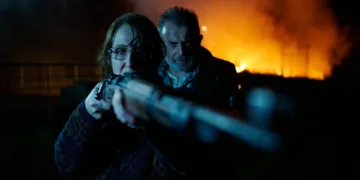
Elizabeth Cullen carries much of the film’s dramatic load, and she plays Elise with the drained steadiness of someone trying to stay upright through sheer will. Elise reads as a person piecing her life together moment by moment, processing new information as it lands, reacting before she has time to rehearse a version of herself that feels “stable.” That choice keeps the supernatural pressure from feeling abstract. It lands as something invasive, as if the threat has found the one place Elise cannot guard.
John Kim and Mia Challis provide grounded counterpoints as Adam and Gwen, tethering the story to a world beyond the compound’s walls. Their presence keeps stakes personal by showing what Elise could lose if she gets swallowed by the sect’s pull again. The script occasionally pushes them into questionable choices, the kind horror plots rely on to keep the machinery moving, and the film does not always smooth over that strain. Still, they function as necessary witnesses to Elise’s unraveling, which matters as the story tightens.
Robin Goldsworthy and Genevieve Mooy sharpen the atmosphere of suspicion as Hyrum and Alma. They project a morality that keeps shifting in the viewer’s hands, and the film uses that uncertainty to keep every offer of help feeling like a potential trap. Their motives stay difficult to read: compassion remains plausible, and so does lingering loyalty to something uglier. Seraphine Harley brings physical menace as Larue, working with unnerving speed and movement that makes danger feel immediate, as if it can cross a room before the mind registers it.
Precision in the Dark
Cinematographer Michael Tessari sidesteps the murky, low-visibility approach that drags down a lot of modern horror. The outdoor imagery arrives crisp and open, giving the woods a clarity that can feel almost indifferent to human panic. That sharpness pays off once the film shifts into the compound’s interiors, where tight spaces and shadowy rooms press in with a different kind of control. Tessari’s framing often implies a watcher just outside the edge of the shot, and that recurring suggestion keeps tension active even in quieter stretches.

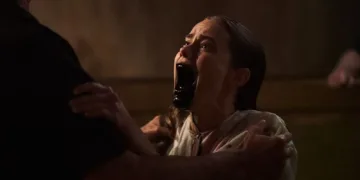
Will Spartalis’ score supports that visual strategy with sound that keeps changing shape. He builds from a low, throbbing ache into sudden percussive hits when the film turns violent, using rhythm as a tool for surprise rather than decoration. The technical centerpiece comes through the film’s commitment to practical effects. A ritual scene involving the extraction of a foreign object from Elise’s throat plays as a lesson in visceral discomfort, built on texture and physical immediacy. It aims for revulsion with craft, and it gets there.
Editor Sean Lahiff handles the first two acts with patience, letting dread accumulate and allowing scenes to breathe long enough for unease to settle in. The final act speeds up into snapped bones and frantic movement, shifting into a more kinetic mode. That escalation lands harder because the earlier sections hold back, giving the later gore a sense of release rather than random excess.
The Weight of Ritual
Phillips, Mike Harding, and Ticia Madsen write a possession story shaped by the specific details of FLDS folklore. Elements such as baptism for the dead appear alongside the use of hallucinogens, tying the supernatural material to practices presented as tangible and recognizable inside the film’s world. That grounding strengthens the story’s internal logic, since the rituals operate as part of a system the community already accepts and enforces.
Larue functions as a figure for the sect’s buried secrets and the harm created by authoritarian control. Through that figure, the film considers how religious fundamentalism can distort a person’s sense of self, turning identity into something that must be hidden, rewritten, or punished.
Elise’s past relationship with Clara introduces a piece of personal history the community tried to erase. The film signals that thread as meaningful, even if it could have benefitted from more time, because it clarifies what Elise is actually fighting for. The “demon” here aligns with suppression, with the cost of being forced to live against the self.
As Diabolic shifts from a psychological study of trauma into a fight for survival, it keeps returning to the same idea: an upbringing like Elise’s does not disappear through distance alone. The supernatural conflict becomes a literal confrontation with a past that keeps pushing up through the floorboards, refusing silence, refusing burial.
Diabolic is a haunting religious horror film that had its early breakout success at the Adelaide Film Festival before securing its 2026 wider rollout. The film officially hits select theaters this Friday, February 13, 2026, with a digital and On Demand release following shortly after on February 20, 2026. It explores the dark recesses of religious fundamentalism through the story of a young woman returning to the remote compound of her childhood. You can catch it in cinemas for a limited run or rent it through major VOD platforms like Prime Video and Apple TV+ starting next week.
Full Credits
Title: Diabolic
Distributor: Brainstorm Media, Monster Pictures, Vortex Media
Release date: February 13, 2026 (Theatrical), February 20, 2026 (Digital/VOD)
Rating: MA 15+
Running time: 95 minutes
Director: Daniel J. Phillips
Writers: Mike Harding, Ticia Madsen, Daniel J. Phillips
Producers and Executive Producers: Grant Hardie, Mike Harding, Ticia Madsen, Vasili Papanicolou, Mark Patterson, Daniel J. Phillips, Silvio Salom, Andrew Mann, Phil Hunt, Compton Ross, Andy Lyon, Ari Harrison, Chris Brown
Cast: Elizabeth Cullen, John Kim, Mia Challis, Luca Asta Sardelis, Robin Goldsworthy, Genevieve Mooy, Terence Crawford, Seraphine Harley, Mark Saturno, Dennis Coard
Director of Photography (Cinematographer): Michael Tessari
Editors: Sean Lahiff
Composer: Will Spartalis
The Review
Diabolic
Diabolic presents a fascinating collision between institutional trauma and supernatural folklore. While the script occasionally leans on familiar possession tropes, the commitment to practical effects and Elizabeth Cullen’s grounded performance provide strength. The film succeeds most when it treats religious fundamentalism as a tangible, suffocating force. It falters slightly in its final pacing, yet remains a sharp example of how specific cultural contexts can revitalize the horror genre. Daniel J. Phillips proves he has a keen eye for atmosphere, making this a film worth watching for fans of folk horror.
PROS
- Strong lead performance by Elizabeth Cullen.
- Visceral practical effects and creature design.
- Effective use of light and shadow in cinematography.
- Grounded exploration of religious fundamentalism.
CONS
- Overly familiar first-act setup.
- Uneven pacing in the final thirty minutes.
- Occasional reliance on predictable genre tropes.