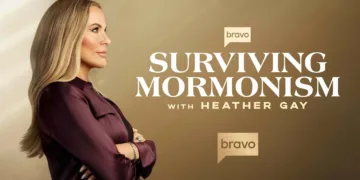































Heather Gay, familiar to viewers from The Real Housewives of Salt Lake City and from her memoirs, shifts into a different kind of spotlight with the three-episode Peacock docuseries Surviving Mormonism With Heather Gay. As a former member of The Church of Jesus Christ of Latter-day Saints (LDS Church), she uses her TV and publishing fame to examine the polished “Mormon influencer boom” that dominates social media feeds.
The series looks past curated perfection and confronts alleged darker realities inside the LDS community and its strict hierarchy. This project marks a deliberate change for Gay, who moves away from reality spectacle and literary self-reflection toward the role of advocate, amplifying the stories of people who say the institution failed them, harmed them, or pressured them into silence. The show keeps its focus on these individuals and functions as a call for accountability aimed at a religious organization with significant cultural power.
The Weight of Testimony and Institutional Betrayal
Surviving Mormonism builds around detailed, harrowing case studies. Each episode lays out specific accounts of trauma that survivors say the church mishandled. An early interview follows David Matheson, a man who once promoted and practiced gay conversion therapy. His reflection on the arrogance required to frame someone’s sexual orientation as an affliction that needs to be “healed” lands with force.

Matheson, who later left the faith and came out as gay, speaks with steady, visible guilt about his past work. The series continues with accounts of alleged child sexual abuse, including the experience of Ben, the husband of Gay’s friend, and the painful memories shared by sisters Jennie and Lizzy. Together, these stories describe what appears to be a pattern of institutional failure. Survivors say Mormon leaders kept secular authorities out of the process and closed ranks, allegedly protecting the Church’s image and the accused while victims carried the damage.
The show refers to records of lawsuits and settlements to underline that pattern. Heather Gay’s role in these segments feels essential. She sits in the interviews as a moderator who listens carefully and absorbs the emotion in the room. The camera catches her growing visibly emotional, connecting her own experience of fear and social pressure to the people in the chair across from her. She offers reassurance and acknowledgment, turning the series into a public space for claims that many of these participants say were ignored behind closed doors.
Trading Dirty Sodas for Dark Secrets
Gay’s on-screen persona sets the tone. Her reality TV stardom might, at first glance, seem like an odd fit for such heavy material. Her mix of warmth, sincerity, and self-deprecating humor proves disarming. She often steps back, functioning as a facilitator who opens the door and then lets others fill the silence. Along the way, she adds short stretches of historical and doctrinal framing, including brief references to the multi-billion-dollar tithing system.
Surviving Mormonism positions itself as a direct counter to the current wave of “Mormon wife mania” content and to the cheerful, produced fluff promoted by trad-wife influencers. The series rejects the idea of a glossy “Mormon 2.0” update to the faith and leans into a mood that stays dark, explanatory, and often angry, a sharp tonal clash with the chaotic antics of RHOSLC.
The episodes work to expose alleged cruelty that hides inside a culture of enforced niceness, a theme captured with eerie precision in Matheson’s line: “It’s the kindest cruel culture.” That tension between smiling surface and reported harm drives the show’s argument.
Pacing, Purpose, and the Cultural Counterweight
Across its three episodes, the series keeps the pacing brisk and direct. The storytelling favors personal testimony over dense theological lectures or historical timelines. Short segments on doctrine and finance appear as context, closer to footnotes than to headline material.
This narrow focus gives the case studies intensity and turns some of them into rapid-fire citations, with less room for fully rounded portraits. The direct style leaves little room for digression, and the show repeats its key concerns with clarity: the LDS Church’s alleged institutional handling of crisis, the patterns of silence, and the gap between public image and private experience.
Surviving Mormonism acts as a cultural counterweight to the glossy, camera-ready images of the faith that flood social media and its adjacent reality franchises. The project treats accountability as its guiding principle and shows Gay returning to that theme again and again, a stance that feels like a long-term position. By the end of the third episode, a question lingers: in this case, does the slick, familiar medium of reality-adjacent television shrink the force of these testimonies, or does it give them a megaphone they never had inside the church walls?
The docuseries Surviving Mormonism With Heather Gay premiered on Bravo, with all episodes immediately available for streaming on Peacock, exploring the host’s journey and the experiences of others who have left or been harmed by the culture of The Church of Jesus Christ of Latter-day Saints (LDS Church). The three-part series delves into controversial practices and allegations of institutional failure, offering a counter-narrative to the faith’s public image.
Credits
Title: Surviving Mormonism With Heather Gay
Distributor: Bravo, Peacock
Release date: November 11, 2025 (Episode 1 on Bravo), November 12, 2025 (All episodes streaming on Peacock)
Rating: TV-14 or TV-MA
Running time: 41–43 minutes per episode
Producers and Executive Producers: Heather Gay, Eli Holzman, Aaron Saidman, Erin Gamble
Cast: Heather Gay, David Matheson, Ben, Jennie, Lizzy
The Review
Surviving Mormonism With Heather Gay
Surviving Mormonism is a necessary, emotional exposé that effectively leverages Heather Gay’s public profile to give voice to serious allegations of institutional failure and harm within the LDS Church. While the quick pacing of the case studies can feel intense, the series is a powerful, sincere counterbalance to the sanitized image promoted by social media trends. It's a significant, courageous use of the reality TV platform for genuine cultural critique.
PROS
- Heather Gay is an empathetic, credible facilitator.
- Features testimonies that are deeply moving and courageous.
- Directly challenges the sanitized "Mormon influencer" image.
- Focuses sharply on institutional conduct and alleged cover-ups.
CONS
- The three-episode format necessitates a rapid succession of harrowing case studies, which can feel superficial.
- Brief segments on church doctrine and finance serve mostly as context, not in-depth analysis.
- Some stylistic choices, like monologues while driving, feel slightly contrived.