




















Michelangelo Merisi da Caravaggio, the Baroque master of fragile flesh, feels like an unquiet presence, never fully settled into history. His legend clings to the label “Bad Boy of Italian Art,” a man whose eruptions of personal violence seem fused to the intensity of pigment he dragged across canvas. The Exhibition on Screen documentary Caravaggio, directed by David Bickerstaff and Phil Grabsky, takes that unrest as its starting point and turns it into an interrogation of a life.
Because the artist left so little written testimony, the directors choose a bold organising principle: a re-imagined, monologuing Caravaggio, played by Jack Bannell, who speaks from within the film as if memory itself had been given a body. This figure tries to close the gap between sparse biographical fragments and the dense emotional weather of the paintings. The production leans on sharply focused close-ups of the canvases, which arrive alongside measured commentary from experts. The result feels like a visual inquest into existence lived on a razor’s edge.
The Mask and the Mirror: A Dialogue with the Dead
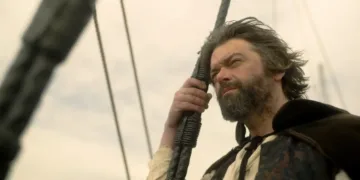
The documentary’s most striking formal decision is the introduction of Bannell as the painter. His performance, with its booming voice, assured swagger and a visible facial wound, presents a Caravaggio recounting his life while at sea, seeking a Papal pardon. This device grows directly from the historical record.
The artist left no private diaries, only police reports and his formidable body of work, so the film needs a consciousness that can speak. The actor’s presence attempts to fill this void and turns the painter into a subjective narrator of his own shadowed existence. Within that performance psychological tension appears. He charms, yet remains poised for attack, eager to assert artistic power, yet slippery whenever the conversation moves toward the specifics of his murder charge.
The man on screen admits to a past marked by childhood plague, street fights and endless drinking, then retreats from full responsibility. The film suggests that the familiar picture of a knife-happy brawler tells only part of the story. To secure significant commissions from Church authorities and elite patrons, Caravaggio needed disciplined professional control, a capacity to hold sacred image and profane impulse together inside the same frame. That double focus shapes the portrait of character that emerges.
The Terror of Illumination
Caravaggio’s enduring genius rests on a radical trust in light and darkness. His practice of chiaroscuro stages human figures inside violent contrasts of brightness and shadow. In later work this intensifies into tenebrism, where heavy blackness threatens to engulf everything except a sharply lit body or face. The screen presentation links this evolving technique to cinematic energy, as if decisive action bursts out of surrounding emptiness and shocks the spectator awake.

His decision to use ordinary people and acquaintances from the streets as models for sacred figures brings religious scenes closer to lived experience. The faces look recognisably human, touched by psychological complexity, which gives the spiritual subject matter an arresting immediacy.
When the film turns to paintings such as Judith Beheading Holofernes or Salome Receives the Head of John the Baptist, attention settles on the women’s expressions, which hold conflicted responses and avoid simple victory. The camera lingers on the grubby feet of workers in The Crucifixion of Saint Peter and, by holding that detail, amplifies Peter’s raw terror into a bleak revelation about bodily fear and mortality.
Perhaps the most clearly existential self-reference appears in David with the Head of Goliath, where Caravaggio gives his own features to the severed, exhausted Goliath. The painting becomes a cold reflection of his persecuted later years and of a self-image shaped by guilt and punishment. Expert observations by historians Helen Langdon and Fabio Scaletti support these emotional readings with concise explanation and confirm the painter’s intricate engagement with questions of art and faith.
The Art of the Expansive Gaze
The documentary works with dense material yet finds a steady rhythm. Information arrives quickly, and the directors reply to that intensity with passages of movement. Shots of the azure Mediterranean and ancient harbours act as breathing spaces between sequences of close scrutiny.
The film uses the Exhibition on Screen format with precision, granting viewers privileged access to works in situ across Rome, Naples and Malta. The story extends beyond a single exhibition and embraces the sweep of Caravaggio’s turbulent life and artistic achievement, which gives the piece wide scope. For viewers new to the painter, the film serves as an inviting starting point that encourages further looking and reading.
For long-time admirers, the rich biographical material, often from recent research, offers renewed engagement. The central creative risk of giving a voice to a historical ghost proves strikingly successful. It creates an eerie closeness to the artist. The film arrives at a simple, harrowing insight: Caravaggio laid his soul bare on the canvas, and the succession of light and shadow records the almost unbearable weight of being human.
Exhibition On Screen: Caravaggio is a biographical documentary that offers the most extensive film exploration of the revolutionary Italian Baroque painter Michelangelo Merisi da Caravaggio. Released in cinemas nationwide on November 11, 2025, the film delves into the mystery, passion, and violence of the artist’s life, featuring expert testimony and dramatic monologue sequences starring an actor as Caravaggio (Jack Bannell). Part of the acclaimed Exhibition On Screen series, this 100-minute film makes complex history accessible and thrilling, and is shown in theaters worldwide as an art house/event cinema release.
Credits
Title: Caravaggio
Distributor: Exhibition on Screen, Seventh Art Productions
Release date: November 11, 2025
Rating: 12A
Running time: 90 – 100 minutes
Director: David Bickerstaff, Phil Grabsky
Writers: David Bickerstaff, Phil Grabsky
Producers and Executive Producers: Phil Grabsky
Cast: Jack Bannell, Helen Langdon, Fabio Scaletti, Andrew Graham-Dixon, Jonathan Jones, Timothy Wilson
Director of Photography (Cinematographer): David Bickerstaff
Editors: Sam Holmes
The Review
Caravaggio
The film is an absorbing quest to reconcile the artistic titan with the fugitive man. Its bold structural choice—giving voice to the dead through Bannell's haunting portrayal—builds a rare intimacy. The documentary succeeds by refusing simple answers, offering a visually stunning, psychoanalytic exploration of the darkness and genius that defined Caravaggio. It's a high-level artistic examination grounded in human fallibility.
PROS
- Bold and effective use of an actor (Jack Bannell) to personify Caravaggio and narrate his life, compensating for lack of personal writings.
- Crisp, detailed close-ups of the artwork provide profound visual access and quality.
- Expertly links the artist's turbulent life (police records, paranoia) to the dramatic and psychological themes in his paintings.
- Well-paced, using evocative travel shots as necessary interludes between intense art analysis.
CONS
- The dramatic reenactment device, while effective, carries an inherent risk of melodrama.
- The film is informationally dense, potentially requiring multiple viewings for full absorption.
- Focuses heavily on the criminal and psychological elements of his life, potentially overshadowing some academic elements.