

















Television often acts as a mirror to the present, yet rarely is the reflection so immediate, the image so raw. The anthology series One Day in October sets aside the comfort of historical distance to create a form of urgent, televised testimony. It arrives not as a reflective look at a past tragedy but as a direct confrontation with an ongoing one.
The series functions as a collection of carefully curated fragments, mirroring how a catastrophic event is often experienced: not as a single, coherent narrative, but as a series of disconnected, intensely personal moments of crisis.
By choosing to tell the story of the October 7th attacks through the eyes of its victims and survivors, the show becomes a vessel for their experiences. It is a harrowing and essential document, a piece of art forged in the crucible of fresh grief, intended as an act of memory for a world that might be tempted to look away.
The Human Scale of an Unspeakable Tragedy
The series’ power resides in its steadfast commitment to the micro-narrative, a technique seen in global cinema where vast historical events are refracted through the prism of individual experience. This approach grounds the incomprehensible scale of the attacks in specific, tangible moments of human endurance. In the episode titled “Sunset,” this strategy is executed with breathtaking intensity.

We first see the Nova music festival as it was meant to be: a space of youthful energy and carefree celebration. This brief idyll makes the subsequent descent into chaos all the more jarring. When friends Amit and Gali take refuge in a portable toilet, their world shrinks to a few square feet of plastic and darkness. The masterful sound design becomes the primary vehicle for the narrative.
We hear not just indiscriminate gunfire, but the chillingly specific details of the massacre unfolding outside: the shouts of terrorists in Arabic, the panicked screams of other festival-goers, and, in one unforgettable moment, the recorded boast of a killer on the phone to his father, “Dad, I’m calling you from a Jewish woman’s phone! I killed her and her husband!”
Within this sonic nightmare, the camera focuses on the small gestures of friendship between the two women, their whispered reassurances and shared looks of terror forming a fragile shield against the horror. Their mobile phones, a ubiquitous symbol of modern connection, become dual-edged instruments of hope and despair, offering a potential lifeline while simultaneously delivering a stream of devastating news from the outside world.
The episode “My Light” explores a different facet of survival, extending the trauma from the moment of attack to the difficult process of its aftermath. The story of Sabin Taasa begins in the specific cultural context of a southern Israeli moshav, where reinforced safe rooms and concrete doors are not dramatic contrivances but normalized features of daily life.
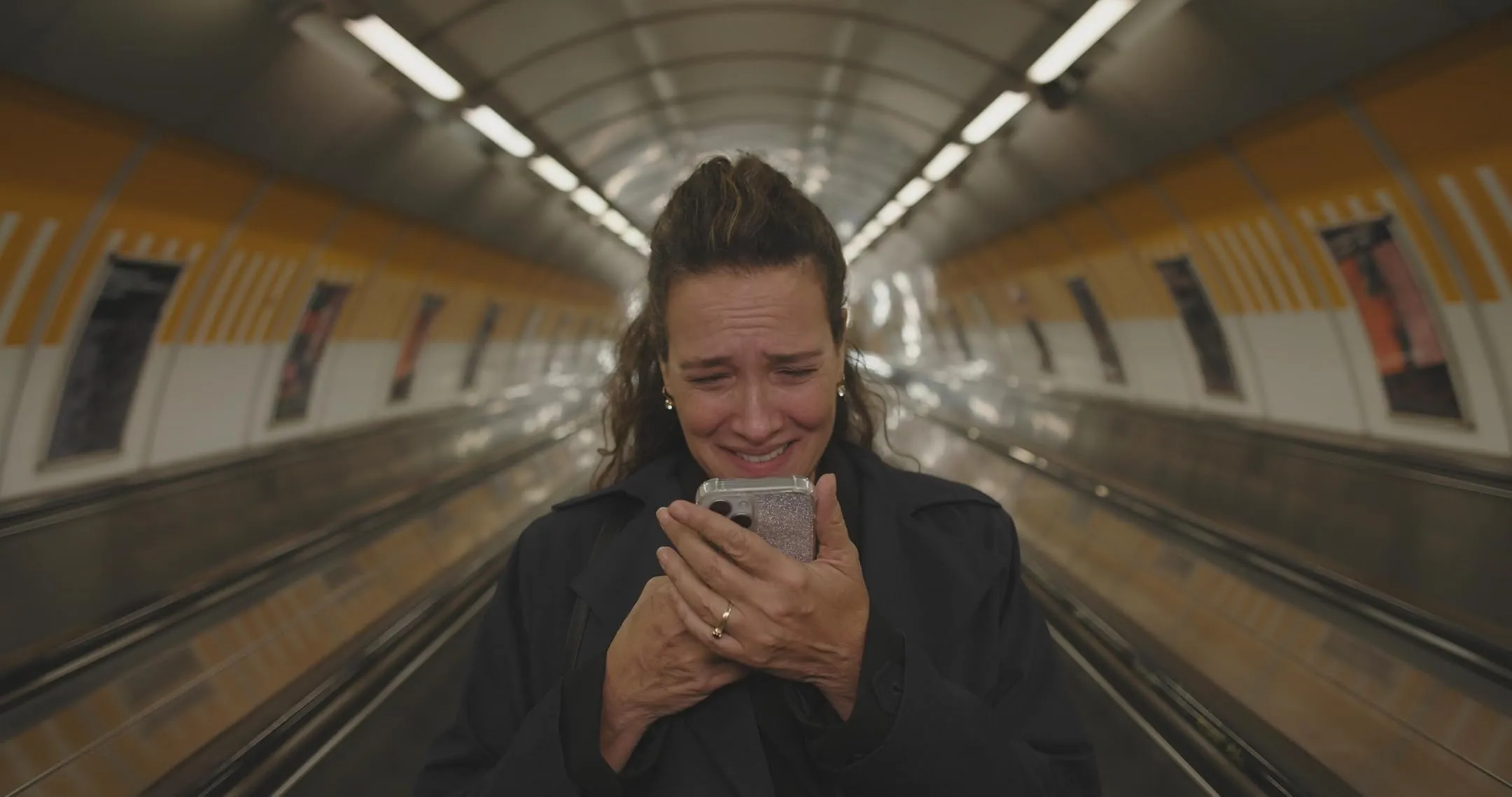
The direction brilliantly juxtaposes the claustrophobic, immediate terror inside the safe room with the polished, almost sterile environments of the French lecture halls Sabin later visits on a speaking tour. This editing choice creates a powerful disconnect, highlighting the immense gap between lived trauma and the world’s detached consumption of it. The episode deeply explores Sabin’s character, charting her journey from a mother gripped by fear to a defiant witness for her family.
Her frustration is palpable when confronted by a journalist who pushes for a “broader context.” Sabin’s sharp retort, “My children are in that film… Do you want to tell them what they endured is political?” serves as the episode’s ethical core. It is a powerful rejection of attempts to politicize or sanitize a profoundly personal tragedy, asserting the primacy of her lived experience.
Divergent Cinematic Visions of Terror
The anthology format allows the series to tailor its cinematic language to each specific story, resulting in episodes that are stylistically distinct yet thematically unified. The direction of “Sunset” is a masterclass in subjective, visceral immersion. The camera acts as a third terrified occupant of the portable toilet, employing shaky, handheld movements and extreme close-ups on panicked eyes and trembling hands.
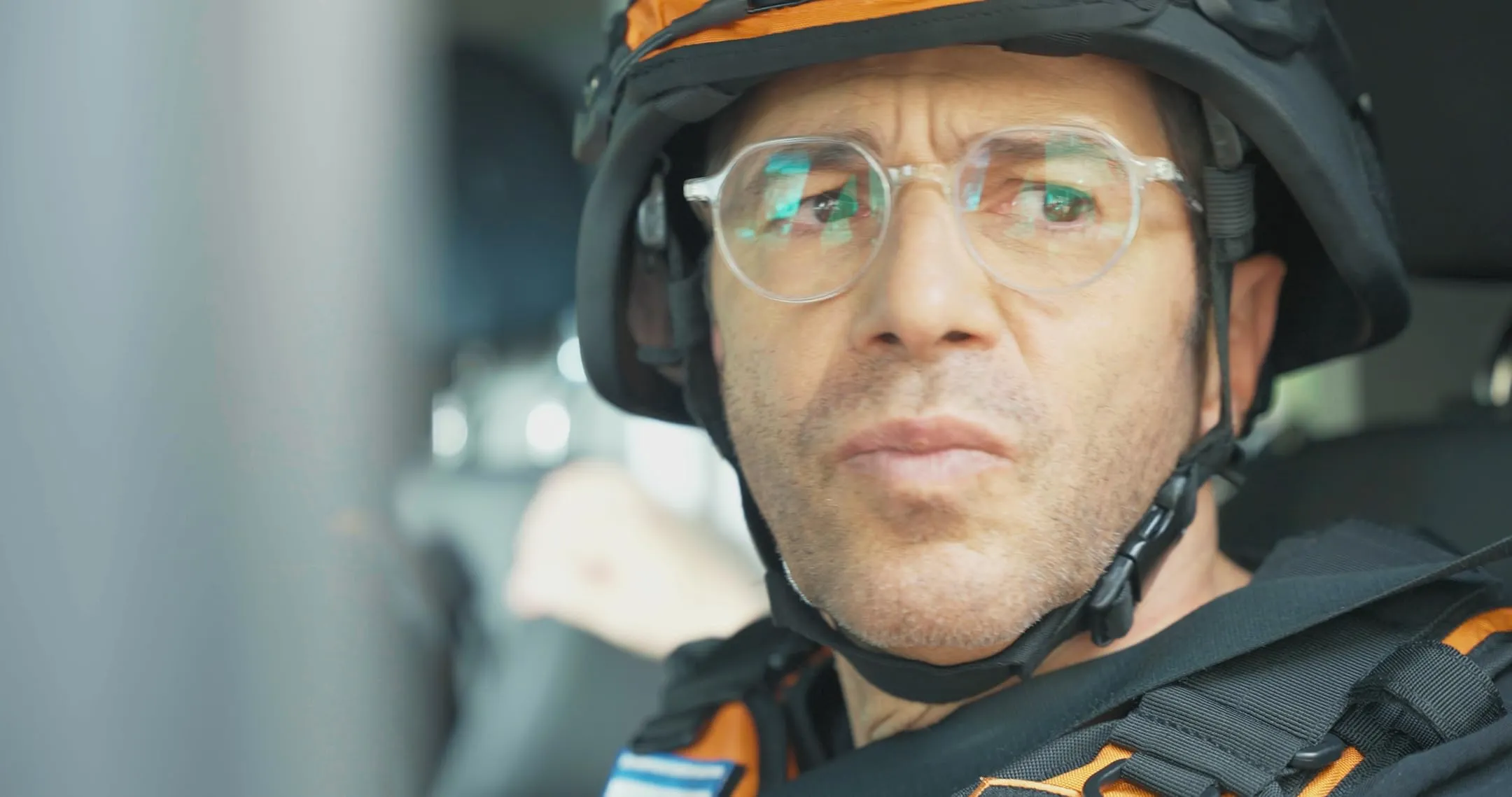
This technique denies the viewer any objective distance, forcing them into the characters’ terrifyingly limited perspective. The episode ventures beyond realism with daring flourishes that externalize the characters’ inner states. An animated sequence featuring a protective “evil eye” symbol, a potent cultural talisman, comes to life on the wall. This moment visualizes a desperate grasp for a metaphysical shield when physical safety has vanished.
In another stylistic break, a character’s phone screen is projected onto the interior walls, transforming the squalid space into a canvas of fear and fragmented information. The filmmakers also manipulate time itself, using an on-screen clock and sharp, tick-tocking jump cuts to stretch moments into agonizing eternities, perfectly capturing the psychological experience of waiting in terror.
In “My Light,” the filmmaking serves a different purpose. Its style is more controlled and reflective, focused on the mechanics of memory and testimony. The framing device of Sabin’s speaking tour is central to this approach, giving her the power to narrate her own trauma rather than having it narrated for her. The series is unflinching in its portrayal of her audiences, some of whom are shown texting or looking away, a subtle but sharp critique of compassion fatigue and indifference.
When the episode incorporates recreated security footage of the attack on her home, it adopts a grainy, black-and-white aesthetic. This visual choice mimics a language we associate with objective evidence, lending a stark and undeniable authenticity to the horror.
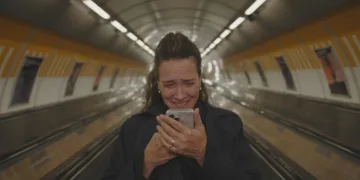
The power of the episode is anchored by Yaël Abecassis’s stunning performance as Sabin. Her face is a landscape of complex, shifting emotions. In one moment, she is radiant with the memory of her lost son; in the next, her expression hardens into defiance as she confronts the inadequacy of the world’s response. It is a portrait of grief as a dynamic, active force.
The Bridge Between Drama and Reality
The series’ most profound statement is delivered after each story ends. In a recurring structural choice, the closing credits are preceded by footage of the real-life survivors meeting the actors who portrayed them. This sequence is a deliberate and powerful decision to break the cinematic illusion. It collapses the comfortable distance between the viewer and the viewed, gently forcing an acknowledgment of the real human beings whose experiences were just dramatized.
This gesture prevents the audience from compartmentalizing the show as just another piece of prestige television; it insists on its status as a document. This meta-textual act serves as the series’ central thesis: that art and testimony are inextricably linked, and that the process of telling these stories is a collaborative and necessary part of healing for both the individuals and the nation they represent.
This approach aligns with a growing movement in global docudrama that intentionally blurs the line between fiction and non-fiction to provoke a more significant ethical engagement from the audience. The final moments do not simply provide closure; they issue a challenge.
They transform the passive act of watching into an active process of witnessing. By revealing the real faces behind the fiction, One Day in October asks its audience not just to remember a historical event, but to connect with the enduring human pain and resilience at its center. The series becomes more than a memorial; it is an invitation to listen, to feel, and to understand the profound strength required to survive and to tell the tale.
One Day in October is a 7-episode anthology drama television series based on personal stories and real-life accounts from the October 7, 2023 attacks in Israel. The series tells several distinct, yet interwoven, narratives of love, courage, sacrifice, and survival, all presented in a real-time scripted format. The first four episodes of the series premiered in Israel on October 7, 2024, on the network yes. In the United States, the series was acquired by HBO Max, where it is scheduled to be released.
Full Credits
Director: Oded Davidoff, Daniel Finkelman
Writers: Oded Davidoff, Daniel Finkelman, Liron Ben-Shlosh, Adam G. Simon, Keren Weissman, Amir Hasfari, Orit Dabush, Yona Rozenkier
Producers and Executive Producers: Daniel Finkelman, Chaya Amor, Aviv Ben-Shlosh, Lee Ben-Shlush Kuperman, Fernando Szew, Jim Berk, Sheldon Rabinowitz
Cast: Swell Ariel Or, Noa Kedar, Naomi Levov, Hisham Suliman, Wael Hamdoun, Yuval Semo, Avi Azulay, Naveh Tzur, Yael Abecassis, Moran Rosenblatt, Michael Aloni, Neta Roth, Sean Softi, Lior Ashkenazi, Uri Perelman
Director of Photography (Cinematographer): Lael Utnik
Composer: Tomer Biran
The Review
One Day in October
One Day in October is not entertainment; it is an essential, harrowing act of testimony. Through its intimate focus, versatile cinematic language, and the powerful bridge it builds between dramatization and reality, the series serves as a courageous and artistically rendered document of human endurance. It is a profoundly difficult but necessary viewing experience, one that confronts an open wound with immense integrity and respect for its subjects, demanding to be witnessed.
PROS
- Grounds a large-scale tragedy in deeply personal and affecting human narratives.
- Each episode uses a distinct and effective visual style to convey different facets of trauma.
- The inclusion of the real-life survivors at the end of each episode adds a profound layer of integrity and emotional weight.
- The acting is superb, capturing the terror and resilience of the individuals portrayed.
CONS
- The series is emotionally draining and may be too difficult for some viewers to watch.
- By design, it avoids a wider political or historical context, which might leave some viewers wanting more information.