

















![Kingdom Hearts Collection [I-III] Review](https://gazettely.com/wp-content/uploads/2026/10/Kingdom-Hearts-Collection-I-III-1-360x180.webp "Kingdom Hearts Collection [I-III] Review: KHII Holds Steady as Newer Entries Fluctuate 40")
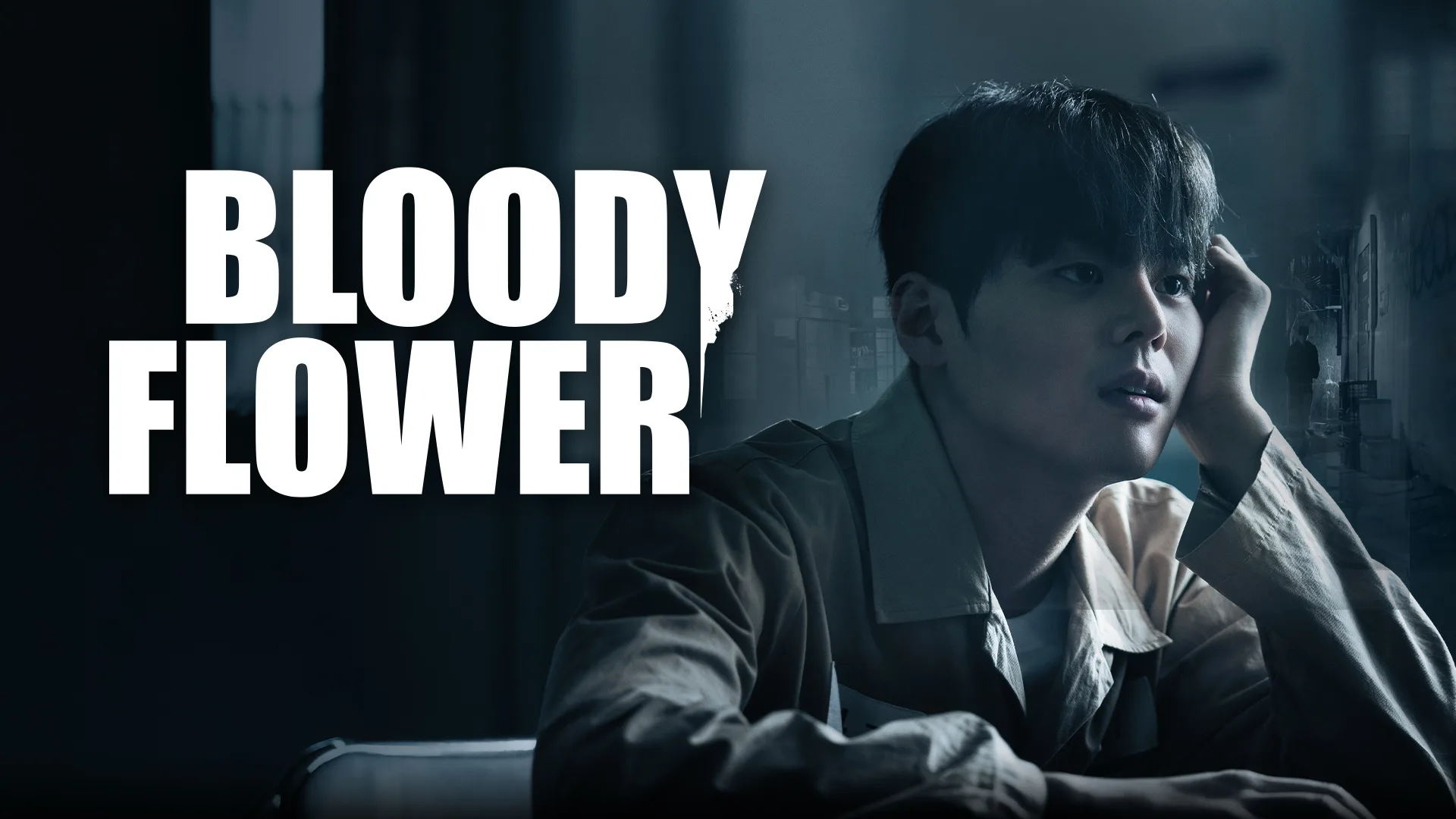

Guam City provides the setting for Bloody Flower, a legal thriller built around a chilling bioethical dilemma. Lee Woo-gyeom appears as a serial killer linked to seventeen brutal deaths. He claims that medical experiments he performed on those victims produced a universal cure for otherwise incurable illnesses. That claim destabilizes the courts and forces public debate.
Prosecutor Cha Yi-yeon treats Woo-gyeom as a monster who should face capital punishment. She refuses to accept that scientific findings could mitigate his crimes. Defense attorney Park Han-jun confronts a different imperative. His daughter suffers from Batten disease and he needs the alleged cure.
That personal stake ties him to a defendant he regards as a psychopath. As the trial unfolds, both sides search for witnesses and evidence, and the case expands from homicide into a dense web of medical and political deception. The series examines how far people will go to survive and whether a killer can occupy the role of savior.
The Savior Complex and the Butcher’s Knife
Lee Woo-gyeom fits an archetype familiar to viewers of darker strands of Indian parallel cinema, a protagonist whose moral framework has fractured and produced something terrifying. His actions carry a perverse form of altruism that echoes anti-heroes in Anurag Kashyap’s work. Woo-gyeom insists that his medical results justify the slaughter, and he shows minimal remorse in court.
His narcissism functions as emotional armor. He frames his calculus so that, by his logic, the lives his cure might save offset the deaths he caused. That utilitarian reasoning echoes moral debates seen across world cinema, while the production’s K-drama sensibility keeps the presentation glossy even as the material unsettles.
The narrative anchors this god complex in trauma. Woo-gyeom was once a promising medical student whose progress ended after a car accident that left him in a three-year coma. On waking he discovered a mutation in his blood. That mutation becomes the source of both power and suffering.
Seeking relief from chronic pain, he experimented on himself and then escalated from trials on plants and animals to human subjects, treating the work with clinical detachment. The series makes his blood’s unusual physical properties the biological basis for its medicinal claims, and that pseudo-scientific grounding gives the premise a gritty texture.
Woo-gyeom frames his crimes through selective victimology. He states that all seventeen victims were criminals, and the defense pushes this line to influence public opinion. The legal strategy presents him as a vigilante rather than a predator, recalling the populist applause for violent retribution in films such as Gabbar is Back. Bloody Flower removes any filmic masala heroism and leaves viewers with the cold irony of a killer who assumes the roles of judge and juror as he harvests material from people. His motive centers on harvesting; punishment does not appear as the motive.
The Erosion of Ethics in the Courtroom
Park Han-jun stands for the desperate everyman whose principles erode under pressure. He begins as a lawyer noted for taking socially significant cases. The cost of his daughter’s Batten disease forces a change in his practice. Financial strain pushes him toward defending wealthy criminals to secure funds.
That arc will be familiar to audiences who have watched films such as Jolly LLB, where legal ideals yield to necessity. Han-jun recognizes that he is acting for access to a miracle even as he protects a man he loathes. His internal conflict is constant. He must mount a rigorous defense while his personal ethics fracture.
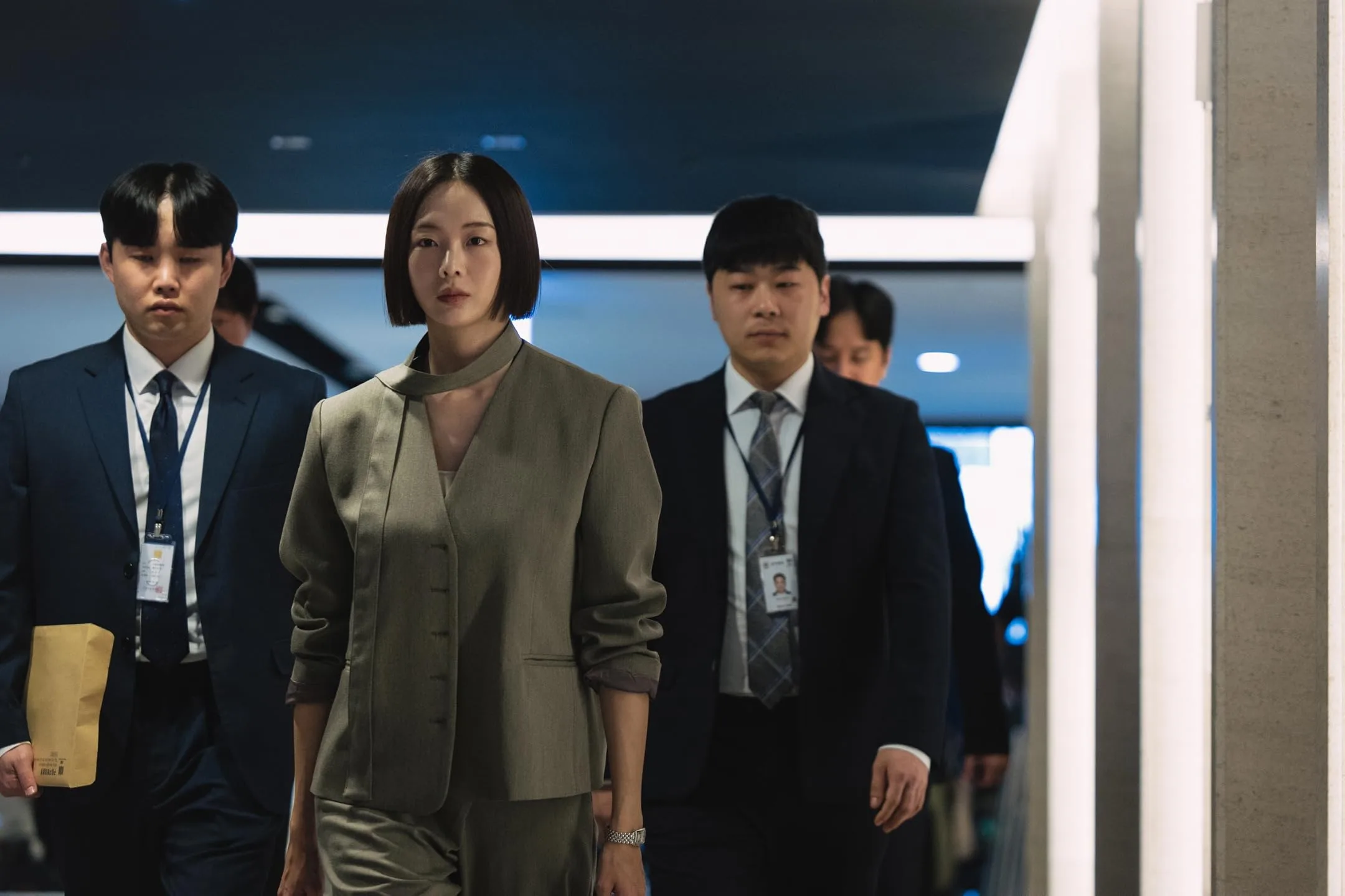
Prosecutor Cha Yi-yeon presents a contrasting posture. She represents strict adherence to law and leaves little room for gray. Yi-yeon comes from privilege as the daughter of the influential Sejin Group and aims to prove her merit on her own terms. That drive fuels her forceful push for the death penalty. Her relationship with Han-jun complicates the trial: he was once her teacher and role model, and his defense becomes a private betrayal for her. The interaction recalls classic mentor-student tensions intensified by life-or-death stakes.
The courtroom serves as a stage for these conflicting philosophies. The defense constructs a bluff about six cured witnesses to gain time. A planned public medical demonstration raises the stakes. Media attention becomes a critical element. Reporter Jo Woo-cheol shapes public reaction and turns the trial into a spectacle, a media circus that brings to mind the commentary on sensationalism in films such as Peepli Live. The prosecution faces a crisis when evidence appears that some of Woo-gyeom’s claims have scientific merit. Yi-yeon must preserve her legal position as scientific findings begin to align with the killer’s narrative.
Conspiracy and the Shift in Narrative Scope
The series shifts from a concentrated character study to a critique of institutions. The search for a so-called red notebook that holds Woo-gyeom’s research triggers this change in scope. The missing material suggests he did not act alone. Professor Han surfaces as an ambiguous figure whose role swings between mentor and possible accomplice.
The murder of Dr. Hong marks a turning point, indicating that dangers extend beyond courtroom drama. The plot probes why medical authorities initially greenlit Woo-gyeom’s work and then allowed it to be buried. That investigative thread produces a creeping paranoia similar to investigative thrillers such as Talvar, where truth becomes layered and obscured.
Corporate and political corruption dominate the latter half. Director Oh Hyeon-deuk appears with a record of ignoring medical breaches, and his involvement points to institutional rot. The Jinnam Research Institute and its ties to Cheum Medical Center form the institutional backdrop for the scandal.
Political actors issue warnings to Yi-yeon and pressure her to halt the inquiry. That interference suggests the presence of powerful interests. The Sejin Group stands to profit from medical breakthroughs regardless of origin, and the series implies that corporate appetite for gain may be a central force behind concealment.
Pacing and genre shift together. The plot moves from a slow-burn courtroom drama into a faster conspiracy thriller as new characters such as Min-gyeong add momentum. That acceleration prevents courtroom sequences from stalling and reorients the ethical dilemma from an individual calculus of ends and means toward institutional scale. Visually, the show adjusts to reflect that shift: cinematography moves from the grimy textures of crime scenes to the bright sterility of courtrooms and corporate offices. The transition highlights a sanitation of violence; the killer’s blood remains visible, while corporate culpability hides behind white coats and legal paperwork.
Bloody Flower is a South Korean mystery thriller that premiered on February 4, 2026. The series, which consists of 8 episodes, is based on the award-winning novel The Flower of Death by Lee Dong-geon. It follows a chilling narrative about a serial killer who claims to have discovered a universal cure for all incurable diseases through his horrific experiments. The show is currently available for streaming on Disney+ in select regions, as well as platforms like Viu and Kocowa for international audiences.
Where to Watch Bloody Flower



Full Credits
Title: Bloody Flower (블러디 플라워)
Distributor: Disney+, Hulu, Viu, Kocowa, Channel K (Prime Video India)
Release date: February 4, 2026
Rating: TV-MA
Running time: 50–60 minutes per episode
Director: Han Yoon-sun
Writers: Go Jun-seok, Lee Dong-geon (Original Novel)
Producers and Executive Producers: Oh Eun-young, EO Content Group, Contents G
Cast: Ryeoun, Sung Dong-il, Keum Sae-rok, Shin Seung-hwan, Jung So-ri, Ko Kyu-pil
Director of Photography (Cinematographer): Han Yoon-sun
Editors: Go Jun-seok
The Review
Bloody Flower
Bloody Flower challenges the audience to decide if a murderer can ever be a savior. Ryeoun anchors the show with a cold performance that balances fragility and malice. The legal battles provide a sturdy framework for the bio-ethical questions. The pacing occasionally stumbles during the investigative sequences. The shift from personal vendetta to corporate cover-up revitalizes the later episodes. This series successfully marries the visceral horror of serial killing with the sterile brutality of the courtroom.
PROS
- The lead actor effectively captures the unsettling calm of a psychopath who believes he is a messiah.
- The central premise forces viewers to question if the outcome justifies the method.
- The show effectively mixes the grime of a serial killer thriller with high-stakes corporate legal drama.
CONS
- The middle episodes suffer from slow investigative scenes that delay the main conflict.
- Prosecutor Cha Yi-yeon often feels trapped in a rigid, one-dimensional archetype compared to the more layered defense attorney.
- Certain legal maneuvers and discoveries rely too heavily on coincidence to move the story forward.