

















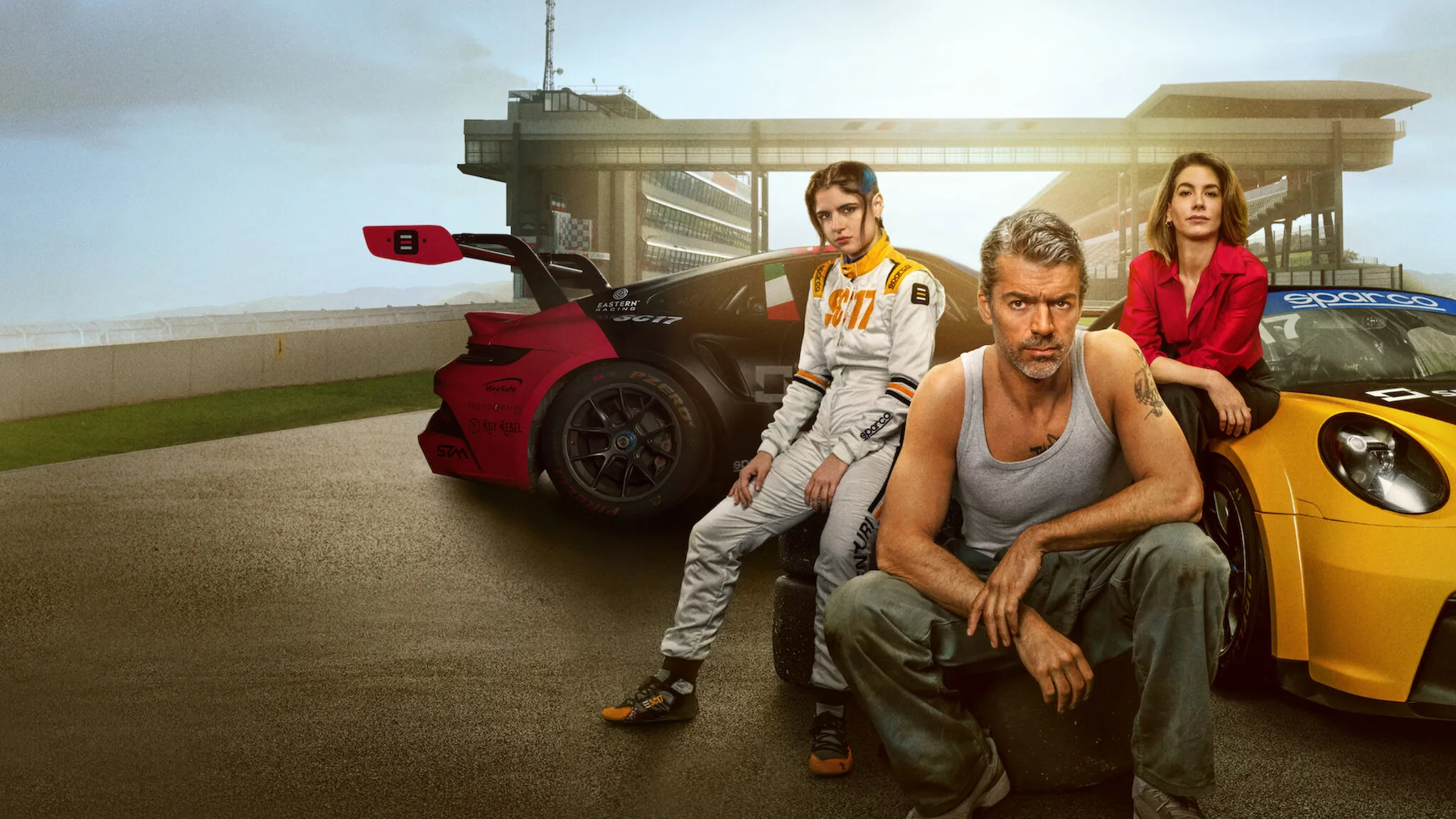

Motorvalley opens as a lean Italian drama set inside the pressure cooker of the Italian GT Championship. The plot centers on Elena Dionisi, a figure whose public self was built around her father’s reputation in racing. Her career collapsed after she tampered with a car to win a race, a choice that led to disqualification and to her father’s death.
A year later Giulio, her brother, runs the family operation, Alpha Blaze, under a corporate energy drink sponsorship that prioritizes profit and brand reach. Elena is cast out and seeks professional repair of her name by forming an independent entry, SC17.
Her roster includes Blu Venturi, a volatile talent with a record of illegal street racing and a prison sentence, and Arturo Benini, a former champion who retreated from the sport after a fatal track accident. The series was filmed in Emilia-Romagna and runs for six episodes. The script treats the mechanics of racing with technical attention while weighing the personal costs faced by people trying to return to a dangerous profession.
Friction and the Weight of History
Conflict between characters drives the drama. Elena moves from disgraced competitor to strategic manager, and her planning shows in the way she recruits people discarded by the official circuit. Blu stands for the sport’s raw energy. She has a past in illegal racing and time in prison, and she holds a persistent antagonism toward conventional authority. Her blue-streaked hair and aggressive on-track approach mark her as an outsider. Arturo lives a quieter life as a mechanic and joins SC17 when financial pressure forces him back into racing, even as he faces threats from a local criminal called Sergio.
The disclosure that Arturo was present in the accident that killed Blu’s father, Michele, creates a fragile dynamic between mentor and pupil. Giulio operates as the series’ central opponent. He treats the family’s history as a marketing asset and pursues commercial growth above tradition.
Those clashing aims let the show treat victories as transactions that carry intense private consequences. Elena must manage internal egos while countering the commercial force backing her brother. Casting favors newer performers who bring a raw authenticity to their roles and allow the interpersonal tensions to feel immediate.
Visceral Aesthetics and Technical Precision
The series builds a visual identity from its setting. Shooting in Emilia-Romagna and on real tracks anchors the story in Italy’s car culture. The cinematography alternates fast cutting with slow-motion work to record high-speed maneuvers and to underline the exactitude Blu’s driving demands. The camera follows her in both sanctioned races and desperate urban escapes.
An electronic score runs through the episodes and mixes with engine noise to form a sustained audio intensity. On- and off-track moments receive roughly equal weight. One scene places Elena on a motorcycle to shield Blu and Arturo from police pursuit, which emphasizes their improvisational skills outside the paddock.
The writing inserts technical language, including mentions of engine control units and detailed car setups, and those specifics reward viewers fluent in mechanical detail. Production avoids sterilized depictions of racing and favors a look that highlights garage dirt and asphalt strain. That visual choice keeps the danger of the sport in plain view.
Underdog Mechanics and Systemic Conflicts
The plot follows an underdog pattern as SC17 is assembled. Elena confronts immediate obstacles such as acute funding shortages and the requirement to pass strict scrutineering. Arturo’s debt to Sergio produces a crime thread that introduces physical peril and pushes him toward car theft, which keeps violence looming over the team. Training moves to remote mountain roads where Blu slowly comes to accept Arturo’s technical instruction despite their fraught past.

Sibling rivalry recurs as a structural engine. Giulio uses sabotage to stall Elena, manipulating her financial channels at pivotal moments and exposing the structural disadvantages facing independent teams. The season balances intimate family scenes with high-adrenaline racing, and it advances toward a final championship event while leaving core personal conflicts unsettled.
Episode by episode the stakes increase, and the characters’ future depends on their capacity to act as a functioning unit. The script refrains from tidy endings and tracks the difficulty of sustaining professional performance under the weight of private ghosts. The series’ tempo mirrors the sport; every gear change and each turn carries implications for the team’s collective survival.
Motorvalley is an Italian action-drama series that premiered globally on Netflix on February 10, 2026. Set in the iconic Emilia-Romagna region—home to Italy’s most prestigious automotive legends—the show follows a disgraced racing heir who attempts to rebuild her family’s legacy by forming an unlikely team of outcasts. You can stream the entire six-episode first season exclusively on Netflix.
Where to Watch Motorvalley


Full Credits
Title: Motorvalley
Distributor: Netflix
Release date: February 10, 2026
Rating: TV-MA (M18)
Running time: Approximately 50 minutes per episode
Director: Matteo Rovere, Pippo Mezzapesa, Lyda Patitucci
Writers: Matteo Rovere, Francesca Manieri, Gianluca Bernardini, Michela Straniero, Erika Z. Galli
Producers and Executive Producers: Matteo Rovere, Groenlandia Group, Banijay Group
Cast: Giulia Michelini, Luca Argentero, Caterina Forza, Giuseppe Spata, Andrea Montovoli, Giovanna Mezzogiorno, Davide Donin, Ivano Chinali
Director of Photography (Cinematographer): Michele D’Attanasio
Editors: Gianni Vezzosi, Marcello Saurino
Composer: Mokadelic
The Review
Motorvalley
Motorvalley establishes itself as a sharp look at professional redemption within the Italian racing world. It successfully trades polished sports tropes for a gritty, technical atmosphere. The central friction between Elena and Blu provides a necessary human element to the high-speed sequences. While some narrative beats feel familiar, the authentic setting and visceral cinematography create a distinct identity for this drama. It offers a grounded perspective on the cost of ambition and the weight of legacy.
PROS
- Authentic use of Emilia-Romagna locations.
- Intense, fast-paced racing cinematography.
- Focus on technical mechanical details.
- Strong character performances.
CONS
- Predictable sibling rivalry.
- Uneven pacing in early episodes.
- Formulaic secondary plot points.