













Being told that your usefulness has expired is a peculiar kind of death. The body remains, the habits remain, the people you love remain, yet an institution has quietly decided that the life you built can be packed into boxes and reassigned.
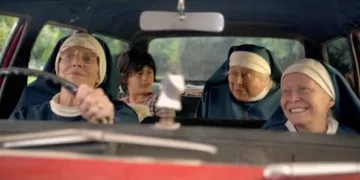
Nat Boltt’s Holy Days, adapted from Dame Joy Cowley’s novel and set in 1970s Aotearoa, hides that melancholy inside a gentle road comedy. Sisters Agnes, Mary Clare, and Luke are elderly Catholic nuns living in a deteriorating convent that church authorities plan to sell. Their response is wonderfully improper. They take Father Findlay’s car, head south in search of a property deed that might save their home, and acquire young Brian Collins as a travelling companion.
There are cigarettes, gambling tickets, ferry problems, failing machinery, and a vehicle whose survival starts to feel suspiciously theological. The film approaches faith lightly. God is present less as doctrine than as the stubborn belief that abandoned things might still deserve saving.
Three Women Left Behind
The quiet cruelty of the convent dispute lies in who is committing it. These women have spent decades serving the Church, caring for children, babies, single mothers, and people who arrived with nowhere else to go. Now the same institution considers their home expendable.
Judy Davis gives Sister Agnes the hard surface required to start a rebellion. She steals the car, pushes the others forward, and behaves like certainty can be manufactured through sheer irritation. Yet Davis lets hesitation flicker beneath Agnes’s commands. Her fear concerns failure rather than belief. Faith can survive doubt. Responsibility is harder.
Jacki Weaver’s Sister Mary Clare carries a softer sorrow. When she reminds Brian that he remains surrounded by adults who care for him, the conversation folds the boy’s grief into the sisters’ situation. Everyone in that moment is trying to explain why love should count as shelter when buildings and families can disappear.
Miriam Margolyes has the broadest comic material as Sister Luke, whose dementia makes her unpredictable. Dentures fly. Medication complicates matters. Some jokes reduce her condition to an easy punchline. Margolyes keeps finding the woman inside them. Luke may lose pieces of the present, yet affection survives intact. There is something painful there. Memory can surrender names, locations, instructions. Love sometimes stays behind.
The Mountain and the Dead
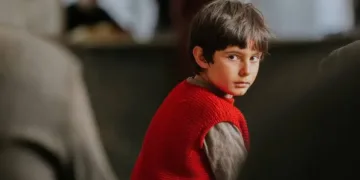
Brian has constructed a geography for grief. His mother is dead, but he believes she waits on Aoraki, and a snow globe containing the mountain becomes the small physical object around which that belief gathers.

Elijah Tamati plays him without the polished rhythms often imposed on child performers. The effect is strongest when Brian hides in his mother’s clothes and cries inside her closet. Nothing about the scene needs interpretation. A child has discovered that fabric can retain the shape of someone who will never wear it again.
His repeated visits to the convent carry the same loneliness. He arrives with supposed sins to confess because confession gives him permission to remain near adults who understand that he does not really want absolution. He wants somewhere to sit.
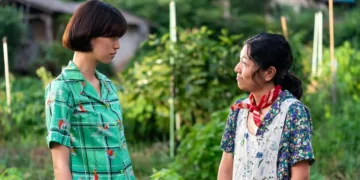
His anger toward his father’s new relationship carries another fear, tied to belonging and cultural identity. The use of Te Reo Māori gives that anxiety a concrete presence rather than treating Brian’s displacement as generic childhood resentment.
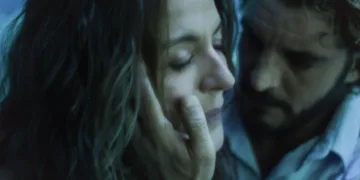
The road eventually bends toward his belief in Aoraki, and the film’s comic rhythm nearly freezes with him during the snowstorm. Brian’s imagined encounter with his mother is tender, frightening, and close to the emotional language the film has been searching for. Boltt occasionally reaches too insistently for tears here, yet the idea beneath the sequence remains piercing: grief can make death seem easier to approach than life.
The trouble is structural. Brian’s crisis overtakes the convent quest, draining momentum from the women’s fight just as that story should tighten. For a while, Holy Days seems to be travelling along two roads that happen to share a car.
Whimsy on an Uneven Road
Boltt keeps the trip itself modest. A ferry must be boarded. Money disappears. Gambling tickets are discovered in a glove box at precisely the useful moment. The car struggles onward with the mechanical dignity of something that should have died several towns ago.
The best comedy comes from personality. Agnes smoking under pressure works because Davis plays the act as routine rather than rebellion. The sisters bargaining their way forward works because their desperation clashes with their outward respectability. Father Findlay, played by Jonny Brugh, provides a neat institutional joke simply by being a priest with appetites considerably less saintly than the women causing trouble.
Other jokes arrive wearing bells. Flying dentures and bodily functions ask the audience to laugh before the characters have given the moment any comic shape. The film sometimes appears convinced that elderly nuns breaking decorum is funny by itself.
Its sentiment has a similar problem. The central deed quest loses urgency after a revelation weakens its practical purpose, while the celebratory dance near the end pushes warmth so firmly that spontaneity slips away.
Still, there are images the sweetness cannot smother: three aging women refusing an orderly disappearance, a grieving boy carrying a miniature mountain, an unreliable car crawling south because stopping would mean accepting what others have decided for them. Perhaps that is where Holy Days comes closest to prayer. Not in certainty. In refusal.
Holy Days premiered at the Santa Barbara International Film Festival on February 5, 2026, and is available on VOD and select theaters. The comedy-drama follows an unhappy young boy and three eccentric elderly nuns as they embark on an unexpected cross-country road trip.
Where to Watch (2026) Online
Full Credits
Title: Holy Days
Distributor: Blue Fox Entertainment, Photon Films, Kismet Movies, Rialto Distribution
Release date: February 5, 2026 (Santa Barbara International Film Festival), March 27, 2026 (North America)
Rating: PG
Running time: 101 minutes
Director: Nat Boltt
Writers: Nat Boltt
Producers and Executive Producers: Roxi Bull, Victoria Dabbs, Sushant Desai, Michelle Morris, Emma Slade
Cast: Judy Davis, Miriam Margolyes, Jacki Weaver, Elijah Tamati, Craig Hall, John Bach
Director of Photography (Cinematographer): Thomas Burstyn
Editors: Carly Turner
Composer: Karl Sölve Steven
The Review
Holy Days
Holy Days finds its deepest feeling when the road grows cold and Brian’s belief that his mother waits on Aoraki stops looking childish and begins looking unbearably human. Nat Boltt’s comedy is less assured elsewhere, with obvious jokes, a weakened property-deed quest, and sentiment that occasionally announces itself too loudly. Yet Judy Davis, Jacki Weaver, Miriam Margolyes, and Elijah Tamati give the film a tenderness its construction cannot always earn. Beneath the stolen car and flying dentures sits a quieter fear shared by child and nun alike: being left behind.
PROS
- Strong central quartet
- Brian’s raw grief
- Warm intergenerational chemistry
- Thoughtful displacement themes
CONS
- Uneven comic material
- Weakening central quest
- Awkward tonal shifts
- Overplayed sentiment