














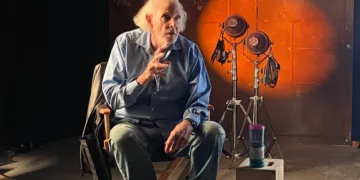











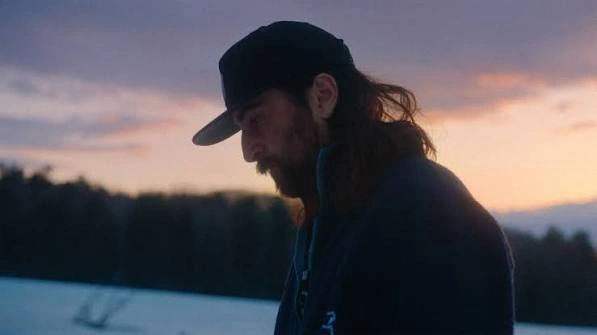

Noah Kahan: Out of Body, directed by Nick Sweeney, follows the Vermont singer-songwriter at the kind of career peak most musicians spend years trying to imagine. The cameras catch him during the towering afterglow of Stick Season, with Madison Square Garden and Fenway Park no longer distant dreams, but actual stops on the calendar. For a film built around sold-out crowds, though, its most revealing moments happen far from the stage.
Kahan’s rise from Strafford, Vermont, to international folk-pop visibility gives the documentary an appealing underdog shape, but Sweeney avoids turning it into a glossy coronation reel. The film is far more concerned with what success does to a person whose art depends on confession, anxiety, homesickness, and family history. Kahan has built a career out of emotional candor, and Out of Body studies the strange cost of that openness once millions of people start listening.
The result is a music documentary that treats triumph as unstable ground. The lights are bright, the crowds are massive, and Kahan still looks like someone trying to find a private room inside his own public life.
Stadium Dreams and the Blank Page
The Fenway Park and Madison Square Garden sequences give Out of Body its scale. Sweeney understands the visual power of watching Kahan command spaces that once seemed unreachable, and the concert footage has the communal charge expected from a modern streaming music doc. The sound mix gives the audience enough crowd energy to feel the size of the moment without drowning out the grain in Kahan’s voice, which remains the film’s emotional anchor.
What makes the documentary sharper is the way it places those grand performances beside Kahan’s creative anxiety. The film keeps returning to the same question: what does an artist write after the songs born from isolation, family pain, and small-town restlessness become global hits? Kahan’s answer, at least for much of the film, is frustration. He strums, jokes, stalls, reflects, and searches for friction in a life that has suddenly become comfortable and heavily monitored.
The industry presence around him adds a quiet pressure. Managers and career voices speak in terms of momentum, direction, and the next move. Kahan speaks like someone worried that his own emotional vocabulary may have changed faster than his songwriting can process. That tension gives the documentary its strongest structural idea. It starts near a grand finale, then rewinds into a story that refuses to feel finished.
Vermont as Memory, Myth, and Emotional Weather
Vermont is treated less like a backdrop than a source code for Kahan’s music. Strafford and the Upper Valley come through in wintry landscapes, blunt local humor, family rooms, old creative spaces, and the kind of small-town intimacy that can feel comforting one minute and suffocating the next. Sweeney’s camera has an affectionate eye for the place, but he avoids postcard prettiness. The townspeople are funny, dry, and unsentimental, which suits Kahan’s own public persona.
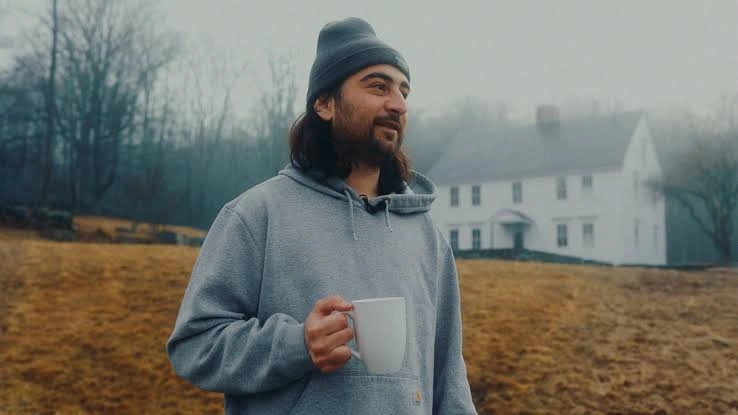
The family material gives the film much of its depth. Kahan’s parents, siblings, and fiancée Brenna are presented as grounding forces, yet the documentary is honest about the unease built into writing songs from private history. His lyrics draw from separation, childhood hurt, anxiety, and the tangled bonds that shape a home. Those songs gained power because they felt personal, but the film asks what happens when family pain becomes a shared artifact for fans.
The material involving his father’s bicycle accident brings a tender strain to the film, especially because Kahan does not always appear polished in those conversations. He can be prickly, funny, guarded, and affectionate in the span of a single exchange. Those contradictions make him feel human rather than curated.
The lighter scenes matter too: drinks with family, jokes with locals, old rooms marked by teenage creativity. Humor becomes a pressure valve. For a critic who loves how a good jazz solo can bend sorrow into swing, Kahan’s wit works in a similar way. It keeps the melancholy moving.
Vulnerability Without a Clean Finish
The most striking parts of Out of Body come from Kahan’s openness about depression, anxiety, body dysmorphia, and disordered eating. These are difficult subjects for any documentary, and Sweeney handles them with a directness that rarely feels exploitative. Kahan’s self-deprecating humor can make him seem relaxed on camera, but the film gradually shows how much distress sits beneath that rhythm of jokes and quick remarks.
The documentary links his mental health to touring fatigue, online response, family guilt, creative paralysis, and the strange distortion that comes with being watched constantly. Fame does not cure his old wounds. It magnifies them, then asks him to perform through the glare. That idea gives Out of Body cultural weight beyond its function as a musician profile. It reflects a generation of artists whose careers are built through intimacy, algorithmic visibility, and the expectation of constant access.
Sweeney’s construction is loose in places. Some personal threads arrive briefly, then fade before they can fully develop. The recording process receives less attention than expected, and the film sometimes feels closer to a lifestyle portrait than a studio diary. Still, that looseness suits a subject caught mid-transition. Kahan has not solved the next chapter yet, and the documentary is honest enough to sit in that uncertainty.
As an introduction for casual viewers, Out of Body is warm, funny, and emotionally accessible. For fans, it deepens the relationship between the songs and the person who wrote them. Its strongest asset is Kahan himself: sharp, anxious, sincere, self-critical, and charismatic enough to make creative paralysis feel unexpectedly watchable.
Noah Kahan: Out of Body is a music documentary that premiered at the SXSW Film & TV Festival before making its official global streaming debut on April 13, 2026. The film offers an intimate look inside the mind of the Grammy-nominated singer-songwriter as his world shifts rapidly following the massive, sudden international success of his album Stick Season. Capturing the final leg of his extensive tour and the mounting anticipation surrounding his career-defining performances at Fenway Park, the narrative follows Kahan as he returns to his rural Vermont roots to confront personal mental health struggles and rediscover his sense of home. Audiences can watch the award-winning documentary streaming exclusively on Netflix.
Where to Watch Noah Kahan: Out of Body (2026) Online


Full Credits
Title: Noah Kahan: Out of Body
Distributor: Netflix
Release date: April 13, 2026
Rating: TV-MA
Running time: 94 minutes
Director: Nick Sweeney
Writers: Nick Sweeney
Producers and Executive Producers: Ben Adelson, David Blackman, Anna Keegan, Ryan Kroft, Devon Libran
Cast: Noah Kahan, Pat, Oliver, Luke, Earl, Melvin Coburn, Elva, Betty, Josh Kahan, Drew Simmons, Richard Kahan, Konrad Mitchell
Director of Photography (Cinematographer): James Adolphus, Asher Brown, Noah Collier, Nick Sweeney
Editors: Paul Little, Ana Veselic
Composer: Oliver Claridge
The Review
Noah Kahan: Out of Body
Noah Kahan: Out of Body is an intimate, uneasy music documentary that finds its strongest material away from the stage. Nick Sweeney captures Kahan as a performer caught between massive success and private uncertainty, with candid reflections on family, fame, body image, and creative fear. Some threads feel underdeveloped, yet the film’s emotional honesty and Kahan’s sharp, self-aware presence make it a moving portrait of an artist trying to write his way into a new chapter.
PROS
- Honest treatment of mental health and body image
- Strong sense of place through Vermont and family material
- Engaging concert footage from major career milestones
- Kahan’s humor gives the film warmth and texture
- Avoids feeling like a simple promotional profile
CONS
- Some personal threads feel incomplete
- Limited focus on the recording process
- Looser structure may frustrate viewers seeking a tighter music documentary
- Best suited to viewers already curious about Kahan’s music