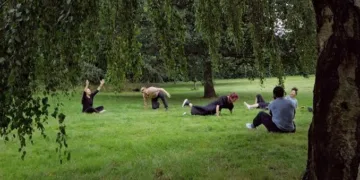

















Sophie Fiennes’ Acting turns rehearsal into its entire dramatic field. The film observes an intensive Cheek by Jowl workshop built around Macbeth, set largely inside the decaying rooms and corridors of Twyford Abbey. The location matters. Its ruined walls, bare floors, and castle-like shadows give Shakespeare’s tragedy a physical home before any throne, crown, or battlefield appears. This is a film about the work before the work, the stagecraft hidden beneath what an audience later mistakes for instinct.
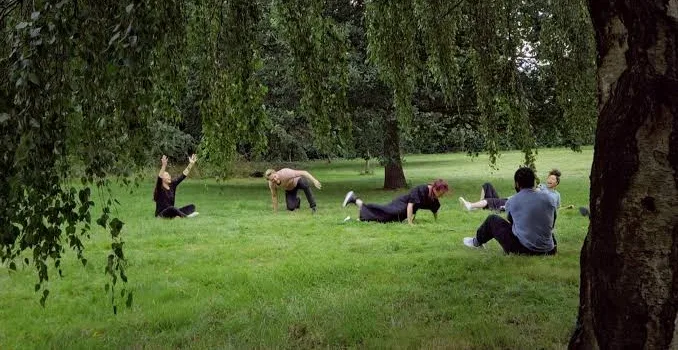
Declan Donnellan leads the sessions with Nick Ormerod nearby, guiding eight actors who rotate through Macbeth and Lady Macbeth. There is no narration, no tidy backstage arc, no final production waiting as a payoff. Fiennes keeps the camera fixed on process: repeated lines, shifting bodies, actor exercises, practical questions, and the slow construction of fear, ambition, guilt, and desire.
That makes Acting a demanding watch by design. It is serious, specialized, and patient, sometimes to a fault. Yet its best passages have the quiet thrill of seeing thought become behavior.
Macbeth in Motion
The richest element in Acting is its understanding that performance begins long before a line sounds polished. Fiennes watches the actors work through famous passages from Macbeth, including “Is this a dagger?”, “Unsex me here,” “Out, damned spot,” and “Tomorrow and tomorrow and tomorrow.”
These speeches arrive with centuries of theatrical weight attached, which can turn them into museum pieces if handled too reverently. Donnellan’s method cuts through that danger by asking basic, practical questions. Where is the dagger? Who is Macbeth speaking to? What happens to the thought before the line arrives? What changes when the actor moves from one wall to another? The answer, repeatedly, is that everything changes.
Donnellan’s teaching style is sharp, generous, and dryly funny. He has little patience for foggy declarations about personal truth, which may be wise, since nothing kills a rehearsal faster than someone guarding their “process” like state secrets. His focus remains on action, attention, and relationship. Shakespeare’s language becomes less intimidating once it is attached to a target, a room, a person, a fear.
The film’s clearest insight involves blocking. Space is treated as an active storytelling tool rather than a decorative container. A doorway can change a power dynamic. A staircase can expose hesitation. A wall can become a partner in the scene. One of the most revealing exercises has an actor repeat a thought in plain language until emotion rises naturally, then return to the text with that impulse still alive underneath. The result is modest in appearance and enormous in effect. A line that felt recited suddenly feels discovered.
For a film about rehearsal, Acting also becomes a stealth lesson in Macbeth. The play’s architecture, its dread, its marital tension, its collapsing sense of time, all emerge through bodies finding pressure in space. Fiennes does not need to explain the tragedy. She lets the workshop show how it breathes.
The Camera Watches, Then Waits
Fiennes takes an austere observational approach, stripping away many of the devices that usually make documentaries easier to digest. There are no talking-head interviews, no explanatory captions introducing every performer, and little biographical framing for Cheek by Jowl. The viewer is placed inside the workshop and left to pay attention. That choice can feel bracing. It can also feel like being handed a seat in drama school without being told where the tea is kept.
The black-and-white cinematography gives Twyford Abbey a stark, haunted beauty. Its corridors and peeling interiors become an atmospheric extension of Macbeth itself, with Inverness Castle suggested rather than built. Natural light does much of the heavy lifting, and the actors’ bodies often look exposed against the ruin around them. The setting gives the film a visual severity that suits its subject. Theatre is full of ghosts, and this building appears to have kept a few on standby.
Fiennes is especially alert to small shifts: a pause before speech, a change in eye line, the moment an actor stops demonstrating emotion and starts receiving it. These are not flashy cinematic beats, but they are dramatic ones.
The restraint has limits. During looser rehearsal passages, the framing can feel uncertain, with the camera sometimes struggling to follow performers moving through space. Some black-and-white cutaways of the grounds add mood without always deepening the film’s shape. The style trusts the process completely, and that trust gives the film intimacy. It also leaves weaker stretches exposed.
The Demands of Watching Work
At 147 minutes, Acting asks a great deal from the viewer. Its structure repeats because rehearsal repeats. Actors return to the same scenes, the same speeches, the same emotional problems, each pass altered by a look, a movement, a question, or a correction. That is honest to the craft. It is also, at times, wearying. The film can begin to feel less edited than preserved, as if every useful workshop moment had been invited to stay for dinner.
This is where Fiennes’ commitment to process becomes both strength and liability. Viewers drawn to theatre, Shakespeare, acting, or documentary form may find the length absorbing, since it grants rare access to a kind of labor usually hidden from public view. The actors allow the camera to catch uncertainty, awkwardness, repetition, and breakthrough. Their vulnerability gives the film its emotional texture. They are not performing mastery. They are being filmed while trying to reach it.
For viewers hoping for personal backstories, a clean dramatic arc, or a final staged version of Macbeth, the film may feel too narrow. It withholds many of the conventional rewards attached to arts documentaries. No grand curtain call arrives. No single transformation organizes the material. Instead, Acting offers a cumulative study of craft, where progress is measured in tiny adjustments that only become meaningful through attention.
The film would likely gain force from tighter shaping and a clearer internal rhythm. Still, its finest moments reveal something rare: performance as a chain of choices, each one built from text, body, space, and thought. For the patient viewer, that is enough to make a familiar tragedy feel newly unstable, alive, and dangerously close.
Acting is a psychological drama television series that premiered on Apple TV+ on May 29, 2026. The narrative charts the volatile, high-stakes trajectory of an intense young method actor in New York City whose shifting identities on stage begin to dangerously bleed into his reality. Audiences can watch the dark, gripping series stream exclusively on Apple TV+ with new episodes dropping weekly.
Full Credits
Title: Acting
Distributor: Apple TV+
Release date: May 29, 2026
Rating: TV-MA
Running time: 43 minutes per episode
Director: Sean Durkin
Writers: Sean Durkin, Michael Mitnick
Producers and Executive Producers: Sean Durkin, Michael Mitnick, David Heyman, Jeff Clifford
Cast: Paul Mescal, Margaret Qualley, Harris Dickinson, Donald Sutherland, Martha Plimpton, Scoot McNairy, Josh O’Connor
Director of Photography (Cinematographer): Mátyás Erdély
Editors: Jennifer Lame
Composer: Daniel Lopatin
The Review
Acting
Acting is a rigorous, patient documentary that turns rehearsal into a drama of its own. Sophie Fiennes captures the fragile labor behind performance with intelligence and restraint, while Declan Donnellan’s guidance gives the film its sharpest insights. Its 147-minute length can feel punishing, and the repetition will test viewers outside theatre circles. Still, for anyone interested in Shakespeare, acting, or the mechanics of craft, it offers rare access to the moment where text becomes feeling.
PROS
- Rare access to high-level rehearsal process
- Strong insight into Shakespearean performance
- Striking black-and-white imagery
- Excellent use of Twyford Abbey’s ruined spaces
- Donnellan’s guidance is precise, witty, and revealing
CONS
- Overlong at 147 minutes
- Repetitive structure may frustrate some viewers
- Limited appeal beyond theatre and documentary fans
- Occasional uneven framing during movement-heavy scenes
- Lacks a final performance payoff