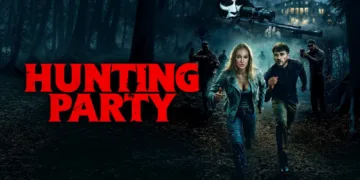












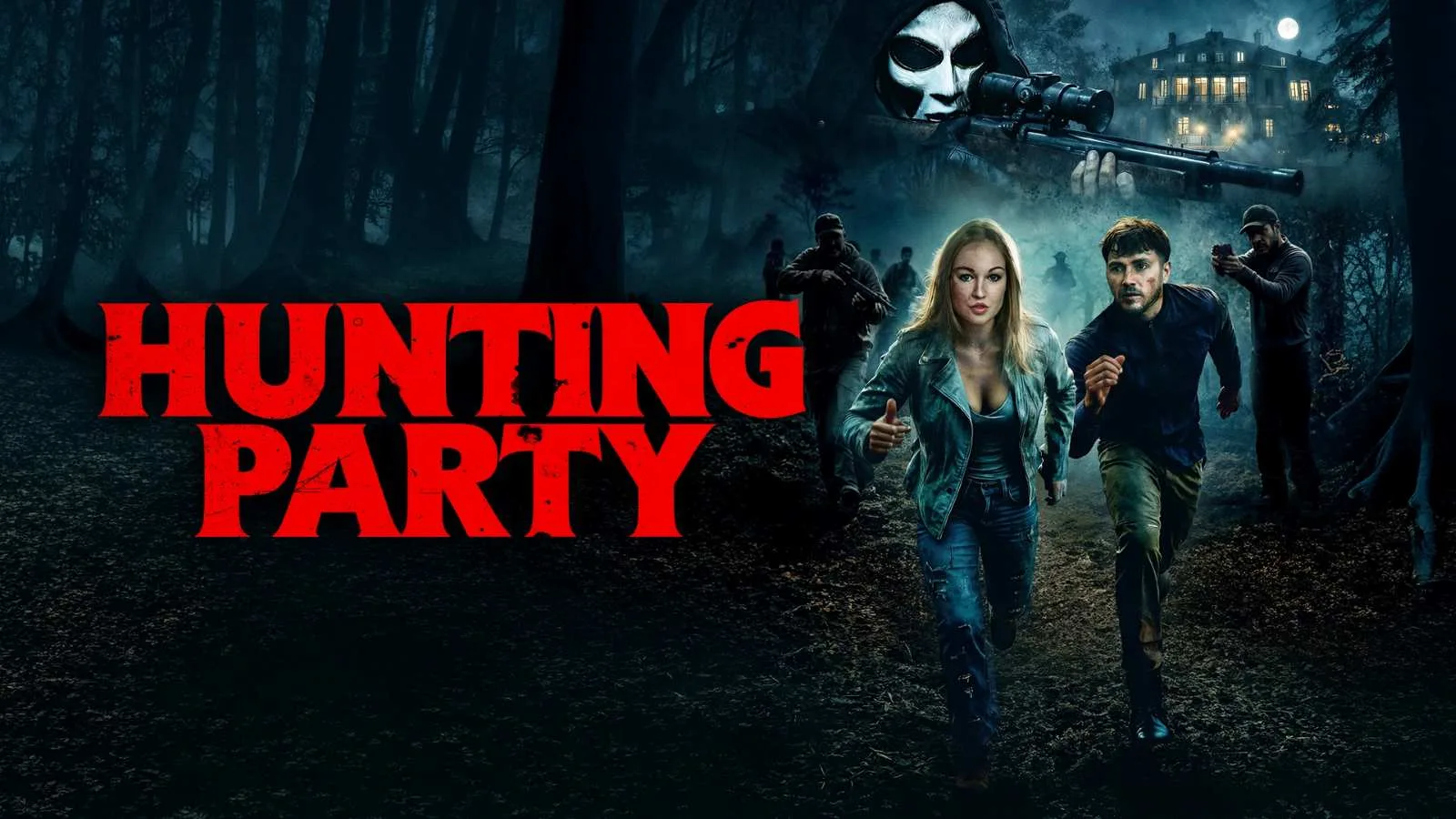

The premise of hunting humans for sport has haunted cinema since its earliest decades. Something about it speaks directly to our deepest anxieties about power, class, and the question of who gets to decide another person’s worth. Danny Patrick’s Hunting Party, which arrived on UK digital platforms via Miracle Media on 11 May 2026, takes that primal concept and channels it through a distinctly British lens: institutional rot, entrenched privilege, and the dangerous fiction that authority confers wisdom.
The setup carries genuine social charge. A secret society of Circuit Court judges, frustrated with a legal system they regard as broken, has devised its own remedy. Convicted criminals are released back into society, then abducted and hunted across the sprawling country estate of the imperious Judge Hardin. Vigilantism dressed in ermine, with a manicured landscape substituting for a courtroom.
The ensemble includes Zoë Scott, Enn Reitel, Mark Wingett, Paul O’Doherty, Ollie Newman, Hannah Oliver, and Tony Curl. Patrick, whose work has consistently engaged with moral ambiguity, signals ambitions beyond genre entertainment. The film wants to probe the uneasy gap between justice and vengeance. That gap is precisely where British public life is currently sitting, which gives the premise a timeliness that genre films rarely earn so honestly.
Three Threads and One Knot
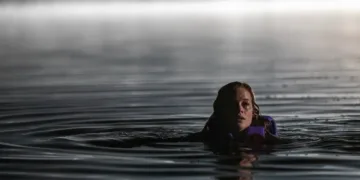
Hunting Party announces itself with confidence. A terrified man tears through fog-drenched countryside at night while armed pursuers close in with bows and arrows, the whole sequence underscored by a pulsing electronic score. It is an effective opening that immediately establishes the film’s genre coordinates and promises a taut ride.
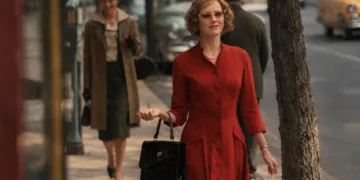
From there, the screenplay constructs three interlocking story strands. The first is the conspiracy itself: Judge Hardin (Enn Reitel) presides over the hunting operation from his estate, with lawyer Henry Kaptan (Mark Wingett) providing the procedural machinery that keeps it functioning. The second follows MI5 agent Eve Campbell (Zoë Scott), whose personal life is a controlled disaster (an affair with her married boss’s husband, a history of addiction, a professional reputation in freefall), and who gradually excavates the truth beneath the Hardin family’s respectable exterior. The third centres on Jay Doherty (Ollie Newman) and his father Danny (Paul O’Doherty), pub owners framed for a murder committed by the volatile Stephen Hardin and dragged into the blood sport as unwilling participants.
The Hardin family, taken as a unit, constitutes the film’s most concentrated source of menace. The patriarch’s cold authority, Katie’s (Hannah Oliver) composed but lethal control, and Stephen’s (Curl Tony) barely contained psychopathy form a kind of aristocratic horror show: a family whose dysfunction expresses itself through murder rather than inheritance disputes.
The screenplay’s central structural challenge is self-imposed. It carries a conspiracy thriller, a family drama, an infidelity subplot, Russian criminal elements, and a survival narrative simultaneously. The ambition is considerable. The execution is uneven. Subplots materialise and quietly recede. The hunt sequences and Eve’s investigation pull the film into sharp relief; the domestic scenes can feel like they belong to a different, smaller production entirely.
A Cast Doing Heavy Lifting
Zoë Scott carries the film with evident authority. Eve Campbell is damaged, sharp, self-sabotaging, and difficult to dismiss, and Scott plays all of those registers simultaneously without signalling which one to trust. There is a gritty, grounded quality to her work that anchors the more heightened material around her. She is equally convincing in the action sequences and the quieter, more psychologically exposed scenes (a rarer combination than appearances suggest). Watching her, it is hard not to think of the cynical, resilient MI5 adjacents who populate the Slough House of Slow Horses: Scott carries precisely that blend of hard-edged intelligence and world-worn pragmatism that would make Eve Campbell a plausible new arrival on Jackson Lamb’s disgraced roster. It is the kind of casting instinct that makes you wonder what she would do with an even longer run of episodes to work with.
Enn Reitel’s Judge Hardin is the film’s other anchor. Reitel brings a chilling, authoritative stillness to the role, the kind of performance that communicates danger precisely because it never strains for it. He embodies a specific British archetype: the man who believes his position has made him right, and who long ago stopped distinguishing between the two.
Mark Wingett, as lawyer Henry Kaptan, delivers the film’s most overtly enjoyable performance. Kaptan is ruthless and coldly arrogant, and Wingett appears to be having a very good time with the material. His scenes crackle.
Curl Tony’s Stephen Hardin is memorably unhinged. The character risks tipping into caricature, but Curl keeps the instability anchored in something that reads as genuinely disturbed.
Hannah Oliver, given less screen time than her character perhaps deserves, leaves a lasting impression as Katie Hardin. Her composed menace proves more unsettling than Stephen’s overt violence, which is precisely the point.
Paul O’Doherty provides the film with its most accessible emotional register. His Danny Doherty is warm, funny, and quietly resilient, with comic timing that relieves tension rather than puncturing it. The father-son dynamic with Ollie Newman’s Jay gives the story its most human dimension. The spread of British and Irish regional accents across the cast adds authentic, lived-in texture that British cinema often sacrifices for southern English homogeneity.
Where the Budget Shows, and Where It Doesn’t
Gabriele Salomoni’s synth-driven score is the film’s most consistently reliable element. It drives momentum, sustains dread, and does substantial atmospheric work that other departments cannot always match. In several sequences, the music effectively functions as the primary storytelling tool.
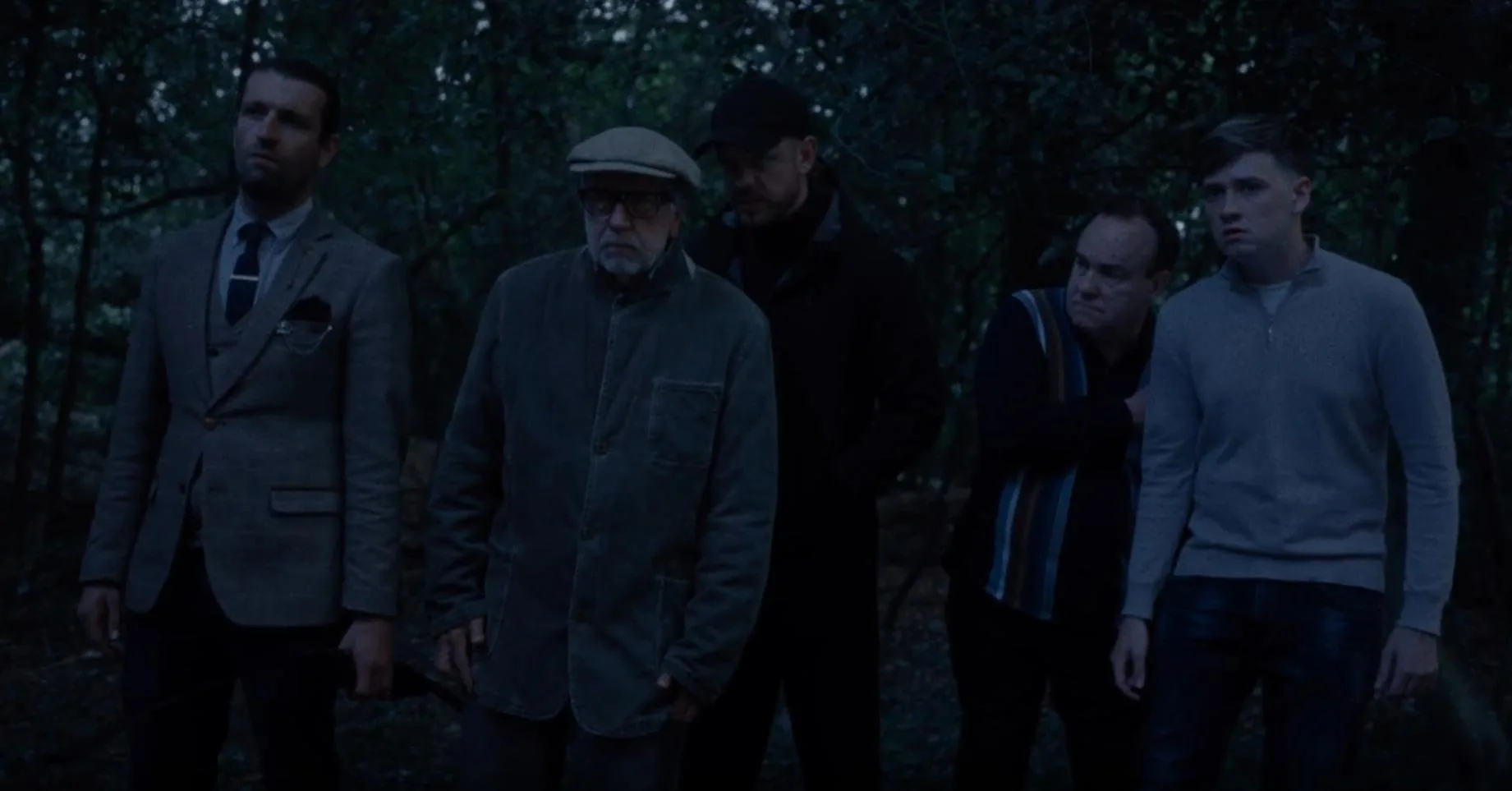
Cinematographer Michael Miles delivers a mixed visual account. The exterior night sequences, shot across fog-soaked rural locations, are the film’s high point: dark, oppressive, and properly cinematic. Aerial footage adds a sense of scope that the budget would not otherwise suggest. Interior scenes are a different matter. Sparse lighting and plain compositions make the office and courtroom settings feel smaller than the narrative surrounding them.
The action choreography is where the production’s constraints are most plainly visible. Individual confrontations carry raw energy, but the fight sequences lack the physical precision that the premise demands. A film built around predatory violence needs its combat to feel dangerous, and here it occasionally feels managed.
Tonally, the film attempts something ambitious: survival thriller, dark comedy, family drama, and conspiracy procedural simultaneously. It finds its voice most clearly in the thriller material, and loses it in the domestic scenes, which can drift toward something resembling a grim television serial. At 92 minutes, pacing rarely becomes a serious problem, though the multithreaded structure means the film occasionally loses forward momentum between its stronger passages.
The independent British crime thriller Hunting Party premiered on UK digital streaming platforms on May 11, 2026. Written and directed by Danny Patrick, the dark thriller takes a classic “human prey” premise and gives it a distinct UK legal twist. The film can be rented or purchased via digital streaming storefronts like Amazon Prime Video or Miracle Media distributed outlets.
Where to Watch Hunting Party (2026) Online
Full Credits
Title: Hunting Party
Distributor: Miracle Media, Darkside Releasing
Release date: May 11, 2026
Rating: PG-13
Running time: 92 minutes
Director: Danny Patrick
Writers: Danny Patrick
Producers and Executive Producers: Danny Patrick
Cast: Mark Wingett, Enn Reitel, Zoë Scott, Curl Tony, Ollie Newman, Paul O’Doherty, Hannah Oliver, Lauren Budd, Emily Webber, Jenni Bowden, Joseph Dann
Director of Photography (Cinematographer): Michael Miles
Editors: Stanislaw Proszowski
Composer: Gabriele Salomoni
The Review
Hunting Party
Hunting Party is an imperfect but genuinely engaging British thriller that punches with more conviction than its budget might suggest. Danny Patrick's screenplay carries real social bite, and a strong ensemble, led by a magnetic Zoë Scott and a chilling Enn Reitel, keeps the material alive through its rougher patches. The synth score is exceptional. The action choreography and uneven interior cinematography hold it back from the heights it occasionally glimpses.
PROS
- Zoë Scott's grounded, compelling central performance
- Enn Reitel and Mark Wingett bring authoritative menace
- Gabriele Salomoni's synth score is outstanding
- Strong opening sequence
- Atmospheric exterior cinematography
- Socially relevant premise with genuine edge
- Paul O'Doherty brings warmth and comic relief
CONS
- Overcrowded narrative with underresolved subplots
- Action choreography lacks polish
- Interior scenes feel visually flat
- Tone wavers between thriller and soap opera