













![Kingdom Hearts Collection [I-III] Review](https://gazettely.com/wp-content/uploads/2026/10/Kingdom-Hearts-Collection-I-III-1-360x180.webp "Kingdom Hearts Collection [I-III] Review: KHII Holds Steady as Newer Entries Fluctuate 37")





Gaslit by My Husband: The Morgan Metzer Story treats domestic abuse as a slow construction project, brick by brick, lie by lie, apology by apology. The Lifetime drama centers on Morgan Metzer, played by Jana Kramer, whose marriage to Rodney Metzer begins as a teenage love story and curdles into a suffocating system of control. Austin Nichols plays Rodney as the kind of man who understands that violence works best after reality has already been softened, bent, and renamed.
The film’s hook is brutal: on New Year’s Eve 2021, Morgan is alone at home, security cameras watching the rooms like silent witnesses, when a masked intruder enters her bedroom. A gun is nearby. Fear is closer. From there, the story moves backward through the marriage, returning to the death of Morgan and Rodney’s newborn son Kevin, the later birth of their twins Mason and Amelia, Morgan’s grief support group, and Rodney’s gradual conversion of intimacy into surveillance.
The title gives away the culprit, which is fitting. This is not a puzzle-box thriller. It is a domestic abuse drama about the terror of living with someone who has turned marriage into a private courtroom, with himself as judge, prosecutor, and unreliable witness.
The Timeline of a Lie
The film uses a fractured chronology, opening with the New Year’s Eve attack before jumping eight years earlier to Morgan giving birth to Kevin. His death after emergency heart surgery becomes the wound that neither parent truly survives intact. Morgan breaks down in the closet, seeks therapy, takes anti-anxiety medication, runs, drinks, and tries to remain functional. Rodney speaks of faith and endurance, then begins to treat her grief as evidence against her.
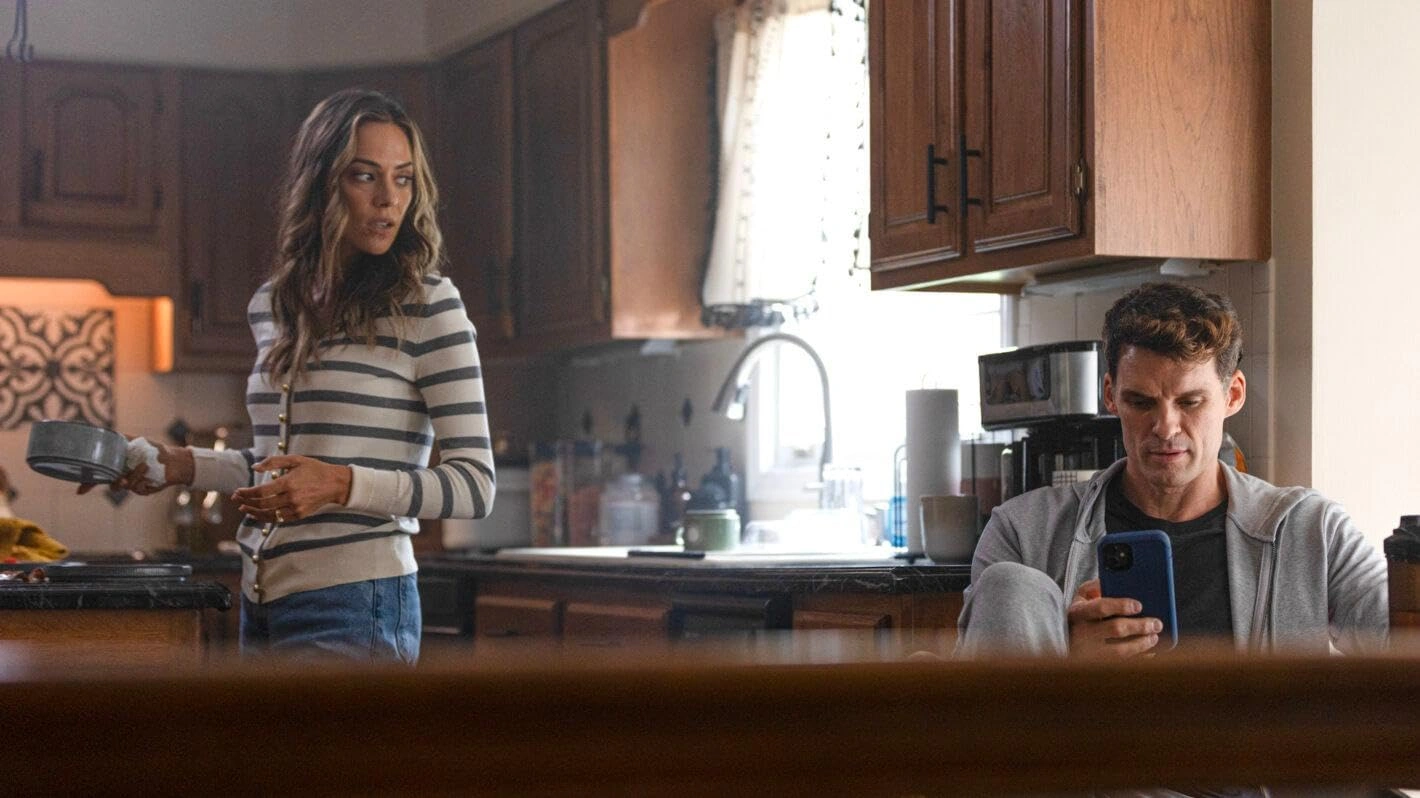
That shift is the film’s sharpest idea. Abuse here does not appear fully formed. It starts as correction. Then concern. Then accusation. Rodney loses jobs and blames Morgan. He claims a $2.7 million trust fund will protect the family, then drains their resources through bad decisions. He mocks Morgan’s interior design ambitions because she has no degree, a detail that lands with familiar middle-class cruelty. Credentials become a cudgel. Love becomes paperwork.
The film tracks several key turns with blunt efficiency: Rodney humiliates Morgan at Kevin’s birthday gathering, stages an edited video to make her look violent, accuses her of infidelity, monitors her contact with Griffith from group therapy, and uses her medication and drinking as proof that she cannot be trusted. Later, his cancer claim becomes a final emotional snare, one last performance of vulnerability from a man who treats sympathy like stolen credit.
The pacing is functional, sometimes too functional. The timeline shifts create unease, yet the film often rushes through trauma as if checking boxes on a grim procedural form. It understands the pattern of coercive control, but its storytelling can feel mechanically arranged, like a warning pamphlet with jump cuts.
Reality Under Siege
Morgan’s arc is built around the recovery of self-trust. That may sound abstract, but the film makes it practical. Can she trust what she remembers? Can she trust what her body tells her? Can she trust the bruise, the fear, the unease in a room where everyone else seems ready to accept Rodney’s version? These questions give the drama its philosophical bite. Gaslighting is epistemic violence, a war against knowledge itself. Rodney does not need to win every argument. He only needs Morgan to doubt the ground beneath her feet.
Jana Kramer gives Morgan a quiet, steady vulnerability. She avoids grand theatrical collapse, which helps the film. Morgan’s pain is often visible in hesitation: a pause before answering, a look after Rodney twists a fact, a strained attempt to stay composed while relatives begin to doubt her. Kramer’s best work comes when Morgan realizes that survival requires a kind of inner rebellion. She must stop asking Rodney to validate reality.
Austin Nichols plays Rodney as a performer trapped in his own show. He can be wounded, charming, indignant, pious, and menacing, often within the same domestic skirmish. His manipulation is theatrical by design. He tells Morgan she forgot promises, says she hit him when he staged an injury, warns that no one will believe her, belittles her business, and reframes her grief as instability. By the time he pretends to rescue her after the attack, the mask has become almost redundant. The man has been wearing one all along.
The limitation lies in the writing. Rodney is readable, perhaps too readable. His violence is tied to ego, money, steroids, resentment, and control, but the film rarely gives him a deeper psychological texture. That makes the abuse legible, which has value. It also makes the drama less complex than the real social machinery it tries to depict.
The Suburb as Surveillance Chamber
Visually, Gaslit by My Husband has the clean, bright plainness of made-for-television drama: tidy interiors, soft lighting, therapy rooms, family gatherings, decorated living spaces, and suburban calm. The style can look generic. It can also feel accidentally apt. Morgan’s home is supposed to be safe, attractive, and well-managed, yet it becomes a chamber of observation and threat. Security cameras sit in corners. A bedroom becomes a crime scene. A driveway becomes a border crossing.
That suburban symbolism carries social weight. The film understands that domestic violence often survives under the camouflage of normalcy. A respectable house can hide a private dictatorship. A husband can weaponize grief, finances, parenting, sex, family reputation, and mental health language, then still appear credible to outsiders. History has taught this lesson many times, from old legal doctrines that treated marriage as male jurisdiction to modern courtrooms where victims still fear being disbelieved. The film’s bluntness fits that lineage, sometimes clumsily, sometimes with necessary force.
The assault scenes are difficult and should be discussed with care. They risk the sensational pull of true-crime spectacle, that uneasy industry where suffering becomes content and content gets thumbnails. Yet the film’s strongest moments keep returning to Morgan’s subjective terror rather than the mechanics of shock. Its moral seriousness is real, even when its dramatic technique wobbles.
Morgan’s sentencing statement, followed by Rodney receiving 70 years in prison, functions as public reclamation. The voice he tried to bury becomes part of the official record. That matters. The film may lack visual sophistication and deeper character shading, but it offers a clear portrait of coercive control and the psychic cost of being trained to mistrust one’s own reality.
Gaslit by My Husband: The Morgan Metzer Story originally premiered on the Lifetime network on June 9, 2024, as part of their popular “Ripped from the Headlines” film slate. This intense true-crime drama follows the real-life harrowing survival journey of Morgan Metzer, whose seemingly perfect marriage to her childhood sweetheart completely unravels following a series of psychological manipulation tactics and a staged home invasion. Viewers can currently watch the movie streaming on the Lifetime Movie Club app, rent or purchase it on digital platforms like Amazon Prime Video, or find it streaming in select regional catalogs on Netflix.
Where to Watch Gaslit by My Husband: The Morgan Metzer Story (2024) Online










Full Credits
Title: Gaslit by My Husband: The Morgan Metzer Story
Distributor: Lifetime, A+E Networks
Release date: June 9, 2024
Rating: TV-14
Running time: 88 minutes
Director: Lee Gabiana
Writers: Benjamin Anderson
Producers and Executive Producers: Jeffrey Tinnell, Jana Kramer, Maritte Go, Robert Tinnell
Cast: Jana Kramer, Austin Nichols, Abigail Esmena, Jolie Rae Caussin, Maximo Sebastian, Stephanie Cotton, Pete Burris, Denise Dal Vera
Director of Photography (Cinematographer): Broderick Engelhard
Editors: Desirae Williams
Composer: Jacques Brautbar
The Review
Gaslit by My Husband: The Morgan Metzer Story
Gaslit by My Husband: The Morgan Metzer Story is blunt, uneven, and visually plain, yet its portrait of coercive control has genuine force. Jana Kramer gives the film a grounded emotional center, while Austin Nichols makes Rodney’s manipulation chillingly ordinary. The drama sometimes leans into true-crime sensationalism, but its clearest scenes understand how abuse rewrites reality before it turns openly violent.
PROS
- Jana Kramer delivers a restrained, affecting performance
- Clear depiction of gaslighting and coercive control
- Strong focus on Morgan’s gradual recovery of self-trust
- Suburban setting adds quiet symbolic weight
- Austin Nichols captures Rodney’s calculated cruelty
CONS
- Direction feels visually generic
- Timeline structure can feel heavy-handed
- Rodney lacks deeper psychological shading
- Some scenes risk true-crime sensationalism
- Dialogue can be blunt and overly explanatory