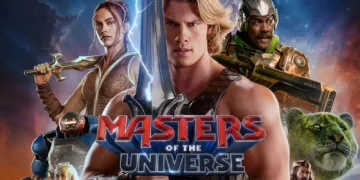
















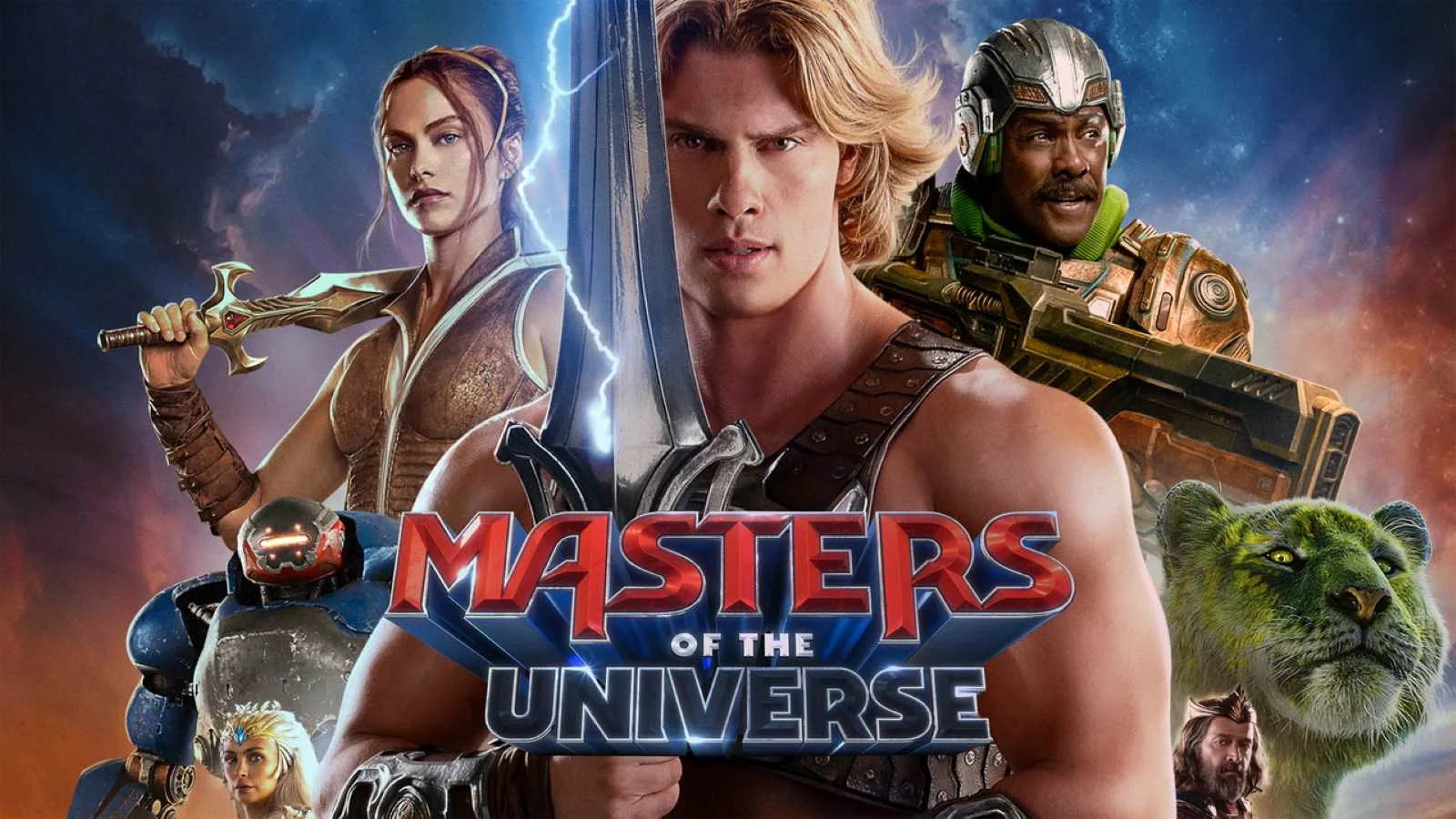

Nearly forty years have passed since the 1987 Dolph Lundgren film nearly buried He-Man in celluloid ignominy. The Masters of the Universe franchise survived through sheer commercial stubbornness: toys, comics, animated series, Netflix content. It persisted the way myths persist, stripped of grandeur, clinging to cultural memory by the grip of a plastic sword. Now director Travis Knight, the stop-motion craftsman behind Kubo and the Two Strings and the surprisingly tender Bumblebee, attempts what the property has never managed: a big-budget live-action film that earns its existence.
The challenge is philosophical before it is cinematic. He-Man is a sword-wielding warrior in leather underwear who rides a giant cat and inhabits a skull-shaped castle. His nemesis is named Skeletor. How does a filmmaker build something earnest from material that resists sincerity at every turn? Knight’s answer, embodied by Nicholas Galitzine as Prince Adam, Jared Leto as Skeletor, Idris Elba as Duncan/Man-At-Arms, and Camila Mendes as Teela, is to wage irony and earnestness simultaneously. The film that emerges is shaped by that conflict as much as by any single decision made in production.
The Apology Built Into the Architecture
The film’s self-awareness is structural. Adam’s opening voiceover introduces the Sword of Power with a shrug: “Yeah, I know, but that’s what they went with.” The green-screen Eternia sequences wear their artificiality like a badge, acknowledging the plastic origins of the mythology without fully committing to them. This is a film that preempts criticism by practicing it, a strategy with a philosophical problem at its center: self-deprecation, sustained long enough, becomes its own form of cowardice.
When the humor is anchored in character, it works with surprising grace. Adam’s fifteen years on Earth, spent in human resources, driving a battered Subaru, attending therapy, and quietly searching for a lost magical sword, generates comedy that does not demand franchise literacy. The collision of corporate-speak with Eternian warrior logic is sharp and earned. His attempts to de-escalate every violent confrontation through dialogue, sincere and doomed every single time, reveal something true about a man who has convinced himself that rational discourse applies to situations that have long since departed from it.
The character names drawn from the toy line, Fisto, Ram-Man, Mekaneck, Evil-Lyn, are the film’s most brazenly self-aware material. Rather than pretending these names carry dignity they were never designed to carry, the script engineers jokes around them with what can only be described as cheerful nihilism. The Fisto gag, Adam explaining the name with blameless logic, lands precisely because it is delivered with innocence rather than nudging self-congratulation.
The strain appears in repetition and in the six-writer seams that run visibly through the tonal fabric. The HR jokes, initially sharp, are revisited past the point where they illuminate anything new. The broader posture of self-awareness begins to feel less like confidence and more like anxiety, the film checking constantly if the audience is still on board, tugging at its own sleeve. The ambition to be simultaneously earnest tribute and ironic send-up is admirable as a concept and exhausting as an experience. The seams show most visibly in moments of tonal hesitation, in scenes where the film seems less certain than its jokes suggest, where the gag lands but the assurance behind it has quietly departed.
What These Actors Do With What They’re Given
Nicholas Galitzine carries the film’s conceptual weight in the most literal sense. His Prince Adam is a man-child in arrested development, apartment walls still plastered with childhood drawings, a shoebox of Eternia memorabilia his only connection to a home he cannot return to. The performance works because Galitzine plays the sincerity straight. Adam’s conviction that every conflict can be resolved through empathy and listening is treated with genuine warmth rather than condescension, making his repeated failures funnier and, occasionally, something approaching melancholy. He is an avatar for a particular kind of masculine confusion: strength as a concept, divorced from its expression, stranded in an HR department in Oklahoma City.
His transformation into He-Man requires a shift in registers without losing the earlier characterization’s thread, and he manages it with a grace the material rarely warrants. He has already proven himself a capable comic performer; here he adds physical conviction without sacrificing the bewildered quality that makes Adam sympathetic.
Jared Leto’s Skeletor is the film’s most disorienting pleasure. Fully digitized, voiced with an accent pitched somewhere between Shakespearean villain and theatrical self-parody, the character is a swaggering, terrified dark lord perpetually undermined by his need for validation. The performance is enormous, florid, committed to its own internal logic. A standout sequence has Skeletor laugh maniacally for an uncomfortable duration before announcing, with bureaucratic practicality, that he is finished and they may proceed. The joke reaches past Skeletor specifically. It is about the performance of villainy as a social contract, about what happens when the script runs out. His costuming deepens the effect: the sleeveless hoodie and, later, the purple dress-shirt give the character a domestic absurdity that somehow does not undermine his menace. I am not entirely certain how Leto manages this, and I suspect the film does not entirely know either.
Idris Elba’s Duncan is the film’s most grounded performance, a warrior whose rigid convictions about strength and manhood are subjected to real consequence. His arc carries more texture than most, and Elba delivers it with a commitment the film occasionally fails to honor with adequate screen time. Camila Mendes has charm but limited material; Teela functions as a plot mechanism dressed in charisma. Alison Brie’s Evil-Lyn is an opportunity largely squandered, the role hovering between menace and comedy without fully inhabiting either. Kristen Wiig’s Roboto, a battle droid repurposed as a reluctant maid, lands her jokes with satisfying precision.
The Plastic World Made Flesh (Mostly)
Knight stages action with a preference for spatial coherence over kinetic chaos. Fights are readable, geography is maintained, and the ensemble of heroes, each defined by a distinct physical specialty, keeps the choreography from collapsing into repetitive punishment. Fisto’s metal fist, Ram-Man’s blunt-force charges, Mekaneck’s extending neck create a visual taxonomy of violence that reflects the toy line’s original logic: every character exists to do one thing extraordinarily well. The approach translates with reasonable success.
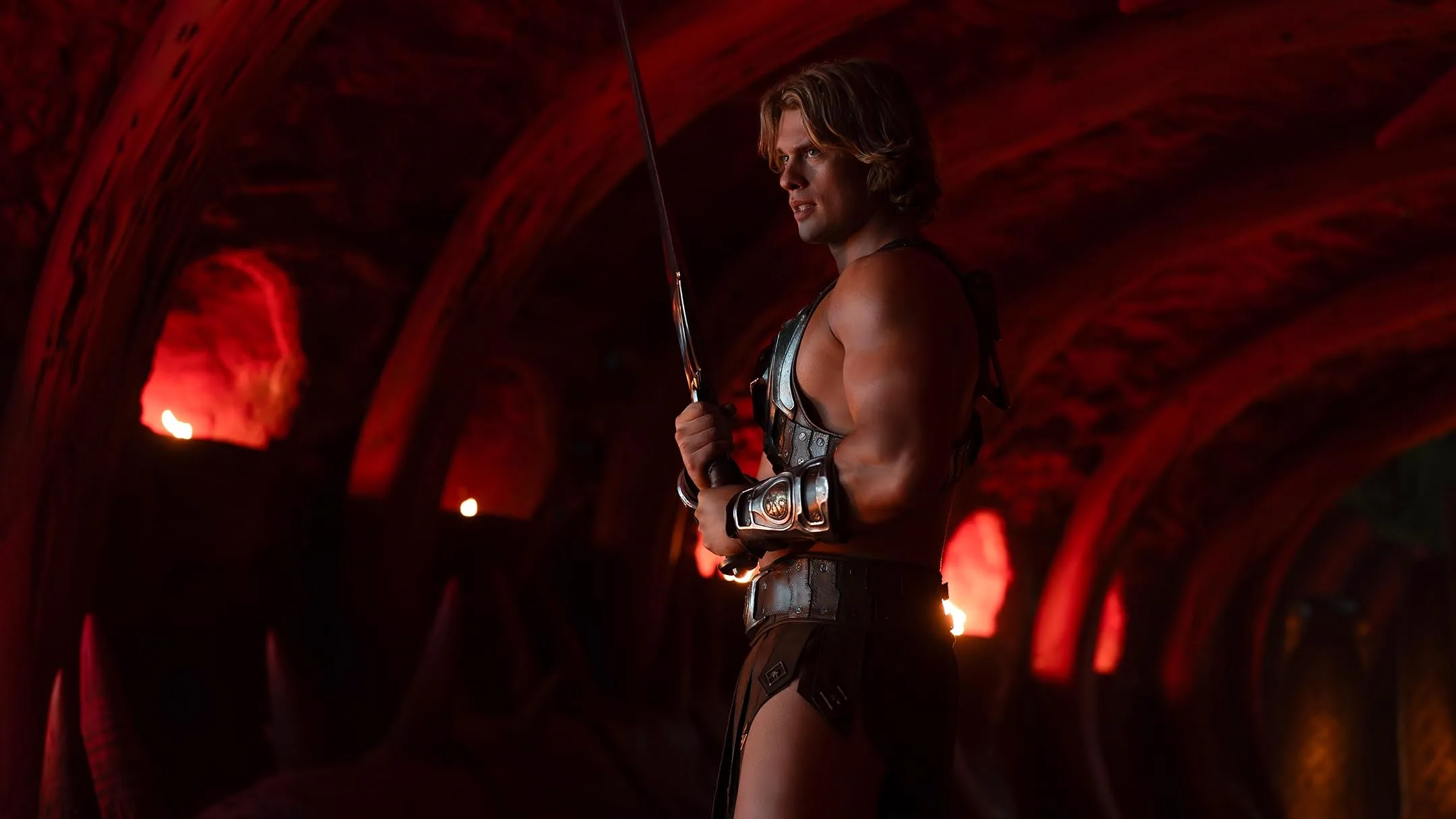
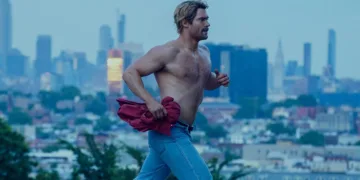
The problem is accumulation. Once Adam’s transformation sequence deposits him into He-Man’s considerably less clothed frame and the third act commences its series of battles, sequences begin to blur. Stakes, enormous in theory, grow curiously muted in practice. The world is ending and it registers, too often, as a management problem. Several set pieces lean so heavily into digital construction that tactile energy drains away, particularly in the Eternia destruction sequences where bodies move against environments that do not quite believe in themselves.
Guy Hendrix Dyas’ production design is the film’s most consistent achievement. Eternia is rendered with a knowing appreciation for the garish, plastic-fantastic aesthetic of the original toy line, treating it as a place that was once splendid and is now ruined under occupation. The choice to honor the franchise’s inherently artificial origins rather than apologize for them gives the world a coherence the script sometimes lacks. Richard Sale’s costume work matches the ambition; Trap Jaw and the film’s other villains arrive in outlandish attire that looks pulled directly from the animated series without tipping into cosplay. Oklahoma City is, by deliberate design, the visual opposite: beat-up Subarus, fluorescent offices, comic book stores. The contrast is legible and effective.
Daniel Pemberton’s score borrows from the fantasy-metal idiom that defined the original franchise era, and the decision to enlist Brian May to quote his own Flash Gordon work is a piece of nostalgia so layered it becomes a comment on nostalgia itself. The score works largely because Pemberton understands that bombast and irony can coexist, that a thundering guitar riff can simultaneously celebrate and gently mock the tradition it borrows from.
The Price of Memory
For those who grew up with the property, the film is generous to the point of excess. Easter eggs accumulate. Character rosters are wide. The animated series is honored in design and spirit. The transformation sequence, Galitzine raising the sword and delivering the franchise’s signature incantation, is handled with genuine affection, the kind that comes from filmmakers who cared about the source material before they were hired to adapt it. A brief cameo from the original live-action He-Man functions as a kind of absolution, an acknowledgment that the past exists and need not be erased. Post-credits sequences gesture toward sequels with the confidence of a studio that has already greenlit them in its imagination.
For viewers without this relationship, the calculus shifts. The self-aware humor compensates somewhat, but it feeds on familiarity. Jokes about Fisto’s name carry weight proportional to the audience’s awareness of what Fisto is. The film’s self-deprecation is genuinely charming when shared between people who have something to deprecate together; experienced cold, it can feel like receiving the punchline to a joke whose setup you missed.
At 141 minutes, the film overestimates its own event status. The final act wears its length visibly, and by the time the post-credits sequences arrive, goodwill has been taxed. There is a question worth sitting with: if a property requires this volume of apologetic self-awareness to function at a commercial scale, what does that reveal about the decision to fund it at this scale? The film does not answer this. It keeps moving, which is perhaps the most honest response available. Memory is not rational. Nostalgia does not require justification. It only requires an audience willing to pay for the reminder.
The live-action blockbuster adaptation Masters of the Universe brings the legendary Mattel fantasy franchise back to the big screen. Directed by Travis Knight, the epic adventure follows Prince Adam, who is guided back to his home planet of Eternia by the Sword of Power after a 15-year separation, only to find it devastated and ruled by the fiendish Skeletor. The film is set for a major theatrical premiere on June 5, 2026. Distributed domestically by Amazon MGM Studios and internationally by Sony Pictures International Releasing, audiences can experience this highly anticipated fantasy adventure exclusively in theaters upon its release.
Where to Watch Masters of the Universe (2026) Online


Full Credits
Title: Masters of the Universe
Distributor: Amazon MGM Studios, Sony Pictures International Releasing
Release date: June 5, 2026
Rating: Not Available
Running time: 140 minutes
Director: Travis Knight
Writers: Chris Butler, Aaron Nee, Adam Nee, Dave Callaham, Alex Litvak, Michael Finch
Producers and Executive Producers: Nate Atwood, Bill Bannerman, Todd Black, David J. Bloomfield, Jason Blumenthal, Robbie Brenner, DeVon Franklin, Ynon Kreiz, Steve Tisch
Cast: Nicholas Galitzine, Camila Mendes, Idris Elba, Jared Leto, Jóhannes Haukur Jóhannesson, Jon Xue Zhang, Alison Brie, Sam C. Wilson, Charlotte Riley, James Purefoy, Morena Baccarin, Kristen Wiig
Director of Photography (Cinematographer): Fabian Wagner
Editors: Paul Rubell
Composer: Daniel Pemberton
The Review
Masters of the Universe
Masters of the Universe knows what it is and occasionally knows what to do with that knowledge. Galitzine's earnestness and Leto's unhinged Skeletor carry considerable weight; the production design honors the source material with genuine affection. The self-awareness that saves the film in its best moments becomes a liability when held too long. At 141 minutes, it exceeds what the material can support. A generous, imperfect act of franchise resurrection.
PROS
- Leto's Skeletor is a genuine, unhinged delight
- Galitzine brings charm and physical commitment
- Production and costume design are highlights
- Earth-bound fish-out-of-water sequences land well
- Pemberton's score carries real energy
CONS
- 141 minutes is too long
- Six writers show in tonal inconsistency
- Third-act battles blur and repeat
- Teela and Evil-Lyn are underwritten
- Heavy CG drains tactile energy from key sequences