





















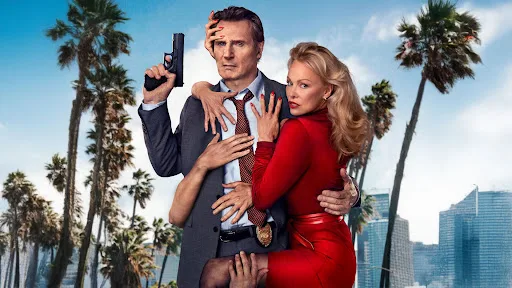

In an era saturated with cinematic sermons and superhero mythologies straining for social relevance, the arrival of The Naked Gun feels less like a movie and more like a cultural intervention. It is a work of profound, unapologetic stupidity, a gleeful throwback that weaponizes nonsense as a defense against the tyranny of meaning. Its commitment to pure, unadulterated humor feels almost radical in 2025.
The film’s plot, a barely-there scaffold involving Lieutenant Frank Drebin Jr. (son of the legendary lawman) and a nefarious tech billionaire, is a deliberate void. The story is not the point; it is the excuse. When the villain’s plan hinges on a remote literally labeled “P.L.O.T. Device,” the film announces its intentions with the subtlety of a flung cream pie.
We are here not for catharsis or character development, but for the gag. This review will therefore treat this magnificent idiocy with the seriousness it ironically deserves, examining its form, function, and defiant spirit.
A Taxonomy of Foolishness
The film’s comedic engine operates on a principle of relentless saturation, a kinetic philosophy of humor that feels distinctly of our moment. The jokes are deployed with a percussive, almost assaultive, rhythm, a joke-per-second velocity that mirrors the dizzying, context-free scroll of a social media feed.
Director Akiva Schaffer seems to understand that sustained attention is a currency few are willing to spend, so he opts for a strategy of overwhelming force. The bravery in this pacing is noteworthy; it requires a supreme confidence to let a potential groaner die on the vine, without apology, knowing that three more gags are already queued up and ready to fire. This creates a unique viewing experience, one where the audience is kept in a state of perpetual comic anticipation, never allowed to get too comfortable or too critical before the next absurdity demands their focus.
Some gags possess a delayed-fuse brilliance, rewarding the attentive viewer. A seemingly simple line or background detail pays off seconds, or even minutes, later, creating a secondary ripple of laughter that is deeper and more satisfying than a simple punchline. It is a structure that encourages, and validates, a second viewing.
The humor itself is a broad and glorious buffet of inspired foolishness, a veritable taxonomy of the absurd. The slapstick frequently pushes beyond mere physical comedy into a realm of cartoon physics, a gleeful rejection of consequence. When Drebin Jr., locked in a frenetic hand-to-hand combat sequence, tears off his adversary’s arms and proceeds to use them as fleshy nunchucks, the gag is not just the shock of the action, but the deadpan seriousness with which he executes it.
It is a perfect lampoon of the hyper-violent choreography of his dramatic roles. In another moment of sublime chaos, a line of armed henchmen, poised for attack, are shown patiently waiting at a “take a number” stanchion, a piece of bureaucratic mundanity injected into a scene of extreme violence that speaks volumes about the absurdity of organized systems. The deadpan wordplay functions as a deconstruction of language itself. Exchanges like “Please take a chair” being met with “I have one at home” are not just puns; they are exercises in a kind of weaponized literalism, exposing the flimsy logic that holds our daily communication together.
The film’s strangest and most telling quirk, however, is its anachronistic charm. The script is peppered with startlingly specific references to Buffy the Vampire Slayer, Sex and the City, and the long-dead Microsoft Office assistant, Clippy. These are not lazy, dated jokes. They are carefully chosen cultural artifacts that define Drebin Jr.’s entire worldview. He is a man emotionally and culturally cryogenized sometime around 2004.
These references position him as a ghost from a specific, lost era of monoculture, a time just before the digital floodgates opened. His reliance on these touchstones is the key to his character, revealing a profound inability to connect with the present and making his bumbling more than just a joke; it is a symptom of a man adrift, a walking embodiment of nostalgia-disorientation.
The Agony of the Straight Man
At the center of this maelstrom is Liam Neeson, and his performance is a quiet marvel of comedic discipline. The entire film hinges on a concept one might call “weaponized credibility,” as it knowingly hijacks the audience’s collective memory of Neeson as a gravel-voiced angel of vengeance. The primary comedic friction is generated by the violent collision of that established gravitas with situations of profound and escalating idiocy. The true genius of his performance is his unwavering commitment. Neeson never mugs, never winks, never once begs for a laugh. He understands that his function is to be the dramatic anchor in a sea of madness.
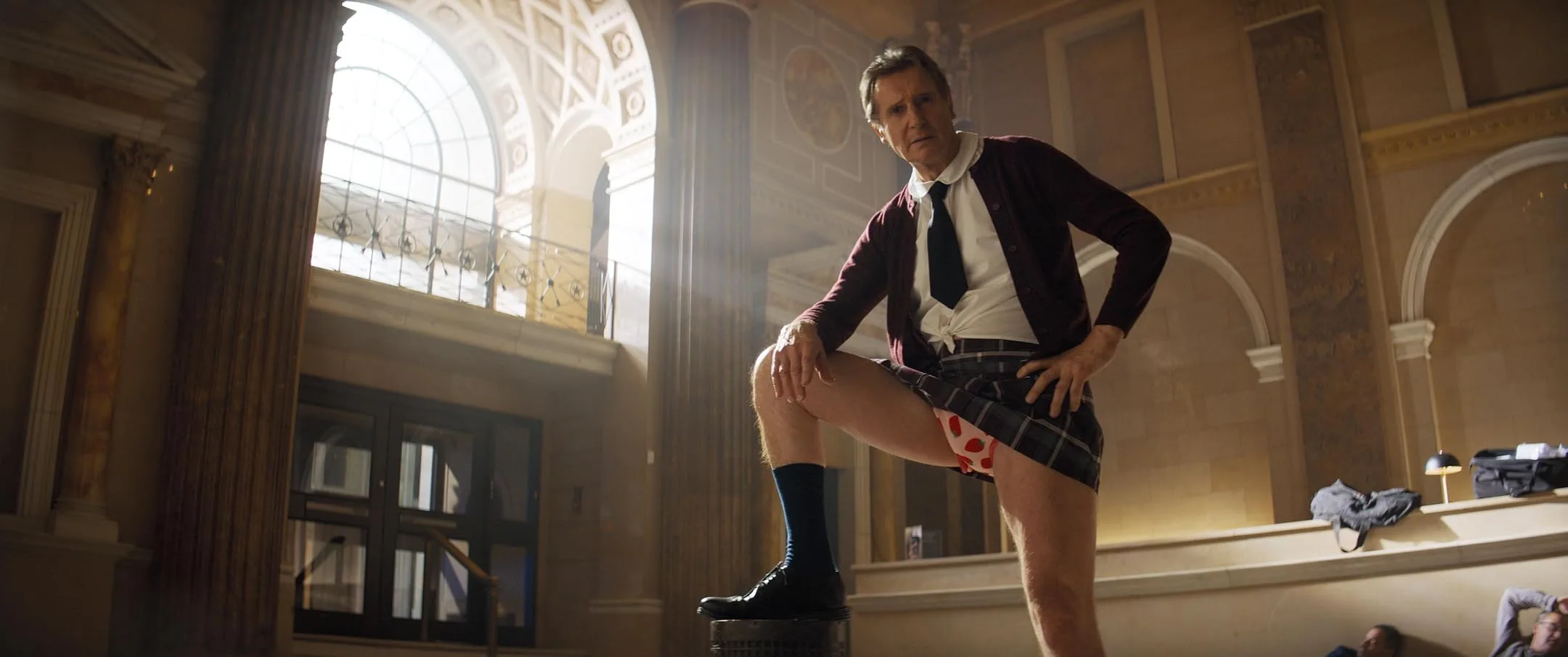
His steely, menacing glare, the very tool that sold a thousand action movie tickets, is repurposed here to set up a punchline about his car’s extended warranty. It is a masterful subversion of his own screen persona, a deconstruction of the modern action hero. The archetype of the hyper-competent, near-silent killer is stripped bare, revealing an insecure, oblivious man-child controlled by his silliest and most selfish impulses.
This Drebin is a significant and fascinating departure from his legendary father. Where Leslie Nielsen’s Frank Drebin was a creature of blissful, almost innocent, post-war American ignorance, Neeson’s Frank Drebin Jr. is a product of a more anxious and fractured time. He is a reflection of a society that has lost faith in its institutions.
His incompetence is not charmingly harmless; it is aggressive, destructive, and rooted in a simmering rage. This is a darker, more contemporary strain of comedic folly. His character is a walking embodiment of obsolete masculinity, a man whose methods and worldview are no longer acceptable. This is most apparent in his tormented, one-sided monologues to a photograph of his father.
He complains about bodycams, accountability, and the injustice of not being able to solve a hostage crisis with a poorly aimed rocket launcher. These moments are pathetic, yet in his confusion, we see a flicker of a relatable struggle: the bewilderment of a man whose world has changed without his permission, leaving him adrift from his own professional and ethical moorings.
Satellites in an Orbit of Idiocy
The ensemble cast forms a perfect chorus for Drebin’s chaotic symphony, each playing their part in enabling or reacting to his madness. Pamela Anderson’s turn as femme fatale Beth Davenport is a delightful and savvy piece of casting. It is a comeback narrative woven directly into the film’s fabric. She showcases a remarkably sharp comedic timing, delivering noir-ish dialogue with a perfect blend of sincerity and parody. But the performance works on a deeper level; it is a knowing wink at her own history of being typecast, a reclamation of the “bombshell” archetype by revealing its inherent, theatrical absurdity.
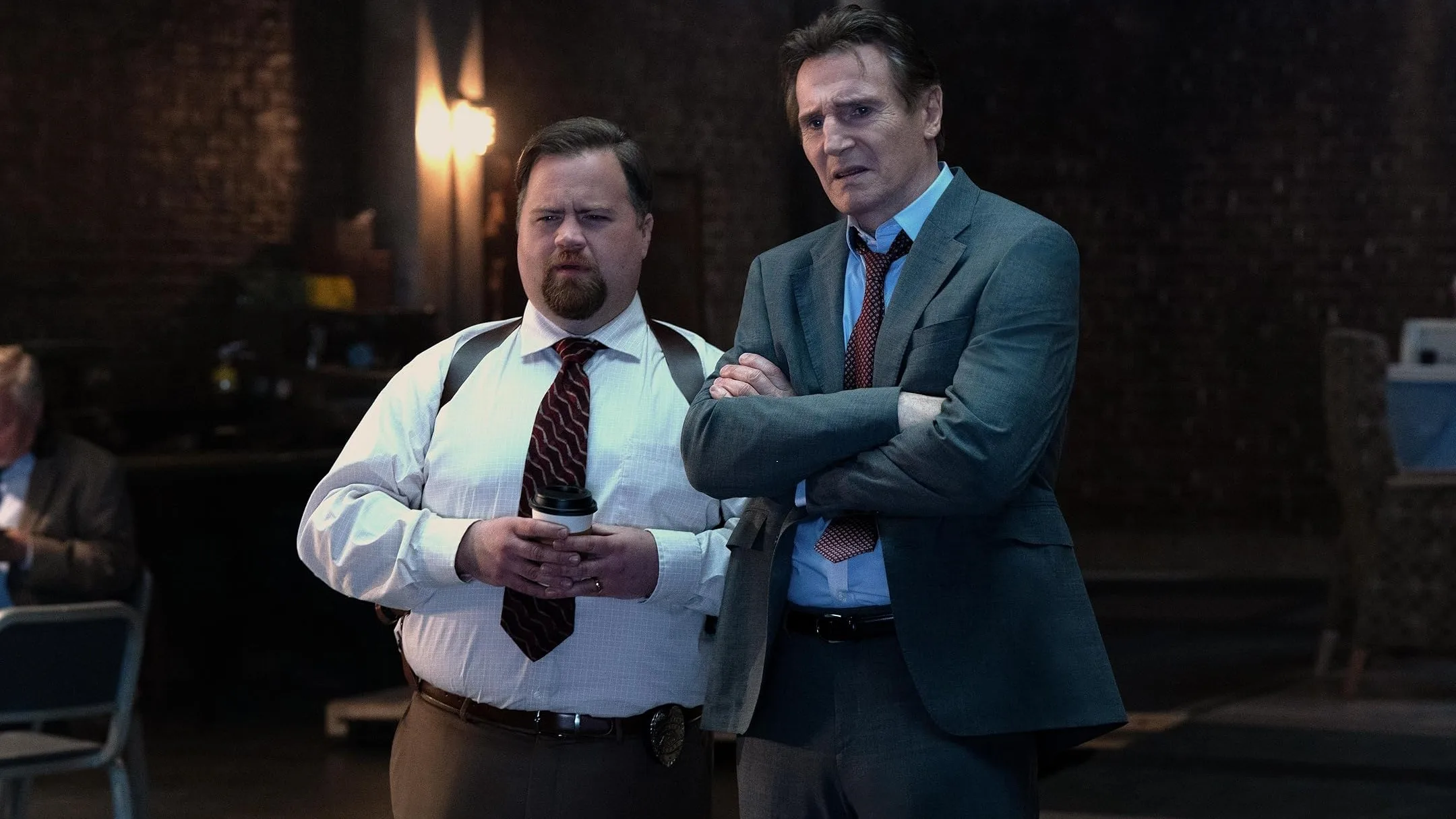
As Drebin’s long-suffering partner, Ed Hocken Jr., Paul Walter Hauser is the essential anchor of sanity. In many ways, he is the audience surrogate, his weary, soul-deep exhaustion a constant, grounding counterpoint to the film’s most lunatic flights of fancy. His performance is often in his reactions; a subtle eye-roll or a pained sigh conveys the sheer weight of the insanity he is forced to witness daily. He is the sensible man in an age of nonsense, and his quiet desperation is as funny as any of Drebin’s overt antics.
Then there is Danny Huston as the villain, Richard Cane, a perfect antagonist for our particular moment in history. Huston portrays him with a smarmy, self-satisfied assurance that is chillingly familiar. He is the tech-bro nihilist, a man whose quasi-philosophical justifications for his evil plan sound unnervingly like a keynote speech at a tech conference. His world-ending scheme is a sublime satire of the god complexes fostered by unchecked wealth and power in Silicon Valley.
The film smartly suggests that the line between world-saving visionary and world-ending maniac is terrifyingly, laughably thin. Cane is not just a stock villain; he is a parody that walks dangerously close to documentary, a reflection of a culture where unimaginable power is wielded by individuals with the emotional maturity of a spoiled child.
The Importance of Being Pointless
Akiva Schaffer directs all this with a surprising and crucial stylishness. In contrast to the flat, utilitarian, almost anti-cinematic look of many classic spoofs, Schaffer’s camera swoops and glides with the kinetic energy of a serious, high-budget action film. This is a deliberate and intelligent philosophical choice. By wrapping the absurd in the visual language of the serious—a kind of high-style low-comedy—he makes the nonsense feel grander and paradoxically more potent.
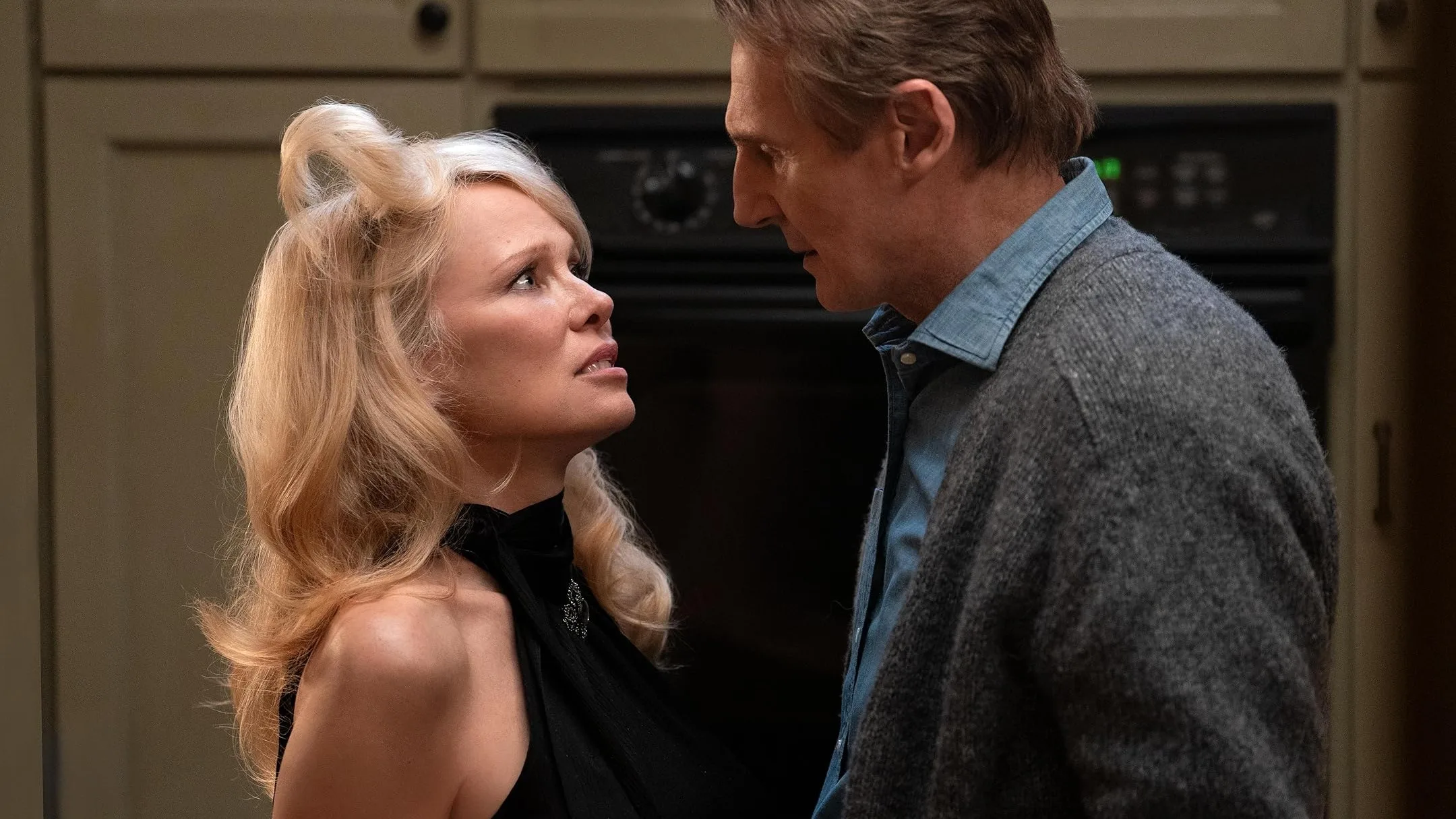
A frantic brawl will be shot with the gritty intensity of a Bourne movie, only to be punctuated by Drebin biting the head off a handgun. The visual language promises gravitas, but the content delivers pure cartoon chaos. This contrast is the film’s primary aesthetic engine, seen most brilliantly in a winter romance montage. It begins as a perfect parody of a cheesy 80s music video, then seamlessly and inexplicably morphs into a full-blown slasher film parody involving their snowman coming to life, a testament to the film’s commitment to genre-blending anarchy.
Ultimately, this film may have a curious and important cultural function. In a deeply fragmented and algorithmically siloed society, the simple act of gathering a roomful of diverse strangers to laugh together at something so utterly and completely meaningless is a rare and powerful form of communion. It is a small act of defiance against the forces that seek to divide us. The movie’s greatest virtue may be its resolute and glorious pointlessness.
It asserts the value of leisure, of silliness, and of shared, purposeless joy in a world that constantly demands productivity and ideological alignment. In its own way, a film that demands nothing from its audience except a willingness to laugh is making a profound statement. It is a reminder that sometimes the most important thing a movie can do is offer a brilliantly executed escape.
The Naked Gun is an action-comedy film that premiered on July 28, 2025, and is scheduled for a wide release in the United States on August 1, 2025. It is being distributed by Paramount Pictures. Currently, the movie is only available in theaters.
Full Credits
Director: Akiva Schaffer
Writers: Dan Gregor, Doug Mand, Akiva Schaffer
Producers: Seth MacFarlane, Erica Huggins
Executive Producers: Daniel M. Stillman, Akiva Schaffer, Pete Chiappetta, Anthony Tittanegro, Andrew Lary
Cast: Liam Neeson, Pamela Anderson, Paul Walter Hauser, Kevin Durand, Danny Huston, Liza Koshy, Cody Rhodes, CCH Pounder, Busta Rhymes, Michael Bisping, Eddie Yu, Moses Jones
Director of Photography: Brandon Trost
Editors: Brian Scott Olds
Composer: Lorne Balfe
The Review
The Naked Gun
The Naked Gun is a triumphant and surprisingly intelligent revival of a dormant genre. Anchored by a masterfully deadpan performance from Liam Neeson and guided by Akiva Schaffer's stylish direction, the film weaponizes stupidity as a potent antidote to our self-serious times. Its relentless barrage of gags, ranging from inspired slapstick to deconstructed wordplay, makes for a hilarious and necessary cinematic experience. It is a glorious celebration of nonsense, proving that sometimes the most profound thing a movie can be is profoundly, unapologetically silly.
PROS
- Liam Neeson's brilliantly committed, straight-faced comedic performance.
- A relentless pace with an exceptionally high density of jokes.
- Akiva Schaffer's direction elevates the material with a stylish, cinematic flair.
- A successful and clever revival of the spoof genre for a modern audience.
- Strong, self-aware supporting performances from Pamela Anderson and Paul Walter Hauser.
CONS
- By design, not every rapid-fire joke lands perfectly.
- The intentionally nonexistent plot may leave some viewers wanting more substance.
- Humor based on dated pop-culture references might not connect with everyone.