



























Netflix’s Age of Attraction enters a streaming field already crowded with romantic experiments, glossy retreats, confessional booths, and producers who seem legally obligated to place attractive singles near water. Its central twist is simple enough to sound gimmicky: forty contestants, aged twenty two to sixty, arrive at a lakeside retreat in Whistler, British Columbia, and are forbidden from asking or revealing one another’s ages.
That rule gives the series its cleanest dramatic engine. Age becomes both absent and everywhere. It is withheld as direct information, then smuggled into the room through cultural memory, slang, body language, career stage, family history, and the occasional blank stare when someone references The Powerpuff Girls or The Hunger Games. The show understands that age is rarely just a number in social life, no matter how often dating shows pretend otherwise. It carries assumptions about desirability, maturity, fertility, money, power, and shame.
Hosted by Nick Viall and Natalie Joy, whose own eighteen year age gap turns them into an on-screen case study, the series tries to ask whether attraction can survive without the usual shortcut of chronology. The answer, as reality television demands, is messy. At its sharpest, Age of Attraction becomes a study of how culture disciplines desire. At its clumsiest, it turns serious social questions into another polished obstacle course for people in good lighting.
The Wilderness Experiment and the Politics of First Impressions
The Whistler setting gives the early episodes a persuasive sense of escape. The cast arrives by seaplane, surrounded by rugged Canadian scenery that makes the premise feel cleaner, freer, and less mediated than it really is. Forest bathing, mountain biking, and white water rafting create a language of physical compatibility before the participants can compare resumes, children, mortgages, or college graduation years.
That choice matters. Many dating shows claim to remove superficial judgment while quietly replacing it with a different hierarchy of looks, confidence, and camera fluency. Age of Attraction at least identifies a real social filter. Age shapes how people are treated long before they speak. Women, especially, often face a harsher cultural clock, one tied to beauty standards, motherhood expectations, and the entertainment industry’s long tradition of treating female aging as a plot complication.
By placing twenty men and twenty women across a wide age range in the same dating pool, the show opens a potentially rich space for representation. Older contestants are not framed as comic relief or tragic singles who missed their chance. They are flirtatious, anxious, guarded, playful, and visibly aware of how others may read them once the numbers surface.
That alone gives the format some charge. Streaming reality television has often been eager to diversify bodies, identities, and relationship structures in theory, while still clinging to narrow images of desirability in practice. This series takes a small, imperfect step toward making age visible as part of that conversation.
The no-age rule also turns pop culture into evidence. A reference lands or fails. A childhood memory reveals too much. A participant’s idea of a nostalgic cartoon becomes a clue in the show’s running investigation. These moments are funny because they feel socially precise. Everyone has experienced that tiny rupture when a shared reference suddenly becomes a generational border crossing.
The series works best during these early encounters, when the premise still feels open. Attraction forms through tone, humor, confidence, and emotional availability. The contestants are not free from judgment, of course. They still judge constantly. They simply have to use messier tools.
The Promise Room and the Drama of Disclosure
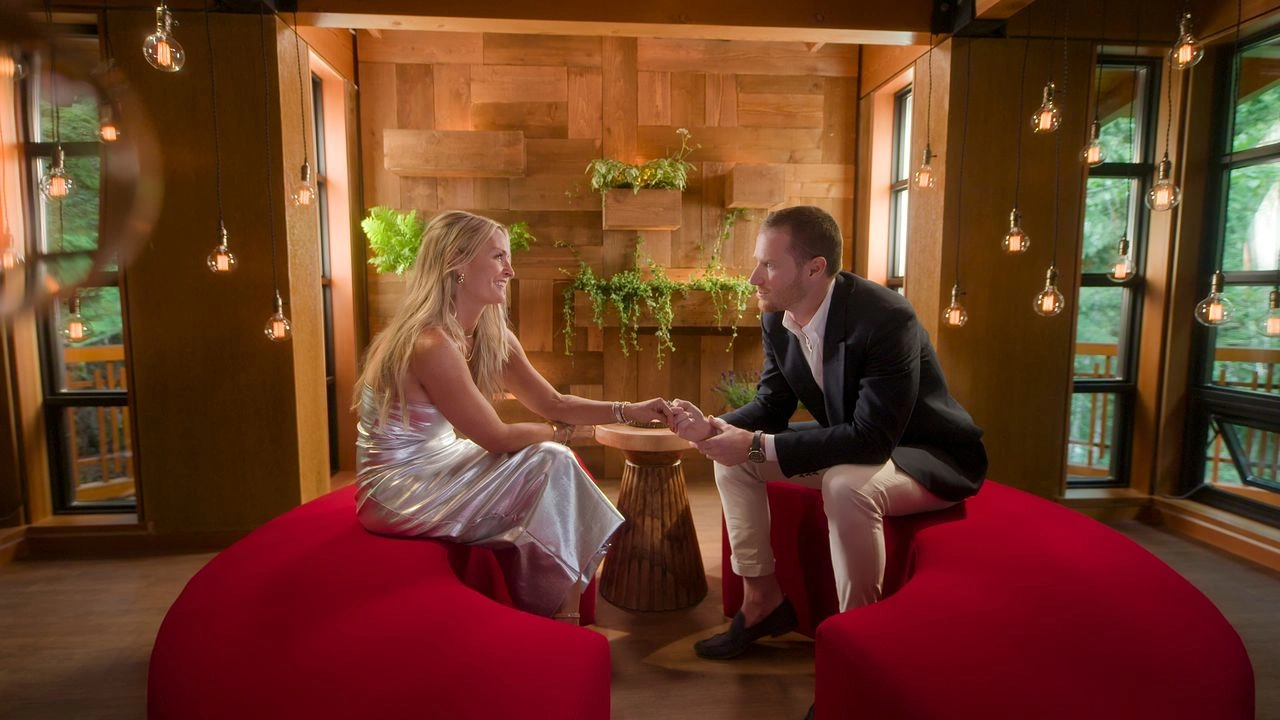
The Promise Room is where the series turns its social experiment into ritual. Couples who feel ready enter a treetop space and exchange promise rings before revealing their ages. The staging is almost comically intense. These rings resemble wedding bands, which gives a relationship formed over days the weight of a life decision. Reality television loves this kind of inflation. A conversation becomes a ceremony. A flirtation becomes a vow. A mild logistical concern becomes a cliffhanger.

Still, the Promise Room gives Age of Attraction its strongest scenes. The reveal is built around a cruelly effective question: what changes when the number becomes real? The participants may insist that they are open minded, yet their faces often betray calculation, relief, embarrassment, or panic. The show catches the instant when attraction must negotiate with social training.
Theresa and John become the clearest example. Theresa is fifty four and has adult children. John is twenty seven. Their twenty seven year age gap could have been edited as pure shock value, yet the series complicates that reaction by presenting John as centered and emotionally steady. His maturity challenges the easy assumption that youth equals recklessness or dependency. Theresa, meanwhile, is asked to occupy a position television rarely grants older women in dating formats: the object of sincere romantic pursuit without apology.
Their pairing exposes one of the show’s most valuable tensions. Viewers may support the principle of romantic freedom while still feeling discomfort when two people occupy sharply different life stages. The discomfort is part of the text. It reveals how deeply audiences have internalized certain romantic timelines, especially around gender. Older men with younger women remain familiar in pop culture. Older women with younger men still trigger a different set of judgments, often dressed up as concern.
Other couples bring quieter anxieties. Andrew worries that fatherhood may alter how Libby sees him. His concern is practical, not abstract. Children are not a symbolic detail; they shape schedules, priorities, emotional availability, and future plans. The age reveal matters because age often stands in for those realities.
The show moves into murkier territory with Tristan, twenty one, and Erin, whose maturity draws him in. His admission that he wants a partner as attractive as his mother creates one of the season’s most uncomfortable moments. It is the kind of line that makes a room go still.
The series deserves credit for allowing the unease to register, though it also benefits from that unease as content. That tension sits at the center of the genre’s ethical bargain. Reality television can expose uncomfortable social patterns, then package them as entertainment before anyone has fully processed what happened.
Vancouver and the Collapse of the Romantic Bubble
The move from Whistler to Vancouver is the season’s smartest structural shift. The wilderness phase allows fantasy to thrive. The apartment building phase forces ordinary life back into the frame. Six couples move forward and live together for two weeks, which is both too short to prove much and long enough to expose the weaknesses producers are hoping to find.
Here, the series becomes less about mystery and more about social pressure. Friends and family enter as representatives of the world outside the experiment. They ask the questions contestants have tried to postpone. Can this work after filming? What happens with children? Who relocates? What will people say? Reality dating shows often treat outside skepticism as an obstacle to romance, yet Age of Attraction makes that skepticism feel culturally revealing. The judgment is not always fair, but it is rarely random.
Theresa’s encounter with her adult children gives the Vancouver section its most loaded material. John is twenty seven, while her eldest child is twenty eight. That one-year difference lands harder than any abstract discussion of age gaps could. It turns the relationship from a private connection into a family disruption. The issue is no longer whether Theresa and John feel chemistry. The question becomes how a relationship rearranges the emotional architecture around it.
The show also grows more self-aware in this phase. Occasional glimpses of crew members and camera operators in hallways puncture the fantasy. Those shots are brief, but useful. They remind viewers that the couples are not simply living together. They are living together under surveillance, inside a schedule, with producers nearby and microphones waiting. In a genre built on the illusion of spontaneous confession, even a small look at the machinery feels honest.
The Vancouver setting also sharpens the show’s engagement with streaming-era romance. Older dating formats often moved toward marriage as the obvious endpoint. Newer streaming shows tend to treat relationships as content ecosystems, built from reveals, reunions, social media discourse, and post-show speculation.
Age of Attraction fits that model while trying to question one of its assumptions: that youthful volatility is the default fuel for dating television. By widening the age range, the series introduces different pressures. Divorce, parenthood, celibacy, fertility anxiety, grown children, and long-distance planning all become part of the romantic field.
That shift makes the show feel slightly less trapped in the eternal adolescence of reality TV. Slightly. The apartment building still has the faint air of a human terrarium with better furniture.
Biology, Boundaries, and the Ethics of Watching
The inclusion of older contestants gives Age of Attraction a gravity that many dating shows avoid. Justin’s fear of missing the chance to become a father is one of the season’s most vulnerable threads. It brings biological time into the conversation without reducing romance to reproduction. His anxiety is personal, yet it points to a wider cultural truth: different ages carry different stakes. A dating choice at twenty five may feel exploratory. A dating choice later in life may arrive with sharper questions about family, health, caregiving, and regret.
The show is especially interesting when it treats intimacy as negotiation rather than spectacle. Vanelle and Jorge’s conversation about celibacy and physical closeness is frank, awkward, and refreshingly adult. Vanelle sets a boundary. Jorge has to respond to it as a person, not a reality show archetype. Their discussion of oral intimacy could easily have been edited for cheap provocation. Instead, the scene becomes a study of how people maintain personal principles inside an environment designed to erode them.
That said, the production’s use of bedroom microphones complicates its more respectful instincts. Capturing the sounds of private encounters may be standard reality TV practice, but it feels especially intrusive here because the series spends so much time asking viewers to take the participants seriously as adults making complicated choices. There is a contradiction between dignifying a boundary conversation and then leaning into the voyeuristic thrill of what happens after the lights go down.
This is where Age of Attraction reveals both the promise and limitation of the genre. It wants to examine stigma around age-gap relationships, yet it still needs gasps, reveals, and intimate footage to keep the machine running. It invites viewers to question social judgment while designing scenes that encourage judgment. The irony is not fatal, but it is persistent.
The mountaintop finale brings the couples to a final decision: stay together or separate. The location is grand, almost absurdly so, as if romance requires altitude to appear sincere. The choice facing the couples is grounded, though. They must decide whether a connection formed under artificial conditions can survive ordinary scrutiny. Age is the headline issue, but the deeper questions involve power, timing, gender expectations, and the public ownership of private desire.
Representation, Social Change, and the Future of Dating Television
Age of Attraction is most valuable as a sign of where unscripted romance is heading. Streaming platforms keep searching for formats that transform social anxieties into digestible experiments. Love without sight. Love under surveillance. Love with financial punishment. Love across age lines. These shows function as cultural stress tests, sometimes accidentally. They reveal what audiences claim to believe and what still makes them flinch.
This series understands that age-gap relationships are not all the same. A twenty seven year gap can carry different meanings depending on gender, money, family status, emotional maturity, and the age of the younger partner. The show does not always explore those distinctions with the depth they deserve, but it does create space for them to surface. Its best scenes resist easy moral sorting. Some pairings feel tender. Some feel impractical. Some raise legitimate concerns. Some reveal bias in the viewer before they reveal anything troubling in the couple.
The representation of older women is especially significant. Television has long treated women’s aging as a problem to solve, hide, or mourn. Here, older women are allowed to desire and be desired. They are also allowed to make questionable choices, which may be the truest form of equality reality TV can offer. Perfect representation often becomes another cage. Messy representation, handled with care, can feel closer to life.
The series also reflects a shift in how streaming television builds intimacy. Rather than relying solely on the marriage plot, Age of Attraction builds suspense through disclosure, social testing, and negotiated compatibility. That structure aligns with a culture where dating is shaped by apps, filters, algorithms, and personal branding. Age is one of the first facts displayed on most dating profiles. Removing it here exposes how much people depend on the data point before they risk emotional curiosity.
Still, the show’s cultural critique only goes so far. Its cast remains shaped by the visual polish expected from Netflix dating formats. Its retreat is beautiful. Its conflicts are cleanly packaged. Its social experiment is carefully engineered to produce the very discomfort it then asks viewers to examine. The result is a series that can be thoughtful and manipulative in the same scene, which may be the most honest thing about it.
Age of Attraction works because its premise touches a real nerve. People say they want love without judgment, yet judgment arrives quickly when desire crosses an approved social line. The series does not settle that contradiction. It stages it, edits it, microphones it, and sends it to the mountaintop. For a dating show, that counts as ambition. For television’s ongoing conversation about age, gender, and romantic freedom, it is a flawed but revealing entry.
Age of Attraction premiered on Netflix on March 11, 2026. This project serves as a social experiment in the dating genre. Hosted by Nick Viall and Natalie Joy, the series asks if romance survives without the knowledge of a partner’s birth year. Participants start at a retreat in Whistler and move to Vancouver to live together. All eight episodes are available to stream on Netflix.
Where to Watch Age of Attraction Online


Full Credits
Title: Age of Attraction
Distributor: Netflix
Release date: March 11, 2026
Rating: TV-MA
Running time: 60 minutes
Director: Paul Starkman
Writers: Jennifer O’Connell, Rebecca Quinn
Producers and Executive Producers: Sam Dean, David Friedman, Jennifer O’Connell, Rebecca Quinn, Nick Viall
Cast: Nick Viall, Natalie Joy, Theresa Demaria, John Merrill, Vanelle Fenmou, Jorge Sanchez, Andrew Wheeler, Libby Vodicka, Logan Goodrid, Vanessa Drozda
Director of Photography: Lindsay Siu
Editors: Dale Estabaya, Matthew Muchka
Composer: Audio Network, APM Music
The Review
Age Of Attraction
Age of Attraction succeeds as a sociological study by introducing a mature cast that brings genuine stakes to the table. The removal of chronological data allows for an analysis of how social norms dictate desire. The transition to Vancouver feels rushed. The family segments feel engineered for conflict. Even so, the core experiment remains effective. It provides a rare look at the complexities of aging and intimacy in a genre that usually prioritizes youth. It is a grounded entry in the Netflix catalog.
PROS
- Mature cast members provide emotional depth and realistic life concerns.
- The Whistler setting offers a visually stunning atmosphere for building bonds.
- Explicit focus on communication regarding personal limits and physical intimacy.
CONS
- The move to Vancouver discards many participants too quickly for the narrative.
- Family introductions feel like forced attempts to generate drama.
- Intrusive audio production in private spaces feels invasive to the viewing experience.