
























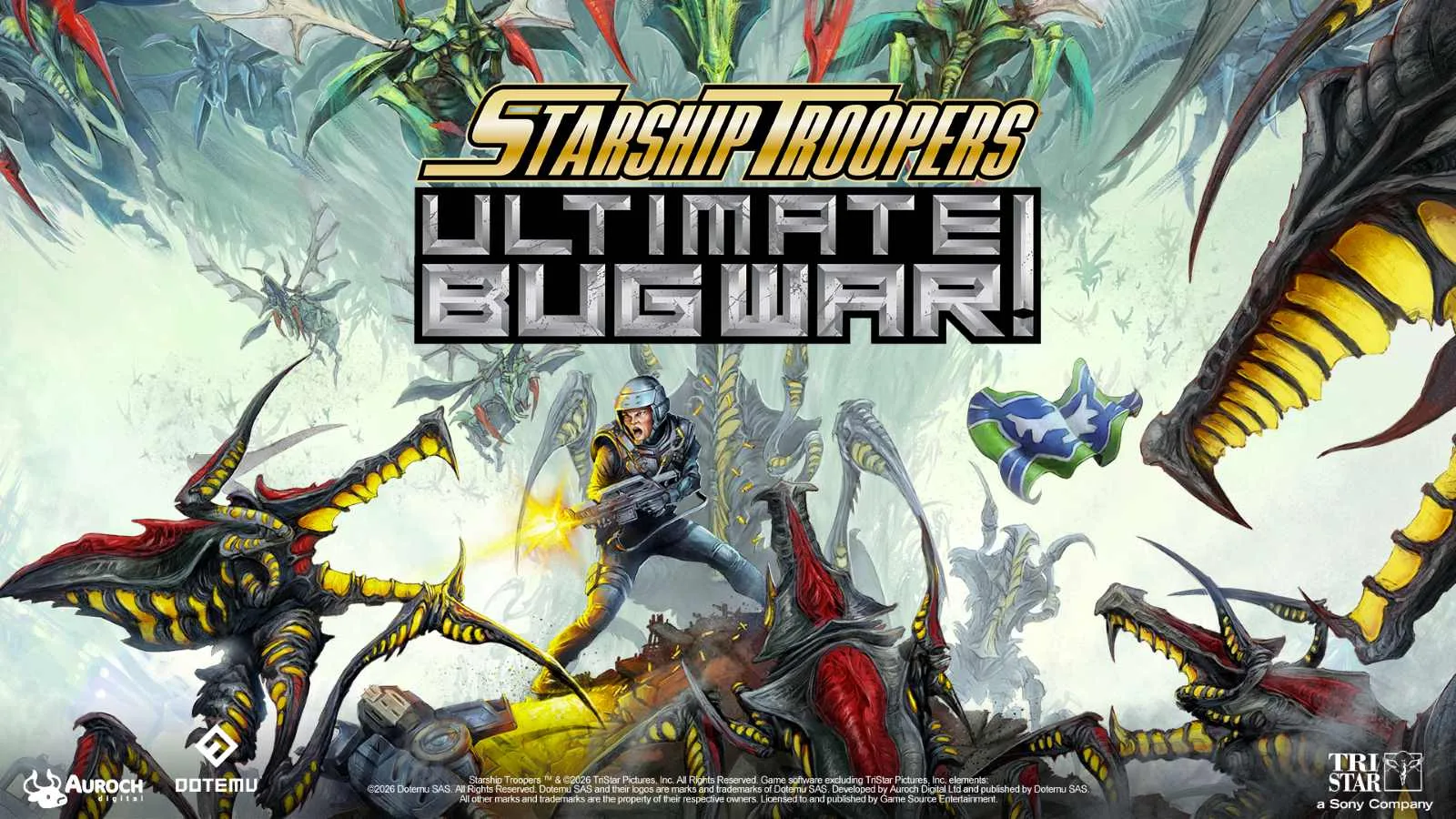

Paul Verhoeven’s 1997 Starship Troopers arrived at a peculiar cultural moment. Built on Robert Heinlein’s militaristic science fiction novel, the film turned its source material inside out, producing a gleaming, gore-soaked satire of fascist cheerfulness that many audiences initially misread as sincere. Decades later, the franchise remains a politically loaded artifact — a property that rewards cultural literacy while remaining accessible to anyone who enjoys watching giant insects explode.
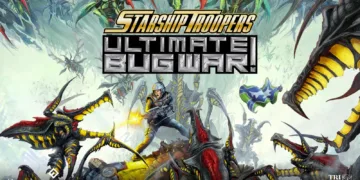
Auroch Digital, the studio behind Warhammer 40,000: Boltgun, takes on that loaded legacy with Starship Troopers: Ultimate Bug War!, a retro-style first-person shooter available on PC, PS5, and Nintendo Switch 2. The game frames itself as an in-universe Federation propaganda tool — a training simulator built around the wartime career of Major Sammy Dietz, sold to the player with a knowing wink. With Helldivers 2 having spent years occupying the satirical bug-shooting space with considerable success, the question Ultimate Bug War must answer is a direct one: what does it bring that justifies its existence alongside a more polished competitor? The answer is mixed, but worth examining closely.
Do Your Part: Propaganda, Pixels, and Paul Verhoeven’s Ghost
The most culturally self-aware decision Ultimate Bug War makes is structural. By framing itself as an in-universe Federation recruitment tool, Auroch positions the player as a target of propaganda rather than a neutral participant. This mirrors the stance of Verhoeven’s film precisely — the audience is addressed by its militaristic world, invited to enjoy the spectacle before the camera slowly reveals the emptiness beneath the patriotism.
In its live-action FMV sequences, the game largely pulls this off. Casper Van Dien returns as Johnny Rico, now a weathered general with an eyepatch, and his performance is sharper than it has any right to be. The mock interviews, the breathlessly patriotic recruitment advertisements between missions — these capture the film’s satirical register with genuine fidelity. Van Dien plays Rico as a man who has entirely become the system he once served, and there is something quietly unsettling about watching him sell an entertainment product with the same face he used to sell a war.
Sammy Dietz, the campaign’s central character, is a thinner creation. She functions primarily as a framework for the game’s locations and objectives, her story running parallel to the original film. The Assassin Bug subplot that nominally drives her arc appears early, vanishes for most of the game, and resurfaces only at the end — a structural problem that undermines the narrative momentum the cutscenes generate.
In-mission, the satirical edge softens considerably. Background soldiers recycle iconic film lines with a frequency that drains them of weight. These phrases land with impact precisely once in the film because of their context. Scattered across nine missions by anonymous troopers, they read as Easter eggs rather than genuine satirical gestures — fan service that slightly diminishes the very thing it is celebrating.
Visually, the game commits to its retro aesthetic: 2D sprite soldiers moving through 3D environments, varied and expressive bug models, animations so deliberately jerky they evoke stop-motion footage from a 1999 mod archive. The movement of friendly troops actually suits the tone, recalling the flat, mass-produced quality of Federation cannon fodder in the film itself.
Sound design tells two stories. Weapons are punchy, bug deaths are visceral, and the live-action sequences carry solid production values. The score is a pronounced weak point — ambient MIDI-brass that feels generic, with the puzzling absence of the original film’s iconic theme. For a licensed product this devoted to fan service, that omission is hard to justify.
Service Guarantees Citizenship: Guns, Bugs, and Calibrated Carnage
The Morita assault rifle is the game’s foundational tool and its best one. Each round connects with a distinctive orange-blue splash against bug chitin — a small visual detail that makes every engagement feel immediate. The rifle has a gas-fed weight to it that many boomer shooters fail to achieve, and targeting the nerve stems of certain bug types introduces a light tactical dimension that rewards attention without demanding expertise. A reload mechanic allows skilled players to cut their reload time by timing a button press correctly, though the game rarely generates the pressure that would make mastering this feel truly necessary.
The wider arsenal covers reasonable ground: a scoped burst-fire Morita variant, a heavy machine gun, a pump-action shotgun, a laser rifle. Weapon switching is most frequently driven by ammunition depletion rather than strategic choice — a consequence of tight ammo reserves offset by supply drops on cooldown.
Where the game establishes its identity most clearly is ordnance. Airstrikes, orbital laser strikes, tactical nuclear bombs, and napalm drops place the player at the top of a lethally excessive chain of command. Dropping a nuclear warhead on a bug swarm is genuinely, absurdly satisfying — the kind of disproportionate response that Verhoeven’s satire would recognize immediately. These tools give Ultimate Bug War a flavor that separates it from comparable boomer shooters, though self-damage risks and long deployment windows mean they demand more caution than the fantasy implies.
Mech suits appear in several missions and represent a missed opportunity. The concept is right — piloting an armored walker through a bug-infested battlefield is the power fantasy the game promises — but fuel limitations cut the experience short before it builds momentum. Gunship door-gun sections feel similarly thin, more obligation than spectacle.
Up to five soldiers can be recruited from the battlefield, and a patch during the review period improved the process considerably, shifting from a clunky manual system to an automatic proximity-based one. The soldiers themselves are fragile and not particularly intelligent, walking into friendly fire with a consistency that might be deliberate commentary on Federation attrition rates, but reads more like a limitation. Simple command options would have given them tactical value beyond serving as a distraction buffer.
From Klendathu to Zegema Beach: Scale, Emptiness, and the War Around You
Nine missions, each running roughly thirty minutes, take the player across locations drawn from the film’s geography: Klendathu, Zegema Beach, the ruins of Buenos Aires, and others. Within each mission, objectives can be tackled in any order — a non-linear structure that suits the fiction of an active warzone and recalls the freedom of older military shooters.
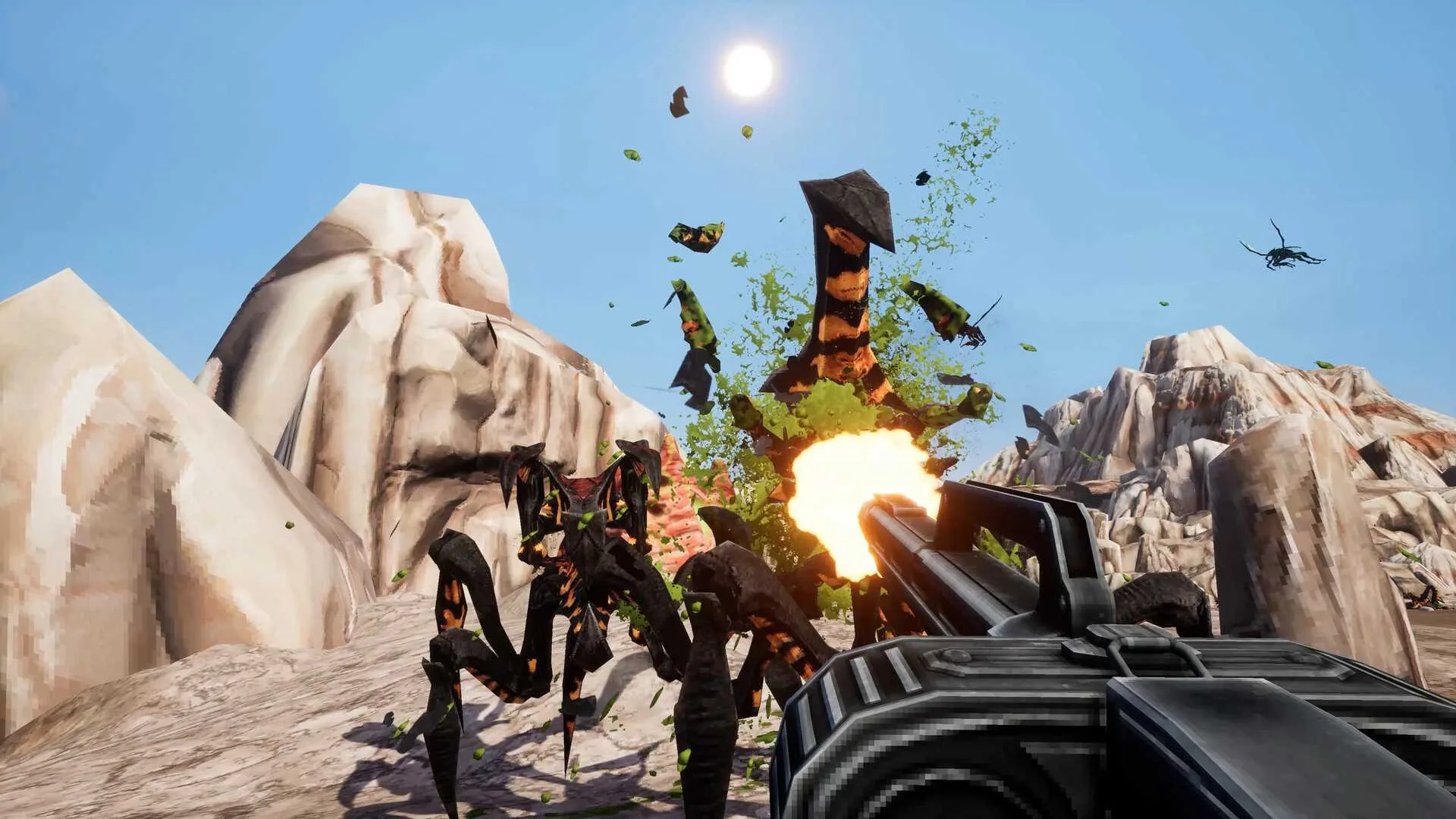
The opening mission, the Klendathu drop, is the campaign’s strongest. Bugs surge from canyon walls and narrow trails at a density the rest of the game rarely matches. Multiple objectives compete for attention, the map has genuine verticality, and the sense of being overwhelmed is sustained throughout. It is the game at full power, and it sets an expectation that subsequent missions do not meet consistently.
From there, the campaign settles into a familiar rhythm. Objectives repeat across missions: plant charges, defend an outpost, destroy bug nests, call in a strike. The sandbox maps create a real sense of scale — distant skirmishes, panicked radio chatter, the impression of a war raging beyond the player’s immediate field of view — but that scale comes at a cost. Large open maps with sparse enemy density mean considerable running between encounters, and the spaces between objectives often offer nothing.
The standout maps beyond Klendathu are Zegema Beach, which carries a resort-turned-warzone identity that the game earns through its visual contrast, and the Buenos Aires ruins, which have an atmospheric weight the rocky terrain levels lack. Enemy density on lower difficulties makes the swarm fantasy difficult to sustain, and the game’s vision of relentless insect warfare is convincing only in concentrated bursts.
Know Your Enemy: The Bug Side of the War
The playable Assassin Bug campaign is the game’s most ambitious idea and its most underdeveloped execution. The Assassin Bug is a shapeshifting insectoid commander with three operational forms: flight for traversal, heavy melee for close combat, and a fire-based ranged configuration. Bug hives serve as spawn points, letting players build a growing squad of units. The in-game justification — that Federation forces run this simulation to study the enemy — fits cleanly within the propaganda framing.
The asymmetric premise carries genuine cultural appeal. Playing as the aggressor against massed Federation infantry, experiencing the war from the other side, carries real thematic weight given how thoroughly Verhoeven’s film asks its audience to consider what separates a soldier from the creatures they are ordered to kill. The game gestures at that question without pursuing it.
In practice, the missions do not support the premise. Objectives consist almost entirely of destroying tents, generators, and soldier bases. Infantry go down in a single hit, combat reduces to holding the attack button until an objective clears, and there is no ambient dialogue or narrative texture connecting these levels to the broader story. The action-RTS hybrid structure, built around managing spawn points and squad numbers, is too shallow to function as genuine strategy.
One structural grace note: players can jump directly into a bug mission following a human one, creating a rhythmic contrast between campaigns. It is a smart option that the quality of the bug missions themselves cannot adequately reward.
Bug Hunt: Replayability, Performance, and What’s Missing
Technical performance is a clear achievement across platforms. The Switch 2 version maintains consistent frame rates both docked and undocked — no small feat given the number of enemies that can fill the screen simultaneously. Mouse controls are also available on Switch 2, implemented cleanly and rare enough on that platform to deserve specific mention.
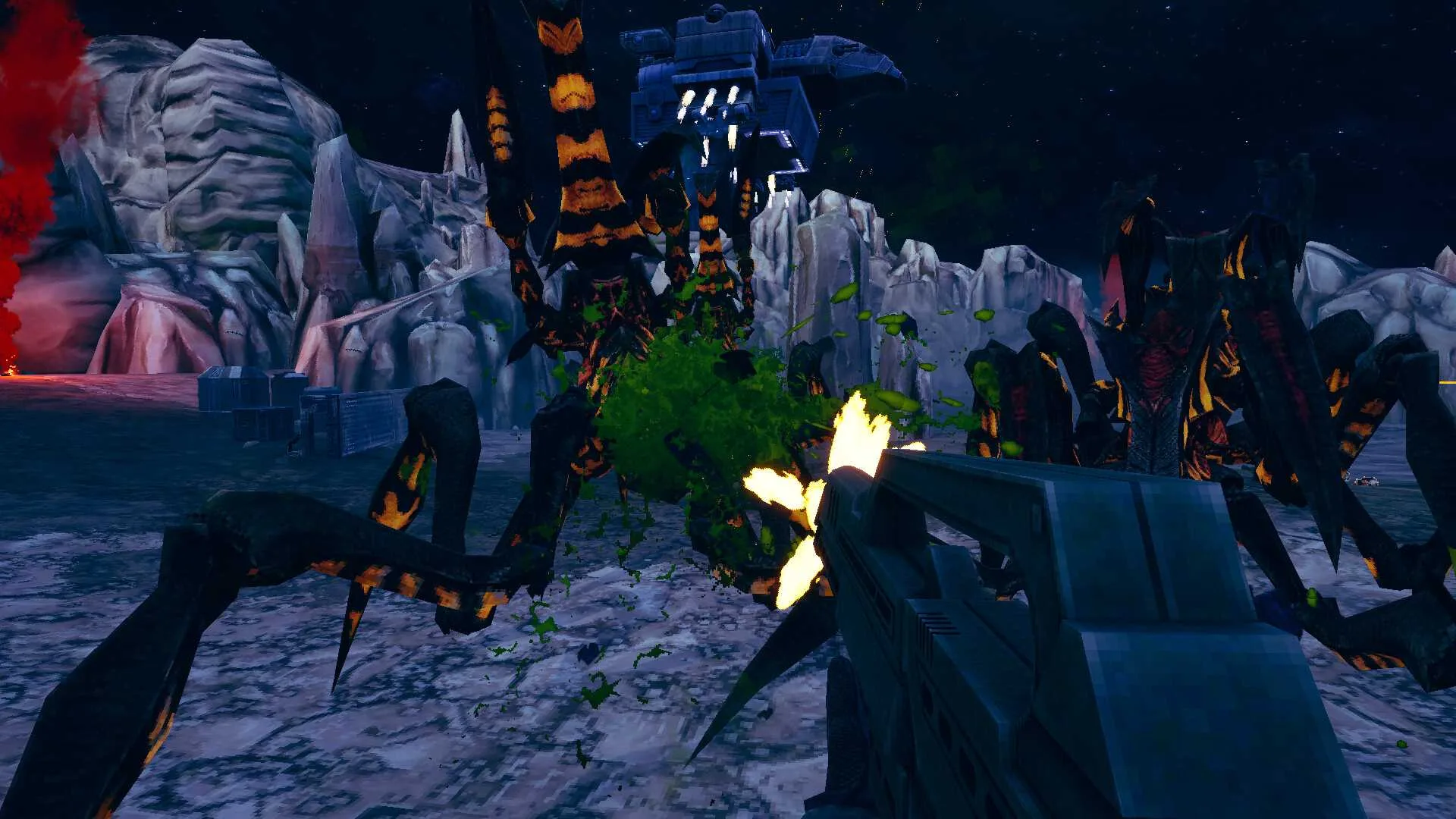
Four difficulty modes give the game meaningful range. Higher settings substantially increase bug density, and the swarm fantasy that lower difficulties struggle to sustain becomes considerably more convincing at the top end. A per-mission scoring system adds a competitive replay incentive for players chasing high marks.
The absence of multiplayer is the package’s most significant structural gap. Co-op play would suit both the tonal chaos and the tactical framework; a Troopers versus Bugs mode feels like an obvious extension given the two playable campaigns. Neither exists at launch. The human campaign is short, the bug campaign adds time without adding quality, and the map secrets offer no meaningful rewards for discovery.
The game is honest about what it is: a lean product built for fans of the film and fans of late-90s shooters. Players seeking long-term engagement beyond the campaign will find little to anchor them once the credits roll.
Starship Troopers: Ultimate Bug War! is a single-player retro-styled first-person shooter that immerses players in the satirical sci-fi universe of the iconic franchise. Released on March 16, 2026, the game features a campaign where players take on the role of Major Samantha “Sammy” Dietz to defend the galaxy against the relentless Arachnid threat. The game distinguishes itself with a visual style reminiscent of 90s shooters, over 30 weapons to master, and live-action FMV sequences that maintain the series’ signature propaganda-style storytelling. Players can experience the “Ultimate Bug War” on PC (via Steam), PlayStation 5, Xbox Series X|S, and Nintendo Switch 2.
Full Credits
Director (Creative/Game Director): Stéphane Perez (FMV Director)
Writers (Lead Writer/Narrative Designer): Grant Stewart, Brian David Gilbert, Karen Han
Producers/Studio Leadership (Producers, Executive Producers, and Key Studio Heads): Tomas Rawlings, Cyrille Imbert
Lead Voice Cast: Casper Van Dien (General Johnny Rico), Charlotta Mohlin (Major Samantha “Sammy” Dietz), Shaun Mendum (Ethan Corto), Maxim Reston
Art Director/Lead Artist: Mike Sneath, Nina Adams
Key Engineering/Technical Leads: Steve S. Ellis
Composer/Sound Director: Alistair Kerley
Developer, Publisher: Auroch Digital, Dotemu
Release Date: March 16, 2026
The Review
Starship Troopers: Ultimate Bug War!
Ultimate Bug War is a game of sharp instincts and uneven execution. Its propaganda framing is genuinely clever, Van Dien's return adds real cultural weight, and the Morita rifle feels exactly right. The Klendathu drop demonstrates what the whole game could have been. But sparse maps, repetitive objectives, an underbaked bug campaign, and the absence of multiplayer leave the package feeling incomplete. Fans of Verhoeven's film will find enough to appreciate. Everyone else may find the Federation's finest falls short of full service.
PROS
- Propaganda framing genuinely captures Verhoeven's satirical tone
- Casper Van Dien's performance is sharper than expected
- Morita rifle feels weighty and satisfying to fire
- Ordnance system adds chaotic, franchise-appropriate spectacle
- Klendathu mission delivers on the swarm fantasy
- Solid technical performance, including Switch 2 mouse support
CONS
- Enemy density is inconsistent across most missions
- Bug campaign is severely underdeveloped
- Repetitive objectives across the human campaign
- Maps are largely empty between encounter points
- No multiplayer at launch
- Score is generic with the film theme notably absent