
























![Kingdom Hearts Collection [I-III] Review](https://gazettely.com/wp-content/uploads/2026/10/Kingdom-Hearts-Collection-I-III-1-360x180.webp "Kingdom Hearts Collection [I-III] Review: KHII Holds Steady as Newer Entries Fluctuate 37")




To return to Arlen, Texas is to return to a specific, comforting frequency of American life. The original King of the Hill built its world not on gags, but on the quiet, often hilarious, truths found in the suburban sprawl. Here lived the Hill family: Hank, a man of unwavering principle whose world was defined by propane, integrity, and the Dallas Cowboys; his wife Peggy, a substitute teacher whose confidence vastly outpaced her abilities; and their son Bobby, a pre-teen enigma who preferred prop comedy to sport.
Their stage was a town of strip malls and tidy lawns, a place where the dramas were small but the feelings were real. The show’s enduring identity rests on this foundation. In an animated landscape populated by gleeful chaos and absurdity, King of the Hill was an act of deliberate restraint, finding its humor in the subtle textures of conversation and the gentle friction between generations. Now, after years of silence from Rainey Street, the screen door creaks open once more, revealing a world that has not stood still.
The World Kept Spinning on Rainey Street
The revival’s central conceit is a sharp, clever reset. Hank and Peggy Hill are returning home, not from a vacation, but from a multi-year stint in a gated American-style compound in Saudi Arabia—a final, lucrative chapter in Hank’s propane career that has funded their retirement. He left one manufactured version of America only to return to the real thing and find it has become unrecognizable.
The narrative jumps forward eight years, and this passage of time is felt immediately as a kind of cultural whiplash. Arlen has transformed in their absence. Hank, a man whose comfort zone is the width of his own driveway, is thrust into a 2025 landscape that feels alien. He lands at DFW, kisses the ground in relief to be back on Texas soil, and is immediately confronted by a Gucci store and a boba tea stand. His bewilderment is palpable.
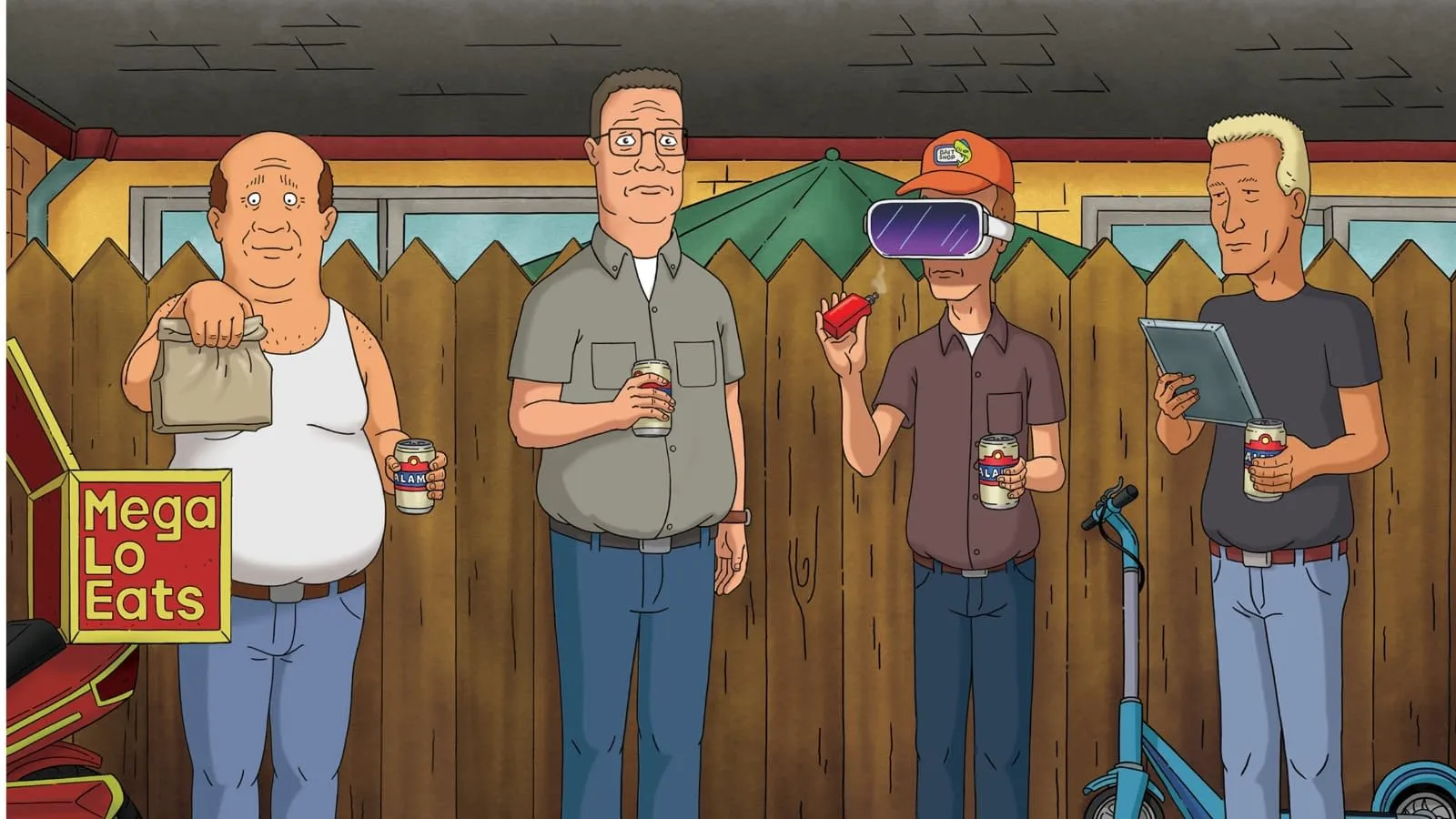
This new world is a barrage of modern ephemera: all-gender bathrooms, electric scooters littering the sidewalks, and rideshare drivers begging for five-star reviews. He is baffled by poke bowls and the fruit-forward IPAs that have replaced his beloved Alamo beer. His reaction is not the angry tirade of a cultural warrior, but the quiet, worried sigh of a man adrift in time. He worries less about the changing world and more about the social faux pas of navigating it, fearing he might “get canceled” by accident.
The ground has shifted even in his own backyard; their house was rented to Brian Robertson, a Black conservative who now occasionally occupies a spot in the back-alley beer klatch, forcing Hank to reconcile his own brand of traditionalism with a new, different voice on his own side of the fence.
That Boy Ain’t a Boy Anymore
The most profound change in Arlen is the one that time guarantees, and the series leans into it with remarkable courage. Bobby Hill is now 21 years old. This is the revival’s masterstroke, a definitive rejection of the static timeline that traps most animated characters in amber.
Bobby is a young man living in Dallas, having skipped college to become the co-owner and chef of “Robata Chane,” a Japanese-German fusion restaurant. The concept is pure Bobby: earnest, unexpected, and strangely brilliant, serving dishes like grilled mackerel with a side of mustard pretzel. He is taller and more mature, yet he is unmistakably himself, his offbeat charm and gentle spirit fully intact.
His romantic pursuit of a grown-up Connie Souphanousinphone introduces him to the complexities of adult dating, including her casual mention of being in an open relationship, a concept that the eternally romantic Bobby must grapple with. His relationship with his father has deepened into something more substantive.
The awkward gulf between them has narrowed, replaced by a tender, man-to-man bond built on a shared, if unspoken, respect for hard work. Hank may not understand his son’s culinary ambitions, but he understands the pride of running a business.
The old gang has aged, too, their lives bent into new shapes by Hank’s absence. Dale Gribble’s lifelong paranoia has found frightening validation in the modern ecosystem of misinformation. He’s no longer just a local eccentric; he’s tapped into a global network of fellow believers, his theories about black helicopters now seeming quaint.
Bill Dauterive, left without Hank’s stabilizing presence, retreated into a state of bedridden seclusion, a tragicomic figure whose emotional fragility has consumed him. Boomhauer, the eternal bachelor, has stumbled into responsibility as a surrogate father figure to his girlfriend’s child, a role made funnier by the fact that the kid cannot understand a word he says.
Even Nancy and John Redcorn have rebranded themselves for the modern age as hosts of a local real estate show, “Selling Arlen.” The revival handles its absences with a respectful quiet. Luanne Platter and her husband Lucky are not present, a silent acknowledgment of the real-world deaths of actors Brittany Murphy and Tom Petty. This decision to not recast, in a show that seamlessly replaces other voices, is a mark of the show’s deep-seated decency, a space left empty out of reverence.
Still Laughing With Them, Not at Them
The series’ comedic soul remains wonderfully intact, its humor still springing from character rather than caricature. It treats modern cultural flashpoints not as targets for scorn but as new, confusing obstacles for its characters to navigate. When Hank confronts the loud, performative rage of the “Manosphere,” the comedy comes from the collision of his quiet, inherent dignity with their aggressive misogyny.

The joke is on his confusion, not on the concepts themselves. In a telling moment, he learns that the Girl Scouts have renamed “Samoas” to “Caramel Delites” to be more sensitive. “That’s a good change,” he says with simple sincerity before buying a box. This is the show’s kind heart laid bare, a consistent refusal of cheap cynicism. It resists the urge for cruel or easy satire, preferring observation to judgment.
New storylines feel authentic, blending timely themes with classic scenarios: Peggy’s good intentions go awry when she opens a free lending library, and Hank and Dale conduct their own unauthorized tour of the George W. Bush Presidential Library. A season-long arc sees Hank develop a secret affection for soccer, a betrayal of his football-first Texas roots that he hilariously tries to hide from his friends.
The show continues to address the social climate with a subtle hand, never mentioning national political figures by name but allowing their influence to be felt through Dale’s empowered paranoia. It draws a clear line between Hank’s traditionalism and Dale’s conspiratorial delusions, presenting Hank’s capacity for small moments of growth as a quiet virtue.
A Familiar Tune in a Different Key
Visually, the new Arlen takes a moment of adjustment. The animation, while preserving Mike Judge’s iconic and beautifully simple character designs, possesses a digital crispness that feels different from the original’s softer, 2D aesthetic.
 King of the Hill Season 14 Review
Movements, at times, appear stiffer, and the environments lack some of the original’s hand-drawn texture, a result of modern computer-assisted techniques. It is a noticeable shift, a modern sheen on a classic design that can be initially jarring. The strength of the writing, however, quickly draws focus away from the new look and back to the characters who inhabit it.
The vocal performances are a triumphant return across the board. Pamela Adlon’s portrayal of an adult Bobby is a masterclass, perfectly pitching his voice to reflect his age without losing the boyish cadence that defines him. The season is also marked by a poignant sense of farewell. Johnny Hardwick, the definitive voice of Dale, recorded his lines for several episodes before his death, and his final performances are a gift.
Toby Huss steps into the role with seamless skill, honoring the character’s legacy. The late Jonathan Joss also makes his final appearance as John Redcorn. These last episodes function as unintentional but beautiful tributes, their storylines imbued with an extra layer of sweetness and finality, celebrating the characters and the actors who gave them such unforgettable life.
King of the Hill Season 14 is a 10-episode revival set to premiere on Hulu on August 4, 2025. All episodes will be released simultaneously. The season is co-produced by Mike Judge and Greg Daniels‘ company, Bandera Entertainment. The revival takes place 15 years later.
Full Credits
Director: Tricia Garcia
Writers: Mike Judge, Greg Daniels, Saladin K. Patterson
Producers: Mike Judge, Greg Daniels, Michael Rotenberg, Howard Klein, Saladin Patterson, Dustin Davis.
Executive Producers: Mike Judge, Greg Daniels, Michael Rotenberg, Howard Klein, Saladin Patterson, Dustin Davis.
Cast: Mike Judge, Kathy Najimy, Pamela Adlon, Johnny Hardwick, Stephen Root, Lauren Tom, Toby Huss, Jonathan Joss, Keith David, Anthony ‘Critic’ Campos, Kenneth Choi, Ki Hong Lee, Tai Leclaire.
The Review
King of the Hill Season 14
This revival accomplishes the difficult task of feeling both nostalgic and new. By bravely aging its characters, especially Bobby, the show finds fresh emotional depth and comedic material without sacrificing the gentle, character-first humor that made it a classic. It navigates a changed world with the same subtle heart and intelligence that defined its original run, proving to be a satisfying and deeply welcome return to Arlen.
PROS
- The bold time-jump narrative is successful, allowing for meaningful character evolution.
- Bobby Hill's transition to a well-realized young adult provides the show's strongest emotional and comedic core.
- The humor remains intelligent and kind-hearted, focusing on character reactions over cheap shots at modern culture.
- Excellent voice acting from the entire cast, including poignant final performances from Johnny Hardwick and Jonathan Joss.
- Effectively navigates contemporary themes with the subtlety and grace that defined the original series.
CONS
- The updated digital animation style can feel stiff and visually jarring compared to the original's smoother 2D look.
- The absence of beloved characters like Luanne and Lucky, while handled respectfully, is felt.







