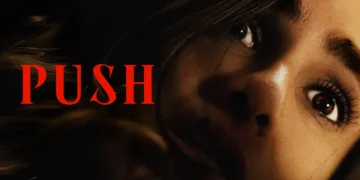
























The modern home is a myth. It is sold not as shelter but as a sanctuary, a curated fortress against the chaos of the world. In Push, Natalie, a real estate agent, is a purveyor of this myth, tasked with selling the unsellable: a sprawling estate whose history is as dark and cavernous as its hallways.
Her own life is a monument to fractured ideals; she is eight months pregnant and navigating the aftershocks of her partner’s death. The house, then, is a perfect mirror for her state—vast, beautiful, and fundamentally broken.
She is attempting to sell a dream she can no longer afford to believe in. When her final appointment of the day arrives, a quiet man credited only as “The Client,” the professional facade crumbles. His presence is an immediate violation, a quiet tear in the fabric of civility. With his arrival, the house ceases to be property and becomes a cage, initiating a terrifying negotiation where the price is survival.
The Geometry of Fear
For a significant portion of its runtime, the film is an exquisite exercise in what might be called architectural dread—the idea that the structures built to house us can just as easily entomb us.
Directors David Charbonier and Justin Powell demonstrate a clinical precision, choreographing a brand of terror that is less about the sudden scare and more about the slow, agonizing realization of being systematically outmaneuvered.
Their direction is lean, stripping away narrative excess to focus on the pure mechanics of suspense. They understand that true horror lies not in seeing the monster, but in knowing it has the blueprints.
This sense of entrapment is amplified by Daniel Katz’s cinematography, which renders the estate in rich, classical strokes of shadow and light. The visual presentation is almost too beautiful for the grim events unfolding, a stylistic choice that heightens the sense of violation. The camera glides through corridors and peers into darkened rooms, creating a suffocating map of a place with no exit.
The filmmakers weaponize the very structure of the house—a dumbwaiter becomes a vessel of dread, a cavernous living room an exposed killing floor, an antiquated elevator a mechanical nightmare. Adding Natalie’s sudden labor to this equation is a stroke of brutalist genius.
The biological imperative to give life collides violently with the immediate necessity of preserving it. It introduces a visceral, ticking clock, making her struggle a dual-front war fought on the battleground of her own body and the unforgiving dimensions of the house.
Primal Forces, Polished Surfaces
The conflict is anchored by two potent, near-archetypal performances that reduce the narrative to its most basic elements: life versus death. Alicia Sanz gives Natalie a tangible desperation that feels earned. Her terror is not the shrill panic of a stock victim but the steely, resourceful fear of a person with everything to lose.

We witness the persona of the grieving professional—a role society demands she maintain even in extremis—dissolve, replaced by a primal mother fighting for a future she can barely imagine. This shedding of modern pretense for raw instinct is compelling; her transformation is the film’s fierce, beating heart.
Opposing her is Raúl Castillo as “The Client,” a figure of profound menace precisely because he lacks definition. He is not a character with a discernible motive; he is a catalyst, a personification of the random violence that our ordered world (represented by the expensive, curated house) pretends to have banished.
His quiet, relentless pursuit is unnerving because it is inexplicable. We expect villains to monologue, to explain their trauma. The Client offers nothing. He is simply an absence of empathy. This is not a battle of wits between two complex individuals. It is a more fundamental clash: the creative, life-giving instinct against a silent, destructive void, played out on expensive hardwood floors.
A Decompression Chamber
A perfectly sealed container maintains pressure. Once breached, its contents rush out, and the intensity is lost. Push thrives when it operates as a sealed vacuum, a pressurized chamber of anxiety. The horror works because it is contained within the symbolic space of the doomed estate. Yet, after methodically building a world of unbearable claustrophobia, the film commits the cardinal sin of opening a window.

The action eventually spills beyond the estate’s walls, and in doing so, the potent, symbolic horror dissipates into the far more conventional haze of a standard thriller. The film seems to lose its nerve, abandoning its airtight logic for something broader and much less interesting. The tight focus is exchanged for a wide, generic lens. It is a baffling choice, like watching a skilled surgeon trade their scalpel for a mallet mid-operation.
Lean efficiency gives way to action sequences that, while functional, lack the inventive dread of the film’s earlier set pieces. Worse, new plot threads are introduced in the final act, flimsy attempts to rationalize a story whose power was rooted in its stark irrationality. It attempts to provide answers to questions that were frightening precisely because they were unanswerable.
This structural faltering is a deep shame, as it betrays the film’s own brilliant thesis. For more than an hour, Push is a masterful study in minimalist terror, a testament to the power of a simple premise executed with formalist rigor.
While it ultimately loses faith in its own suffocating design, making the final act feel like a narrative afterthought, the experience of being trapped inside that initial, perfect construction is so unnerving and expertly crafted that it remains an essential piece of filmmaking. It reminds us that the most frightening spaces are not the ones filled with monsters, but the ones that show us how little separates our sanctuaries from our tombs.
“Push” is a horror thriller that had its world premiere at the Sitges Film Festival in October 2024. It will be available for streaming on Shudder and AMC+ Roku Premium Channel starting July 11, 2025.
Full Credits
Director: David Charbonier, Justin Powell
Writers: David Charbonier, Justin Powell
Producers: Justin Powell, Ryan Scaringe, David Charbonier
Executive Producers: Amy Lippens, Jilbert Daniel, Alicia Sanz, Raúl Castillo, Del Charbonier
Cast: Alicia Sanz, Raúl Castillo, David Alexander Flinn, Gore Abrams, Justin Marcel McManus, Cole Gleason, Linc Hand, Luke Barnett, Dagney Kerr
Director of Photography (Cinematographer): Daniel Katz
Editors: Stephen Boyer
Composer: Matthew James
The Review
Push
A film of two distinct halves, Push is a brilliant, nerve-shredding exercise in contained terror for its first hour. The direction and performances build an atmosphere of almost unbearable dread within a single, terrifying location. It is a profound shame that the film abandons this airtight construction for a conventional and less impactful final act. While the flawed conclusion prevents it from achieving greatness, the sheer filmmaking prowess on display in its setup makes it a compelling, if frustrating, watch. The first two-thirds are a masterclass in suspense.
PROS
- Exemplary build-up of suspense and a palpable sense of dread.
- Stylish, atmospheric cinematography that makes the location a character.
- Powerful and believable lead performances.
- A smart, high-stakes premise that maximizes tension.
CONS
- The final act abandons the claustrophobic tension that made the film work.
- Narrative focus weakens significantly in the last third.
- Introduces underdeveloped ideas late in the story.