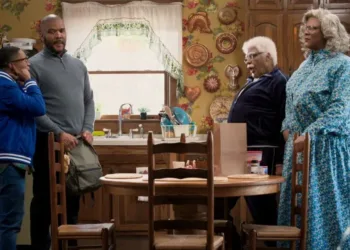
The return of Mabel “Madea” Simmons is less a surprise and more a cyclical certainty, a cinematic constant in an unsteady world. In Madea’s Destination Wedding, the thirteenth film centered on Tyler Perry’s matriarchal creation, the premise arrives with familiar haste.
Madea’s nephew, the perpetually stressed district attorney Brian, is aghast to learn his daughter Tiffany is getting married. The groom, Zavier, is a man Brian instantly loathes, and to compound the indignity, his wealthy ex-wife Debrah manipulates him into footing the bill for a Bahamian ceremony.
The film’s opening, a preamble of casual arson at a gas station, serves as a mission statement: the aggression is cartoonish, the stakes are low, and the chaos is the point. What follows is a predictable collision of family melodrama and broad vacation hijinks, as Brian summons his entire chaotic clan for support, an act of self-sabotage that guarantees his anxieties are the least of his problems.
A One-Man Trinity
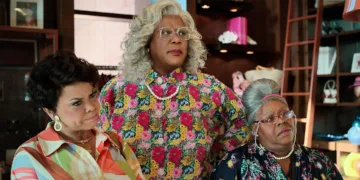
At the center of this maelstrom is Tyler Perry, who not only directs but also performs a theatrical trinity as the uptight Brian, the abrasive Madea, and the crude Joe. His technical skill in portraying these three distinct personas is undeniable, particularly in sequences where they share the screen, trading barbs on a porch in a display of well-timed character work.
Brian is a vessel of simmering professional frustration, his composure constantly threatened by his family’s antics. Joe is a creature of pure id, a vessel for gleeful, consequence-free vulgarity whose only purpose is to puncture any moment of sincerity.
And Madea herself is the gravitational center, a contradictory figure who is both the primary agent of chaos and the designated dispenser of skewed, hard-won wisdom. In these moments, Perry the actor demonstrates a versatility that often feels more considered than his work as a director.
The supporting ensemble functions as a collection of comedic archetypes set in amber, a necessary chorus for Perry’s central performances. David and Tamela Mann as Mr. Brown and Cora, alongside Cassi Davis as Aunt Bam, replay their signature beats with practiced ease. Mr. Brown’s digestive issues, Cora’s piety, and Bam’s unquenchable libido are not character traits so much as reliable comedic functions.
The film’s style heavily favors a loose, improvisational cascade, with scenes often devolving into a cacophony of overlapping banter. This freestyle approach is a high-wire act without a net; it can feel like watching a scene search for its own punchline in real time. For every sharp one-liner that lands, there are several more that dissipate into a tedious, undisciplined noise, creating an exhausting rhythm of setup and misfire.
Lost in the Lobby
The film operates with a striking disregard for narrative momentum. The central plot of the wedding is a distant shore, and the journey there is marked by a profound sense of inertia. Entire sections of the movie are dedicated to the mundane logistics of travel, stretched into protracted comedic set pieces.
The process of acquiring passports becomes a lengthy skit on Madea’s theatrical paranoia around law enforcement, while the airplane boarding sequence wallows in the physical comedy of squeezing into seats and Mr. Brown’s predictable bodily betrayals. These scenes are not built to advance the story but to fill time, serving as standalone sketches loosely tethered to the main event.
The Atlantis Bahamas resort is less a setting than a co-star, its opulent halls and waterslides receiving more dedicated camera attention than the nominal romantic leads. This is filmmaking as a vacation video, where the location itself becomes the primary focus.
The story gives way to a litany of luxurious distractions: the family gleefully charges exorbitant spa treatments and casino losses to Brian’s room, Joe fondly recalls his pimping days while ogling young women at a bachelor party, and Mr. Brown has a calamitous, multi-angle encounter with a waterslide. The visual language lavishes attention on the resort’s amenities with sweeping, glossy shots, a stark contrast to the static, stage-like framing of the dramatic scenes.
The commitment to showcasing this environment is so total that it effectively overwhelms the intended story about Tiffany and Zavier’s relationship, turning the film into a feature-length advertisement where the plot is merely an occasional visitor.
Sermons and Slapstick
The humor deployed throughout is a blunt instrument, ranging from broad slapstick to antiquated social commentary that feels hermetically sealed from the present day. Madea brandishing an AK-47 on her porch or the persistent jokes about the necessity of child discipline are presented without a hint of irony, rooted in a boomer-era grievance that underpins much of the franchise’s worldview.
Buried beneath the gags are faint attempts to explore genuine themes—Brian’s paternal insecurities, the crushing financial burden of modern weddings, and the need for parents to trust their adult children. Yet these fragile moments of sincerity are consistently suffocated by the surrounding buffoonery.
A potentially poignant conversation about fatherhood is immediately undercut by a crude interjection from Joe, making it impossible for any emotional weight to accumulate. The film exists in a state of perpetual tonal whiplash.
This dissonance culminates in the abrupt pivot to melodrama in the final act, a trademark of Perry’s style. It’s a rapid tidying of loose ends, where complex emotional issues are resolved through simplistic speeches and sudden, unearned changes of heart.
This desire to preach sits uneasily alongside the impulse to entertain through chaos, and the two are never successfully reconciled. Ultimately, Madea’s Destination Wedding is a product built for a pre-existing audience.
It offers no new ideas or artistic evolution, instead delivering a familiar concoction with unwavering consistency. It exists within a perfectly closed loop of creation and consumption, a film that preaches to its own devoted choir and offers no reason for anyone outside its dedicated congregation to attend.
“Madea’s Destination Wedding” is a comedy film released on July 11, 2025. It is the thirteenth film in the Madea cinematic universe and is available to watch on Netflix.
Full Credits
Director: Tyler Perry
Writers: Tyler Perry
Producers: Tyler Perry, Yolanda T. Cochran, Angi Bones
Executive Producers: Niya Palmer, Keisha Lance Bottoms, Terri J. Vaughn
Cast: Tyler Perry, Cassi Davis Patton, David Mann, Tamela Mann, Taja V. Simpson, Diamond White, Jermaine Harris, Xavier Smalls
Director of Photography (Cinematographer): Michael Watson
Editors: Larry Sexton
Composer: Jongnic Bontemps
The Review
Madea's Destination Wedding
3Score
Madea's Destination Wedding is less a movie and more a content delivery system for a pre-existing fanbase. While Tyler Perry’s skill at inhabiting multiple roles remains a curious technical feat, it’s not enough to salvage a narrative lost in a sea of promotional shots and undisciplined comedic riffs. The film prioritizes its luxurious setting over story, resulting in a tedious and tonally confused affair. It's a cinematic loop built for devotees; all others will find the destination is not worth the journey.
PROS
Tyler Perry's versatile performance as three distinct characters.
The technical execution of scenes where Madea, Joe, and Brian interact.
The familiar cast chemistry will appeal to longtime fans of the series.
CONS
An extremely slow pace with a narrative that frequently stalls.
The plot feels secondary to showcasing the Bahamas resort location.
Jarring and inconsistent tonal shifts between broad comedy and melodrama.
Much of the humor is repetitive, crude, and feels outdated.