

























![Kingdom Hearts Collection [I-III] Review](https://gazettely.com/wp-content/uploads/2026/10/Kingdom-Hearts-Collection-I-III-1-360x180.webp "Kingdom Hearts Collection [I-III] Review: KHII Holds Steady as Newer Entries Fluctuate 40")


Following a celebrated return, a second effort always faces a unique pressure. EA Sports College Football 26 arrives not as a reinvention, but as an exercise in enrichment. Instead of tearing down the successful foundation of its predecessor, this year’s game digs deeper into the soil of what makes the college game special.
It’s a focused attempt to bottle the intense spirit of Saturday traditions, heated rivalries, and campus pride. The goal is clear: to build upon a strong start by layering in the details and authentic touches that transform a simple simulation into a reflection of a sport defined by its passion. This year tests if refinement can be as exciting as a revolution.
Gameday Authenticity: The Sights and Sounds of Saturday
The most significant change in College Football 26 is how it grounds you in a specific place and time. Watching Virginia Tech take the field to “Enter Sandman” or seeing Arizona’s turnover sword used after a pick isn’t just window dressing; it’s a specific, authored moment of authenticity.
This sense of place is amplified by a dynamic lighting system that sees afternoon shadows lengthen into twilight and the crisp light of September fade into the cool haze of November. The audio landscape is equally rich, with dozens of new marching band covers of popular songs and stadium-specific chants like Michigan’s third-quarter ritual. The game’s world feels alive and reactive.
Where the game connects its presentation to player action is through its new Rivalry Engine. A collection of 85 real-world trophies transforms the “Play Now” mode from a sterile exhibition into a series of meaningful grudge matches. Suddenly, a random game against a rival has stakes, a tangible prize that exists outside of a season-long campaign.
Each victory and defeat writes a small story. The Trophy Room acts as a personal museum, chronicling these emergent narratives and giving history to your actions. It’s a clever system that provides motivation and context for every single game, making even casual play feel purposeful.
Smaller touches round out the package. The choice between two commentary crews allows for some broadcast variety, and the addition of new mascots and authentic stadium configurations enhances the visual fidelity. The welcome ability to skip most pre-game pageantry shows a respect for the player’s time, acknowledging that while the atmosphere is a huge part of the appeal, sometimes you just want to get to the kickoff.
On-Field Evolution: Smarter, Smoother Football
Beneath the pageantry, the moment-to-moment gameplay of College Football 26 feels more considered and intentional. The most impactful change comes on defense. For years, defensive backs in football games have been gifted with an almost supernatural awareness, intercepting passes without ever turning their heads.

This game makes a fundamental alteration to that system: a defender must now physically see the ball to make a clean catch. If they cannot, their best option is to swat it away. This single adjustment introduces a new risk/reward calculation for the player. The “swat” button is no longer a forgotten input but a critical tool, transforming a source of frustration into a readable and fair interaction.
This is complemented by new custom zone adjustments, giving defensive players a creative tool to paint their coverage on the field, much like an offensive player designs a custom route.
Offense receives similar refinements. The running game feels more dependable thanks to visibly improved blocking AI. Guards intelligently find defenders at the second level, and tackles are more effective at sealing the edge, making pitch plays and outside runs a viable strategy rather than a gamble. Smoother tackling animations and better situational awareness from all players reduce the moments of unpredictable physics.
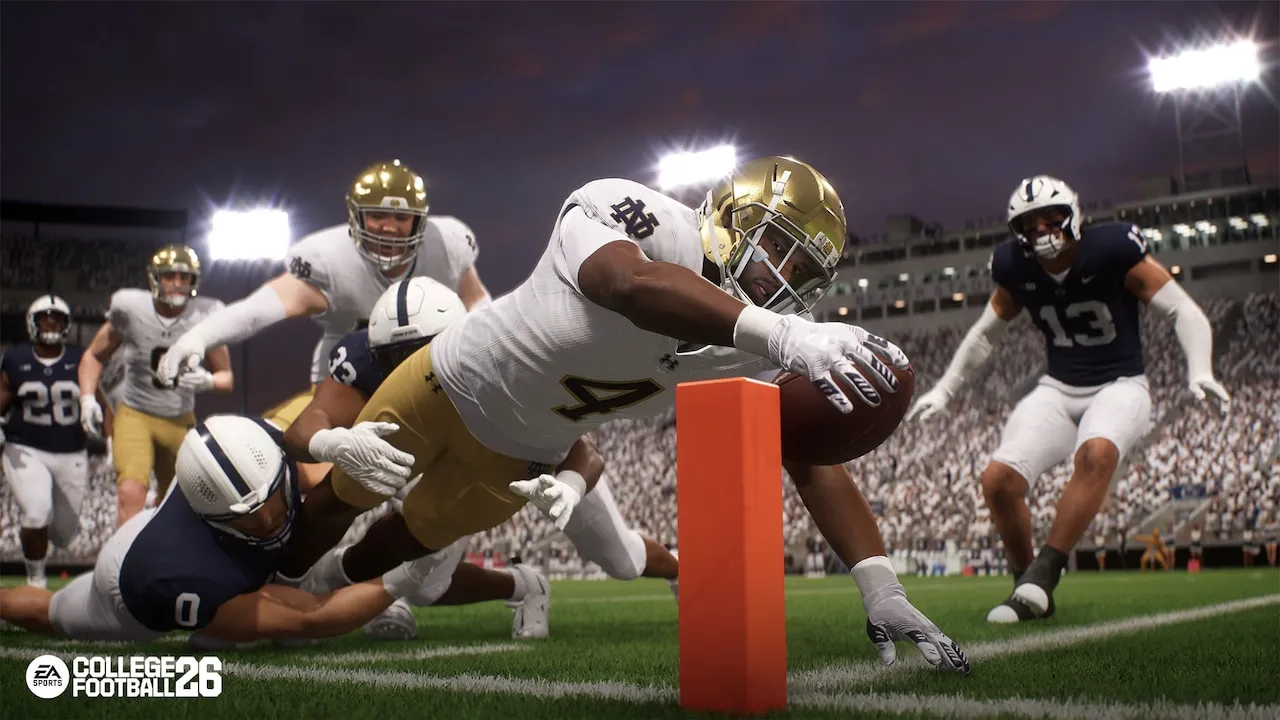
A new ability for a ball-carrier to reach for the goal line or first down marker gives players a final, desperate tool in critical situations. The playbook is also expanded with more modern concepts like Run-Pass Options (RPOs), offering a wider set of tools for offensive strategists.
Game management also sees a significant quality-of-life improvement with dynamic substitutions. A simple tap of the D-pad allows you to swap players without pausing, a small change that does wonders for maintaining the flow of a game.
This works in concert with the more pronounced wear and tear system. Player fatigue and minor injuries are now a persistent factor across a whole season, forcing you to think about roster depth and strategic substitutions. It adds a light resource management element that makes your decisions between games feel more consequential.
These mechanical improvements make the game’s greatest weakness all the more puzzling. While some legacy AI quirks remain, the most baffling design choice is the stubborn refusal to include a dedicated tutorial. New systems are left for the player to discover through trial and error.
The game does contain tips and explanations for its new mechanics, but they are buried within the challenges of the separate Ultimate Team mode. For a game that has taken such positive steps toward smarter, more accessible systems, walling off the instructions for how to use them is a genuine disappointment.
The Heart of the Program: Dynasty Mode Deep Dive
Dynasty mode has always been the game’s long-form strategy campaign, and this year it leans further into its role-playing elements. The inclusion of over 300 real-world coaches and coordinators grounds your decisions in a recognizable reality, but the deeper systems are what give the mode its texture.
Expanded “Build a Coach” options, which now include specific sideline demeanors and stances, allow you to craft a distinct persona. This choice is not merely cosmetic; it ties into the revamped coaching archetypes. The new perk trees feel more like a proper character progression system, forcing meaningful choices about your coaching identity—will you be a master tactician or a charismatic recruiter? This structure makes the multi-season arc of developing a coach feel earned and rewarding.
The core activities of recruiting and roster management have been refined to be both deeper and more intuitive. A persistent “team needs” tracker on the recruiting screen is a smart user interface choice that helps you stay focused. The most dynamic system, however, is the upgraded Transfer Portal.
With over 2,000 players available, it functions less like a simple free agent market and more like a volatile relationship system. Player “dealbreakers” are no longer static, evolving as a player’s career progresses. This introduces a constant tension, forcing you to manage not just on-field performance but also player happiness and ambitions. It’s a system that creates emergent stories of loyalty, betrayal, and second chances, requiring you to adapt your strategy season after season.
For those who want to build their program with others, the mode now includes the crucial technical backbone of cross-platform play. This feature ensures that the online Dynasty community will be larger and healthier, making it far easier to find a full league of dedicated players regardless of their console choice.
A Star’s Beginning: The Revamped Road to Glory
Road to Glory receives a much-needed structural overhaul, beginning your journey not on a college campus, but under the Friday night lights of high school. This initial chapter frames your early career through a series of “moments”—scripted, high-pressure challenges within games that determine your star rating and attract the attention of real-life college coaches. It’s a compelling narrative hook that successfully establishes a personal story arc and gives your recruitment process a sense of earned progression.

Once on campus, the mode introduces light management systems for your grades, training, and personal brand, adding a welcome layer of off-field decision-making. The experience of being a backup player, often a tedious waiting game in past titles, is made far more engaging through a variety of new practice mini-games. These provide a clear and interactive path to improving your skills and fighting for a starting spot, making the climb up the depth chart feel like an active pursuit rather than a passive wait.
However, the mode’s narrative ambitions are undermined by some baffling mechanical choices. The objective system often exists in a contextual vacuum; the game might challenge you to achieve a 50-yard run on a specific drive, completely ignoring that you accomplished that exact feat on the possession just before. This breaks the illusion of a responsive story.
More damaging to the core fantasy is the decision to grant your rookie player full play-calling authority from the outset. It robs the experience of a crucial progression arc—the fantasy of earning a coach’s trust over time. Instead of feeling like a developing star who must prove their worth, you feel like a veteran play-caller from your first snap, a disconnect that the mode never reconciles.
The Supporting Cast: Other Ways to Play
Beyond the core single-player campaigns, College Football 26 includes the familiar suite of EA Sports modes. Ultimate Team returns as the expected card-collecting team-builder, driven by player packs and in-game currency. The addition of a new “Solos” mode provides a dedicated path for offline players, a welcome feature for those who prefer not to engage with the online competitive scene.

Minor quality-of-life updates, like a clear indicator when a new card is an upgrade over a current starter, help streamline the menu navigation. However, the mode is still built around microtransactions and is reportedly hampered by slower menu loading times compared to the rest of the game.
For players seeking a straightforward online competitive experience, Road to the Playoff offers a seasonal head-to-head ladder. This mode has seen the fewest changes, with its core structure remaining largely untouched.
The primary tweak is an increase in the number of wins required to make the playoff, extending the seasonal grind slightly from 10 wins to 12. A new pre-game scouting report gives you a brief overview of your opponent’s tendencies, adding a small but appreciated strategic layer to the matchmaking process.
The Review
EA Sports College Football 26
EA Sports College Football 26 is a masterful second act, deepening its simulation with meaningful mechanical refinements and an unparalleled sense of gameday authenticity. The Rivalry system and revamped Dynasty mode provide endless motivation, while smarter on-field play makes every snap feel more intentional. While a perplexing lack of a tutorial and some fumbled execution in its career mode hold it back from perfection, the core experience is so compelling and richly detailed that it stands as the new benchmark for sports simulations.
PROS
- Incredible gameday atmosphere and presentation.
- The Rivalry and Trophy Room systems give every game purpose.
- Smarter on-field AI, especially the revamped defensive back play.
- Deeply engaging and refined Dynasty mode with real coaches.
CONS
- The complete absence of a proper tutorial is baffling.
- Road to Glory mode has immersion-breaking design flaws.
- Ultimate Team is still driven by microtransactions.