




























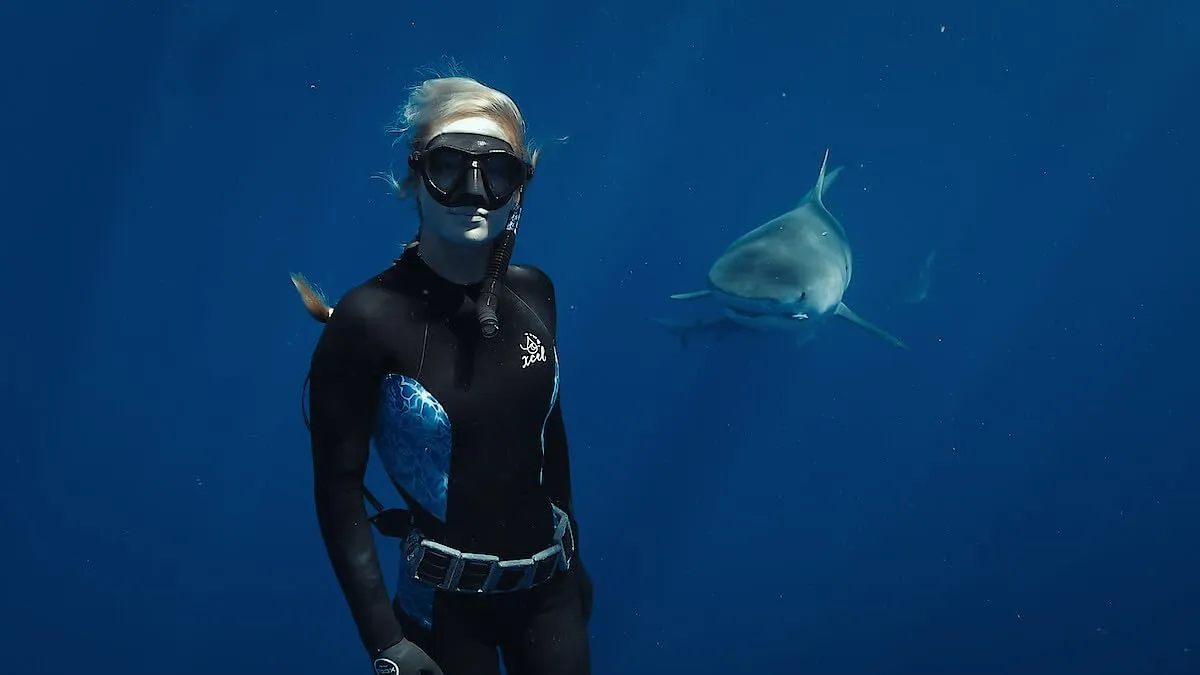

The film opens in an aquatic cathedral of impossible blue, a space where human anxieties are born. A lone figure, Ocean Ramsey, hangs suspended in the water, her form a soft apostrophe in a sentence written by sharks. They glide around her, these ancient engines of our nightmares, their movements not predatory but possessing a kind of cold, planetary grace.
The immediate expectation of violence dissolves into a quiet, unsettling reverence. Here, the film posits its central thesis without a word: it seeks to confront the terror we have projected onto the natural world. It questions whether the monster is the creature of teeth and fin, or the reflection we see in its unblinking eye.
This is Ramsey’s life, a strange and constant negotiation with the sublime. The documentary chronicles her mission to re-sculpt the public’s perception of sharks from mindless killers into vital beings. With her partner, the photographer Juan Oliphant, she wages a war of aesthetics, deploying breathtaking images as weapons against ingrained fear, a campaign that drags them from the ocean’s profound silence into the chambers of legislative debate.
An Anatomy of Obsession
The film suggests Ramsey’s compulsion was not learned but innate, a covenant with the abyss made in childhood. Her first encounter with a shark did not trigger flight, but a strange, magnetic pull. This is the portrait of a soul who has always felt more at home in the alien deep than on solid ground.
Her preternatural ability to hold her breath for over six minutes is presented as more than a physiological feat; it is a spiritual discipline, a method of dissolving the self. By silencing the desperate human need for air, she sheds her otherness and becomes, for a few sacred minutes, just another creature in the silent, flowing world. She claims this is not the thrill-seeker’s high but a state of profound connection, a sense of belonging that perhaps the world of people could never offer her.
Into this solitary communion enters Juan Oliphant, a photographer who understands the power of the captured image. Their partnership is a fusion of her esoteric experience and his technical ability to translate it for the masses. They recognize a stark truth: her private worship, when filmed, becomes a powerful public sermon.
The mission crystallizes into a form of modern evangelism, a crusade waged on screens and social media feeds. The strategy is both brilliant and troubling. The film shows how Ramsey’s own image—her physical form moving with an almost liquid grace among the predators—becomes the primary vehicle for the message. She becomes the beautiful, palatable face of a terrifying truth, her presence essential to making the monstrous seem divine.
The Abyss Gazes Back
The film’s most potent arguments are not spoken but shown. The camera descends with Ramsey into a world of profound beauty, capturing images that feel less like documentation and more like scripture. We are given the gift of proximity without the threat of annihilation.
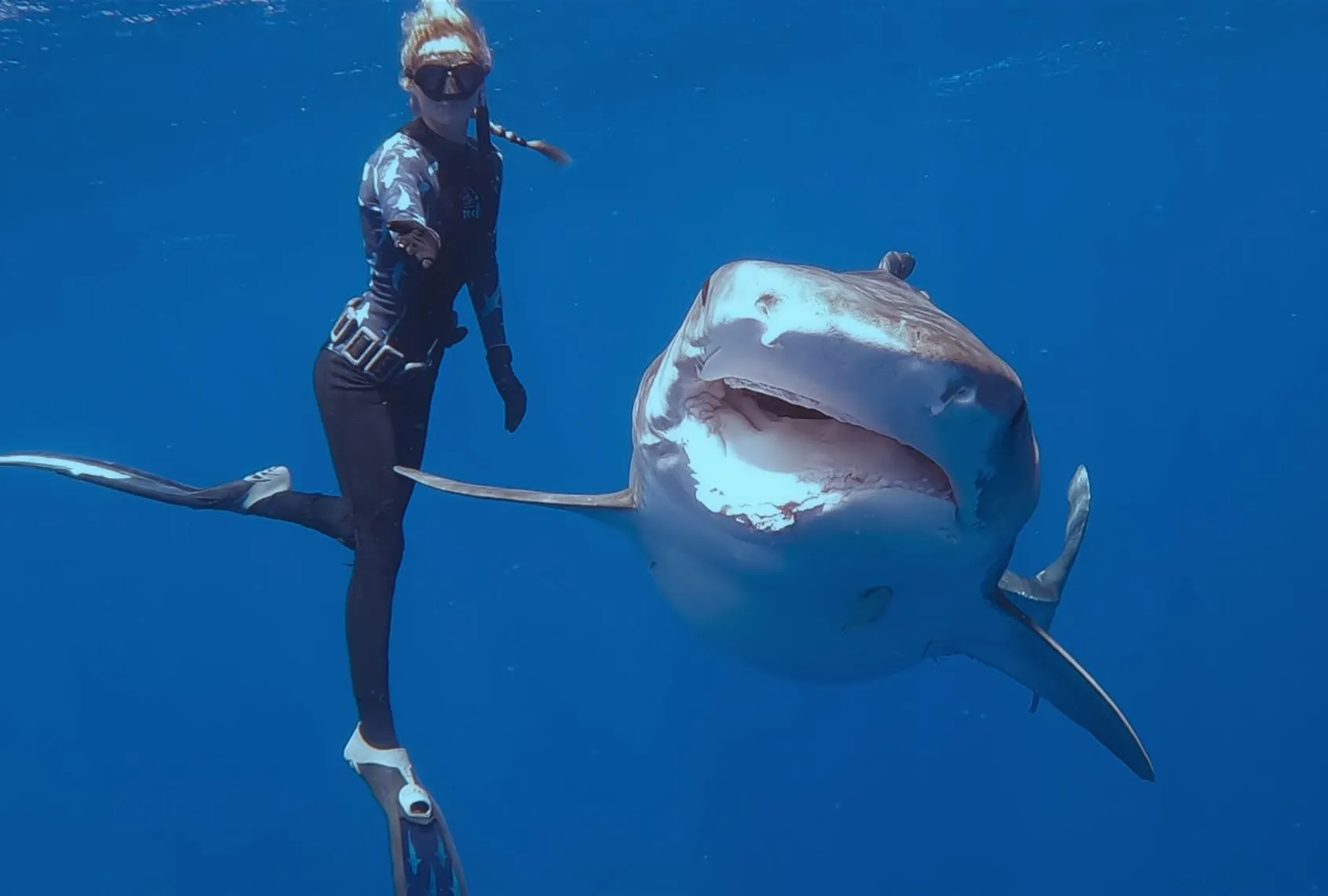
The light filtering through the deep, the textured hide of a tiger shark passing inches from the lens, the slow ballet of these massive bodies—it is an aesthetic argument of overwhelming force. The footage insists that these are not monsters, but beings of a different, more ancient order.
An orchestral score swells and recedes, manipulating our fear into a state of hypnotic wonder. For ninety minutes, we are invited to see what Ramsey sees, to feel the grace that she feels, and in this, the film is a masterwork of persuasion.
Yet, this very beauty casts a long, unsettling shadow. The documentary gestures toward the controversies surrounding Ramsey, but it is in the unasked questions that the true philosophical weight lies. Is this science, or is it a new kind of performance art where the artist risks her life for the spectacle?
The criticism that her work lacks scientific legitimacy misses the point; she is not a researcher in the traditional sense, but perhaps a high priestess of an experiential faith, her authority derived not from data but from her survival and the stunning images she brings back from the void. The line blurs further with the quiet commodification of her crusade.
The branded merchandise and for-profit dives feel like a necessary sin in a world where even noble causes must be packaged for consumption, a quiet tragedy that taints the purity of the mission. But the darkest question is one of influence. By making this dance with death look so serene, so attainable, is she not creating a dangerous gospel? She presents a vision of communion that, for a less gifted disciple, would surely end in a final, bloody sacrament.
A Willing Sacrifice
There is a moment in the film where Ocean Ramsey, with a terrifying placidity, says she is “good to go anytime.” This is not the hubris of a person who believes they are indestructible, the tragic delusion that consumed Timothy Treadwell. It is something colder, more unnerving: the calm declaration of a martyr who has already made her peace with oblivion.
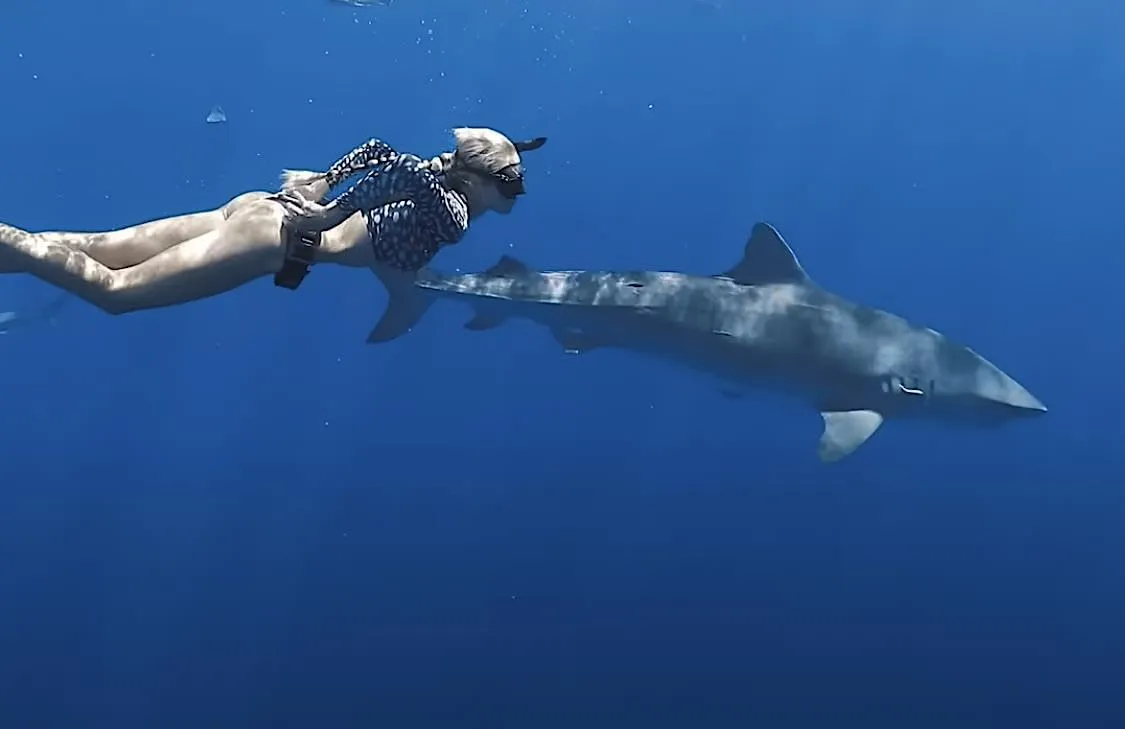
Her pact is not with the sharks, but with her own annihilation. This willing embrace of non-existence is what makes her such a transfixing subject. She has looked into the abyss and, instead of recoiling, found a strange sense of purpose in its depths. Her life’s work appears as a protracted, elegant suicide note written on water, a conscious uncoupling from the world of the living for a cause she deems more significant.
This chilling devotion finds its tragic counterpoint in the face of her husband, Juan Oliphant. He is the man behind the camera, the silent witness tasked with documenting his wife’s dance with death. In his eyes, the film captures a profound and unspoken agony. His love requires him to participate in the very ritual that could claim her.
The documentary hints at a deep power imbalance, where his own survival instinct is subjugated to her singular, all-consuming mission. He is trapped in her orbit, a partner in her crusade but seemingly powerless to save her from its ultimate conclusion.
This quiet, human tragedy, simmering beneath the surface of the public controversy, is the film’s most potent and haunting element. It is the personal cost of a divine obsession, a story of love tethered to the certainty of loss.
An Echo in the World of Men
After so much time spent in the silent, fluid world of the deep, the film’s turn toward the terrestrial feels almost crude. The abstract communion must be translated into the clumsy grammar of human politics. The fight for House Bill 553 in Hawaii gives the narrative a concrete anchor, pulling the ethereal mission down to the noisy, contentious floor of legislative debate.
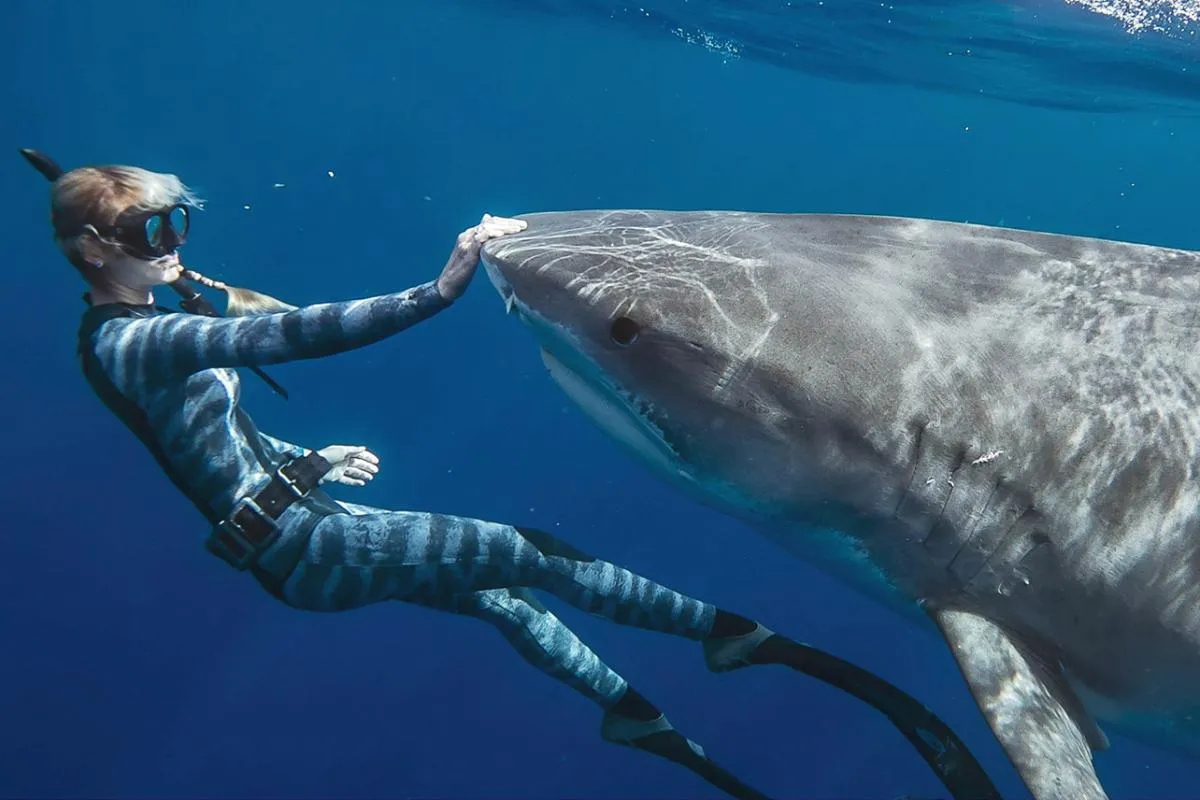
This is where the images must do their work in the world of men. The story of Roxy, a tiger shark with a jaw broken by human intervention, serves as the necessary martyr. Her specific, wounded body becomes the emotional currency for the political transaction, a tangible wound to rally around. This pivot gives the film a forward momentum, a sense that Ramsey’s spiritual quest can have a real, if messy, echo in law.
Does the film truly alter our perception? Perhaps. One is certainly left with an archive of impossibly beautiful images, a new respect for the complexity of these animals, and the haunting portrait of their defender. But the fear is not erased. It is merely complicated, deepened. We are left not with simple answers but with a more profound disquiet.
We now understand the creature, but we are also left to contemplate the complicated, unsettling nature of the human who would sacrifice everything to it. The film successfully replaces a primal fear of the unknown with an intellectual awe for it. We are left staring at the screen, appreciating the majesty of the deep, and the strange, unknowable depths of the woman who would willingly dissolve into it.
“Shark Whisperer” is a documentary that premiered on Netflix on June 30, 2025. It is available for streaming exclusively on Netflix.
Full Credits
Director: J.P. Stiles, Harrison Macks, James Reed
Producers: Kate Bradbury, Emily Hoadley, Patrick Johnson, Chamberlain Staub
Cast: Ocean Ramsey, Juan Oliphant
Director of Photography (Cinematographer): Juan Oliphant
Composer: Roger Goula, Sam Thompson
The Review
Shark Whisperer
Shark Whisperer is a visually hypnotic and philosophically troubling film. It succeeds as a powerful aesthetic argument for the majesty of sharks, replacing primal fear with a complex, informed awe. However, it is most memorable as a haunting portrait of its central figure, a complicated zealot whose righteous crusade is shadowed by a chilling acceptance of her own demise and a disregard for its human cost. It offers no easy comfort, leaving you instead with the profound and unsettling beauty of both the creature and the obsessive soul who seeks it.
PROS
- Breathtaking and intimate underwater cinematography.
- A profound and fascinating psychological study of a complex central figure.
- Successfully challenges and deepens the viewer's perception of sharks.
- Raises compelling questions about conservation, spectacle, and obsession.
CONS
- The film’s perspective on its subject can feel uncritical, glossing over the more troubling aspects of her methods.
- The controversy surrounding the scientific validity of her work is acknowledged but not deeply explored.
- The human drama, while powerful, often feels like a tragic, unspoken undercurrent rather than a central focus.