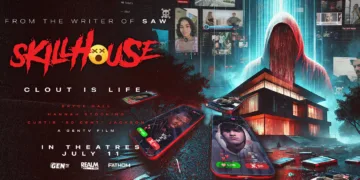


























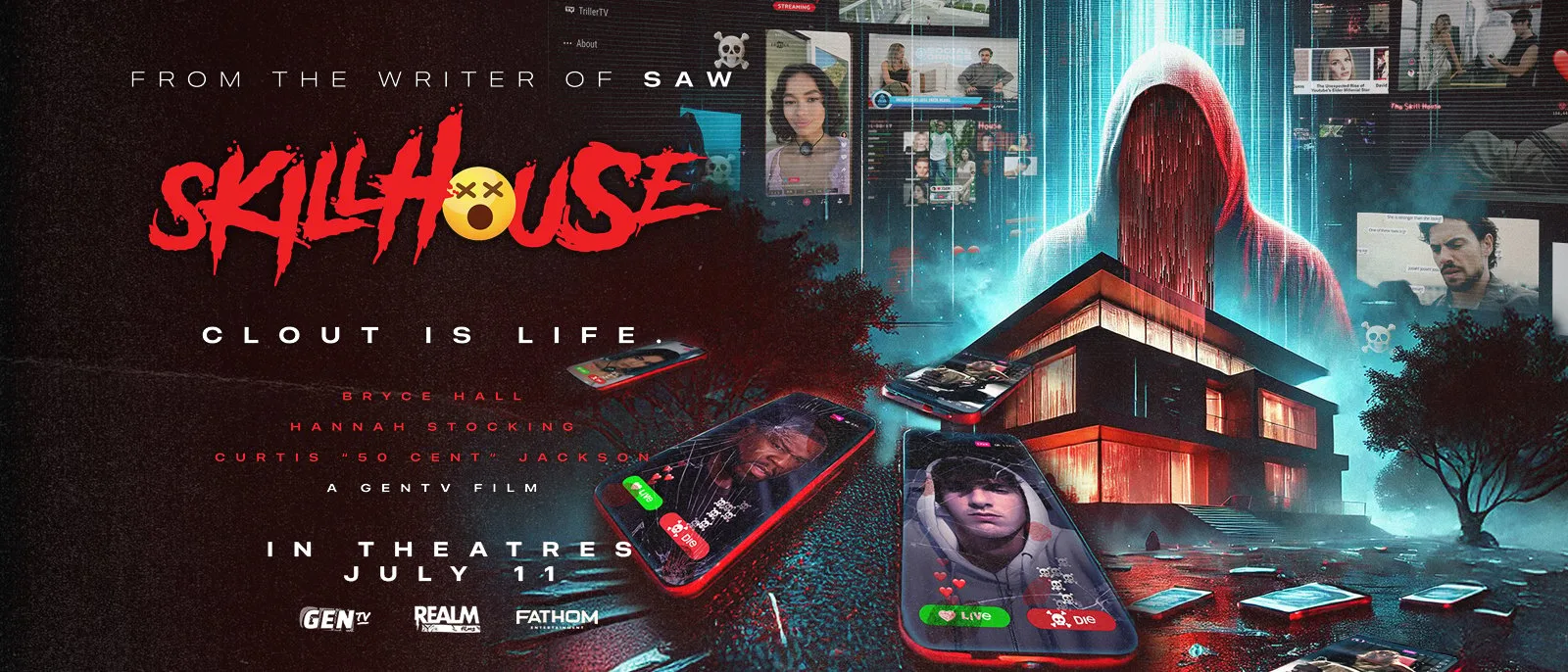

Josh Stolberg’s “Skillhouse” presents a grotesque meditation on contemporary fame, trapping ten social media influencers within the claustrophobic confines of a Los Angeles mansion where survival hinges on digital validation. The film’s central conceit—lives measured in likes—transforms the horror genre’s traditional death games into a perverse reflection of our attention economy.
Carter Swick, portrayed by real-life influencer Bryce Hall, serves as our reluctant protagonist, having previously survived an attack that claimed his sister Lauren. The masked antagonist, dubbed the “Triller Killer,” orchestrates a macabre competition watched by millions, each contestant bound by explosive collars that enforce participation through the threat of decapitation.
Stolberg, drawing from his experience with the Saw franchise, constructs a nightmare where Curtis “50 Cent” Jackson appears as himself, functioning as both host and moral arbiter of this digital colosseum. The film’s 94-minute runtime becomes a compressed examination of how social media transforms human worth into algorithmic currency. Here, the ancient Greek concept of kleos—glory achieved through others’ recognition—finds its most degraded expression: validation through virtual hearts and thumbs-up icons.
Narrative Fractures and Temporal Distortions
The film’s structural architecture reveals both ambition and limitation. Stolberg opens with a sharp establishing sequence—Carter and Lauren’s initial encounter with their masked tormentor—before executing a three-month temporal leap that immediately destabilizes narrative momentum. This temporal gap, while serving expositional efficiency, creates a philosophical void where character motivation should reside. The transition from grief to gamification feels abrupt, almost surgical in its emotional detachment.
The storytelling mechanics borrow heavily from the Saw playbook, yet lack that franchise’s meticulous puzzle-box construction. Logic gaps emerge like fault lines: How does the killer orchestrate such elaborate kidnappings without detection? Why do millions of viewers watch without alerting authorities? These questions aren’t merely plot holes—they’re existential chasms that reveal the film’s discomfort with its own premise.
Stolberg’s pacing creates a paradox: the film feels simultaneously rushed and interminable. Characters face elimination before the audience develops investment, yet the 94-minute runtime stretches like digital eternity. The third act’s twist revelations arrive with mechanical precision, predictable as algorithmic recommendations. The mid-credits sequence suggests expanded mythology, but feels more like desperate franchise-building than organic narrative necessity.
The game show format, theoretically rich with satirical potential, becomes oddly sterile. Rules shift without logic, competition mechanics feel arbitrary, and the social media element—supposedly the film’s beating heart—pulses with artificial rhythm.
The Performance of Authenticity
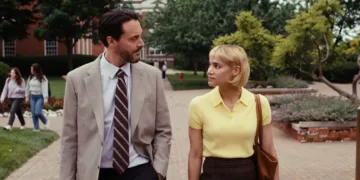
Bryce Hall’s casting represents either inspired meta-commentary or cynical stunt casting—perhaps both simultaneously. His portrayal of Carter Swick requires him to perform a fictional version of his public persona, creating layers of performative identity that mirror social media’s constructed nature. Hall’s acting, while limited in traditional dramatic range, possesses an eerie authenticity when depicting digital-age narcissism and vulnerability.
The supporting ensemble—including MMA fighter Paige VanZant and actress Leah Pipes—delivers performances that hover between intentional caricature and genuine limitation. Their portrayals of influencer archetypes feel less like character work and more like ethnographic study, documenting a specific cultural moment without necessarily understanding it.
Neal McDonough’s appearance as a law enforcement figure provides the film’s most traditionally competent performance, though his role feels imported from a different, more serious production. His scenes create tonal whiplash, suggesting the film’s uncertainty about its own genre identity.
50 Cent’s involvement adds another layer of meta-textual complexity. Playing himself while hosting a death game creates uncomfortable questions about celebrity complicity in society’s voyeuristic tendencies. His reported legal disputes with the production only enhance the film’s themes of exploitation and consent—though whether this was intentional remains unclear.
The villain remains frustratingly anonymous, a cipher whose motivation arrives through exposition rather than character development. This anonymity might serve the film’s themes about faceless digital persecution, but it also robs the horror of personal stakes.
Visual Decay and Digital Aesthetics
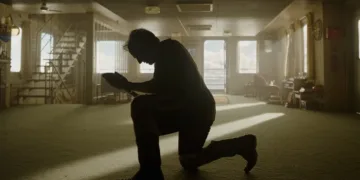
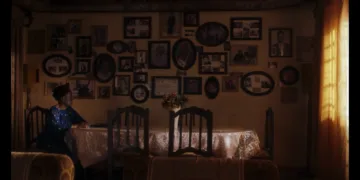
Stolberg’s visual language suffers from what might be called “digital decay”—a pervasive yellow haze that transforms every frame into a jaundiced nightmare. This chromatic choice, while potentially symbolic of social media’s toxic influence, creates an oppressive visual monotony that flattens the film’s emotional range. The cinematography opts for functional coverage over expressive composition, suggesting budget constraints rather than aesthetic choice.
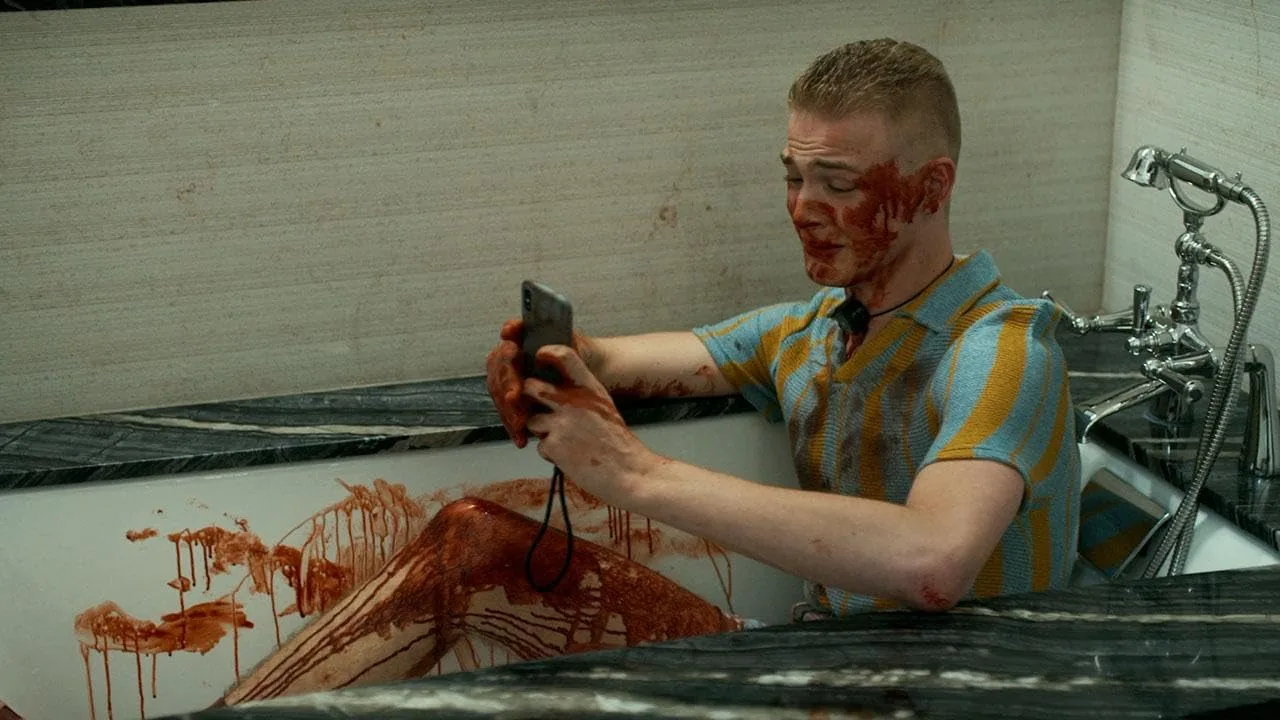
The mansion setting, theoretically rich with gothic potential, becomes merely a series of connected rooms rather than a character in its own right. Production design feels borrowed from generic luxury porn, lacking the specific details that would ground the space in recognizable reality or meaningful symbolism.
The film’s practical effects work provides its most visceral pleasures. Blood flows with appropriate viscosity, and the collar-based decapitations deliver satisfying mechanical brutality. These moments of gore achieve a kind of analog honesty that contrasts sharply with the film’s digital themes.
However, the social media interface elements—supposedly central to the film’s concept—feel artificial and unconvincing. Stock footage of “viewers” watching the carnage creates an uncanny valley effect, while AI-generated graphics add another layer of digital artificiality to an already synthetic experience.
The sound design lacks the precision necessary for effective horror, failing to create the acoustic intimacy that might compensate for visual limitations. The score remains largely forgettable, neither enhancing tension nor providing emotional guidance through the film’s tonal shifts.
Skillhouse is a horror film released on July 11, 2025, in the United States. It’s distributed by Fathom Entertainment. The film can be watched in theaters and may become available on streaming platforms like Disney+ or HBO Max at a later date.
Full Credits
Director: Josh Stolberg
Writers: Josh Stolberg
Producers: Alex Baskin, Jaime Burke, Ryan Kavanaugh, Amy S. Kim, Brad Baskin, Brett Dahl, Daniel Herther, Pat Peach, Taylor Powers, Norm Reiss, Bobby Sarnevesht, Josh Stolberg, Shane Valdez
Cast: Neal McDonough, 50 Cent, Caitlin Carmichael, Leah Pipes, Paige VanZant, John DeLuca, Hannah Stocking, Ivan Leung, Bryce Hall, Emily Mei, McCarrie McCausland, Todrick Hall
Director of Photography: Will Barratt
Editors: Scott Di Lalla, David Prindle
Composer: Ryan Huntley Andrews
The Review
Skillhouse
"Skillhouse" presents a fascinating premise hampered by pedestrian execution. While Stolberg's commentary on digital-age narcissism occasionally pierces through the film's technical limitations, the end result feels like a missed opportunity—a social media horror film that understands neither effective horror nor authentic social media culture. The practical gore effects and meta-textual casting provide momentary intrigue, but cannot elevate the material beyond its fundamental structural weaknesses.
PROS
- Effective practical gore effects and creative kill sequences
- Timely social media commentary with philosophical depth
- Meta-textual casting creates interesting performative layers
- Solid 94-minute runtime avoids overstaying its welcome
CONS
- Visually monotonous with oppressive yellow-tinted cinematography
- Weak character development and predictable plot mechanics
- Unconvincing social media interface elements and stock footage usage
- Inconsistent tone between horror and satirical elements
- Logic gaps undermine narrative credibility