




























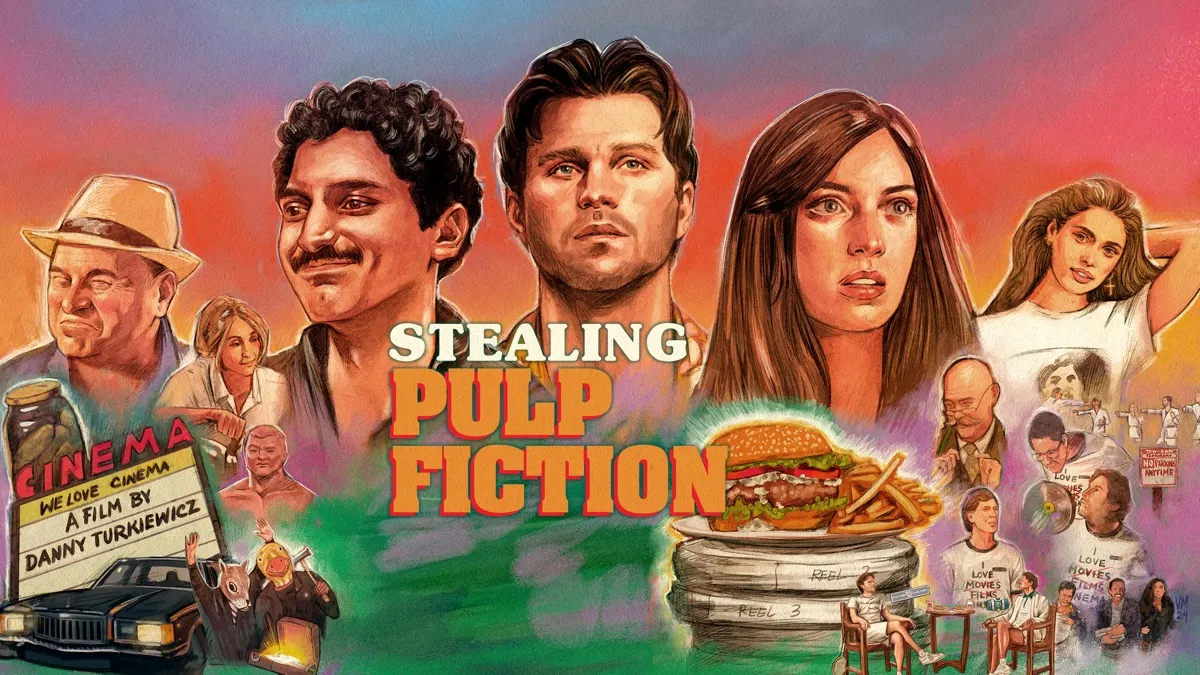

What happens when cinephilia tips into criminality? Stealing Pulp Fiction presents this tantalizing question through its high-concept plot. The film introduces us to Jonathan and Steve, two film enthusiasts whose reverence for Quentin Tarantino inspires a daring, if ill-conceived, scheme: to steal the director’s personal 35mm print of his 1994 masterpiece.
This self-aware heist comedy positions itself as a caper for the movie-literate generation, a story steeped in the very culture it aims to celebrate. It sets up a scenario rich with potential for satire and suspense. Yet, as the narrative unfolds, one is left to wonder if the filmmakers’ ambition to pay tribute to a cinematic icon was ultimately matched by their ability to deliver a coherent film.
A Heist Half-Hatched
The film’s opening scenes offer a flicker of promise, consciously mirroring the style of its subject. A conversation in a diner between our two protagonists immediately evokes the snappy, pop-culture-filled dialogue that made Tarantino a household name. This initial motivation—a pure, if obsessive, fandom—is an intriguing launchpad.
It speaks to a global phenomenon where a film becomes a part of one’s identity. However, the plot soon abandons this unique foundation, a decision that proves fatal to the film’s soul. The heist’s purpose inexplicably shifts from a passion project to a generic plan for simple monetary gain, shedding the very element that made it distinctive.
This pivot feels particularly hollow when contrasted with heist narratives in Indian cinema, where even in commercial ventures like the Dhoom series, a strong emotional or philosophical driver is paramount. The spectacle of the heist there is matched by the gravity of the motive. Here, the motive deflates, turning a grand gesture of fandom into a petty crime.
The story is further derailed by a baffling subplot involving a break-in at their therapist’s office, a diversion that feels imported from a different, much broader comedy and does little but stall momentum. Consequently, the film’s lean 78-minute runtime, which should feel brisk, feels paradoxically bloated and lethargic, padded with aimless scenes that lead nowhere.
An Assembly of Misfits
The film’s character dynamics prove as inconsistent as its plot. The central friendship between Jonathan (Jon Rudnitsky) and Steve (Karan Soni) has moments of authentic chemistry that suggest a believable shared history.
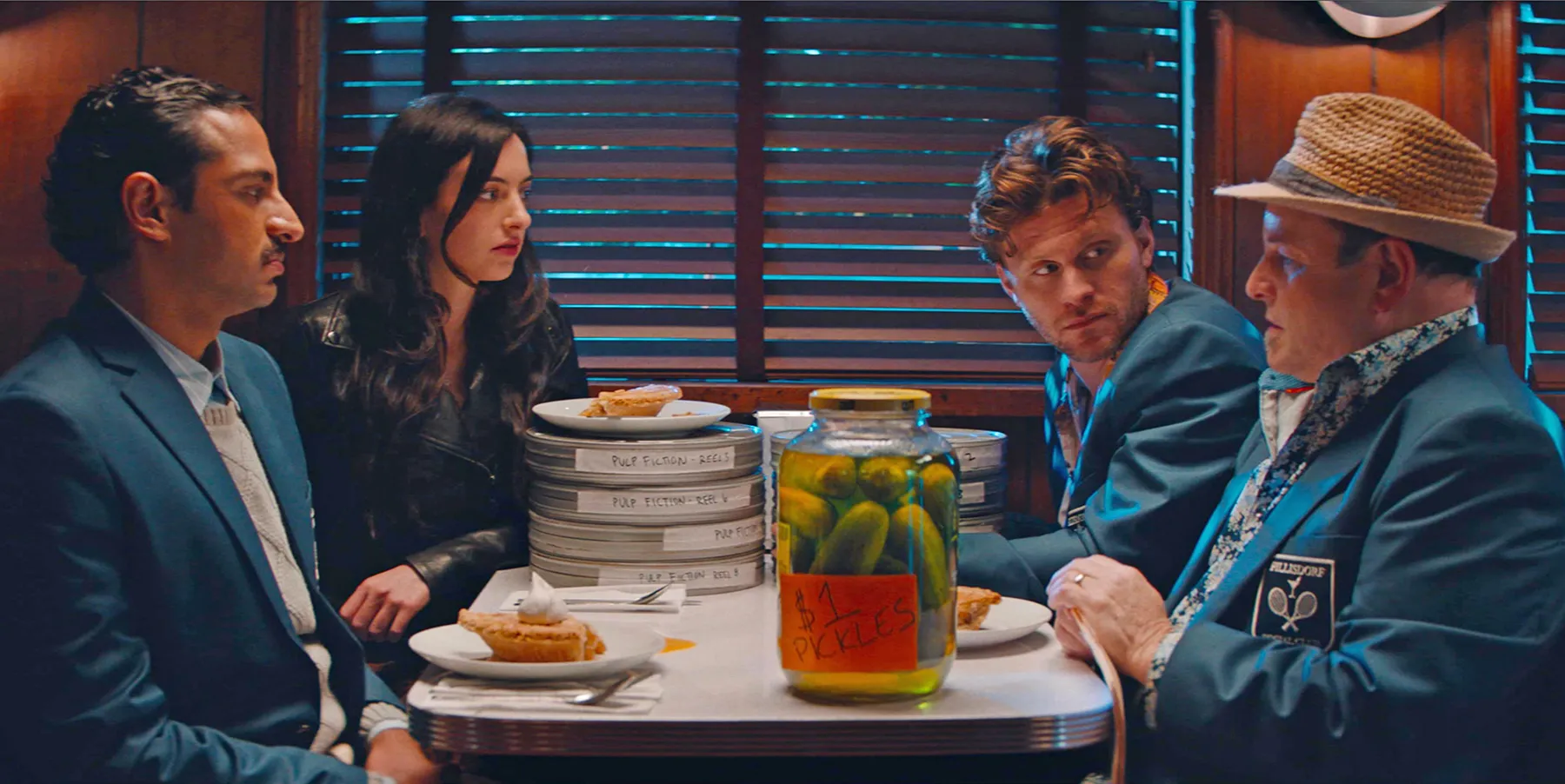
The script, however, undermines this with a strange, patronizing dynamic that casts Steve as a childlike, easily confused sidekick. For an actor of Indian heritage like Karan Soni, who has become a familiar face in Hollywood, this one-dimensional, often grating role feels like a squandered opportunity and a narrative regression.
It lacks the nuance seen in the evolving friendships of modern Indian films like Zindagi Na Milegi Dobara, which explore the supportive and complex bonds between men. Here, the friendship feels shallow and transactional.
The ensemble is rounded out by equally puzzling characters. Elizabeth (Cazzie David), the anti-Tarantino contrarian, is brought into the scheme with the stated goal of burning her share of the print—a nonsensical inclusion that creates conflict without logic.
The script never uses her to foster a genuine debate on film culture; she is merely an obstacle whose motivation defies belief and creates a gaping plot hole. Jason Alexander’s Dr. Mendelbaum is a peculiar oddity, a therapist operating from a karate studio whose quirks feel more strange than funny.
His performance belongs to a much broader farce, clashing tonally with the indie-comedy sensibility of the leads. To complete the picture, the brief appearance of an actor as Tarantino is a caricature so poor it borders on insulting, lacking any of the director’s known charisma and reducing him to a crude cartoon.
The Art of Imitation
A film that borrows from another must understand its soul, not just its skin. This is a lesson long understood in global cinema, including the filmmaking traditions of India, where inspiration from Hollywood has produced both masterful adaptations and clumsy copies.
A successful homage, like the 1993 thriller Baazigar which transformed the core of A Kiss Before Dying into a quintessentially Bollywood revenge saga, understands that borrowing requires transformation. Stealing Pulp Fiction unfortunately fails this crucial test, falling into the category of clumsy copy. It mistakes superficial references for meaningful tribute.
We are given surf rock music cues, chapter cards, and a half-hearted dance scene, but these elements are stripped of the context that made them iconic. The dialogue tries to capture the rhythm of Tarantino’s meandering conversations, but where his digressions reveal character, these feel like empty chatter.
The film’s most significant failure is conceptual: it is a heist movie about Pulp Fiction, a film that is fundamentally not about a heist. To reduce that film—a story about intersecting lives, chance, and grace—to a mere physical object to be stolen is to profoundly misunderstand its thematic weight. The “stealing” of the title becomes literal, but the film fails to steal any of the original’s magic.
Style Without Substance
Ultimately, the film is undone by its technical execution. The comedy consistently fails to land, handicapped by clumsy timing that creates an awkward, cringeworthy atmosphere for the viewer. Jokes are often followed by a telling silence or an abrupt musical cut, as if to manually signal a punchline’s arrival.
The humor becomes repetitive, relying on characters explaining their own gags—a cardinal sin that shows a deep lack of confidence in the material. This lack of rhythm is matched by an uninspired and visually inert visual style. The cinematography is largely static and the compositions are stilted, a stark contrast to the kinetic energy of the very director the film seeks to honor.
A film about the love of cinema should feel cinematic, yet the direction here is flat, creating no sense of suspense or visual excitement. Even the most formulaic Bollywood entertainer often possesses a baseline of visual vibrancy that is conspicuously absent here. What could have been a sharp, loving satire of film fandom becomes a profound missed opportunity, a fun concept defeated by flawed execution in nearly every department.
The film “Stealing Pulp Fiction” was released in select theaters and on digital platforms in the United States on June 27, 2025. It had its premiere at the Newport Beach Film Festival on October 19, 2024. The film is available to stream for free on Kanopy, and can also be rented or purchased on various platforms, including Amazon Video, Apple TV, and Fandango at Home.
Full Credits
Director: Danny Turkiewicz
Writers: Danny Turkiewicz
Producers: Ben Shields Catlin, Slava Shut, Danny Turkiewicz, Ian Novotny, Chris Barry, Josh Zakaria, Jordan Willcox, Becca Standt
Cast: Jon Rudnitsky, Cazzie David, Karan Soni, Taylor Hill, Oliver Cooper, Jason Alexander
Director of Photography (Cinematographer): Joshua Allen
Editors: Ross Kolton, Natalie Toppino
Composer: Adam Brock, Johnny Nicholl, Brandon Rosiar
The Review
Stealing Pulp Fiction
Despite a clever premise that promises a witty love letter to cinema, Stealing Pulp Fiction is a profound disappointment. The film bungles its execution at every turn, trading sharp satire for clumsy jokes and a cohesive plot for scattered, nonsensical scenes. Its attempt at homage is merely superficial, capturing none of the style or spirit of its namesake. What remains is a creatively bankrupt and unfunny caper that fails to live up to its own fantastic idea, proving that a great concept alone cannot save a poorly made film.
PROS
- An inventive and promising core concept for a heist comedy.
- The two lead actors share a believable on-screen chemistry as lifelong friends.
CONS
- An unfocused plot that abandons its central motivation.
- Clumsy, unfunny humor with poor comedic timing.
- Superficial references that fail to work as a meaningful homage.
- Flat, uninspired direction and cinematography.
- Poorly written characters with illogical and contradictory motivations.